
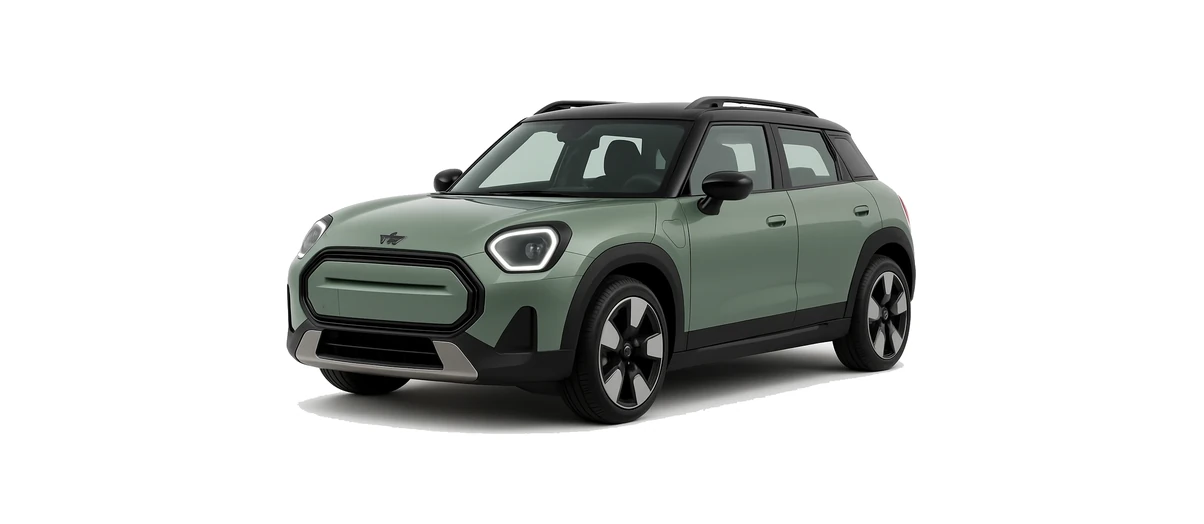
The Mini Aceman is a compact 5-door electric crossover that sits between MINI’s hatchback heritage and the practicality of a small SUV. For UK buyers, the current Aceman range is battery electric only, so choosing the right charging setup is an important part of everyday ownership.
This guide focuses on the UK-market Mini Aceman E, Mini Aceman SE and MINI JCW Aceman. All use the same basic charging connector arrangement: Type 2 for AC charging and CCS Combo 2 for DC rapid charging. However, the battery sizes and rapid-charging limits differ by variant, so it is worth understanding which model you have before comparing charging times.
View Mini Aceman Charging Cables
Mini Aceman Battery and Charging Specifications
The Mini Aceman uses a Type 2 socket for AC charging and a CCS Combo 2 connection for DC rapid charging. EV Database UK lists the charge port location as the right rear side of the car. The vehicle’s onboard AC charger is rated at up to 11 kW, although most UK homes with a single-phase supply will charge at up to 7.4 kW when using a typical dedicated home wallbox.
The key point for owners is that the Aceman E and the Aceman SE/JCW share the same connector type but do not share the same battery capacity or DC rapid-charging ceiling. The Aceman E is listed with a smaller battery and up to 70 kW DC charging, while the SE and JCW versions use the larger battery and are rated at up to 95 kW DC.
| Model | Battery capacity | AC charging | DC rapid charging | Official WLTP range |
|---|---|---|---|---|
| Mini Aceman E | 42.5 kWh gross / 38.5 kWh usable | Up to 11 kW | Up to 70 kW | 185-192 miles |
| Mini Aceman SE | 54.2 kWh gross / 49.2 kWh usable | Up to 11 kW | Up to 95 kW | 238-252 miles |
| MINI JCW Aceman | 54.2 kWh gross / 49.2 kWh usable | Up to 11 kW | Up to 95 kW | 213-243 miles |
Battery Options
There are two battery sizes across the current UK Mini Aceman range. The Aceman E uses a 42.5 kWh gross battery, with around 38.5 kWh usable capacity listed by EV Database UK. This is the lighter, shorter-range option and is well suited to town driving, commuting and regular local trips.
The Aceman SE and MINI JCW Aceman use a larger 54.2 kWh gross battery, with around 49.2 kWh usable capacity. The SE is the longest-range version in the official MINI UK figures, while the JCW model prioritises performance and has a lower WLTP range band than the SE despite using the same listed battery capacity.
Because battery capacity has a direct effect on charging time, the larger-battery versions will usually take longer to charge from low to full on an AC charger. On DC rapid chargers, however, the higher 95 kW peak charging capability of the SE and JCW helps reduce the difference during typical motorway charging stops.
AC Charging Speed
All current UK Mini Aceman variants are listed with an 11 kW AC onboard charger. This is the maximum AC rate the car can accept when connected to a suitable three-phase AC charging point. MINI UK quotes 0-100% AC charging at 11 kW as approximately 4 hours 15 minutes for the Aceman E and around 5 hours 30 minutes for the Aceman SE. EV Database UK models the SE and JCW at around 5 hours 15 minutes on 11 kW three-phase AC.
In the UK, many domestic properties have single-phase electricity. A dedicated single-phase home wallbox is commonly rated at up to 7.4 kW, so the car will not normally charge at the full 11 kW at home unless the property has a compatible three-phase supply and an appropriate charger. On a 7.4 kW home wallbox, a realistic guide is roughly 6 hours 15 minutes for the Aceman E and about 8-9 hours for the Aceman SE or JCW, depending on conditions, state of charge and charger output.
For cable selection, the vehicle-side connector is Type 2. If you use an untethered home wallbox or an untethered public AC post, a Type 2 to Type 2 charging cable is the appropriate cable type for the Mini Aceman. MINI UK also lists a Mode 3 charging cable as standard equipment, but owners may still want to check the cable length, phase rating and condition of any cable supplied with the car.
DC Rapid Charging Speed
DC rapid charging is used for longer journeys, motorway stops and situations where you need to add range quickly. The Mini Aceman uses the CCS part of its charging port for rapid charging. At a rapid charger, the cable is attached to the charging unit, so you do not use your own Type 2 AC cable for DC charging.
The Aceman E is rated at up to 70 kW DC. MINI UK quotes around 28 minutes for a 10-80% DC charge under suitable conditions. The Aceman SE and MINI JCW Aceman are rated at up to 95 kW DC, with MINI UK quoting around 31 minutes for a 10-80% rapid charge.
These peak figures are not guaranteed every time you plug in. Rapid-charging performance depends on factors such as charger output, battery temperature, state of charge, battery health, ambient temperature and the vehicle’s charging curve. Using a charger rated well above the car’s limit will not make the car charge beyond its own maximum. For example, an Aceman E will still be limited by its 70 kW DC capability even if connected to a 150 kW or 350 kW charger. The SE and JCW are similarly limited by their 95 kW rating.
Range and Efficiency
Official WLTP range figures give a useful comparison between variants, but real-world range will vary. Driving speed, weather, wheel size, use of heating or air conditioning, traffic conditions and terrain can all make a noticeable difference.
MINI UK lists the Aceman E at 185-192 miles WLTP, while EV Database UK gives an estimated real-world combined range of about 140 miles. The Aceman SE is officially rated at 238-252 miles WLTP, with EV Database UK estimating around 180 miles in mixed real-world use. The MINI JCW Aceman is listed by MINI UK at 213-243 miles WLTP, with EV Database UK estimating around 170 miles.
For everyday planning, many owners will find it more useful to think in terms of weekly energy use rather than full-to-empty range. If you cover 30 miles a day, a regular overnight top-up on a home wallbox will usually be more convenient than waiting until the battery is low. MINI UK recommends charging to 80% to help optimise battery life, with 100% charges best reserved for longer journeys where the extra range is useful.
Charging at Home
Home charging is usually the most convenient way to run a Mini Aceman in the UK. A dedicated Type 2 wallbox allows you to plug in when you get home and start the next day with the battery level you need. If your wallbox is tethered, the cable is permanently attached. If it is untethered, you will need a separate Type 2 to Type 2 cable.
A 7.4 kW home wallbox is the practical maximum for many single-phase UK homes. Although the Aceman can accept up to 11 kW AC, that higher rate normally requires a suitable three-phase supply. If you are installing a charger, use a qualified installer who can assess your property, earthing arrangements, consumer unit capacity and any load-management requirements.
A 3-pin charger is generally best suited as a backup or occasional charging solution, but can be used regularly if a qualified electrician has confirmed the socket and electrical installation are suitable for sustained EV charging. Three-pin charging is much slower than a wallbox and should not be treated as a direct replacement for a properly installed dedicated EV charger unless your electrical installation has been checked for that use.
Public Charging
Public charging falls into two broad categories: AC destination charging and DC rapid charging. AC destination chargers are common in car parks, hotels, workplaces and town centres. Many are untethered, so you will need your own Type 2 to Type 2 cable. The Aceman’s 11 kW AC capability is useful when connected to a suitable three-phase AC post, although some posts or network settings may supply less.
DC rapid and ultra-rapid chargers are intended for shorter stops on longer journeys. They have their own CCS cable attached, so you simply use the connector on the charger. The most efficient rapid-charging strategy is usually to charge from a lower state of charge to around 80%, rather than waiting for the final 20%, which tends to be slower on most EVs.
For motorway trips, check both charger availability and charger power before you set off. An Aceman E does not need a charger above 70 kW to reach its listed peak, while the Aceman SE and JCW can make use of chargers up to their 95 kW limit. Higher-powered chargers may still be convenient if they are available, but they will not override the car’s own charging cap.
Vehicle-Specific Features
EV Database UK lists the Mini Aceman as using a 400 V electric architecture on the Spotlight dedicated EV platform. It also lists a heat pump as standard equipment, which can help with cabin heating efficiency in colder conditions compared with less efficient heating methods.
Battery preconditioning is also listed as standard, with navigation-linked preparation for DC charging. In practice, this means it is sensible to set a rapid charger as the destination in the MINI navigation system where possible, so the car can prepare the battery for faster charging under suitable conditions.
Bidirectional power features are not listed as available for the current Aceman data covered here. EV Database UK lists V2L, V2G and V2H as not supported, so owners should not plan to use the Aceman as an external power source or home energy backup system.
Charging Tips
- Match the cable to the car: the Mini Aceman uses a Type 2 AC socket, so a Type 2 to Type 2 cable is the correct choice for untethered AC charging.
- Do not assume 11 kW at home: most UK single-phase home wallboxes charge at up to 7.4 kW. The full 11 kW AC rate needs a compatible three-phase setup.
- Use 80% for daily charging: following MINI’s recommendation to charge to 80% for everyday use can help optimise battery life.
- Reserve 100% for longer journeys: charge to full when you need the extra range, then set off soon after charging completes where practical.
- Plan rapid stops by variant: the Aceman E is limited to 70 kW DC, while the SE and JCW are rated up to 95 kW DC.
- Use navigation for rapid charging: setting the charger as your destination can help the battery precondition before a DC charging stop.
Frequently Asked Questions
What charging cable does the Mini Aceman use?
The Mini Aceman uses a Type 2 connector for AC charging. For untethered home wallboxes and many public AC charge points, you need a Type 2 to Type 2 charging cable.
Can the Mini Aceman charge at 22 kW AC?
No. The current UK Aceman is listed with an 11 kW AC onboard charger. If you connect to a 22 kW AC post, the car will still be limited to its own 11 kW AC maximum, assuming the post and cable support that rate.
How long does the Mini Aceman take to charge at home?
On a typical UK 7.4 kW single-phase home wallbox, expect roughly 6 hours 15 minutes for the Aceman E and around 8-9 hours for the Aceman SE or JCW. Exact times depend on battery level, charger output and conditions.
Does the Mini Aceman E rapid charge as quickly as the SE?
No. The Aceman E is rated at up to 70 kW DC, while the Aceman SE and MINI JCW Aceman are rated at up to 95 kW DC. MINI UK quotes around 28 minutes for 10-80% in the Aceman E and around 31 minutes for the SE and JCW.
Is the Mini Aceman a plug-in hybrid?
No. The current UK-market Mini Aceman covered here is a battery electric vehicle. It is charged from mains electricity and does not have a petrol engine or plug-in hybrid powertrain.
What This Means for Drivers
The Mini Aceman is straightforward to charge once you understand the differences between variants. Every model uses Type 2 AC and CCS rapid charging, so cable selection is simple: for AC charging, focus on a good-quality Type 2 to Type 2 cable if you use untethered charge points.
The main differences are battery size and DC speed. The Aceman E has the smaller battery and a 70 kW DC limit, while the Aceman SE and JCW use the larger battery and can rapid charge at up to 95 kW. For home charging, all variants can accept up to 11 kW AC, but many UK owners will see up to 7.4 kW from a normal single-phase wallbox.
For everyday ownership, the easiest routine is to charge at home or at work to around 80%, use public AC charging when parked for longer periods, and reserve DC rapid charging for longer journeys. If you plan ahead and use the navigation-linked preconditioning before rapid charging, the Aceman should fit neatly into typical UK EV driving patterns.
Looking for a Charging Cable for Mini Aceman?
We offer Mini Aceman charging cables suitable for Type 2 AC charging at home, work and public charging points, including options for owners who use untethered wallboxes or destination chargers.
View Mini Aceman Charging Cables
Please note that this information is intended as a guide. Charging specifications may change due to model and year of manufacture. For precise information, always refer to your vehicle user manual.

