
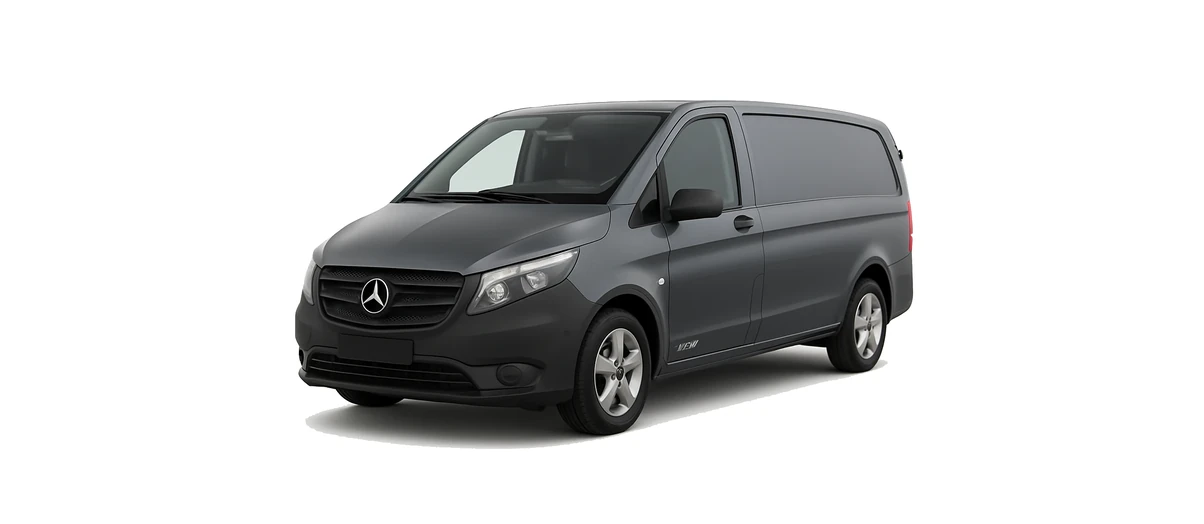
The Mercedes eVito is the battery-electric version of the Mercedes-Benz Vito, offered in the UK as a practical medium electric van and, in eVito Tourer form, as a passenger-carrying variant. For trades, delivery work, local fleets, hotels, shuttle operators and private users, the key charging point is simple: the eVito uses a Type 2 connection for AC charging and a CCS connection for DC rapid charging in the UK and Europe.
However, eVito specifications are not all the same. Current UK eVito Panel Van information lists a 60 kWh usable battery, while current UK eVito Tourer documentation lists a larger 90 kWh usable battery. Older used eVito vans can have different battery sizes, ranges and charging capability. That means cable advice is broadly consistent, but range expectations and charging times should always be checked against the exact vehicle.
View Mercedes eVito Charging Cables
Mercedes eVito Battery and Charging Specifications
For current UK models, the Mercedes eVito uses Type 2 AC charging and CCS DC rapid charging. AC charging is used at home, at depots, workplaces and many public destination chargers. DC rapid charging is used on higher-powered public chargers, typically at motorway services, charging hubs and commercial rapid-charging sites.
| Variant | Usable battery | WLTP range | AC charging | DC rapid charging |
|---|---|---|---|---|
| Current UK eVito Panel Van | 60 kWh | Up to around 159–160 miles | Up to 11 kW | Up to 80 kW; around 35 minutes from 10–80% in suitable conditions |
| Current UK eVito Tourer | 90 kWh | Around 225–228 miles, depending on version | Up to 11 kW | Up to 110 kW; around 40 minutes from 10–80% in suitable conditions |
| Older used eVito vans | Varies by model year | Varies by model year | Check exact specification | Check exact specification |
The important point for owners is that a current Panel Van and a current Tourer should not be treated as identical from a planning perspective. A fleet operator using eVito Panel Vans for urban routes will have different charging needs from a shuttle operator using eVito Tourers for longer passenger journeys.
Battery Options
The current UK eVito Panel Van is listed with a 66 kWh gross battery and 60 kWh usable capacity. Mercedes-Benz UK material gives a WLTP range of around 159–160 miles for this model, depending on version and conditions. It is the most relevant specification for many UK van buyers looking at the eVito as a working vehicle.
The current UK eVito Tourer is different. UK documentation for the Tourer lists a 100 kWh gross battery with 90 kWh usable capacity and a WLTP range of around 225–228 miles, depending on length and trim. It also has a higher stated DC rapid-charging peak than the current UK Panel Van.
Used eVito buyers should be particularly careful. Early eVito examples had shorter range and different charging capability, so it is worth checking the registration year, battery capacity and onboard charger details before relying on current-model figures. If you are buying a charging cable, the Type 2 AC connection is the relevant point to confirm, but journey planning depends heavily on the specific battery fitted.
AC Charging Speed
Current UK eVito Panel Van and eVito Tourer specifications both list 11 kW AC charging. This is the maximum AC charging rate the vehicle can accept when connected to a suitable three-phase AC charger.
In many UK homes and smaller depots, the most common installed wallbox is a single-phase 7.4 kW charger. The eVito can use this type of charger, but it will not reach the full 11 kW AC maximum on a single-phase supply. In practical terms, a 7.4 kW wallbox is still a strong option for overnight charging, especially for vans returning to base at the end of each working day.
Mercedes-Benz documentation lists the current eVito Panel Van at about 6 hours 30 minutes for a 0–100% AC charge at 11 kW. The larger-battery eVito Tourer is listed at about 10 hours from 0–100% at 11 kW. On a 7.4 kW home or depot wallbox, a full charge will take longer, but many owners will not need to charge from empty to full every day.
For untethered AC chargers, the cable you normally need is a Type 2 to Type 2 charging cable. This applies to many home wallboxes, workplace chargers and public fast chargers where the cable is not already attached to the unit.
DC Rapid Charging Speed
For longer days, fast turnaround or routes that exceed the comfortable daily range, the eVito can use CCS DC rapid charging. On the current UK eVito Panel Van, Mercedes-Benz material states DC charging at up to 80 kW, with a 10–80% rapid charge taking about 35 minutes under suitable conditions.
The current UK eVito Tourer is listed with DC charging at up to 110 kW and a 10–80% time of about 40 minutes. Although the Tourer has a higher peak rate, it also has a larger battery, which is why the 10–80% time remains in a similar broad window.
For DC rapid charging, you do not normally need to carry a separate CCS cable. UK CCS rapid chargers are normally tethered, meaning the charging cable is attached to the charger. You simply park, plug in the tethered CCS connector, follow the charger’s payment or app process and begin charging.
Rapid charging is usually most efficient when planned around the 10–80% window. Charging beyond 80% can be useful when you need maximum range, but the charge rate generally slows at higher states of charge, so a short top-up to 70–80% is often quicker than waiting for a full battery.
Range and Efficiency
The current UK eVito Panel Van is listed with a WLTP range of up to around 159–160 miles. The current UK eVito Tourer is listed at around 225–228 miles, depending on length and specification. WLTP figures are useful for comparison, but real-world range can vary significantly.
With a van, load and use case matter a great deal. A lightly loaded vehicle on urban routes may perform differently from a fully laden van on faster roads in winter. Passenger use, heating demand, roof racks, motorway speeds, tyre condition and driving style can all affect energy consumption. For business users, it is sensible to build a range buffer into route planning rather than assuming the maximum WLTP figure will always be available.
The eVito’s underfloor battery packaging helps preserve the practical Vito-style load or passenger space, which is useful for operators moving from a diesel Vito to an electric van. Five recuperation modes are described for current eVito variants, helping the driver adjust how strongly the vehicle recovers energy when slowing down. Tourer documentation also refers to D Auto, which can support more adaptive recuperation behaviour where fitted.
Charging at Home
For most private owners and small business users, home or depot charging is the cheapest and most convenient way to run an eVito. If the van returns to the same base overnight, a dedicated wallbox allows the driver to start each morning with the desired charge level without relying on public chargers.
A 7.4 kW wallbox is suitable for many UK installations. It will not use the eVito’s full 11 kW AC capability, but it is still capable of adding a substantial amount of range overnight. If your premises have a compatible three-phase electrical supply, an 11 kW AC charge point may allow the current eVito to charge at its listed maximum AC rate.
A standard 3-pin charging lead is generally best suited as a backup or occasional charging solution, but can be used regularly if a qualified electrician has confirmed the socket and electrical installation are suitable for sustained EV charging. For a working van, a dedicated EV charge point is usually the more practical long-term solution because it is faster, safer for repeated high-load use when correctly installed, and easier to schedule.
If the wallbox is untethered, you will need a Type 2 to Type 2 cable. Many drivers keep one cable in the van so they can also use untethered public and workplace charge points.
Public Charging
Public charging for the Mercedes eVito falls into two main types: AC destination charging and DC rapid charging. AC charging is common in car parks, hotels, business parks, town centres and workplaces. These chargers may be tethered or untethered. If untethered, you use your own Type 2 to Type 2 cable.
DC rapid chargers are the better option when you need a shorter stop. They use the CCS connector and are normally tethered, so no separate rapid-charging cable is required. For operators, the practical question is often not just charger speed but charger location. A rapid charger that fits naturally into a delivery round, airport run or passenger shuttle route can be more useful than a faster charger that requires a detour.
Van drivers should also consider bay size and access. Some public charging sites are designed around passenger cars, so longer L2 or L3 eVito variants may need more care when parking. For regular commercial use, it is worth identifying reliable sites with suitable bay layouts before the van is needed on a time-sensitive route.
Vehicle-Specific Features
The eVito is a front-wheel drive electric van based on the Vito/eVito platform. The battery is mounted under the floor, helping maintain the familiar load area or passenger layout that Vito users expect. Current Panel Van models are available in L2 and L3 lengths, while the Tourer is also offered in L2 and L3 passenger configurations.
Current eVito information describes multiple recuperation modes, allowing the driver to tailor energy recovery to the route. This can be particularly useful in urban driving, where frequent slowing and stopping gives more opportunity to recover energy.
Mercedes-Benz app and digital services may support remote vehicle and charging-status functions where fitted and activated. Availability can depend on vehicle specification, account setup and connected services status, so owners should check the exact vehicle and subscription details.
Charging Tips
- Choose the right everyday cable: for most UK AC charging, a Type 2 to Type 2 cable is the key cable to carry.
- Check your variant: do not assume a Panel Van and Tourer have the same battery or rapid-charging performance.
- Plan around 10–80% on rapid chargers: this is the window used for the published rapid-charging times and is usually the quickest way to add useful range.
- Use depot charging where possible: returning to base with a scheduled overnight charge is often simpler and cheaper than relying on public charging.
- Allow a working range buffer: payload, temperature, road speed and heating use can all reduce real-world range.
- Check older vans carefully: early eVito models may not match current 60 kWh Panel Van specifications.
- Do not buy a separate DC cable: CCS rapid chargers in the UK are normally tethered.
Frequently Asked Questions
What charging cable does the Mercedes eVito use?
For AC charging, the Mercedes eVito uses a Type 2 connection. If you are using an untethered home, workplace or public AC charger, you will normally need a Type 2 to Type 2 cable. For DC rapid charging, the eVito uses CCS, and the cable is normally attached to the rapid charger.
Can the Mercedes eVito charge at 11 kW?
Current UK eVito Panel Van and eVito Tourer specifications list 11 kW AC charging. To achieve this, you need a compatible three-phase AC charger and electrical supply. On a typical UK single-phase 7.4 kW wallbox, the van will charge below its 11 kW AC maximum.
How long does the Mercedes eVito take to rapid charge?
The current UK eVito Panel Van is listed at up to 80 kW DC, with around 35 minutes for a 10–80% rapid charge in suitable conditions. The current UK eVito Tourer is listed at up to 110 kW DC, with around 40 minutes for 10–80%.
Is the eVito Panel Van the same as the eVito Tourer?
No. They share the eVito name and use Type 2/CCS charging, but current UK specifications differ. The Panel Van is listed with a 60 kWh usable battery, while the Tourer is listed with a 90 kWh usable battery. Range and charging figures should therefore be checked by variant.
Should I rely on public charging for a working eVito?
Public charging can work well, especially with reliable rapid chargers on regular routes. However, most business users will find home, workplace or depot charging more predictable for daily operation, with public rapid charging used for longer days or unexpected route changes.
What This Means for Drivers
The Mercedes eVito is straightforward from a connector point of view: Type 2 for AC charging and CCS for rapid charging. The more important ownership detail is variant awareness. A current UK eVito Panel Van, current eVito Tourer and older used eVito can have very different range and charging expectations.
For most drivers, the practical setup is a dedicated home or depot wallbox, a good-quality Type 2 to Type 2 cable for untethered AC charging, and planned use of tethered CCS rapid chargers when longer journeys require it. Fleet and business users should base charging plans on real routes, typical payload, dwell time and access to reliable charging rather than headline range alone.
Looking for a Charging Cable for Mercedes eVito?
We offer charging cables suitable for Mercedes eVito AC charging, including Type 2 options for home, workplace and public untethered charge points. Choose a cable that matches your charger setup and how you use the vehicle day to day.
View Mercedes eVito Charging Cables
Please note that this information is intended as a guide. Charging specifications may change due to model and year of manufacture. For precise information, always refer to your vehicle user manual.

