
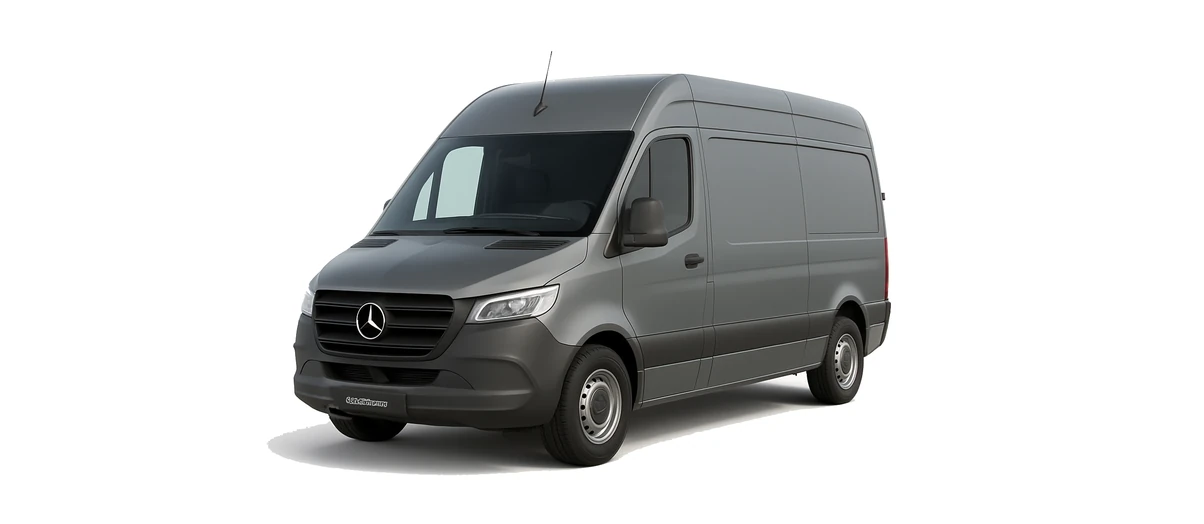
The Mercedes eSprinter is a battery-electric large van designed for professional use, including parcel delivery, service fleets, mobile workshops and converted chassis cab applications. The current UK eSprinter range is very different from earlier short-range versions, so charging advice should be based on the latest 81 kWh and 113 kWh usable battery options rather than older first-generation figures.
For most operators, the eSprinter charging decision is not just about maximum charging speed. It is about whether the van can return to base, charge predictably overnight and be ready for the next route. The standard 11 kW AC onboard charging is well suited to depot and workplace charging, while the optional 22 kW AC upgrade can reduce turnaround times where a compatible three-phase supply is available. On longer routes, the CCS rapid charging capability of up to 115 kW allows practical top-ups during driver breaks.
View Mercedes eSprinter Charging Cables
Mercedes eSprinter Battery and Charging Specifications
The current UK Mercedes eSprinter is a fully electric van, not a plug-in hybrid. Mercedes-Benz Vans lists it with rear-wheel drive and a Type 2 vehicle socket for AC charging, plus a CCS rapid charging port for DC charging. In UK and European charging terms, this means the eSprinter uses a Type 2 connection for home, workplace and destination chargers, and a CCS2-style connection for rapid chargers.
Current UK price-list information shows 11 kW AC charging as standard, with 22 kW AC available as an option on relevant builds. DC rapid charging is listed at up to 115 kW. Mercedes gives 10-80% rapid charging times of 34 minutes for the 81 kWh battery and 42 minutes for the 113 kWh battery under suitable conditions.
Because the eSprinter is often specified for commercial work, the exact charging experience can depend on the body style, wheelbase, roof height, conversion, payload and charging infrastructure installed at the depot. It is also worth checking the individual build sheet for cable provision, as current UK Mercedes-Benz material is not fully consistent on whether a Type 2 cable is supplied with every vehicle.
Battery Options
The current UK eSprinter range is offered with two usable high-voltage battery capacities: 81 kWh and 113 kWh. Mercedes describes these as lithium iron phosphate, or LFP, batteries. LFP chemistry is commonly valued in commercial EV applications because it is robust and well suited to repeated daily charging routines.
The 81 kWh battery is likely to suit local delivery, facilities support and shorter regional routes where the van returns to base regularly. It still needs proper charging planning, especially if the van is heavily loaded, driven at higher speeds or used in colder weather, but it can be a practical choice for predictable daily mileage.
The 113 kWh battery gives the eSprinter its longest current UK range potential and will be the more suitable choice for longer routes, higher daily mileage and multi-stop operations where operators want a larger energy reserve. It also takes longer to charge from empty on AC, simply because it stores more energy, so depot charger power and dwell time become especially important.
AC Charging Speed
AC charging is the main charging method for many eSprinter operators. Current UK models list 11 kW AC charging as standard. At 11 kW, Mercedes gives approximate 0-100% charging times of 8 hours 30 minutes for the 81 kWh battery and 11 hours 15 minutes for the 113 kWh battery. These figures make sense for overnight depot charging, particularly where vehicles are parked for a full shift break.
Some eSprinter builds can be specified with optional 22 kW AC charging. With the 22 kW option, Mercedes lists 0-100% AC charging times of around 4 hours 30 minutes for the 81 kWh battery and 6 hours for the 113 kWh battery. This can be valuable for multi-driver operations, split shifts or vans that return to base during the day.
However, 22 kW AC should not be assumed. The van must have the optional 22 kW onboard charger, the charge point must support 22 kW AC, and the site electrical supply must be suitable. Many domestic UK charge points are 7.4 kW single-phase units, which will charge the eSprinter more slowly than an 11 kW or 22 kW three-phase workplace unit.
DC Rapid Charging Speed
For public rapid charging and high-power depot charging, the Mercedes eSprinter uses its CCS connection. Current UK data lists DC rapid charging at up to 115 kW. Under suitable conditions, Mercedes states a 10-80% DC charging time of 34 minutes for the 81 kWh battery and 42 minutes for the 113 kWh battery.
In day-to-day use, it is normally better to plan rapid charging around 10-80% rather than 0-100%. Charging speeds are usually strongest through the middle of the battery and slow down as the battery approaches full. For a working van, a shorter rapid top-up to restore the range needed for the next leg is often more efficient than waiting for a full charge.
Rapid charging speed can be affected by charger availability, battery temperature, state of charge, load, weather and site power. A charger rated above 115 kW will not make the eSprinter exceed its listed maximum, but it may still be useful if it can reliably deliver the van’s requested charging power.
Range and Efficiency
Mercedes-Benz UK lists current panel van WLTP range figures from 161 to 272 miles depending on variant, while current chassis cab figures are listed from 169 to 274 miles. These figures are variant-dependent and should not be treated as one guaranteed daily range for every eSprinter.
Real-world range will vary significantly in a large electric van. Payload, roof height, body length, conversions, auxiliary equipment, driving speed, route profile, ambient temperature and cabin heating can all make a noticeable difference. Independent UK review context suggests the larger 113 kWh version can be capable of around 220 miles in practical use, while the 81 kWh battery is more suited to shorter duty cycles. Operators should compare their own route data with the chosen battery size rather than relying only on the headline WLTP figure.
For fleet use, it is wise to build in a margin. A van that can theoretically complete a route in mild weather may need more charging support in winter, when carrying heavy loads or when drivers spend more time on faster roads.
Charging at Home
Although the eSprinter is primarily a commercial vehicle, some owner-drivers and small businesses may charge at home. A dedicated home wallbox is usually the most convenient and controlled option. On a typical UK single-phase 7.4 kW home charge point, charging will be slower than the eSprinter’s standard 11 kW capability, but it may still be workable if the van is parked for long periods overnight.
For businesses operating from home premises, it is important to consider parking position, cable length, electrical supply capacity and whether the van can be charged without trailing cables across public paths. A long-wheelbase van may need a different cable length from a car, especially if the charge point is mounted away from the usual parking position.
A 3-pin charger is generally best suited as a backup or occasional charging solution, but can be used regularly if a qualified electrician has confirmed the socket and electrical installation are suitable for sustained EV charging. For an eSprinter, a 3-pin socket will be very slow because of the battery size, so it should not be the main charging plan for a high-mileage working van.
Public Charging
Public charging is useful for longer eSprinter routes, unexpected diversions and vans that cannot always return to base. For AC public charging, the eSprinter uses a Type 2 cable. For DC rapid charging, the CCS cable is usually tethered to the charger, so drivers connect the charger’s own cable to the van.
When planning public charging for a large van, physical access matters as much as charger speed. Drivers should check whether the charger bay can accommodate a long van, whether height restrictions apply, and whether the cable can comfortably reach the eSprinter’s charge port. Rapid charging hubs designed with vans in mind can be easier to use than compact car-park installations.
For fleet managers, it is also worth setting rules for charging cards, apps and reimbursement. A van that depends on public charging needs reliable access to networks along its route, not just a theoretical charger on a map.
Vehicle-Specific Features
The current eSprinter uses a modular electric van layout, with high-voltage components in the front module, the battery mounted under the floor between the axles and an electrically driven rear axle. This packaging helps Mercedes offer both panel van and chassis cab body styles for different commercial applications.
UK information also describes three drive programmes and five recuperation levels, allowing drivers to adjust how the van uses and recovers energy. In urban delivery work, selecting an appropriate recuperation setting can help reduce brake use and improve efficiency, especially on stop-start routes.
Mercedes’ MBUX system supports eSprinter-specific electric-vehicle functions such as charging settings, navigation support and pre-conditioning features. Availability and operation can depend on the exact specification, so operators should confirm build-level equipment rather than assuming every feature is present on every van.
Charging Tips
- Base your plan on the current-generation eSprinter. Avoid older charging figures from previous eSprinter models, which had much smaller batteries and shorter range.
- Use 11 kW AC as the standard assumption. This is the listed standard AC charging rate for current UK models and is well suited to overnight depot charging.
- Only plan around 22 kW AC if the van and site support it. The 22 kW AC charger is optional, and the depot must have suitable three-phase charging infrastructure.
- Plan rapid stops from 10-80%. This aligns with the charging window Mercedes uses for its quoted rapid charging times.
- Check cable length before ordering. Large vans often need more reach than a passenger car, particularly in depots with fixed charging bays.
- Train drivers on charging access. For public charging, bay layout, account access and charger reliability can all affect route timing.
- Confirm whether a cable was supplied. Mercedes-Benz UK material is inconsistent on cable inclusion, so check the individual vehicle handover pack or build sheet.
Frequently Asked Questions
What charging cable does the Mercedes eSprinter use?
The Mercedes eSprinter uses a Type 2 connection for AC charging. For DC rapid charging, it uses a CCS connection, and the rapid charger normally has its own tethered cable.
Is the Mercedes eSprinter a plug-in hybrid?
No. The current UK Mercedes eSprinter is a battery-electric vehicle. It does not have a petrol or diesel engine for driving.
Does every eSprinter have 22 kW AC charging?
No. Current UK information lists 11 kW AC charging as standard, with 22 kW AC available as an option. Check the specific van specification before planning charging infrastructure around 22 kW AC.
How long does the Mercedes eSprinter take to rapid charge?
Mercedes lists 10-80% DC rapid charging in around 34 minutes for the 81 kWh battery and around 42 minutes for the 113 kWh battery, at up to 115 kW under suitable conditions.
Can I charge an eSprinter from a normal 3-pin socket?
It is possible with the correct equipment, but it is very slow for a van with this battery size. A 3-pin charger is generally best suited as a backup or occasional charging solution, but can be used regularly if a qualified electrician has confirmed the socket and electrical installation are suitable for sustained EV charging.
What This Means for Drivers
The Mercedes eSprinter is best approached as a route-planned electric working vehicle. If the van returns to base and has enough dwell time, 11 kW AC charging can provide a straightforward overnight routine. If the operation needs faster daytime turnaround, the optional 22 kW AC system may be worth specifying, provided the site can support it. For longer journeys, CCS rapid charging at up to 115 kW gives the eSprinter practical flexibility, especially when drivers plan efficient 10-80% top-ups.
The key is to match battery size, charger power and daily mileage to the job. A local delivery route, a converted chassis cab and a long-distance service van may all need different charging strategies, even though they share the same eSprinter name.
Looking for a Charging Cable for Mercedes eSprinter?
We offer Type 2 charging cables suitable for Mercedes eSprinter AC charging, with options to help suit home, workplace and depot charging setups.
View Mercedes eSprinter Charging Cables
Please note that this information is intended as a guide. Charging specifications may change due to model and year of manufacture. For precise information, always refer to your vehicle user manual.

