
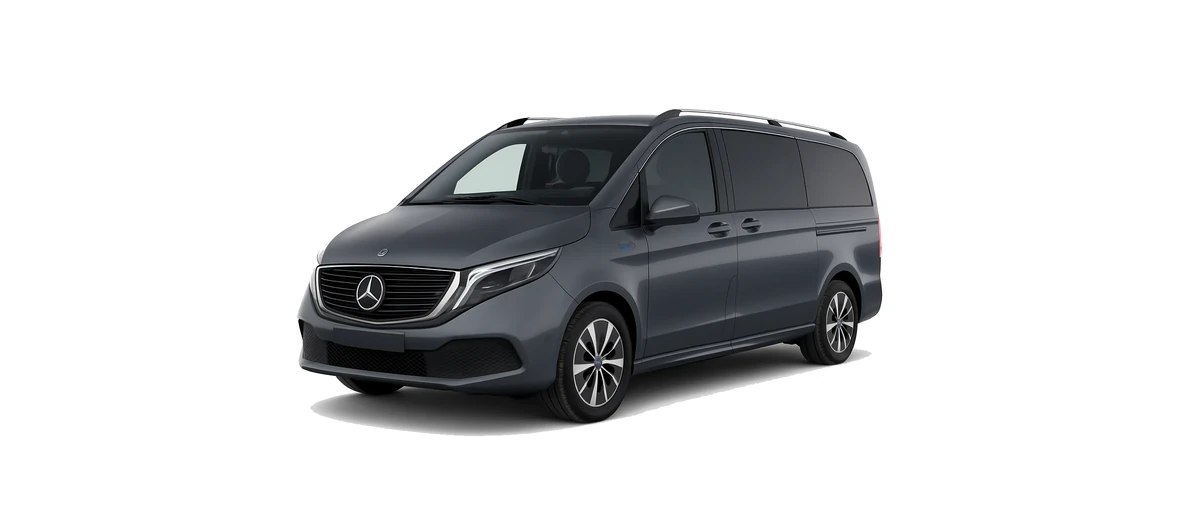
The Mercedes EQV is a large all-electric MPV designed for families, executive travel, airport transfers and premium passenger transport. Based around the V-Class/Vito-style passenger van format rather than a dedicated ground-up EV platform, it combines a sizeable cabin with battery-electric running and zero tailpipe emissions.
Because the EQV is a large seven-seat electric vehicle with a substantial battery, charging habits matter. It is not the kind of EV where a short top-up always covers a week of use. For most UK drivers, the best ownership experience comes from regular overnight AC charging, sensible route planning and well-timed CCS rapid charging stops on longer journeys.
View Mercedes EQV Charging Cables
Mercedes EQV Battery and Charging Specifications
The current UK Mercedes-Benz EQV 300 is a battery electric vehicle. Mercedes-Benz UK lists the EQV with electricity as its fuel type, 0 g/km CO2 emissions and a WLTP range of up to 222 miles for the current EQV 300 Executive Long. Independent data sources for the facelifted 2024-on EQV 300 Long and Extra-Long models list broadly similar charging hardware.
| Vehicle type | Battery electric large MPV / passenger van |
|---|---|
| AC charging connector | Type 2 |
| DC rapid charging connector | CCS Combo 2 / CCS2 |
| Maximum AC charging | Up to 11 kW, where suitable three-phase AC charging is available |
| Typical UK home charging | Up to around 7.4 kW on many single-phase home wallboxes |
| Maximum DC rapid charging | Up to 110 kW |
| Typical rapid charge window | Approximately 10-80% in around 41 minutes, depending on conditions |
The charging port is listed by EV Database as being on the left side/front of the vehicle. For AC charging, the EQV uses a Type 2 connection. For DC rapid charging, it uses CCS2, with the rapid charger’s own tethered cable.
Battery Options
Battery figures for the Mercedes EQV vary slightly depending on model year and data source, so it is worth treating them with context rather than assuming one universal capacity for every UK car.
Current Mercedes-Benz UK technical data for the EQV 300 Executive Long states a usable battery energy content of 93.3 kWh. EV Database lists the current 2024-2026 EQV 300 Long and Extra-Long with a 100.0 kWh nominal battery and 90.0 kWh usable capacity. Older UK material and many reviews of 2020-2024 cars also commonly refer to a 90 kWh usable battery.
In practical terms, all of these figures point to the same ownership reality: the EQV has a large battery by passenger-car standards, and it benefits from planned charging. If you can charge at home or at base overnight, you can often start each working day or family journey with a useful state of charge rather than relying heavily on rapid chargers.
AC Charging Speed
The Mercedes EQV supports AC charging at up to 11 kW through its onboard charger. This is useful when connected to an appropriate three-phase AC supply, such as some workplace, depot, hotel or destination chargers.
However, most UK homes have a single-phase electrical supply. On a typical single-phase home wallbox, the practical maximum will usually be around 7.4 kW rather than the EQV’s full 11 kW capability. That means a full charge from a low battery will take considerably longer at home than it would on an 11 kW three-phase AC supply.
The EQV will not charge faster than its onboard AC limit when connected to a higher-rated AC post. For example, if you plug into a 22 kW public AC charger, the vehicle is still limited to up to 11 kW AC. This is normal: the post can offer more power, but the vehicle decides how much AC power it can accept.
DC Rapid Charging Speed
For longer journeys, the EQV uses CCS2 DC rapid charging. The maximum DC charging rate is up to 110 kW, with a typical 10-80% rapid charge taking around 41 minutes in favourable conditions. Some UK review sources describe the same broad rapid-charging session as roughly 40-45 minutes.
This is quick enough for planned motorway stops, but the EQV is not an ultra-rapid 800 V vehicle and should not be treated as a 150 kW, 200 kW or higher-speed charging model. Plugging into a 150 kW or 350 kW charger is still possible if the connector is CCS and the charger is compatible, but the vehicle will only draw power up to its own limit and according to the charging curve.
As with most EVs, charging typically slows as the battery gets closer to full. On long trips, it is usually more efficient to rapid charge to around 80% and continue the journey, rather than waiting for the final 20% unless you genuinely need the extra range.
Range and Efficiency
Mercedes-Benz UK quotes up to 222 miles WLTP for the current EQV 300 Executive Long. EV Database gives a real-world range estimate of about 195 miles for current EQV 300 Long data. Real-world range will vary with speed, temperature, load, driving style and use of heating or air conditioning.
The EQV’s size is central to understanding its energy use. It is a large electric MPV with space for passengers and luggage, so it will generally use more energy than a smaller hatchback or saloon. Motorway driving, cold weather and a full load of passengers can all reduce the distance available between charges.
For airport-transfer drivers, hotels, chauffeur operators and families using the EQV for holidays, it is sensible to build in more charging margin than you might in a smaller EV. If a route looks possible on paper with only a small amount of remaining charge, a short earlier rapid-charge stop may be the more comfortable choice.
Charging at Home
For most private UK owners, home charging will be the most convenient way to run a Mercedes EQV. A dedicated Type 2 home wallbox lets you charge overnight and begin the next day with a known battery level. If your home supply is single-phase, expect charging up to around 7.4 kW rather than the car’s full 11 kW AC capability.
A Type 2 charging cable is the correct cable type for untethered AC wallboxes and many public destination chargers. Some home chargers are tethered, meaning the cable is permanently attached to the unit. Others are untethered, in which case you use your own Type 2 cable.
A 3-pin charger is generally best suited as a backup or occasional charging solution, but can be used regularly if a qualified electrician has confirmed the socket and electrical installation are suitable for sustained EV charging. This point is especially important with a vehicle like the EQV because its large battery means domestic socket charging can be very slow and places a long, continuous load on the circuit.
If the EQV is used commercially or as a high-mileage family vehicle, a home, workplace or depot charging routine is strongly recommended. Regular AC charging reduces reliance on public rapid chargers and can make daily scheduling far more predictable.
Public Charging
Public charging for the Mercedes EQV falls into two main categories: AC destination charging and DC rapid charging.
AC destination chargers are common at hotels, town centres, car parks, workplaces and leisure venues. These usually use a Type 2 connection. If the post is untethered, you will need your own Type 2 cable. The EQV can charge at up to 11 kW AC where the site and supply allow, but on lower-rated posts it will charge at the lower available rate.
DC rapid chargers are the better option for motorway and long-distance use. These use CCS2 and almost always have a tethered cable attached to the charger, so you do not use your own Type 2 cable for DC rapid charging. Your own cable is for AC charging only.
Mercedes-Benz UK material references the Mercedes me Charge / MB.CHARGE Public ecosystem, and EV Database lists Autocharge support for current EQV entries while Plug & Charge is not listed as supported. In day-to-day use, network access, app compatibility, payment method and charger reliability will matter just as much as the maximum power figure on the charger.
Vehicle-Specific Features
The Mercedes EQV is aimed at drivers who need passenger space, comfort and refinement rather than compact-EV efficiency. Current UK data sources describe Long and Extra-Long versions, with a 150 kW front-wheel-drive electric powertrain and seven-seat premium MPV positioning.
EV Database lists a heat pump as standard for current EQV 300 Long and Extra-Long entries. A heat pump can help improve heating efficiency compared with relying solely on resistive heating, particularly in cooler weather, although real-world range will still be affected by temperature, vehicle load and driving speed.
Current EQV data does not list vehicle-to-load, vehicle-to-home or vehicle-to-grid capability. The EQV should therefore be considered as a conventional battery electric MPV for charging purposes, not as a bidirectional energy device.
Charging Tips
- Use AC charging whenever the vehicle is parked for longer periods. Overnight home or depot charging is ideal for a large-battery vehicle like the EQV.
- Do not expect 11 kW at every home charger. Many UK homes are single-phase, so around 7.4 kW is a more realistic expectation unless you have suitable three-phase infrastructure.
- Carry the right Type 2 cable. This is the cable you need for untethered AC wallboxes and many public destination chargers.
- Use CCS rapid chargers for long journeys. DC rapid charging uses the charger’s tethered CCS cable, not your own Type 2 cable.
- Plan conservatively in winter. Cold weather, high speeds and a full passenger load can reduce range.
- Rapid charge to around 80% when time matters. Charging beyond 80% usually slows down, so shorter, better-timed stops can be more efficient on long routes.
- Check charger access before arrival. The EQV is a large vehicle, so bay size, cable reach and parking layout can matter more than they do with smaller EVs.
Frequently Asked Questions
What charging cable does the Mercedes EQV use?
The Mercedes EQV uses a Type 2 connector for AC charging. For DC rapid charging, it uses CCS Combo 2 / CCS2, with the cable normally tethered to the rapid charger.
Can the Mercedes EQV charge at 22 kW AC?
No. The EQV’s AC onboard charging limit is up to 11 kW. It can connect to a 22 kW AC post where compatible, but it will not charge at 22 kW.
How fast can the Mercedes EQV rapid charge?
The EQV can DC rapid charge at up to 110 kW. A 10-80% charge is typically quoted at around 41 minutes, although real charging time depends on battery temperature, state of charge, charger performance and conditions.
What is the real-world range of the Mercedes EQV?
Mercedes-Benz UK quotes up to 222 miles WLTP for the current EQV 300 Executive Long. EV Database estimates around 195 miles in real-world use for current EQV 300 Long data. Your actual range will vary with load, temperature, speed and driving style.
Is the Mercedes EQV a plug-in hybrid?
No. The EQV is a battery electric vehicle. It runs on electricity and does not have a petrol or diesel engine for propulsion.
What This Means for Drivers
The Mercedes EQV is best approached as a spacious electric shuttle that rewards planning. Its large cabin and sizeable battery make it highly useful for family, executive and passenger-carrying duties, but they also mean charging is a bigger part of ownership than it is with smaller EVs.
For most UK drivers, the ideal setup is a Type 2 home, workplace or depot charging routine supported by CCS rapid charging on longer journeys. Expect up to around 7.4 kW from many UK home wallboxes, up to 11 kW from suitable three-phase AC charging, and up to 110 kW from compatible DC rapid chargers.
If you understand those limits, the EQV is straightforward to live with: charge regularly when parked, use rapid chargers strategically, and choose a cable that suits untethered AC charging at home and in public.
Looking for a Charging Cable for Mercedes EQV?
We offer Mercedes EQV charging cables for Type 2 AC charging at home, work and public destination chargers, helping you choose a cable that matches how you use your vehicle.
View Mercedes EQV Charging Cables
Please note that this information is intended as a guide. Charging specifications may change due to model and year of manufacture. For precise information, always refer to your vehicle user manual.

