
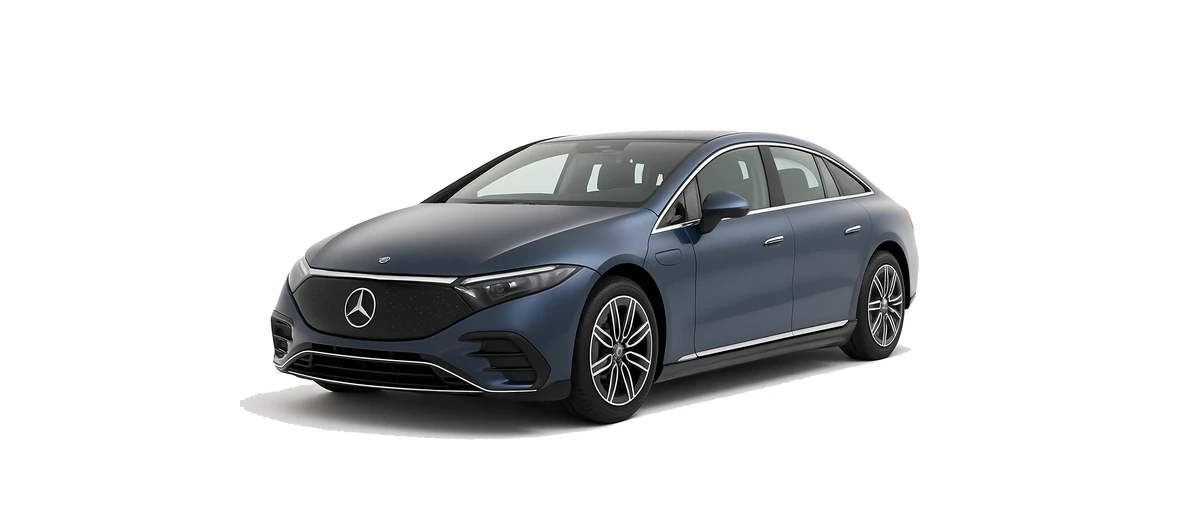
The Mercedes EQS is a large-battery luxury electric saloon / liftback, designed for long-distance comfort as much as everyday driving. For UK owners, the charging connector is straightforward: the EQS uses a Type 2 inlet for AC charging and a CCS Combo 2 connection for DC rapid charging. The detail that matters is model year and variant, because current facelift models have different battery and charging figures from many earlier UK EQS examples.
This guide focuses on the current UK facelift Mercedes EQS Saloon range, including the EQS 400, EQS 450+ and EQS 580 4MATIC, while also highlighting why used-EQS owners should check the exact specification of their car. In practical terms, most UK home charging will be at around 7.4 kW from a single-phase wallbox, even though the current EQS has an 11 kW onboard AC charger. On long journeys, the current facelift cars can make strong use of high-power DC rapid chargers, with variant-dependent peak charging rates of up to 330 kW or 350 kW.
View Mercedes EQS Charging Cables
Mercedes EQS Battery and Charging Specifications
The UK Mercedes EQS Saloon is a battery-electric vehicle, not a plug-in hybrid or range-extender. Current UK Mercedes-Benz material lists the facelift EQS Saloon range as the EQS 400, EQS 450+ and EQS 580 4MATIC. These are built around Mercedes-Benz’s dedicated EVA2 electric luxury platform, with current UK information also referring to an 800 V DC charging system.
For AC charging, current UK technical data lists an 11 kW onboard charger. The car-side AC socket is Type 2, which is the standard connector used by most UK home wallboxes and many public destination chargers. For rapid charging, the EQS uses the CCS Combo 2 part of the same charge port, allowing connection to DC rapid and ultra-rapid chargers.
The key point for owners is not just the plug type, but the exact version of the car. Current facelift/MY26 figures should not be applied to every used EQS. Earlier UK cars, particularly 2021 to 2024 and some pre-facelift examples, commonly have different battery sizes and lower DC charging capability, often around 200 kW rather than the 330–350 kW figures of the current facelift range.
Battery Options
For the current UK facelift EQS Saloon, Mercedes-Benz UK lists a usable battery capacity of 112 kWh for the EQS 400. Independent data estimates the gross capacity at around 118.5 kWh. This is already a very large EV battery, so even partial top-ups can add a meaningful amount of range.
The current EQS 450+ and EQS 580 4MATIC are listed with a 122 kWh usable battery capacity, with independent estimates putting gross capacity at around 129 kWh. The EQS 450+ is the range-focused rear-wheel-drive version, while the EQS 580 4MATIC adds all-wheel drive and higher performance. Both use the same stated usable battery capacity in current UK data.
If you are buying or charging a used EQS, check the registration year, trim and technical data for that specific car. Some earlier EQS models were commonly around 107.8–118 kWh usable depending on version and market data, so charging times and rapid charging behaviour may not match the latest facelift figures.
AC Charging Speed
Current UK EQS technical data lists an 11 kW onboard AC charger. That means the car can accept up to 11 kW from a suitable three-phase AC supply. This is useful at some workplaces, hotels, commercial premises and certain public AC charge points.
At home in the UK, however, many properties have a single-phase electrical supply. A typical dedicated home wallbox will usually provide up to around 7–7.4 kW, depending on the installation and charger. As a result, most UK EQS owners should think of home charging as an overnight or overnight-plus process rather than a short full-charge stop.
Mercedes-Benz UK material gives 7 kW home wallbox times of around 17 hours for the EQS 400 and around 19 hours for the EQS 450+ and EQS 580 4MATIC. At 11 kW, official times are around 11 hours 30 minutes for the EQS 400, while current UK information has shown 13 hours 30 minutes for the larger-battery EQS 450+ and EQS 580 4MATIC on the product page. A 2026 UK brochure lists 11 hours 30 minutes for all three at 11 kW, so owners should use these as guide figures and refer to the latest technical data for their exact car.
DC Rapid Charging Speed
DC rapid charging is where the current facelift EQS is particularly well suited to long-distance use. For current UK models, the EQS 400 is listed with DC charging up to 330 kW, while the EQS 450+ and EQS 580 4MATIC are listed up to 350 kW. These figures require a compatible high-power DC charger and favourable charging conditions.
Official current UK 10–80% rapid charging times are 25 minutes for the EQS 400 and 27 minutes for the EQS 450+ and EQS 580 4MATIC. Independent estimates suggest roughly 28–30 minutes on suitable high-power chargers, which is broadly consistent with the official figures once real-world variables are considered.
For long trips, it is usually more efficient to charge within the faster part of the battery curve, often around the 10–80% window, rather than waiting for the final 20% unless you need the extra range. Charging slows at higher states of charge to protect the battery and manage heat, so a second shorter stop can sometimes be quicker than charging to 100% on a rapid charger.
Range and Efficiency
The current UK EQS range offers some of the longest official WLTP figures in the electric car market, but the figure depends on variant and specification. Mercedes-Benz UK lists the current EQS 400 at up to 490 miles, the EQS 450+ at up to 542 miles and the EQS 580 4MATIC at up to 526 miles. The EQS 450+ achieves the highest official UK figure in the current range.
Real-world range will vary with speed, temperature, road conditions, wheel and tyre choice, cabin heating or cooling, and driving style. EV Database estimates combined real-world range at around 415 miles for the EQS 400, around 450 miles for the EQS 450+ and around 415 miles for the EQS 580 4MATIC. Those figures are not guarantees, but they are useful planning numbers for typical mixed driving.
The EQS is a large and heavy luxury EV, so motorway speed has a significant effect on efficiency. A relaxed cruise, sensible tyre pressures and using the car’s navigation for charging stops can all help make the most of the battery.
Charging at Home
For most UK EQS owners, a dedicated Type 2 home wallbox will be the most convenient way to charge. You can plug in when you get home, use an off-peak electricity tariff where available, and leave with a useful charge each morning. Because the EQS battery is large, many owners will not regularly charge from empty to full; instead, they will top up from perhaps 40% to 80% as part of normal use.
A Type 2 charging cable is suitable for home wallboxes that have a socket rather than a tethered lead, and it is also useful for untethered public AC posts. If your home charger is tethered with a Type 2 plug, you may not need your own cable at home, but carrying one in the car is still helpful for destination charging.
A 3-pin portable charger is generally best suited as a backup or occasional charging solution, but can be used regularly if a qualified electrician has confirmed the socket and electrical installation are suitable for sustained EV charging. With a battery as large as the EQS’s, a domestic plug will be very slow, so it is not the preferred day-to-day option for most owners.
Public Charging
Public charging for the Mercedes EQS falls into two main categories: AC destination charging and DC rapid charging. AC posts are often found in car parks, hotels, workplaces and town centres. They typically use a Type 2 socket, so you will usually need your own Type 2 cable unless the charger is tethered.
DC rapid and ultra-rapid chargers have tethered CCS cables, so you do not need to use your own charging cable for rapid charging. For the current facelift EQS, choosing high-power chargers can make a major difference on long trips, particularly where the charger can deliver the high power the car is capable of accepting.
Mercedes-Benz UK references MB.CHARGE Public with Navigation with Electric Intelligence and a range monitor that can plan charging stops. Using the built-in navigation is a sensible approach because it can base route planning on the car’s current consumption, the journey ahead and available charging options. Battery preconditioning for rapid charging should not be assumed unless confirmed for your specific model and software version.
Vehicle-Specific Features
The current Mercedes EQS Saloon is listed with a heat pump in UK equipment information. A heat pump can improve heating efficiency compared with traditional resistive heating in many conditions, helping reduce the range impact of cabin heating during colder weather.
Mercedes-Benz UK also references pre-installation for MB.CHARGE Home Pro and bidirectional charging at home, including potential feed-in to the domestic or public grid. This should be treated carefully: availability depends on the relevant Mercedes equipment and service, model year, market support, installation and compatible home charging infrastructure. It should not be assumed that every EQS on UK roads can provide vehicle-to-grid or vehicle-to-home functionality today.
Vehicle-to-load support, where the car directly powers external devices through an onboard outlet or adaptor, is not confirmed for the EQS in the reviewed UK data and should not be treated as an available feature.
Charging Tips
- Check your exact model year. A current facelift EQS 450+ is not the same as an earlier pre-facelift EQS when it comes to battery and rapid charging figures.
- Use a Type 2 cable for AC charging. This is the right cable type for untethered home wallboxes and most public AC posts.
- Do not expect 11 kW at every home. Many UK homes are single-phase, so around 7.4 kW is a more realistic maximum for domestic wallbox charging.
- Use DC rapid chargers on long journeys. The current facelift EQS is designed to make strong use of high-power CCS charging.
- Plan around 10–80% stops. This is usually the fastest part of a rapid charging session.
- Let the car plan the route. Mercedes navigation and charging planning can help match stops to the route and current energy use.
Frequently Asked Questions
What charging cable does the Mercedes EQS use?
The Mercedes EQS uses a Type 2 connection for AC charging. For DC rapid charging, it uses CCS Combo 2, and rapid chargers have their own tethered cables.
Can the Mercedes EQS charge at 22 kW AC?
Current UK EQS technical data lists an 11 kW onboard AC charger. Some international or cable-related references mention 22 kW capability or options, but 22 kW AC should not be treated as standard for current UK EQS models.
How long does the Mercedes EQS take to charge at home?
On a typical UK 7 kW home wallbox, current Mercedes-Benz data suggests around 17 hours for the EQS 400 and around 19 hours for the EQS 450+ and EQS 580 4MATIC. In everyday use, many owners will top up rather than charge from empty to full.
How fast can the Mercedes EQS rapid charge?
For current UK facelift models, the EQS 400 is listed at up to 330 kW DC, while the EQS 450+ and EQS 580 4MATIC are listed at up to 350 kW DC. Official 10–80% times are 25 minutes for the EQS 400 and 27 minutes for the EQS 450+ and EQS 580 4MATIC.
Do older Mercedes EQS models charge at the same speed?
Not necessarily. Earlier UK EQS cars often have different battery capacities and are commonly associated with lower DC charging capability, around 200 kW. Always check the technical data for the exact vehicle.
What This Means for Drivers
The Mercedes EQS is a long-range luxury EV where charging is easy to understand at the connector level, but specification detail matters. For AC charging, a Type 2 cable is the key item for untethered home and public chargers. For DC charging, the car uses CCS and the cable is built into the rapid charger.
For most UK owners, the practical home charging experience will be based around a 7–7.4 kW wallbox, not the full 11 kW AC capability of the car. That is still perfectly workable if you charge regularly and take advantage of overnight parking. On longer journeys, current facelift models can use very high DC charging rates, but used-EQS owners should avoid assuming their car has the same 330–350 kW capability as the latest range.
Looking for a Charging Cable for Mercedes EQS?
If you need a Type 2 cable for home wallboxes or public AC charging, choose a cable that matches how and where you charge your Mercedes EQS, taking account of your home supply, charger type and whether you want a cable to keep in the boot for destination charging.
View Mercedes EQS Charging Cables
Please note that this information is intended as a guide. Charging specifications may change due to model and year of manufacture. For precise information, always refer to your vehicle user manual.

