
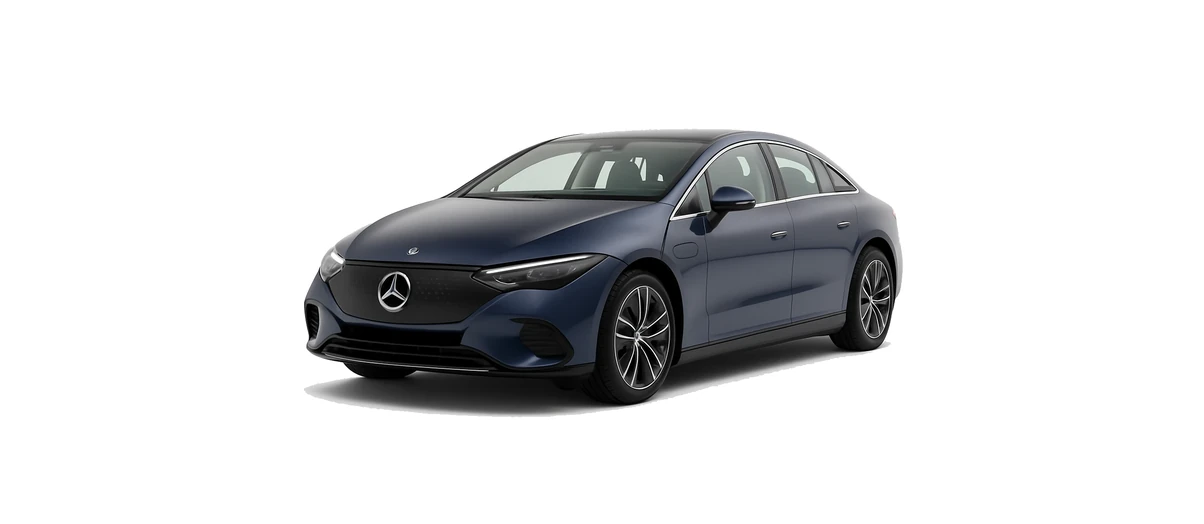
The Mercedes EQE is a battery-electric executive saloon, positioned as the electric counterpart to Mercedes-Benz’s larger business-class models. This guide focuses on the EQE Saloon rather than the separate EQE SUV, as the two models have different specifications and should not be treated as interchangeable when choosing charging equipment.
For UK drivers, the key point is that the Mercedes EQE uses a Type 2 connection for AC charging and a CCS Combo 2 connection for DC rapid charging. That means a Type 2 charging cable is used for home wallboxes and many untethered public AC charge points, while motorway-style rapid and ultra-rapid chargers normally have their own tethered CCS cable attached.
Charging capability varies by EQE version. The current UK EQE 350+ Saloon is listed by Mercedes-Benz UK with 11 kW AC charging, while the Mercedes-AMG EQE 53 Saloon is listed with 22 kW AC charging. Both are listed with up to 170 kW DC rapid charging and a 10-80% rapid-charge time of around 32 minutes in suitable conditions.
View Mercedes EQE Charging Cables
Mercedes EQE Battery and Charging Specifications
The Mercedes EQE is a full battery-electric vehicle, not a plug-in hybrid. Mercedes-Benz UK currently lists the EQE Saloon as the EQE 350+ Sport Edition, alongside a separate Mercedes-AMG EQE 53 Saloon page. Used examples may include earlier EQE 300, EQE 350, EQE 350+, EQE 500 and AMG versions, so it is worth checking the exact model and year before relying on a single set of figures.
For the current UK EQE 350+ Saloon, Mercedes-Benz UK lists a usable battery capacity of 96 kWh, a WLTP range of up to 422 miles, maximum AC charging of 11 kW and maximum DC charging of 170 kW. The current UK Mercedes-AMG EQE 53 Saloon is listed with a 90 kWh usable battery, up to 306 miles WLTP range, 22 kW AC charging and 170 kW DC charging.
In practical terms, the EQE is designed for comfortable long-distance electric driving. Its large battery means home charging is particularly useful, because adding a substantial amount of range from a normal domestic socket would take a very long time. A dedicated wallbox and the correct Type 2 cable make day-to-day charging far more convenient.
Battery Options
Battery capacity depends on the variant and model year. Current UK data from Mercedes-Benz lists the EQE 350+ Saloon with a 96 kWh usable battery. The AMG EQE 53 Saloon is listed separately with a 90 kWh usable battery. Earlier and used EQE versions may show different figures, and independent databases sometimes list different usable capacities for model-year entries.
This matters because battery size affects how long a full charge takes. For example, a 96 kWh usable battery charged from a low state of charge on a typical 7.4 kW home wallbox will require an overnight or extended charging session. The car does not charge at the peak rate for every minute of a session, and charging losses also mean the energy taken from the wall will be higher than the usable energy stored in the battery.
If you are buying a used EQE, check the vehicle’s exact model designation and specification. Do not assume the battery size, AC charging rate or range is identical across all EQE saloons.
AC Charging Speed
AC charging is the type of charging used by home wallboxes, workplace chargers and many destination chargers at hotels, car parks and shopping locations. The Mercedes EQE uses a Type 2 socket for AC charging in the UK and Europe.
The current UK EQE 350+ Saloon is listed with a maximum AC charging capacity of 11 kW. This typically requires a suitable three-phase AC supply. Most UK homes have single-phase electricity, where a dedicated EV wallbox commonly charges at up to around 7.4 kW. As a result, many EQE 350+ owners will see home charging speeds closer to 7.4 kW rather than the car’s 11 kW maximum.
The Mercedes-AMG EQE 53 Saloon is different. Mercedes-Benz UK lists this variant with a 22 kW AC on-board charger, which can be useful where three-phase 22 kW AC charging is available. However, that does not mean every EQE supports 22 kW AC charging. Standard EQE 350+ owners should work from the 11 kW figure unless their own vehicle documentation states otherwise.
For cable selection, a Type 2 cable rated for 32 amp three-phase operation is the most flexible option, because it can support up to 22 kW AC where both the vehicle and charge point allow it. On a 7.4 kW single-phase home wallbox, the same cable can still be used; the car and charger will simply charge at the lower available rate.
DC Rapid Charging Speed
DC rapid charging is used for longer journeys when you need to add range quickly. The Mercedes EQE uses the CCS Combo 2 connector for DC charging, and public rapid chargers normally have the CCS cable permanently attached. You do not use your own Type 2 cable for DC rapid charging.
Mercedes-Benz UK lists both the current EQE 350+ Saloon and AMG EQE 53 Saloon with up to 170 kW DC charging. The quoted 10-80% charging time is around 32 minutes, assuming a suitable high-power CCS charger, a battery at the right temperature and a charge session that begins at a low enough state of charge to allow high charging power.
As with most EVs, charging speed is not constant from 10% to 80%. The car may accept higher power earlier in the session and then reduce power as the battery fills. Charging beyond 80% is often slower, so on long trips it can be quicker to stop, charge to around 70-80%, and continue rather than waiting for a near-full battery.
Range and Efficiency
The current UK EQE 350+ Saloon has an official WLTP range of up to 422 miles. Real-world range will usually be lower and depends on temperature, speed, road conditions, wheel and tyre specification, driving style, cabin heating or cooling, and payload. Independent real-world estimates place the EQE 350+ at around 320 miles in mixed use, but actual results will vary.
The AMG EQE 53 is more performance-focused and has a lower official range. Mercedes-Benz UK lists up to 306 miles WLTP for the current AMG EQE 53 Saloon. Drivers choosing the AMG model should expect energy consumption to be influenced by its higher-performance drivetrain, wheel choices and driving style.
For daily use, many owners will not need to charge to 100% every day. Setting a lower charge limit for regular driving can be a sensible routine, with 100% reserved for longer journeys where the extra range is useful. Always follow the guidance in the vehicle handbook or infotainment charging settings.
Charging at Home
Home charging is usually the most convenient way to run a Mercedes EQE. With a dedicated 7.4 kW wallbox, the car can be plugged in overnight and ready for the next day without relying on public infrastructure. Because the EQE has a large battery, topping up little and often is usually easier than waiting until the battery is nearly empty.
If you have a typical single-phase UK home supply, expect a practical maximum of around 7.4 kW from a suitable wallbox. If you have access to a three-phase electrical supply, the EQE 350+ may be able to use up to 11 kW AC, while the AMG EQE 53 may be able to use up to 22 kW AC, subject to the charger, cable and installation.
A 3-pin charger is generally best suited as a backup or occasional charging solution, but can be used regularly if a qualified electrician has confirmed the socket and electrical installation are suitable for sustained EV charging. For a large-battery car such as the EQE, a 3-pin connection will be much slower than a dedicated wallbox and is not the most convenient primary charging method for most owners.
If your home wallbox is untethered, you will need your own Type 2 cable. If it is tethered, the cable is attached to the unit, but carrying a Type 2 cable is still useful for public AC charging.
Public Charging
Public charging for the Mercedes EQE falls into two main categories: AC destination charging and DC rapid charging. AC destination chargers are often found in town centres, car parks, workplaces, hotels and leisure venues. Many are untethered, so you connect with your own Type 2 cable. Charging speeds vary, with 7 kW, 11 kW and 22 kW posts all common in the UK.
DC rapid and ultra-rapid chargers are used when you need a faster stop, especially on motorway and A-road routes. These chargers use a tethered CCS cable and are the best match for the EQE’s 170 kW DC capability. To make the most of them, arrive with the battery warm, a relatively low state of charge and enough headroom to charge efficiently.
Some EQE model-year entries are listed with Plug & Charge and Autocharge support, but availability can depend on the vehicle, software, charging network and account setup. If supported, these features can make public charging simpler by reducing the need to use apps or RFID cards at compatible chargers.
Vehicle-Specific Features
The Mercedes EQE is built on Mercedes-Benz’s dedicated EVA2 electric vehicle platform. UK and European models use Type 2 AC and CCS Combo 2 DC charging connections, with the charging port commonly listed on the right-side rear of the vehicle.
A heat pump is listed as standard in the research data for current MY25 EQE saloon entries. A heat pump can help improve efficiency in cooler conditions by reducing the energy needed for cabin heating compared with purely resistive heating systems.
Battery preconditioning is also listed as standard, including navigation-linked preconditioning on relevant MY25 entries. When you use the car’s built-in route planning to navigate to a rapid charger, the vehicle can prepare the battery for faster charging, subject to conditions. This is especially useful in colder weather, when an unprepared battery may charge more slowly.
Vehicle-to-load, vehicle-to-home and vehicle-to-grid functions are not listed as supported for the MY25 EQE saloon entries in the research data, so the EQE should not be bought on the assumption that it can power external devices or a home.
Charging Tips
- Use a Type 2 cable for AC charging. This applies to untethered home wallboxes and many public AC charge points.
- Remember that CCS rapid chargers are tethered. You do not need to carry a separate CCS cable for public DC rapid charging.
- Choose cable capacity with your variant in mind. EQE 350+ owners should account for 7.4 kW home charging and up to 11 kW AC where available; AMG EQE 53 owners may benefit from 22 kW AC support on suitable three-phase chargers.
- Use the car’s navigation before rapid charging. Where supported, this helps battery preconditioning work before you arrive.
- Plan long trips around the 10-80% window. Charging beyond 80% is usually slower and is best saved for when you need the extra range.
- Check your exact specification. Older EQE saloons and current variants do not all have the same battery size or AC charging rate.
Frequently Asked Questions
What charging cable does the Mercedes EQE use?
The Mercedes EQE uses a Type 2 cable for AC charging at home, work and many public destination chargers. For DC rapid charging, it uses the CCS Combo 2 connection, and the rapid charger provides the cable.
Can the Mercedes EQE charge at 22 kW AC?
It depends on the variant. Mercedes-Benz UK lists the current AMG EQE 53 Saloon with 22 kW AC charging, but the current EQE 350+ Saloon is listed with 11 kW AC charging. Do not assume all EQE saloons support 22 kW AC.
How fast can the Mercedes EQE rapid charge?
Mercedes-Benz UK lists up to 170 kW DC rapid charging for both the current EQE 350+ Saloon and AMG EQE 53 Saloon, with a 10-80% time of around 32 minutes in suitable conditions.
Is the Mercedes EQE a plug-in hybrid?
No. The Mercedes EQE Saloon is a battery-electric vehicle with no petrol or diesel engine.
Should I buy a single-phase or three-phase Type 2 cable?
A three-phase 32 amp Type 2 cable gives the most flexibility, especially if you use 11 kW or 22 kW public AC charge points. It can still be used on a normal 7.4 kW single-phase wallbox, where the charging rate will be limited by the wallbox and supply.
What This Means for Drivers
For most UK Mercedes EQE owners, the day-to-day charging setup is straightforward: use a dedicated home wallbox where possible, carry a Type 2 cable for untethered AC chargers, and use tethered CCS rapid chargers on longer journeys. The main detail is variant awareness. The EQE 350+ and AMG EQE 53 do not have identical AC charging capability, so cable and charger expectations should be based on the exact vehicle.
If you drive an EQE 350+, a cable suitable for 7.4 kW home charging and up to 11 kW AC public or three-phase charging will cover the vehicle’s listed AC capability. If you drive an AMG EQE 53, a 22 kW-capable three-phase Type 2 cable can help you use the car’s higher AC charging rate where compatible infrastructure is available.
Looking for a Charging Cable for Mercedes EQE?
We offer Mercedes EQE charging cables for home and public AC charging, including Type 2 options suitable for UK wallboxes and untethered charge points.
View Mercedes EQE Charging Cables
Please note that this information is intended as a guide. Charging specifications may change due to model and year of manufacture. For precise information, always refer to your vehicle user manual.

