
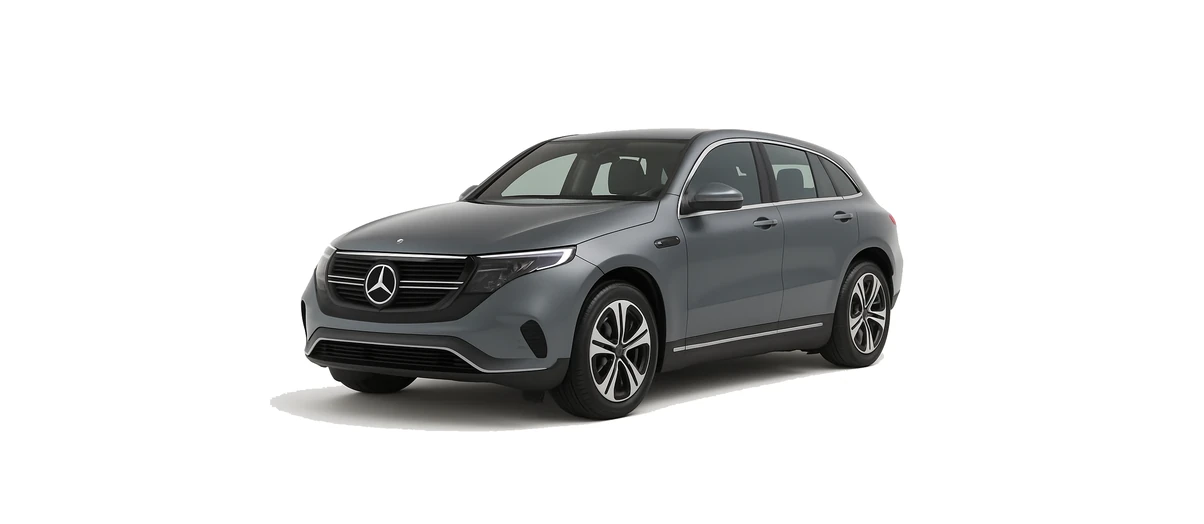
The Mercedes EQC is a battery-electric SUV that was sold in the UK as the EQC 400 4MATIC. It is now a discontinued model, with production ending in 2023, but it remains a popular used premium EV thanks to its comfortable cabin, dual-motor all-wheel drive and useful real-world range.
For used buyers and current owners, the most important charging point is that not every EQC has the same AC charging capability. Early UK cars are commonly listed with a 7.4 kW onboard AC charger, while later cars may support 11 kW AC on a three-phase supply. In practice, many UK homes are single-phase, so a typical home wallbox will still charge at up to around 7.4 kW even if the vehicle itself can accept 11 kW on three-phase.
This guide explains Mercedes EQC home charging, public charging, rapid charging and cable selection, with particular focus on how to approach the early 7.4 kW versus later 11 kW AC charging difference.
View Mercedes EQC Charging Cables
Mercedes EQC Battery and Charging Specifications
The UK-market Mercedes EQC was sold as the EQC 400 4MATIC. It is a full battery-electric vehicle, not a plug-in hybrid, and uses a Type 2 socket for AC charging and a CCS Combo 2 connection for DC rapid charging. The charging port is located on the right rear side of the vehicle.
Published figures vary slightly depending on model year, trim and source. As a useful guide, the EQC has an approximately 85 kWh gross battery capacity, with around 80 kWh usable capacity. WLTP range figures are generally quoted in the high-240s to high-250s miles, while real-world range is often estimated at around 225 miles depending on weather, driving style, speed, tyres and use of heating or air conditioning.
For charging, the EQC is best understood in two areas: AC charging for home and destination charging, and DC charging for motorway or long-distance rapid charging.
- Vehicle type: Battery-electric SUV
- UK model: Mercedes EQC 400 4MATIC
- Battery: Approximately 85 kWh gross / 80 kWh usable
- AC charging: 7.4 kW on many early cars; later cars may support 11 kW three-phase
- Typical UK home charging: Up to around 7.4 kW on a single-phase wallbox
- DC rapid charging: Around 110 kW maximum
- Rapid charging time: Typically around 40 minutes from 10-80%
- Charging connector: Type 2 AC / CCS Combo 2 DC
Battery Options
Unlike some electric cars that were sold with several battery sizes, the Mercedes EQC range in the UK is relatively simple. The EQC 400 4MATIC was the only UK powertrain and battery combination, using an 80 kWh usable battery and dual-motor all-wheel drive.
This makes cable selection easier than it can be on some other used EVs, because you are not choosing between multiple battery packs. However, the onboard AC charger specification is still important, especially if you are considering three-phase charging or buying a cable specifically for 11 kW use.
If you have a used EQC and need to confirm the exact specification, check the vehicle documentation, VIN-based specification, Mercedes service information or the vehicle charging display. This is particularly relevant for cars built or registered around the 2020/2021 model-year changeover, when published charging specifications can appear inconsistent between sources.
AC Charging Speed
AC charging is what the EQC uses when connected to a home wallbox, workplace charger, hotel charger or most public destination charging posts. The EQC uses a Type 2 connection for AC charging.
The key point is that there is not one universal AC charging figure for every UK EQC. Early cars, roughly from the 2019 to 2020 period, are commonly listed with a 7.4 kW onboard AC charger. Later cars, from around the 2020/2021 update onwards, may be listed with an 11 kW onboard charger, which requires a three-phase AC supply to achieve the higher rate.
For most UK households, this distinction may not change everyday charging very much. A normal UK home wallbox is usually installed on a single-phase supply and will typically deliver up to 7.4 kW. That means even a later 11 kW-capable EQC will usually charge at up to around 7.4 kW at home unless the property has a suitable three-phase supply and compatible charger.
As a rough guide, a 7.4 kW home charger can add a substantial overnight charge to the EQC. A full charge from very low to 100% may take around 11 hours, depending on the charger, battery temperature, state of charge and vehicle settings. In everyday use, most drivers will not be charging from empty; they will usually top up from a partial state of charge overnight.
If you own or are buying an early EQC, do not assume it can charge at 11 kW AC. Check the exact onboard charger specification before buying equipment specifically for three-phase charging.
DC Rapid Charging Speed
For long journeys, the Mercedes EQC uses CCS Combo 2 DC rapid charging. CCS rapid chargers have their own tethered cables, so you do not need to buy a separate CCS cable for public rapid charging.
The EQC’s DC charging capability is around 110 kW. Some data sources list a very similar maximum figure of around 112 kW, but in practical terms it is best thought of as an approximately 110 kW rapid-charging EV. Plugging into a 150 kW, 250 kW or 350 kW ultra-rapid charger will not make the EQC charge at those higher speeds, because the car sets the limit.
A typical 10-80% rapid charge takes around 40 minutes in suitable conditions. The exact time can vary depending on the charger, battery temperature, starting state of charge, ambient conditions and how busy the charging site is. Like most EVs, the EQC will reduce its charging rate as the battery fills, especially above 80%.
For that reason, long-distance charging is usually most efficient when planned around shorter stops in the 10-80% range rather than waiting for 100% on a DC rapid charger. Charging to 100% may be useful before setting off from home or when you genuinely need the range, but it is usually slower and less time-efficient on a public rapid charger.
Range and Efficiency
Published WLTP range figures for the Mercedes EQC vary by model year, trim and source. Figures around 248-259 miles appear in UK material and EV specification databases. A sensible working figure for many drivers is a real-world range of around 225 miles, although this should be treated as a guide rather than a guarantee.
As a large premium SUV with dual-motor all-wheel drive, the EQC is not as efficient as smaller, lighter electric cars. Motorway speeds, winter temperatures, roof boxes, heavy loads and short journeys with cabin heating can all reduce range. Gentler driving, pre-planned charging stops and making use of overnight home charging can make ownership much easier.
The EQC is listed by EV specification data as having a heat pump as standard, which can help with cabin heating efficiency in cooler weather. However, range will still be affected by low temperatures, wet roads and high-speed driving, as with any EV.
Charging at Home
For most UK Mercedes EQC owners, the best home charging setup is a dedicated 7.4 kW Type 2 wallbox. This suits the majority of UK single-phase homes and gives a practical overnight charging solution. You can choose either a tethered charger, with the cable permanently attached, or an untethered charger, where you use your own Type 2 charging cable.
A tethered home charger is convenient because the cable is always ready to plug in. An untethered charger gives a cleaner look when not in use and allows you to use different cable lengths if needed. If you regularly use public AC charging, you will usually still want a separate Type 2 cable in the car, even if your home charger is tethered.
Owners with access to three-phase power may be able to take advantage of 11 kW AC charging on later EQC models, provided the vehicle, charger and electrical supply all support it. This is more common at commercial premises, workplaces and some larger homes than in standard domestic installations. Early EQCs should be checked carefully, as many are limited to 7.4 kW AC.
A 3-pin domestic charging lead is generally best suited as a backup or occasional charging solution, but can be used regularly if a qualified electrician has confirmed the socket and electrical installation are suitable for sustained EV charging. For a vehicle with a large battery like the EQC, a 3-pin plug will be much slower than a dedicated wallbox and is not the most convenient primary charging method for most owners.
Public Charging
When using public AC chargers, the EQC needs a Type 2 cable unless the charging point is tethered. Many public AC posts in the UK are untethered, so carrying a Type 2 cable is highly recommended. If your EQC is an early 7.4 kW car, a compatible Type 2 cable will support normal single-phase charging. If your car is a later 11 kW version and you expect to use three-phase AC posts, make sure your cable is suitable for three-phase 11 kW charging.
For public rapid charging, use CCS chargers. These are typically found at motorway services, rapid charging hubs, retail parks and larger public charging locations. The cable is attached to the charger, so your own Type 2 cable is not used for DC rapid charging.
It is worth checking charging networks before setting off, especially on longer trips. Look for charger availability, connector type, speed, payment method and recent reliability reports. The EQC can use higher-rated rapid chargers, but it will only draw up to its own supported limit of around 110 kW before tapering as the battery fills.
Vehicle-Specific Features
The Mercedes EQC was based on a GLC-derived architecture rather than a dedicated EV-only platform. That does not prevent it from being a capable electric SUV, but it helps explain why some packaging and charging details differ from newer bespoke EVs.
The charging port is on the right rear side, which is useful to remember when positioning the car at home or at public chargers. Cable length can matter, particularly on driveways where the charger is mounted away from the rear of the vehicle, or at public bays where the post position varies.
The EQC does not support vehicle-to-load, vehicle-to-grid or vehicle-to-home functionality according to the research data used for this guide. Battery preconditioning for rapid charging is also not listed as available, so rapid charging performance may be more affected by battery temperature than in some newer EVs with more advanced route-based preconditioning systems.
Charging Tips
- Check your onboard charger: Early EQCs are often 7.4 kW AC, while later cars may support 11 kW on three-phase. Confirm the exact car before buying equipment for 11 kW use.
- Choose the right Type 2 cable: A Type 2 cable is useful for public AC charging and untethered home chargers. Consider cable rating and length based on your parking setup.
- Do not overpay for unnecessary rapid-charging claims: The EQC uses CCS rapid charging at around 110 kW, regardless of whether the charger itself is rated much higher.
- Plan long journeys around 10-80%: This is usually faster than charging close to 100% on a DC rapid charger.
- Use scheduled charging if available: Charging overnight on an EV tariff can reduce running costs.
- Allow for winter range reduction: Cold weather, wet roads and motorway driving can noticeably reduce range.
Frequently Asked Questions
Is the Mercedes EQC a plug-in hybrid?
The Mercedes EQC is a full battery-electric vehicle. The UK model was the EQC 400 4MATIC, using a large high-voltage battery and electric motors only.
What charging cable does the Mercedes EQC use?
For AC charging, the EQC uses a Type 2 cable. For DC rapid charging, it uses CCS Combo 2, but CCS rapid chargers have tethered cables, so you do not need to buy a separate CCS cable.
Does every Mercedes EQC charge at 11 kW AC?
No. Early UK EQC models are commonly listed at 7.4 kW AC. Later models may support 11 kW AC on a three-phase supply, but many UK home chargers are single-phase and will typically be limited to around 7.4 kW.
How fast can the Mercedes EQC rapid charge?
The EQC can rapid charge at around 110 kW in suitable conditions. A 10-80% charge typically takes about 40 minutes, although this varies with charger performance, battery temperature and state of charge.
Where is the charging port on the Mercedes EQC?
The charging port is on the right rear side of the vehicle.
Can the Mercedes EQC use a 350 kW charger?
It can plug into a compatible CCS ultra-rapid charger, but it will not charge at 350 kW. The vehicle’s own DC charging limit is around 110 kW, and the rate will taper as the battery fills.
What This Means for Drivers
The Mercedes EQC is straightforward to live with if you understand its charging limits. For most UK owners, a 7.4 kW home wallbox and a good-quality Type 2 public charging cable will be the most practical combination. Later 11 kW-capable cars can benefit from three-phase AC charging where available, but that does not change the reality that most domestic UK charging is still single-phase.
The main used-car caution is to verify the exact onboard AC charger before assuming 11 kW capability. Once that is confirmed, cable choice is simple: Type 2 for AC charging, CCS for rapid charging using the charger’s attached cable, and sensible route planning for longer journeys.
Looking for a Charging Cable for Mercedes EQC?
If you need a Type 2 cable for home, workplace or public AC charging, We offer Mercedes EQC charging cables suitable for everyday UK use. Choose the cable rating and length that match your vehicle specification, charger type and parking layout.
View Mercedes EQC Charging Cables
Please note that this information is intended as a guide. Charging specifications may change due to model and year of manufacture. For precise information, always refer to your vehicle user manual.

