
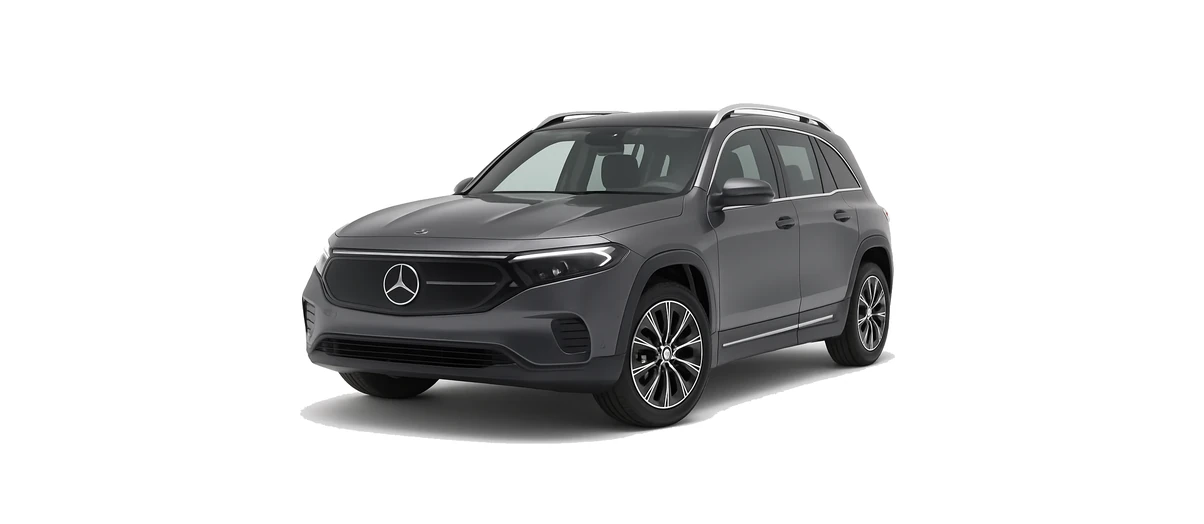
The Mercedes EQB is a battery-electric compact SUV with a practical, family-focused layout and, on many UK specifications, the option of seven seats. It sits in an unusual part of the used EV market: it is more spacious and versatile than many compact electric crossovers, but its charging setup remains straightforward. Every UK/EU EQB uses a Type 2 connection for AC charging and CCS Combo 2 for DC rapid charging.
Where EQB ownership does need a little care is variant identification. The later EQB 250+ prioritises range with a larger usable battery, while EQB 300 4MATIC and EQB 350 4MATIC versions use a smaller usable pack but add all-wheel drive. The charging cable choice is broadly the same across the range, but range expectations and charging times can vary by version, model year, trim, wheels and conditions.
View Mercedes EQB Charging Cables
Mercedes EQB Battery and Charging Specifications
The Mercedes EQB is a BEV only; it is not a plug-in hybrid and does not have a petrol or diesel range-extender. UK-market cars use a rear-right, off-side rear charging flap with a Type 2 upper AC inlet and CCS lower DC pins for rapid charging.
| Specification | Mercedes EQB charging detail |
|---|---|
| Vehicle type | Battery-electric compact SUV / crossover |
| AC connection | Type 2 |
| DC rapid connection | CCS Combo 2 |
| Charging port location | Rear right / off-side rear charging flap |
| Maximum AC charging | 11 kW, where three-phase AC is available |
| Typical UK home wallbox speed | Up to 7.4 kW on a normal single-phase supply |
| Maximum DC rapid charging | Up to around 100 kW, depending on conditions |
| Typical DC 10-80% time | Approximately 32-35 minutes, depending on model and source |
The EQB’s AC charging limit is important when choosing cables. It can use a 32 amp Type 2 cable on UK public AC posts and home wallboxes, but it will not charge at 22 kW AC. If connected to a 22 kW public AC post, the car will limit the session to its own onboard charger capability.
Battery Options
There is no single battery figure that applies to every Mercedes EQB. UK specifications changed by model year and variant, and used examples may differ from late facelift cars.
- EQB 250+ facelift / late UK model: commonly listed with a 73.9 kWh gross battery and 70.5 kWh usable capacity. Mercedes-Benz UK data has shown 70.5 kWh usable energy content and a WLTP figure of up to 322 miles for an EQB 250+ Sport Executive, although WLTP varies with trim and equipment.
- EQB 300 4MATIC facelift / late UK model: typically listed with a 69.7 kWh gross battery and 66.5 kWh usable capacity. UK data and reviews indicate WLTP figures in the region of the high 240s to mid-250s miles, depending on version.
- EQB 350 4MATIC used / earlier UK examples: also commonly listed with a 69.7 kWh gross battery and 66.5 kWh usable capacity, with similar AC and CCS charging hardware to the other EQB versions.
Because the EQB is now mainly relevant as a used or nearly-new family EV, check the exact variant, model year and vehicle build data before relying on a quoted battery size or range figure. Some live manufacturer pages and used listings may not reflect the same ordering status or specification details.
AC Charging Speed
The Mercedes EQB has an 11 kW AC onboard charger. In practical UK ownership, this means two different experiences depending on your electricity supply.
Most UK homes have single-phase power. On a typical 7.4 kW home wallbox, the EQB 250+ is estimated to take roughly 11 hours 15 minutes from 0-100%, while EQB 300/350 versions with the 66.5 kWh usable battery are closer to around 10 hours 45 minutes. In everyday use, you will rarely charge from completely empty to completely full, so overnight charging is usually more than adequate.
On a three-phase AC supply, the EQB can use up to 11 kW. Under those conditions, an EQB 250+ is estimated at around 7 hours 45 minutes for 0-100%, while EQB 300/350 versions are around 7 hours 15 minutes. Three-phase home charging is less common in the UK, but it may be available at some workplaces, commercial premises and certain public AC destinations.
DC Rapid Charging Speed
For motorway and long-distance driving, the EQB uses CCS rapid charging at up to around 100 kW. The commonly quoted 10-80% time is approximately 32-35 minutes, depending on the source, model version and conditions.
As with all EVs, the maximum rapid charging rate is not held for the whole session. Charging power depends on state of charge, battery temperature, charger capability, weather and the car’s charging curve. In practice, the most efficient rapid-charging strategy is usually to arrive with a lower state of charge and leave at around 80%, rather than charging to 100% at every stop. Above 80%, DC charging normally slows significantly.
The EQB is based on a 400 V architecture and its 100 kW headline rate is modest compared with some newer-generation EVs. That does not make it difficult to use on long trips, but it does reward sensible planning, especially if the car is fully loaded with passengers and luggage.
Range and Efficiency
The EQB 250+ is the range-focused version in the late UK line-up. Mercedes-Benz UK data has shown up to 322 miles WLTP for the EQB 250+ Sport Executive, while independent data gives different WLTP high/low values depending on equipment and an estimated real-world range of around 255 miles.
EQB 300 4MATIC and EQB 350 4MATIC versions are generally shorter-range models because they use the 66.5 kWh usable battery and all-wheel-drive powertrain. EV Database estimates around 210 miles of real-world range for these versions, while WLTP values vary by model year and trim.
Real-world range will vary with speed, temperature, wheel size, tyre condition, load, use of heating or air conditioning, and driving style. A seven-seat EQB carrying a family, luggage and roof accessories on a cold motorway run will not match its best WLTP figure. Around town and on mixed routes, efficiency is typically more favourable.
Charging at Home
For most UK EQB drivers, a dedicated 7.4 kW home wallbox is the most convenient charging method. Plug in overnight and the car can be ready each morning with the charge limit you have selected. A Type 2 wallbox setup is the correct match for the EQB’s AC inlet.
A 32 A Type 2 cable is a sensible choice for untethered home wallboxes and public AC posts. It gives the car access to its full single-phase home charging potential and will also work on many public AC chargers. If you use a tethered home charger, the cable is permanently attached, but a separate Type 2 cable is still useful for public destination charging.
A 3-pin charger is generally best suited as a backup or occasional charging solution, but can be used regularly if a qualified electrician has confirmed the socket and electrical installation are suitable for sustained EV charging. Domestic sockets were not primarily designed for repeated high-load EV charging, so inspection and appropriate protection matter.
Many owners set the car to charge during cheaper overnight electricity periods where an EV tariff is available. If you do not need maximum range every day, using a sensible charge limit can reduce time spent at high state of charge and help make daily charging more efficient.
Public Charging
On public AC chargers, the Mercedes EQB uses a Type 2 cable. Many UK destination chargers are 7 kW, 11 kW or 22 kW AC. The car can make use of up to 11 kW where three-phase charging is available, but it will not exceed that AC limit even if the post is rated higher.
For rapid and ultra-rapid chargers, the cable is normally tethered to the charger and you use the EQB’s CCS inlet. A high-powered charger rated well above 100 kW can still be used, but the car will only draw what it can accept at that moment. This is normal and does not mean the charger or vehicle is faulty.
Some late facelift EQB variants may support Plug & Charge when correctly configured with compatible services such as Mercedes me or MB.CHARGE, but this should be checked against the specific vehicle build year, account setup and charging network. Older cars and some setups may require app, RFID card or contactless payment activation instead.
Vehicle-Specific Features
The EQB is built on Mercedes-Benz’s MFA2-based platform rather than a dedicated EV-only architecture. It is a 400 V vehicle, and its packaging allows a compact SUV body with useful family practicality. Many UK specifications were available with a third row, making the EQB one of the more distinctive electric seven-seat options in its class.
Research data indicates that a heat pump is fitted and that battery preconditioning is supported. Where available, using the car’s navigation and electric route planning can help prepare the battery before a DC rapid charging stop. This can improve charging consistency, particularly in cold weather, although the actual charging rate will still depend on the charger and battery conditions.
Vehicle-to-load, vehicle-to-home and vehicle-to-grid functions are not listed as supported for the EQB. If those features are important to you, the EQB should not be chosen on the assumption that they can be added through a cable alone.
Charging Tips
- Choose the right cable: a 32 A Type 2 cable is appropriate for UK home wallboxes and public AC charging.
- Do not expect 22 kW AC: the EQB’s onboard AC charger is 11 kW, so higher-rated AC posts will not make it charge faster than the car allows.
- Use rapid charging between 10% and 80%: this is usually quicker than charging close to 100% on a DC charger.
- Precondition where possible: use the car’s navigation-based charging route planning when heading to a rapid charger.
- Check the variant: EQB 250+, EQB 300 4MATIC and EQB 350 4MATIC models have different range expectations.
- Plan for winter: cold weather and motorway speeds can reduce range, so leave extra margin on family trips.
Frequently Asked Questions
What charging cable does the Mercedes EQB use?
The Mercedes EQB uses a Type 2 cable for AC charging. For DC rapid charging, it uses the CCS Combo 2 connection, and the rapid charger normally has its own tethered cable.
Can the Mercedes EQB charge at 22 kW AC?
No. The EQB has an 11 kW AC onboard charger. It can connect to a 22 kW AC post, but the car will limit charging to its own maximum AC capability.
How fast will the EQB charge at home?
On a typical UK single-phase 7.4 kW wallbox, a full 0-100% charge is roughly 10 hours 45 minutes to 11 hours 15 minutes depending on battery version. Normal top-ups are usually much shorter.
How long does rapid charging take?
A 10-80% DC rapid charge is typically around 32-35 minutes in suitable conditions. Charging to 100% on a rapid charger will take longer because the rate slows at higher states of charge.
Is the Mercedes EQB a hybrid?
No. The Mercedes EQB is a battery-electric vehicle only. It does not use a petrol or diesel engine.
Does the EQB support V2L or V2G?
Reliable specification data checked for the EQB does not list V2L, V2H or V2G support.
What This Means for Drivers
The Mercedes EQB is a practical electric family SUV with simple charging requirements. For most UK owners, the right setup is a Type 2 home wallbox and a 32 A Type 2 cable for untethered wallboxes and public AC charging. The car’s 11 kW AC capability is useful where three-phase power is available, but most home charging will be at up to 7.4 kW.
The main buying and ownership point is to identify the exact version. An EQB 250+ has the longest range potential, while EQB 300 and EQB 350 4MATIC models offer all-wheel drive with a shorter range profile. On longer trips, CCS rapid charging at around 100 kW is usable and predictable if you plan around 10-80% stops and make use of battery preconditioning where available.
Looking for a Charging Cable for Mercedes EQB?
We offer Mercedes EQB charging cables suitable for Type 2 home and public AC charging, including options for drivers using untethered wallboxes or destination chargers.
View Mercedes EQB Charging Cables
Please note that this information is intended as a guide. Charging specifications may change due to model and year of manufacture. For precise information, always refer to your vehicle user manual.

