
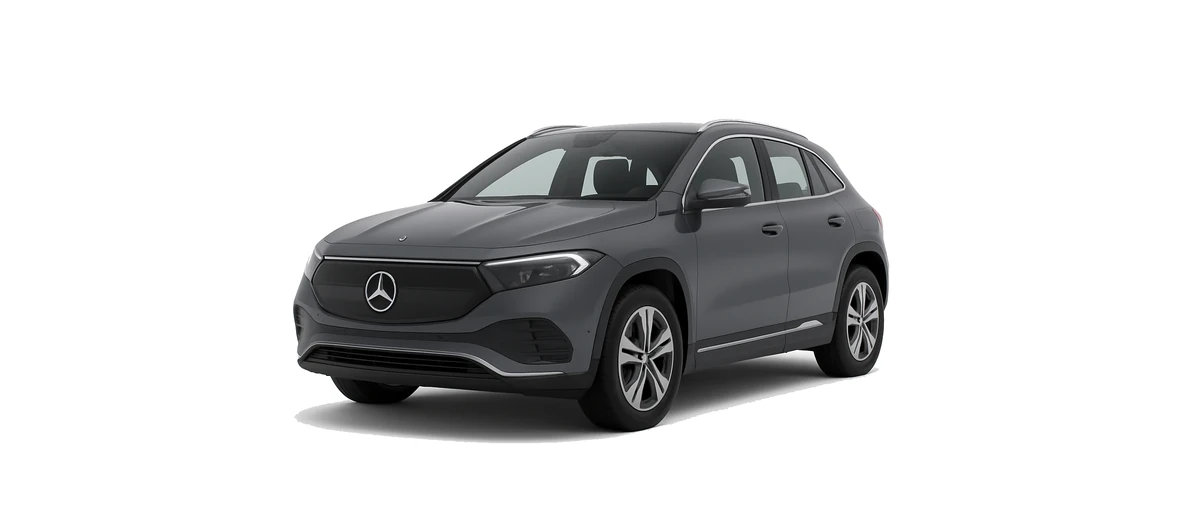
The Mercedes EQA is a compact electric SUV/crossover and, in the UK context covered here, it is a battery-electric vehicle rather than a plug-in hybrid. For drivers choosing a charging cable, the good news is that the cable advice is straightforward: UK and European Mercedes EQA models use a Type 2 connection for AC charging and CCS Combo 2 for DC rapid charging.
Where the EQA needs a little more care is in the detail behind battery size, range and charging times. Current UK Mercedes-Benz materials focus heavily on the EQA 250+, while the Mercedes-Benz UK MY805 brochure also lists EQA 300 4MATIC and EQA 350 4MATIC versions. Older used EQA 250 cars are also on UK roads and can have different battery and range data. This guide explains the differences without treating every EQA as if it has the same specification.
View Mercedes EQA Charging Cables
Mercedes EQA Battery and Charging Specifications
The key charging specification for most owners is the EQA’s onboard AC charging limit. Mercedes-Benz UK information and independent EV specification sources list 11 kW AC charging for current UK-market EQA models. This is achieved using Type 2 AC charging, typically on a three-phase supply.
For rapid charging, current UK Mercedes-Benz data supports a maximum DC charging rate of 100 kW. DC rapid charging uses the CCS Combo 2 connector, which is the common rapid charging standard across the UK and Europe. According to EV Database and Zapmap, the EQA’s charging port is located on the right-side rear flank.
In practical terms, this means the EQA can be charged from a home wallbox, many workplace chargers, untethered public AC posts and motorway-style DC rapid chargers. The cable you carry is mainly for AC charging; DC rapid chargers almost always have their own tethered cable attached to the charger.
Battery Options
Mercedes EQA battery information varies by version and model year, so it is worth checking your exact car if you are comparing range or charging times.
The current/facelift EQA 250+ is the longest-range context in the data reviewed. EV Database lists this version with a 73.9 kWh nominal battery and 70.5 kWh usable capacity. Mercedes-Benz UK materials describe the usable battery capacity as around 70 kWh or 70.5 kWh. In the Mercedes-Benz UK MY805 brochure, WLTP range for the EQA 250+ varies by trim and equipment, with figures up to 346 miles; the live Mercedes-Benz UK page has shown 345 miles for an EQA 250+ Sport Executive.
The EQA 300 4MATIC and EQA 350 4MATIC listed in the UK MY805 brochure use a different battery capacity. Mercedes-Benz UK lists 66.5 kWh battery capacity for these all-wheel-drive variants, and EV Database lists the EQA 350 4MATIC as 69.7 kWh total and 66.5 kWh usable. The brochure quotes WLTP ranges of around 258 to 266 miles depending on trim and equipment.
Earlier used UK EQA 250 models, particularly 2021-2022 cars, are also relevant for owners looking for charging cables. These should not be confused with the newer EQA 250+ specification. EV Database lists earlier EQA 250 cars with 66.5 kWh usable capacity and a lower estimated real-world range than the newer 250+ version.
AC Charging Speed
The Mercedes EQA’s maximum AC charging rate is 11 kW. However, this does not mean every EQA owner will see 11 kW at home. Most UK homes have a single-phase electrical supply, and the usual practical maximum for a dedicated home wallbox on a single-phase supply is around 7.4 kW.
On a typical 7.4 kW home wallbox, an EQA 250+ will usually take overnight to charge from low to full. EV Database estimates around 11 hours 15 minutes for a 0-100% charge at 7.4 kW for the EQA 250+. In day-to-day use, most drivers will not be charging from 0% to 100%; topping up from, for example, 30% to 80% will be considerably quicker.
On an 11 kW three-phase AC charger, Mercedes-Benz UK’s MY805 brochure quotes 10-100% AC charging times of around 7 hours 15 minutes for the EQA 250+ and around 6 hours 45 minutes for EQA 300/350 4MATIC models. Three-phase home charging is less common in the UK, but it may be available at some homes, workplaces and public AC sites.
For cable selection, a 32 amp Type 2 cable is appropriate for public AC charging. A three-phase 22 kW-rated Type 2 cable will not make the EQA charge above its 11 kW onboard AC limit, but it is compatible and can be a sensible future-proof option if you may use other EVs later.
DC Rapid Charging Speed
For longer journeys, the Mercedes EQA uses CCS DC rapid charging. Mercedes-Benz UK lists a 100 kW maximum DC charging rate for current/spec-brochure EQA models. The UK MY805 brochure quotes 10-80% DC charging in around 35 minutes for the EQA 250+ and around 32 minutes for EQA 300/350 4MATIC versions.
As with all EVs, the peak DC rate is not maintained throughout the whole charging session. Charging is usually fastest at lower to mid battery percentages and slows as the battery fills, particularly above 80%. For this reason, rapid charging to 100% on a journey is often slower than making shorter 10-80% stops where practical.
You do not need to bring your own cable for CCS rapid charging. Public DC rapid chargers have a fixed cable and connector attached to the unit. Your own Type 2 cable is used for AC charging posts, not for CCS rapid charging.
Range and Efficiency
The Mercedes EQA’s range depends on the version, trim, wheel size, temperature, driving style, speed, load and use of heating or air conditioning. WLTP figures are useful for comparing vehicles, but they should not be treated as guaranteed real-world range.
For the current EQA 250+, Mercedes-Benz UK material gives WLTP figures up to the mid-340-mile area depending on trim and equipment. EV Database estimates a real-world range of around 260 miles for the EQA 250+, which is a more cautious everyday guide than the best-case WLTP figure. The EQA 300 4MATIC and EQA 350 4MATIC versions listed in the UK brochure have lower quoted WLTP ranges, around 258-266 miles, reflecting their different battery and drivetrain configuration.
Cold weather can reduce EV range, especially if the cabin and battery are cold at the start of a trip. EV Database lists the EQA 250+ as having a heat pump as standard, which can help cabin heating efficiency compared with relying only on resistive heating. Even so, winter range will usually be lower than mild-weather range.
Charging at Home
For most Mercedes EQA owners, home charging is the cheapest and most convenient way to run the car. A dedicated 7.4 kW Type 2 wallbox is usually the practical home option on a standard UK single-phase supply. This allows the car to be plugged in overnight and ready for the next day without relying heavily on public charging.
If your wallbox is untethered, you will need a Type 2-to-Type 2 charging cable. If your wallbox is tethered, the cable is permanently attached to the charger, but many EQA owners still carry a Type 2 cable for public AC charging.
A 3-pin domestic charger is generally best suited as a backup or occasional charging solution, but can be used regularly if a qualified electrician has confirmed the socket and electrical installation are suitable for sustained EV charging. Standard domestic sockets were not primarily designed for repeated high-load EV charging over many hours, so professional checking is important.
Owners who can access off-peak electricity tariffs may find it useful to schedule charging overnight. The EQA’s battery is large enough that small, regular top-ups are often easier than waiting until the battery is nearly empty.
Public Charging
For public AC charging, the Mercedes EQA uses Type 2. Many UK destination chargers, workplace chargers and town-centre posts are untethered, meaning you need to use your own Type 2 cable. These chargers may be rated at 7 kW, 11 kW or 22 kW, but the EQA will only draw what the car, charger and cable can all support.
If you plug into a 22 kW AC post, the EQA will not charge at 22 kW because its onboard AC charger is limited to 11 kW. On a three-phase 22 kW post with a suitable three-phase cable, the car can use up to its 11 kW AC limit where the charger and site allow.
For motorway and long-distance charging, use CCS rapid or ultra-rapid chargers. Although many modern chargers are capable of much more than 100 kW, the EQA’s official maximum in the UK data reviewed is 100 kW DC, so higher-rated chargers will not make the car charge at 150 kW, 200 kW or 350 kW.
Vehicle-Specific Features
The EQA includes several features designed to make EV ownership easier. Mercedes-Benz lists Navigation with Electric Intelligence, which can plan charging stops using factors such as state of charge, route, topography, weather and charging infrastructure. Mercedes me Charge and EQ navigation services are also listed in the UK MY805 brochure, subject to activation, availability and service terms.
Pre-entry climate control is listed as standard. Where possible, use this while the car is plugged in so the cabin can be warmed or cooled using power from the charger rather than drawing solely from the battery at the start of your journey.
EV Database lists Plug & Charge / ISO 15118-2 support for the EQA 250+, although availability in practice may depend on charger network compatibility, account setup and vehicle/software configuration. The same source lists V2L and V2H as not supported for the EQA 250+; no reliable UK source reviewed confirmed bidirectional charging capability for the EQA.
Charging Tips
- Choose the right cable: a Type 2-to-Type 2 cable is the correct AC cable type for UK/EU Mercedes EQA models.
- Remember the onboard limit: the EQA can accept up to 11 kW AC, so a 22 kW AC post will still be limited by the car.
- Use 7.4 kW as the home benchmark: most UK single-phase home wallboxes charge at around 7.4 kW, even though the car can take 11 kW on three-phase.
- Rapid charge to 80% on journeys: for long trips, 10-80% charging stops are usually more time-efficient than waiting for 100%.
- Pre-condition the cabin when plugged in: using pre-entry climate control from the charger can help preserve driving range.
- Check your exact version: EQA 250+, EQA 300/350 4MATIC and earlier EQA 250 cars have different range and battery data.
Frequently Asked Questions
What charging cable does the Mercedes EQA use?
The Mercedes EQA uses a Type 2 cable for AC charging. For DC rapid charging, it uses the CCS Combo 2 connector, and the cable is normally attached to the rapid charger.
Can the Mercedes EQA charge at 22 kW AC?
No. The EQA’s onboard AC charging limit is 11 kW. It can plug into a 22 kW AC post with a suitable Type 2 cable, but the car will not charge above its onboard AC limit.
How fast does the Mercedes EQA charge at home?
On a typical UK 7.4 kW single-phase wallbox, the EQA is well suited to overnight charging. Exact time depends on battery size, starting percentage and target percentage. Mercedes-Benz quotes faster AC times on 11 kW three-phase charging where available.
How fast is Mercedes EQA rapid charging?
Mercedes-Benz UK data supports a 100 kW maximum DC rapid charging rate. The UK brochure quotes 10-80% in around 35 minutes for the EQA 250+ and around 32 minutes for EQA 300/350 4MATIC models.
Is the Mercedes EQA a plug-in hybrid?
No. The EQA covered in this UK/EU charging guide is a battery-electric vehicle. It charges from the mains and drives on electric power only.
What This Means for Drivers
The Mercedes EQA is relatively simple from a charging-cable point of view. Whether you drive a current EQA 250+, an EQA 300/350 4MATIC or an earlier used EQA 250, the key UK/EU charging standard is Type 2 for AC charging and CCS for rapid charging.
The main thing to avoid is assuming every EQA has the same battery or range. The EQA 250+ has different figures from the 4MATIC versions and earlier EQA 250 cars. For charging, however, the important practical limits are consistent: plan around 7.4 kW for most UK home wallboxes, up to 11 kW on suitable three-phase AC charging, and up to 100 kW on CCS DC rapid charging.
Looking for a Charging Cable for Mercedes EQA?
If you need a compatible Type 2 cable for home, workplace or public AC charging, the we have a range of Mercedes EQA charging cables suitable for UK/EU Type 2 charging.
View Mercedes EQA Charging Cables
Please note that this information is intended as a guide. Charging specifications may change due to model and year of manufacture. For precise information, always refer to your vehicle user manual.

