
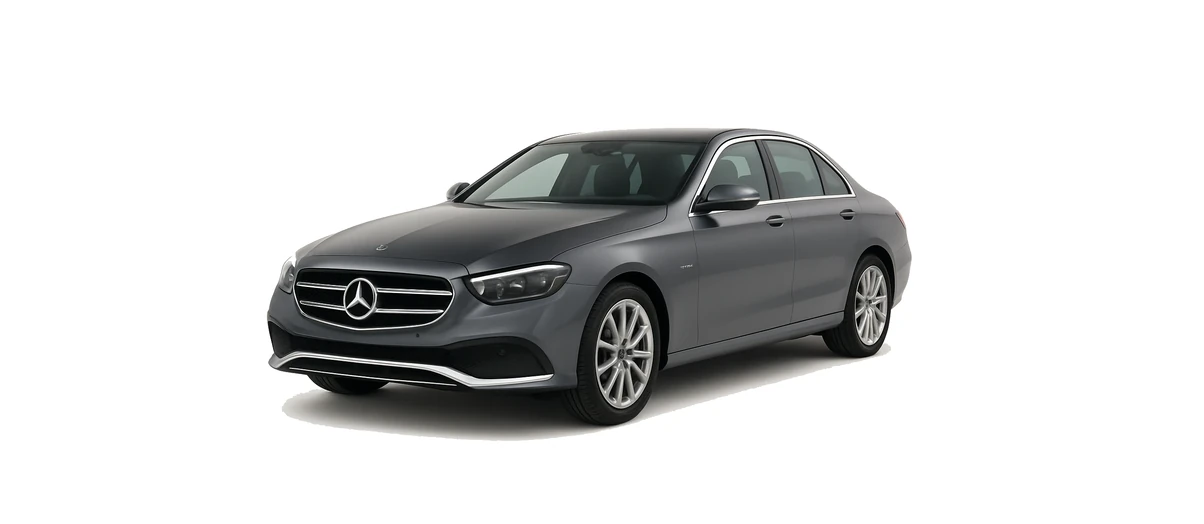
The Mercedes E 350e is a plug-in hybrid version of the E-Class, not a fully electric vehicle. For UK buyers and used-car owners, the key point is that the E 350e badge usually refers to the earlier W213 E-Class plug-in hybrid, launched around 2016/2017 and now discontinued. It combines a petrol engine with an externally chargeable high-voltage battery, giving short-distance electric driving with the flexibility of petrol for longer journeys.
This guide focuses on the original UK-market Mercedes E 350e. That matters because newer Mercedes-Benz E-Class plug-in hybrids currently sold in the UK are listed as E 300 e and E 300 de, not E 350e. Those newer cars have much larger batteries and different charging capabilities, so their figures should not be assumed to apply to the E 350e. If you are buying a charging cable for a used E 350e, checking the charge-port shape and the handbook is the safest first step.
View Mercedes E 350e Charging Cables
Mercedes E 350e Battery and Charging Specifications
The original Mercedes E 350e is best understood as a small-battery plug-in hybrid. Mercedes-Benz environmental material for the E 350 e lists a high-voltage battery energy content of 6.4 kWh and describes an electric range of up to 33 km under the older certification approach used at the time. That is not a modern WLTP range figure, so it should be treated as historical context rather than a direct comparison with today’s plug-in hybrids.
For charging, commonly referenced data for the W213 E 350e lists a Type 2 AC charging connection and an on-board AC charger of around 3.7 kW. In practical terms, this means the car can use a home wallbox or untethered public AC charge point, but it will only draw power up to the car’s own limit. A 7 kW home charger is still suitable, but the E 350e will not charge at the full 7 kW rate.
Battery Options
For the original W213 Mercedes E 350e, the battery figure to use with most confidence is the Mercedes-Benz stated battery energy content of 6.4 kWh. Some third-party charging references quote slightly different gross or usable figures, such as around 6.2 kWh gross and approximately 5.6 kWh usable, but these should not be treated as official Mercedes-Benz usable-capacity data.
There is an important generational distinction. Current UK Mercedes-Benz E-Class plug-in hybrid models are E 300 e and E 300 de, with Mercedes-Benz UK listing a much larger usable battery energy content and faster charging for those newer vehicles. However, these are not the original UK E 350e. Unless your car is a later import or a differently badged market variant, do not use current E 300 e or E 300 de battery and charging figures when choosing a cable for a W213 E 350e.
AC Charging Speed
The original Mercedes E 350e is generally listed with a 3.7 kW AC charging limit. This is set by the car’s on-board charger, not by the cable alone. If you connect the car to a 7 kW home wallbox or a higher-rated AC public charge point, the vehicle will still charge at around its own maximum AC rate.
Because the battery is small by modern plug-in hybrid standards, a full charge can be relatively quick compared with larger PHEVs and full EVs. Third-party references commonly suggest roughly two hours from empty to full when using a suitable AC charging point rated at 3.7 kW or above. Real charging time can vary depending on starting state of charge, temperature, charger behaviour and the condition of the vehicle.
For cable selection, a Type 2 charging cable is the normal choice for UK home wallboxes and untethered public AC charge points. A single-phase cable is generally appropriate for a car with a 3.7 kW AC limit, although some owners choose a higher-rated Type 2 cable for future compatibility with other vehicles.
DC Rapid Charging Speed
The original W213 Mercedes E 350e should not be planned around DC rapid charging. Sources reviewed for the E 350e list Type 2 AC charging and no confirmed DC rapid-charge capability for the original model. In other words, the car is intended to be charged from AC points rather than motorway-style rapid chargers.
This is another area where confusion with newer E-Class plug-in hybrids can arise. Current E-Class PHEV models in the UK may have DC charging capability depending on model and specification, but those vehicles are sold as E 300 e and E 300 de rather than the original E 350e. If your vehicle has a larger combined AC/DC inlet, or if it is an import, check the handbook and vehicle build information before relying on any charging-speed assumption.
Range and Efficiency
Mercedes-Benz material for the original E 350 e quotes up to 33 km of electric range under the older certification method used at the time. Converted to miles, that is around 20 miles, but it is not a WLTP figure and should not be treated as a guaranteed real-world result. Day-to-day electric range will depend on journey type, outside temperature, driving style, cabin heating or air conditioning use, tyre condition and how much of the trip can be completed at moderate speeds.
As a plug-in hybrid, the E 350e works best when it is charged regularly for local journeys. Short commutes, school runs, town driving and low-speed suburban trips are where the battery can make the biggest difference to fuel use. On longer motorway journeys, the petrol engine will do more of the work, so charging strategy is more about starting with a full battery than stopping mid-journey to recharge.
Charging at Home
Home charging is usually the most convenient way to run a Mercedes E 350e efficiently. Even though the car is limited to around 3.7 kW AC, a dedicated home wallbox can still be worthwhile because it provides a robust, convenient and purpose-designed charging setup. You can plug in after each journey and start the next day with a full battery, which is exactly how small-battery plug-in hybrids are intended to be used.
A 7 kW home charger will not make the original E 350e charge at 7 kW, but it remains a sensible installation for many households. It can serve the E 350e comfortably and may also be useful if you later move to a newer plug-in hybrid or a fully electric car. If the wallbox is untethered, you will need a compatible Type 2 cable to connect the car.
A 3-pin portable charger is generally best suited as a backup or occasional charging solution, but can be used regularly if a qualified electrician has confirmed the socket and electrical installation are suitable for sustained EV charging. Avoid using damaged sockets, extension leads or unknown outdoor sockets, and do not assume that any domestic socket is suitable for repeated long charging sessions.
Public Charging
For public charging, the original Mercedes E 350e is mainly suited to AC charge points with a Type 2 connection. Many UK destination chargers at supermarkets, hotels, car parks, workplaces and town centres use Type 2 AC sockets. If the unit is untethered, you will need your own Type 2 cable.
Because the battery is small and the AC charging speed is modest, public charging makes most sense when the car will be parked for a while anyway. For example, topping up during a meal, a shopping trip or a work meeting can be worthwhile. It is less useful to make special charging stops on long journeys, because the petrol engine already provides long-distance flexibility and the E 350e is not generally listed with DC rapid charging.
Before plugging in, check the charge point tariff. Some public AC chargers charge by time as well as energy, and a car with a lower AC charging limit may not be the most cost-effective vehicle to leave connected for longer than necessary after charging has finished.
Vehicle-Specific Features
The most important vehicle-specific feature of the Mercedes E 350e is its plug-in hybrid layout. It is designed to offer electric running for shorter trips while retaining the petrol engine for flexibility. That means the charging routine is different from a full EV: you are not relying on charging for every mile, but regular charging is still essential if you want the best efficiency from the car.
The other key feature is the generational split within the E-Class plug-in hybrid family. The E 350e name is associated with the earlier W213 model in the UK, while newer E-Class PHEVs on Mercedes-Benz UK’s current product pages use E 300 e and E 300 de names. Those newer cars should be treated separately for cable and charging advice.
As a quick owner checklist, look at three things before buying a cable: the exact badge and model year, the shape of the charging inlet behind the flap, and the vehicle handbook. If your car has the original Type 2 AC-only arrangement, a Type 2 cable for AC charging is the relevant choice. If your vehicle appears to have a different inlet or is a later import, verify the specification before purchasing.
Charging Tips
- Charge little and often: The E 350e’s small battery is well suited to regular top-ups at home.
- Use a Type 2 cable: This is the relevant cable type for home wallboxes and untethered UK public AC charge points on the original E 350e.
- Do not expect 7 kW charging: A 7 kW wallbox is suitable, but the car will usually charge at around its 3.7 kW on-board limit.
- Avoid planning around rapid chargers: The original E 350e is not generally listed with DC rapid charging capability.
- Check used-car details: Imports, later vehicles or misdescribed listings may not match the usual UK W213 E 350e assumptions.
- Unplug when finished on paid public chargers: This helps avoid idle fees and keeps the bay available for other drivers.
Frequently Asked Questions
Is the Mercedes E 350e a fully electric car?
No. The Mercedes E 350e is a plug-in hybrid. It has a petrol engine and an externally chargeable high-voltage battery, so it can drive short distances on electric power but is not a battery-electric vehicle.
What charging cable does the Mercedes E 350e use?
For the original W213 E 350e, the relevant connection is commonly listed as Type 2 AC. A Type 2 charging cable is used for untethered home wallboxes and many UK public AC charge points.
How fast can the Mercedes E 350e charge?
The original E 350e is commonly listed with a 3.7 kW AC on-board charger. Even if you connect it to a 7 kW wallbox, the car will usually charge only up to its own AC limit.
Can the Mercedes E 350e use rapid chargers?
The original W213 E 350e is not generally listed with DC rapid charging capability. It should be treated as an AC-charging plug-in hybrid unless your handbook or vehicle specification clearly says otherwise.
Are current E-Class PHEV charging figures the same as E 350e figures?
No. Current UK Mercedes-Benz E-Class plug-in hybrids are listed as E 300 e and E 300 de, and they have different battery and charging specifications. Those figures should not be applied to the original E 350e without checking the exact vehicle.
What This Means for Drivers
For most UK Mercedes E 350e owners, the practical charging setup is simple: use a Type 2 cable, charge from a home wallbox where possible, and treat public AC charging as a useful top-up option rather than the basis of long-distance travel. The car’s petrol engine gives flexibility, but the best efficiency comes from plugging in regularly and using the battery for short everyday trips.
The main thing to avoid is confusing the discontinued E 350e with newer E-Class plug-in hybrids. The original E 350e is a small-battery, Type 2 AC-focused PHEV with a commonly listed 3.7 kW charging limit. Newer E 300 e and E 300 de models are different vehicles for charging purposes.
Looking for a Charging Cable for Mercedes E 350e?
If you need a suitable Type 2 charging cable for a Mercedes E 350e, We offer model-specific cable options for home and public AC charging; before ordering, check your vehicle’s charge port and handbook if it is an import or a later E-Class plug-in hybrid variant.
View Mercedes E 350e Charging Cables
Please note that this information is intended as a guide. Charging specifications may change due to model and year of manufacture. For precise information, always refer to your vehicle user manual.

