
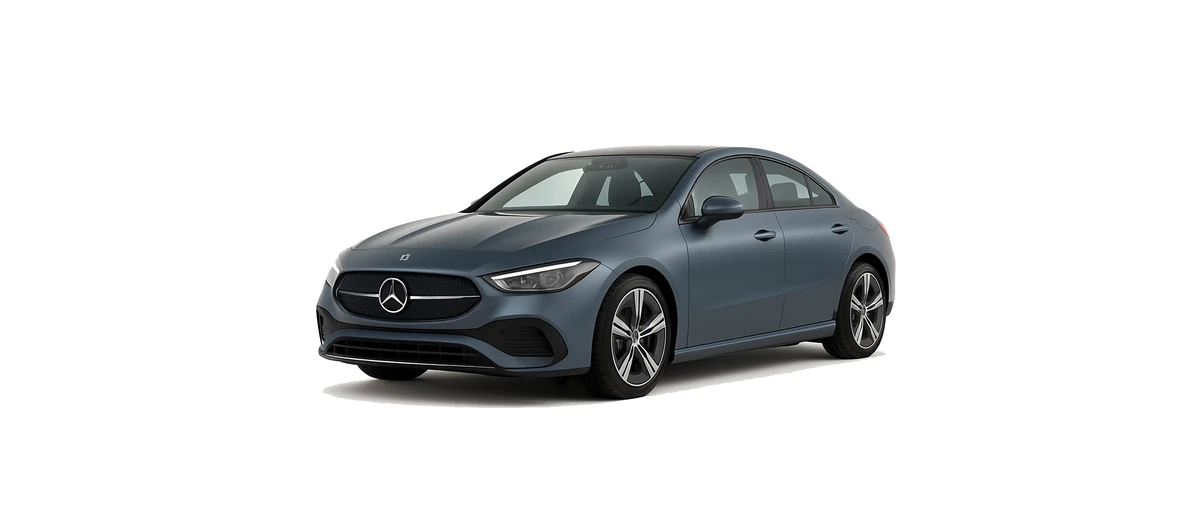
The Mercedes CLA name now covers more than one type of plug-in vehicle, so the first step is to identify which CLA you have. The current UK-market Mercedes-Benz CLA Electric, also described as the CLA with EQ Technology, is a fully electric car based on the Mercedes-Benz Modular Architecture. It is available in CLA 200 Electric and CLA 250+ forms, with different battery sizes, WLTP range figures and DC rapid charging peaks.
Older used-market Mercedes CLA 250 e models are plug-in hybrids, not full battery-electric vehicles. They use a much smaller battery and have very different charging expectations. This guide focuses mainly on the current CLA Electric saloon / four-door coupé, while highlighting where older CLA 250 e owners need to be careful not to apply the new BEV figures to their car.
View Mercedes CLA Charging Cables
Mercedes CLA Battery and Charging Specifications
For UK and European CLA Electric models, AC charging uses a Type 2 connection and DC rapid charging uses CCS Combo 2. EV Database lists the charging inlet for the electric CLA at the right-side rear. Mercedes-Benz UK also refers to a Mode 3 Type 2 charging cable, but it is important to separate cable rating from the car’s onboard AC charging limit.
The current CLA Electric has an 11 kW maximum AC charging capacity. That means a 22 kW-rated Type 2 cable may be suitable to use, but it does not make the car charge at 22 kW on AC. On DC, the CLA Electric benefits from an 800 V architecture, with the CLA 250+ quoted by Mercedes-Benz UK at up to 320 kW under suitable conditions.
Battery Options
The current UK CLA Electric range includes two main battery specifications. The CLA 200 Electric is listed by Mercedes-Benz UK with a 58 kWh usable battery and up to 330 miles WLTP range. It has 11 kW AC charging and a DC rapid charging peak of up to 200 kW, with a quoted 10-80% DC time of around 20 minutes when using a suitable charger and conditions are favourable.
The CLA 250+ with EQ Technology is the longer-range version. Mercedes-Benz UK lists an 85 kWh usable battery, up to 483 miles WLTP range, 11 kW AC charging and up to 320 kW DC rapid charging. Its quoted 10-80% DC time is around 22 minutes on an appropriate high-power charger.
By contrast, the previous-generation CLA 250 e plug-in hybrid used a much smaller 15.6 kWh gross battery. It should not be compared directly with the new CLA Electric. A used CLA 250 e may still use a Type 2 cable for AC charging, but the battery size, electric-only range and charging speed are completely different.
AC Charging Speed
Both current CLA Electric variants have an 11 kW onboard AC charger. On a three-phase AC supply, a full charge can therefore be considerably quicker than on a typical single-phase domestic wallbox. Mercedes-Benz UK’s 0-100% AC charging figure is based on the car being able to use 11 kW, which many UK homes cannot provide without a three-phase electrical supply.
Most UK home wallboxes provide up to 7.4 kW on single-phase power. At that rate, the CLA 250+ with its 85 kWh usable battery will take materially longer than the 9-hour 0-100% figure associated with 11 kW AC charging. In everyday use, many owners will not charge from completely empty to full; topping up overnight from, for example, 30% to 80% is usually more realistic and more convenient.
For untethered home chargers and many public AC posts, a Type 2 to Type 2 charging cable is the correct cable family for the current CLA Electric in the UK and Europe. Choosing a cable rated above the car’s AC limit can still be sensible for compatibility and future use, but the vehicle will only draw what it can accept.
DC Rapid Charging Speed
DC rapid charging is where the new CLA Electric differs most dramatically from the older CLA 250 e plug-in hybrid. The current BEV uses CCS Combo 2 for rapid charging and is built around an 800 V electric architecture. Mercedes-Benz UK quotes up to 200 kW DC for the CLA 200 Electric and up to 320 kW DC for the CLA 250+.
For the CLA 250+, Mercedes-Benz UK lists a 10-80% DC rapid charging time of around 22 minutes. For the CLA 200 Electric, the listed 10-80% time is around 20 minutes. These figures depend on battery temperature, state of charge, charger capability, charger voltage, site load and vehicle specification.
Mercedes-Benz UK also refers to an additional 400 V DC charging system allowing up to 100 kW at 400 V DC chargers. The exact availability may depend on specification, so owners should check their vehicle documentation or Mercedes-Benz account details. If you use an older or lower-voltage rapid charger, charging may be slower than the headline 800 V figures.
Range and Efficiency
The headline WLTP range for the CLA Electric depends on version. The CLA 200 Electric is listed at up to 330 miles WLTP, while the CLA 250+ is listed at up to 483 miles WLTP. These are laboratory test figures designed for comparison, not a guaranteed distance in all conditions.
Real-world range will vary with speed, temperature, tyres, driving style, payload, weather and use of heating or air conditioning. EV Database estimates around 360 miles of real-world range for the CLA 250+, which is a useful planning figure for mixed driving. Motorway range in winter may be lower, while gentle urban and A-road driving in mild weather can be more efficient.
The CLA Electric’s standard heat pump should help reduce heating-related energy use compared with relying solely on resistive heating. Even so, cold weather can still affect range and charging speed, especially if the battery is cold before a rapid charging session.
Charging at Home
For most CLA Electric owners, home charging will be the cheapest and most convenient way to run the car. A dedicated 7.4 kW wallbox is the common UK setup, especially when paired with an EV-friendly electricity tariff. Because the CLA Electric supports up to 11 kW AC, it will make full use of a 7.4 kW single-phase wallbox but will not reach its maximum AC rate unless connected to a suitable three-phase supply.
If your wallbox is untethered, you will need a Type 2 charging cable. If your wallbox is tethered, the cable is already attached, but you may still want a separate Type 2 cable for public AC posts. A 5 metre cable is often practical for driveway use, while a longer cable can help when public charging bays are awkwardly positioned.
A 3-pin domestic charger is generally best suited as a backup or occasional charging solution, but can be used regularly if a qualified electrician has confirmed the socket and electrical installation are suitable for sustained EV charging. For a car with an 85 kWh usable battery, a 3-pin socket will be much slower than a dedicated wallbox, so it is usually not the preferred everyday option.
Public Charging
Public AC charging posts in the UK often require you to bring your own Type 2 cable. These are useful for parking-based charging at workplaces, hotels, town centres and longer-stay car parks. The CLA Electric will charge at up to 11 kW AC where the post and electrical supply allow, but many AC posts and UK electrical arrangements may provide less.
For long journeys, CCS rapid and ultra-rapid chargers are the better match. These chargers have the DC cable attached to the unit, so you do not use your own Type 2 cable for DC rapid charging. For the fastest possible sessions in a CLA 250+, choose a high-power CCS charger that supports 800 V operation and has enough output to approach the vehicle’s peak charging rate.
As with all EVs, the highest DC speeds are usually seen over a limited part of the charging curve. Charging from 10% to 80% is normally much quicker than charging from 80% to 100%, so long-distance stops are often most efficient when you charge enough to reach your next stop rather than waiting for a full battery.
Vehicle-Specific Features
The CLA Electric is based on the Mercedes-Benz Modular Architecture and uses an 800 V electric architecture. This is a key reason the CLA 250+ can offer such high quoted DC charging rates on suitable chargers. Mercedes-Benz Group also states that the electric CLA has an air-side heat pump as standard.
Battery preconditioning is another useful feature for rapid charging. EV Database lists automatic battery preconditioning using navigation for the CLA 250+, and the current CLA Electric range is understood to support battery preparation for charging. For best results, use the car’s built-in navigation to route to a rapid charger so the vehicle can prepare the battery where supported.
Vehicle-to-load is not listed as available for the CLA Electric in the supplied UK research data, and UK support for vehicle-to-grid or vehicle-to-home should not be assumed. Owners interested in bidirectional charging should check the exact UK vehicle specification, software status and charger compatibility before making plans around it.
Charging Tips
- Check whether your car is a current CLA Electric BEV or an older CLA 250 e plug-in hybrid before choosing charging advice.
- Use a Type 2 cable for AC charging at untethered home chargers and many UK public AC posts.
- Do not assume a 22 kW-rated cable means the CLA Electric will AC-charge at 22 kW; the current UK BEV specification is 11 kW maximum AC.
- For the fastest DC charging, use a high-power CCS charger that supports 800 V operation.
- Use the car’s navigation when heading to a rapid charger so battery preconditioning can operate where available.
- Expect slower charging in cold weather, at very high states of charge or on lower-powered public chargers.
- If using a 3-pin charger, have the socket and installation checked by a qualified electrician before relying on it for regular EV charging.
Frequently Asked Questions
What charging cable does the Mercedes CLA Electric use?
The current UK Mercedes CLA Electric uses Type 2 for AC charging and CCS Combo 2 for DC rapid charging. For most UK public AC posts and untethered home wallboxes, you need a Type 2 to Type 2 cable.
Does the Mercedes CLA Electric charge at 22 kW on AC?
No. Mercedes-Benz UK lists the current CLA Electric with an 11 kW maximum AC charging capacity. A 22 kW-rated Type 2 cable can still be used if suitable, but the car will not draw 22 kW on AC.
How fast can the CLA 250+ rapid charge?
Mercedes-Benz UK quotes up to 320 kW DC for the CLA 250+ and around 22 minutes for a 10-80% charge on a suitable rapid charger. Actual speeds depend on charger capability, battery temperature, state of charge and conditions.
Is the older Mercedes CLA 250 e the same as the new CLA Electric?
No. The CLA 250 e was a plug-in hybrid from the previous generation, with a much smaller battery than the current battery-electric CLA. It may still use a Type 2 cable for AC charging, but its charging speeds and electric range are very different.
Can I use a public rapid charger with my own cable?
No. CCS rapid and ultra-rapid chargers have their own heavy DC cable attached. Your own Type 2 cable is for AC charging, not DC rapid charging.
What This Means for Drivers
The Mercedes CLA is a good example of why vehicle generation matters. A current CLA Electric is a long-range battery-electric car with Type 2 AC charging, CCS rapid charging, an 11 kW onboard AC charger and strong DC rapid charging capability. The CLA 200 Electric and CLA 250+ also have different battery sizes and range figures, so owners should use the specification for their exact model.
For everyday UK ownership, a dedicated home wallbox and a suitable Type 2 cable will cover most charging needs. For long-distance journeys, the CLA Electric’s CCS capability and 800 V architecture make high-power rapid chargers the best choice, particularly for the CLA 250+. Older CLA 250 e plug-in hybrid owners should follow PHEV-specific guidance rather than relying on the new CLA Electric figures.
Looking for a Charging Cable for Mercedes CLA?
We offer charging cables for Mercedes CLA owners, including Type 2 options for the current CLA Electric and suitable cable choices for compatible plug-in models.
View Mercedes CLA Charging Cables
Please note that this information is intended as a guide. Charging specifications may change due to model and year of manufacture. For precise information, always refer to your vehicle user manual.

