
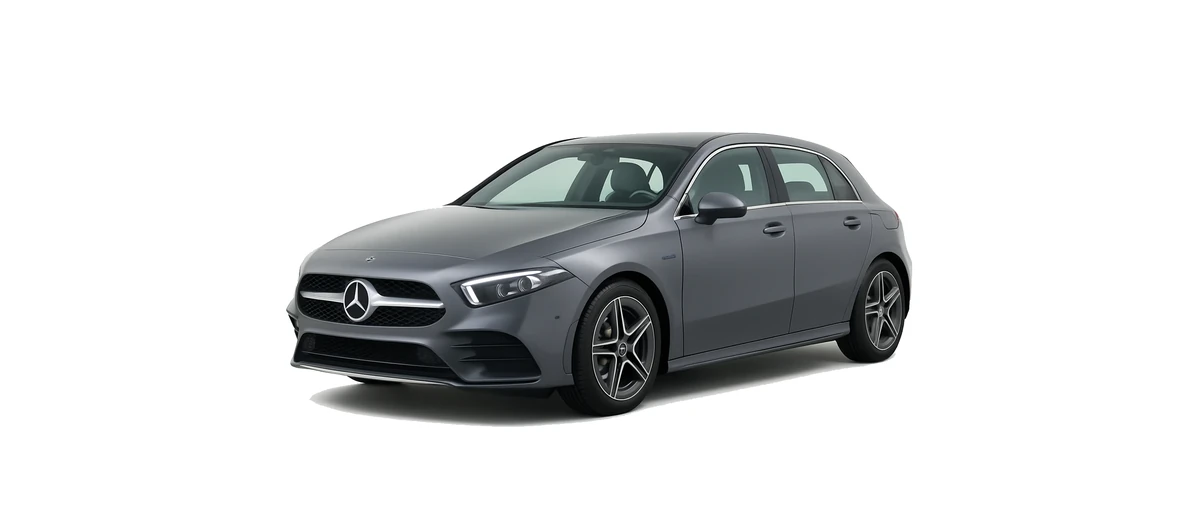
The Mercedes A 250e is a plug-in hybrid version of the A-Class, available as a 5-door hatchback and 4-door saloon. It is not a full battery-electric vehicle: it combines a petrol engine with an electric motor and a mains-rechargeable high-voltage battery. That makes charging habits especially important. If you keep the battery topped up, many daily journeys can be completed using electric power, while the petrol engine is available for longer trips.
This guide focuses on UK charging for the Mercedes A 250e and, importantly, separates current UK cars from earlier used examples. Current Mercedes-Benz UK material for March 2025 production lists 11 kW AC charging and 22 kW DC charging, but earlier A 250e cars were commonly quoted with different battery and AC charging specifications. If you are buying a cable for a used car, it is worth checking the exact model year and build specification before assuming a particular charging speed.
View Mercedes A 250e Charging Cables
Mercedes A 250e Battery and Charging Specifications
For current UK A 250e models, Mercedes-Benz UK brochure data lists a usable lithium-ion battery capacity of 13.0 kWh, 11 kW AC charging and 22 kW DC charging. The charging connection used in the UK and Europe is Type 2 for AC charging and CCS Combo 2 for DC rapid charging. The charging flap is located on the rear right-hand side of the vehicle.
As a general guide, current UK brochure figures quote around 2 hours for a 10-100% charge from an 11 kW AC wallbox or charge point, and around 28 minutes for a 10-80% charge using 22 kW DC rapid charging. Those figures are useful for current facelift-era cars, but they should not be applied automatically to every A 250e on the used market.
- Vehicle type: petrol plug-in hybrid electric vehicle
- Body styles: A-Class hatchback and saloon
- AC connection: Type 2
- DC connection: CCS Combo 2
- Current UK AC charging: listed as up to 11 kW
- Current UK DC charging: listed as up to 22 kW
- Charging port location: rear right-hand side
Battery Options
The main complication with the Mercedes A 250e is that battery capacity information varies by age and specification. Current UK brochure data for March 2025 production lists a 13.0 kWh usable battery, while Mercedes UK tax data snippets refer to a 16.0 kWh input capacity for current derivatives. These figures relate to current/facelift UK cars.
Earlier pre-facelift A 250e models, commonly found on the used market from around 2019 to 2022, were often referenced with approximately 15.6 kWh gross capacity and around 10.6 kWh usable capacity. The key point is not to mix old and current data. A current UK A 250e and an early used A 250e may both wear the same badge, but they may not have the same usable battery capacity or charging capability.
If you own the car already, the most reliable approach is to check the owner’s manual, Mercedes me vehicle information, build sheet or dealer-supplied specification. If you are looking at a used A 250e, ask the seller to confirm the charging equipment fitted to that particular car.
AC Charging Speed
AC charging is the type of charging most A 250e owners will use most often. It covers home wallboxes, workplace chargers and many public destination chargers found in car parks, supermarkets, hotels and town centres.
For current UK A 250e models, Mercedes-Benz UK lists an 11 kW AC onboard charger and a 10-100% AC charging time of around 2 hours from a suitable 11 kW wallbox or charge point. To make use of 11 kW AC charging, the charge point needs to be capable of supplying three-phase power, and the cable must also support three-phase charging.
However, many UK homes have single-phase electricity. On a typical 7.4 kW single-phase home wallbox, a current A 250e will charge at the maximum available from that installation rather than at 11 kW. That is normal and does not indicate a fault with the vehicle or cable.
Older A 250e models need an extra caveat. Earlier UK cars were commonly listed with 7.4 kW AC charging, while some market and equipment-dependent references mention lower standard AC charging with optional higher capability. For this reason, a Type 2 three-phase 11 kW cable is a sensible general recommendation for current UK cars and is backward compatible with lower AC charging rates, but it will not force an older car to charge faster than its onboard charger allows.
DC Rapid Charging Speed
Unlike many plug-in hybrids, the Mercedes A 250e has been listed with DC charging capability in UK Mercedes material. Current UK brochure data quotes 22 kW DC charging and a 10-80% charging time of around 28 minutes. Because the battery is relatively small compared with a full electric car, the charging session can still be short even though the peak DC rate is modest by battery-electric vehicle standards.
For public DC rapid charging, you do not need to bring your own DC cable. CCS rapid chargers have tethered cables attached to the charging unit. You simply use the charger’s CCS connector and plug it into the vehicle’s CCS socket.
DC charging can be useful on longer days when you want to restore electric range quickly, but it is not always the cheapest or most convenient way to run a plug-in hybrid. For many owners, the best value comes from charging regularly at home or work and using public DC charging only when it genuinely helps the journey.
Range and Efficiency
Current UK Mercedes-Benz brochure data gives WLTP/EAER electric range figures that vary by body style and trim. The hatchback is listed at around 47 to 52 miles, while the saloon is listed at around 48 to 53 miles. These are official test-cycle figures, not a guaranteed real-world result in every condition.
In everyday UK driving, around 40 miles is a more cautious expectation for many drivers, although the actual result depends on temperature, road type, speed, driving style, wheel and tyre specification, climate control use and how much regenerative braking is available during the journey. Short urban and suburban trips are usually where a plug-in hybrid like the A 250e makes the most sense, especially if you can recharge at home overnight.
Efficiency also depends heavily on whether the car is actually charged. If the battery is left empty and the A 250e is driven mainly as a petrol hybrid, running costs and emissions will be higher than they could be. Regular charging is the difference between getting the benefit of the plug-in hybrid system and carrying around a battery that is rarely used.
Charging at Home
Home charging is the simplest way to get the best from the Mercedes A 250e. If you have off-street parking, a dedicated home wallbox gives you a convenient, safer and usually faster charging solution than relying on a domestic socket. Most UK home wallboxes are 7.4 kW single-phase units, which are suitable for the A 250e even if a current car is capable of up to 11 kW AC on a three-phase supply.
For an untethered home wallbox, you will need a Type 2 Mode 3 charging cable. For current UK cars, an 11 kW three-phase Type 2 cable is the most future-proof choice because it matches the quoted 11 kW AC capability and will also work with lower-powered single-phase charge points. Owners of earlier A 250e models can also use a compatible Type 2 cable, but the vehicle may charge at 7.4 kW or less depending on the car’s onboard charger and the charge point.
A 3-pin charger is generally best suited as a backup or occasional charging solution, but can be used regularly if a qualified electrician has confirmed the socket and electrical installation are suitable for sustained EV charging. Extension leads should be avoided, and any domestic socket used for EV charging should be in good condition, correctly protected and appropriate for prolonged load.
Public Charging
For public AC charging, the Mercedes A 250e uses a Type 2 connection. Many public AC charge points are untethered, meaning you need to bring your own Type 2 cable. This is where a good-quality Type 2 cable is particularly useful: it allows you to use workplace chargers, destination chargers and public posts that do not have a cable attached.
It is important to understand the difference between the charge point’s rating and the car’s onboard AC charger. A public AC post may be labelled 22 kW, but a current UK A 250e is listed at up to 11 kW AC, and some earlier cars may be lower. The car will only draw what it is designed to accept, subject to the cable and charger also supporting that rate.
For public DC rapid charging, use the tethered CCS cable attached to the rapid charger. You do not need to buy or carry a separate rapid charging cable. Because DC charging prices can be higher than home electricity tariffs, it is worth treating rapid charging as a convenience option rather than the default charging method for every week.
Vehicle-Specific Features
The A 250e is built around the Mercedes-Benz compact A-Class platform and packages its high-voltage battery beneath the rear-seat area. From a charging perspective, the most important vehicle-specific points are the PHEV powertrain, the Type 2 AC socket, the CCS Combo 2 DC connection and the rear right-hand charging flap location.
The petrol plug-in hybrid layout means the car can continue a journey after the electric range is depleted, but that should not be taken as a reason to ignore charging. The A 250e is at its most efficient when it is used as intended: charged frequently and driven electrically for local journeys, with the petrol engine supporting longer trips.
The other vehicle-specific issue is the model-year split. Current UK brochure figures show 13.0 kWh usable capacity, 11 kW AC and 22 kW DC. Earlier examples may differ, particularly around usable battery capacity and AC charging speed. If your aim is cable selection, choose a Type 2 cable that suits the highest capability you are likely to use, while remembering that the car itself determines the final charging rate.
Charging Tips
- Charge little and often: plug in at home or work whenever convenient so the car starts local journeys with useful electric range.
- Use the right cable: a Type 2 Mode 3 cable is required for untethered AC charging points.
- Consider an 11 kW three-phase cable: it suits current UK A 250e charging capability and remains compatible with lower-powered AC charging.
- Check used-car specifications: older A 250e models may not have the same AC charging speed or usable battery capacity as current UK cars.
- Do not expect 22 kW from AC posts: current UK cars are listed at 11 kW AC, while 22 kW refers to DC charging in current UK brochure data.
- Use DC charging selectively: it can be quick because the battery is small, but home or workplace charging is usually better for routine running costs.
Frequently Asked Questions
What charging cable does the Mercedes A 250e use?
The Mercedes A 250e uses a Type 2 cable for AC charging. For untethered home wallboxes and public AC charge points, you will need your own Type 2 Mode 3 charging cable.
Should I choose a single-phase or three-phase cable?
For current UK A 250e models, an 11 kW three-phase Type 2 cable is the safest general recommendation because Mercedes UK lists 11 kW AC charging. It is also backward compatible with single-phase home wallboxes and lower-powered public chargers. Earlier cars may charge at a lower rate, so check your vehicle specification.
Can the Mercedes A 250e use rapid chargers?
Current UK Mercedes-Benz brochure data lists 22 kW DC charging using a CCS Combo 2 connection, with a quoted 10-80% time of around 28 minutes. Public DC rapid chargers have tethered cables, so you do not need to bring your own DC cable.
How long does the A 250e take to charge at home?
Current UK data quotes around 2 hours for 10-100% on an 11 kW AC wallbox or charge point. On a typical UK 7.4 kW single-phase home wallbox, charging may take longer. Earlier A 250e models may also have different AC charging capability.
Is the Mercedes A 250e a full electric car?
No. The A 250e is a plug-in hybrid. It has a petrol engine, an electric motor and a rechargeable battery. It can drive on electric power for shorter journeys, but it is not a battery-electric vehicle.
What This Means for Drivers
The Mercedes A 250e can be very effective as a low-running-cost daily car if it is charged regularly. Current UK cars offer useful electric range for commuting and local journeys, while the petrol engine gives flexibility for longer trips. The charging hardware is straightforward: Type 2 for AC charging and CCS for DC charging.
The main buying decision is cable choice. For most UK owners, a Type 2 Mode 3 cable is essential if you want to use untethered home, workplace or public AC charge points. For current UK A 250e models, an 11 kW three-phase cable is the most future-proof option because it matches the current quoted AC capability and still works on lower-powered chargers. If you own an earlier A 250e, the same cable may still be suitable, but the vehicle may charge at 7.4 kW or another specification-dependent rate.
Looking for a Charging Cable for Mercedes A 250e?
We offer Mercedes A 250e charging cables suitable for Type 2 AC charging, including options for home wallboxes, workplace charging and untethered public charge points.
View Mercedes A 250e Charging Cables
Please note that this information is intended as a guide. Charging specifications may change due to model and year of manufacture. For precise information, always refer to your vehicle user manual.

