
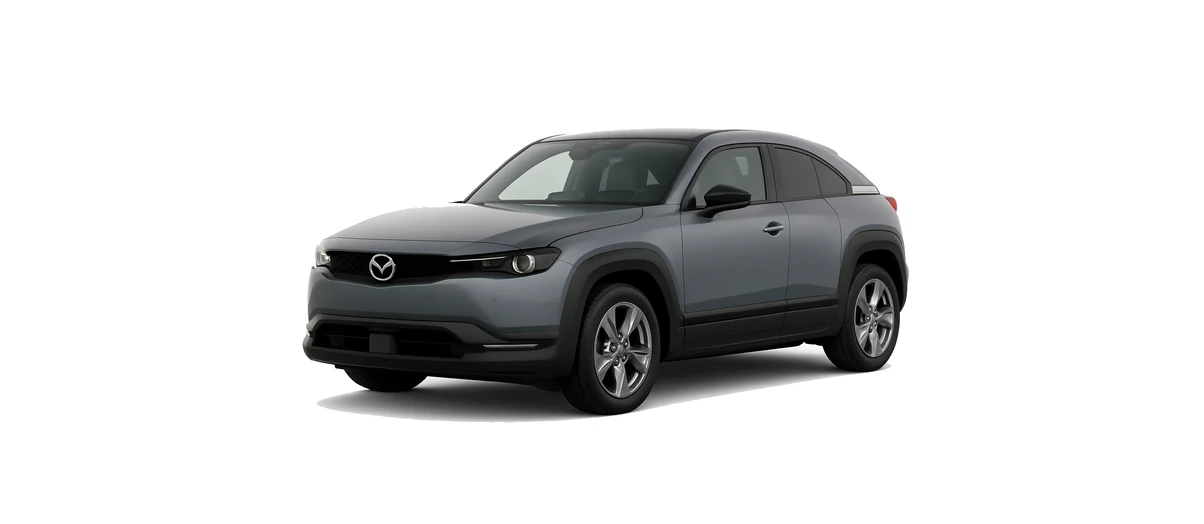
The Mazda MX-30 is a slightly unusual car to write a charging guide for, because the same badge has been used for two different plug-in models in the UK. Early cars were the pure-electric Mazda MX-30 e-Skyactiv EV, while later cars included the Mazda MX-30 e-Skyactiv R-EV, a series plug-in hybrid range-extender with a small battery and a rotary petrol generator.
That distinction matters. The pure-electric MX-30 has a 35.5 kWh gross battery and relies entirely on charging for its driving range. The R-EV has a 17.8 kWh battery for electric driving, but the wheels are driven by an electric motor while the petrol rotary engine acts as a generator when needed. Both use UK/EU Type 2 AC charging and CCS rapid charging, but their battery sizes, charging limits and day-to-day charging patterns are different.
This guide explains what UK owners and used-car buyers need to know about Mazda MX-30 charging at home, on public AC posts and on DC rapid chargers, with practical advice on choosing the right cable.
View Mazda MX30 Charging Cables
Mazda MX30 Battery and Charging Specifications
For UK cars, the Mazda MX-30 uses a Type 2 connector for AC charging and a CCS Combo 2 connector for DC rapid charging. The charge inlet is located on the right-hand, off-side rear quarter. On public rapid chargers, the CCS cable is normally tethered to the charger, so you do not need to carry or buy a separate DC rapid charging cable.
| Variant | Battery | AC charging | DC charging | Official electric range |
|---|---|---|---|---|
| MX-30 e-Skyactiv EV | 35.5 kWh gross; around 30 kWh usable estimated | Type 2, up to 6.6 kW | CCS, up to 50 kW | Up to 124 miles WLTP |
| MX-30 e-Skyactiv R-EV | 17.8 kWh gross | Type 2 AC charging | CCS, up to around 36 kW in Mazda UK data | Up to 53 miles WLTP electric range |
UK availability also needs careful wording. The pure-electric MX-30 EV was sold in the UK from 2021 and later left the line-up. The R-EV joined the UK range in 2023 and was also reported as removed from the UK and European line-up by early 2026. Used examples and late dealer stock may still be available, but the MX-30 should not be treated as a straightforward current factory-order model.
Battery Options
The pure-electric MX-30 EV uses Mazda’s deliberately compact 35.5 kWh battery. Mazda positioned this as a “right-sized” battery rather than a long-range pack, which helps explain why the MX-30’s range is shorter than many newer electric SUVs. EV Database estimates usable capacity at around 30 kWh, but that should be treated as an estimate rather than a Mazda-published usable figure.
The MX-30 R-EV is different. It is not a battery-electric vehicle in the same sense as the earlier MX-30 EV. It has a 17.8 kWh battery and a small 830 cc rotary petrol engine that works as a generator. The car is still plug-in chargeable and can cover many local journeys on electric power, but the range-extender changes how owners tend to use public charging and long-distance driving.
AC Charging Speed
For most UK owners, AC charging is the most important charging method. This is what you use with a home wallbox, workplace charger or many untethered public charge points. The Mazda MX-30 uses a Type 2 connection for AC charging.
The pure-electric MX-30 EV has a 6.6 kW on-board AC charger. That means it cannot charge faster than roughly this rate on AC, even if plugged into an 11 kW or 22 kW public AC post. A higher-rated Type 2 cable can still be compatible, but it will not make the BEV charge faster than the car’s own AC limit.
On a typical 7 kW UK home charge point, the pure-electric MX-30 can be charged from empty to full in roughly five and a half hours according to EV Database-style estimates. Mazda UK material for later MX-30 EV cars quotes a 20-80% AC charge in around three hours using a 7.2 kW home or public charger.
For the MX-30 R-EV, Mazda UK’s later guide quotes a 20-80% AC charge in around one and a half hours using a 7.2 kW home or public charger. Because the R-EV battery is much smaller, short top-ups can add a useful amount of electric driving range.
DC Rapid Charging Speed
Both UK MX-30 variants support CCS rapid charging, but expectations should be realistic. Rapid chargers use the lower, additional DC pins of the CCS connector and nearly always have their own heavy tethered cable attached.
For the pure-electric MX-30 EV, Mazda UK data lists DC rapid charging at up to 50 kW. Mazda’s official fast-charge figures are often quoted for 20-80% charging under favourable conditions, while EV Database estimates around 44 minutes for a 10-80% rapid charge. It is therefore better not to assume a universal 10-80% time of around 25 minutes for every MX-30 EV charging session.
The MX-30 R-EV has a smaller battery and Mazda UK material lists DC charging at up to around 36 kW, with 20-80% possible in about 25 minutes in suitable conditions. In practice, rapid charging speed depends on battery temperature, starting state of charge, charger output, charger sharing and the car’s charging curve.
Range and Efficiency
The pure-electric Mazda MX-30 EV has an official WLTP combined range of up to 124 miles. Independent real-world estimates are lower, at around 105 miles depending on conditions. In winter, at motorway speeds, or with heavy use of heating and demisting, the usable range may be noticeably less.
This means the MX-30 EV is best suited to drivers who can charge regularly and whose routine journeys are mostly local or regional. It can use rapid chargers for longer trips, but it was not designed around high-mileage motorway use in the same way as larger-battery EVs.
The R-EV’s official electric range is up to 53 miles WLTP, with Mazda also listing a higher city electric range figure in some UK material. For many owners, that is enough for commuting, school runs and local journeys if the car is plugged in frequently. However, the R-EV’s total petrol-plus-electric driving range should not be confused with BEV electric range.
Charging at Home
A dedicated 7 kW home wallbox is the most convenient charging solution for most Mazda MX-30 owners. It gives the pure-electric MX-30 EV enough power to refill comfortably overnight and lets R-EV owners restore most of their electric range quickly between journeys.
If your home charger is untethered, you will need a Type 2 to Type 2 Mode 3 charging cable. Mazda UK specification material lists Type 2 Mode 2 and Mode 3 AC charging cables as standard equipment on the MX-30, but used cars may not always come with their original cables. When buying used, it is worth checking which cables are physically present, their condition and whether they are suitable for your charger.
A 32 amp single-phase Type 2 cable is a sensible match for most UK home charging, as it supports the output of a typical 7 kW wallbox. A three-phase 11 kW or 22 kW-rated cable may also work on compatible posts, but it will not make the pure-electric MX-30 EV exceed its 6.6 kW AC charging limit.
A 3-pin portable charger can be useful in limited circumstances. However, a 3-pin charger is generally best suited as a backup or occasional charging solution, but can be used regularly if a qualified electrician has confirmed the socket and electrical installation are suitable for sustained EV charging. Avoid using damaged sockets, extension leads or unknown outdoor sockets for sustained charging.
Public Charging
For public AC charging, the MX-30 uses the same Type 2 connection as most UK and European EVs and plug-in hybrids. Many destination chargers, workplace units, supermarket chargers and council-operated charge points are untethered, so you will usually need to bring your own Type 2 cable.
For public rapid charging, use a CCS charger. The CCS plug combines the Type 2 upper section with two additional DC pins below. These rapid chargers are usually tethered, so you simply select the charger, connect its CCS cable and follow the network’s payment or app process.
It is worth remembering that public charger power is only one part of the equation. Plugging a pure-electric MX-30 into a 150 kW rapid charger does not mean it will charge at 150 kW; the car’s own maximum DC rate is much lower. Similarly, a 22 kW AC post will not charge the BEV faster than its on-board AC charger allows.
Vehicle-Specific Features
The MX-30’s design is distinctive, with freestyle rear-hinged rear doors and a compact SUV/crossover body. It is based on Mazda’s Skyactiv-Vehicle Architecture rather than a dedicated electric-only platform, according to EV Database information.
For charging, the key vehicle-specific point is the split between MX-30 EV and MX-30 R-EV. The EV is a short-range battery-electric car. The R-EV is a series plug-in hybrid range-extender: the electric motor drives the wheels, while the rotary engine is used to generate electricity rather than mechanically driving the wheels in a conventional hybrid layout.
Some R-EV specification material refers to external power capability. In particular, the R-EV Makoto trim includes a 1500 W standard UK 3-pin socket for powering external devices. This should be treated as trim-specific external power functionality, not a feature that every Mazda MX-30 has.
Charging Tips
- Identify your variant first: check whether you own the pure-electric MX-30 EV or the MX-30 R-EV, as the battery size and charging pattern are different.
- Use Type 2 for home and public AC charging: a Type 2 to Type 2 cable is the main cable for untethered home, workplace and destination chargers.
- Do not overspend expecting faster AC charging: the BEV’s AC rate is limited by its 6.6 kW on-board charger.
- Charge little and often: the BEV’s small battery makes regular top-ups more useful than waiting for a very low state of charge.
- Use CCS for rapid charging: rapid chargers have tethered CCS cables, so you do not need to carry a separate DC cable.
- Plan winter journeys conservatively: range can reduce in cold weather, especially on faster roads.
- Check used-car cables: if buying a used MX-30, confirm whether the original Mode 2 and Mode 3 cables are included and undamaged.
Frequently Asked Questions
Is the Mazda MX30 a pure electric car?
Some are, but not all. The MX-30 e-Skyactiv EV is a pure battery-electric car. The MX-30 e-Skyactiv R-EV is a series plug-in hybrid range-extender with a 17.8 kWh battery and a rotary petrol generator.
What charging cable does the Mazda MX30 use in the UK?
For AC charging, UK MX-30 models use a Type 2 connector. For untethered home and public AC chargers, you need a Type 2 to Type 2 Mode 3 cable. DC rapid charging uses CCS Combo 2, and the cable is normally attached to the rapid charger.
Can the Mazda MX30 use a 22 kW public AC charger?
It can connect to many 22 kW Type 2 AC posts with a suitable cable, but the pure-electric MX-30 EV will not charge at 22 kW. Its AC charging is limited by the car’s on-board charger, which is listed at up to 6.6 kW.
How long does the pure-electric Mazda MX30 take to charge at home?
On a typical 7 kW home wallbox, a full charge for the pure-electric MX-30 EV is around five and a half hours from empty in independent estimates. Mazda UK material also quotes around three hours for a 20-80% AC charge using a 7.2 kW charger.
How far does the Mazda MX30 go on a charge?
The pure-electric MX-30 EV has an official WLTP range of up to 124 miles, with real-world estimates closer to around 105 miles. The MX-30 R-EV has an official electric range of up to 53 miles WLTP before the petrol generator extends the journey.
What This Means for Drivers
The Mazda MX-30 is easiest to live with when its charging limits are understood. The pure-electric EV version has a modest battery, so regular home charging is more important than chasing the fastest public chargers. A 7 kW home wallbox and a good Type 2 cable are usually enough to make it practical for local commuting and everyday trips.
The R-EV is a different proposition. Its smaller battery makes frequent short charging sessions worthwhile, but the petrol range-extender means it is less dependent on rapid charging for longer journeys. Even so, plugging in regularly is still the best way to get the most from its electric driving capability.
For both versions, the right cable choice is straightforward: Type 2 for AC charging, CCS for rapid charging, and realistic expectations about what the car can accept. Once you know whether you have the EV or R-EV, the Mazda MX-30 becomes much easier to charge efficiently.
Looking for a Charging Cable for Mazda MX30?
If you need a replacement or spare Type 2 cable for home, workplace or public AC charging, We offer Mazda MX30 charging cables suitable for UK Type 2 charging points.
View Mazda MX30 Charging Cables
Please note that this information is intended as a guide. Charging specifications may change due to model and year of manufacture. For precise information, always refer to your vehicle user manual.

