
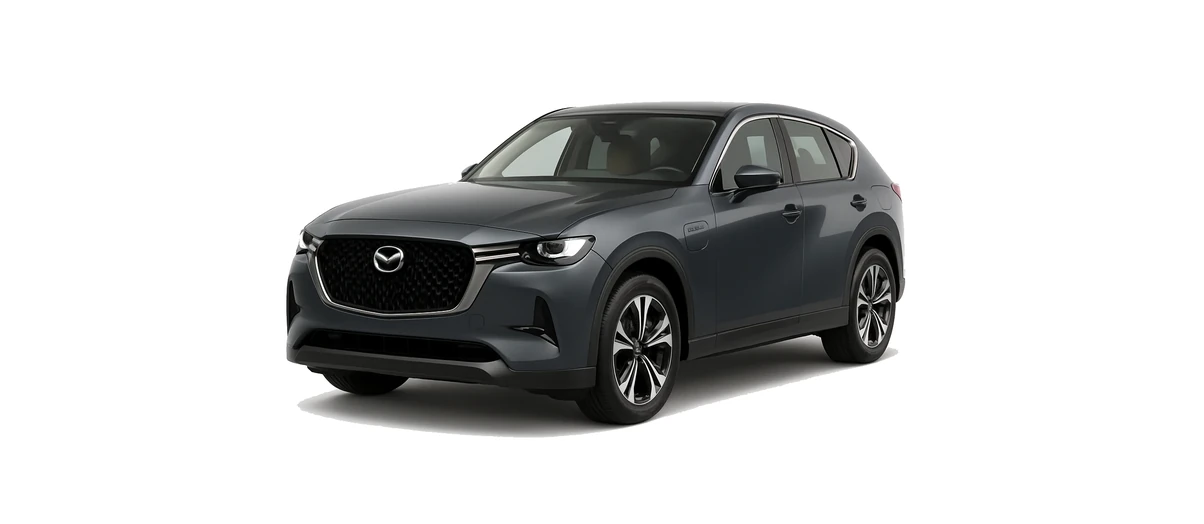
The Mazda CX-60 is a large SUV available in the UK with more than one type of powertrain, so it is important to be clear about which version this charging guide covers. The charging-relevant model is the Mazda CX-60 2.5 e-SKYACTIV PHEV AWD 327ps Automatic. This is a plug-in hybrid electric vehicle, not a pure battery-electric car. It combines a petrol engine, an electric motor and a mains-chargeable battery, allowing local electric driving when there is sufficient charge available.
The diesel mild-hybrid CX-60 variants do not plug in and do not use EV charging cables. For the PHEV, charging is best understood as simple, frequent AC top-ups rather than the rapid-charging routine associated with many full EVs. Mazda UK lists a Type 2 AC charging connection, a 17.8 kWh lithium-ion battery and a 7.2 kW on-board charger for the CX-60 PHEV. That makes home charging, workplace charging and public AC charging the main focus for owners.
View Mazda CX-60 Charging Cables
Mazda CX-60 Battery and Charging Specifications
UK-market information checked against Mazda UK’s April 2026 CX-60 Prices & Specifications guide confirms that the plug-in CX-60 uses a 355 V lithium-ion battery with a listed battery size of 17.8 kWh. Mazda does not publish a usable battery capacity figure in that guide, so it is best not to compare the car using an assumed usable capacity.
The CX-60 PHEV uses Type 2 AC charging. Mazda lists a 7.2 kW on-board charger and provides charging times for Mode 3 AC charging via a home or public charge point, plus slower Mode 2 charging from a UK 3-pin plug. The car is designed to make regular AC charging straightforward, particularly if you can plug in at home or at work.
For cable selection, the key point is that the CX-60 PHEV charges using Type 2 AC. A Type 2 Mode 3 charging cable is the relevant cable for untethered home wallboxes and many public AC charge points. Mazda UK specifications also list Type 2 Mode 2 and Type 2 Mode 3 cables as included with the car, although owners of used vehicles should always check what is actually supplied with their individual car.
Battery Options
The UK charging data in Mazda’s specification guide relates to the 2.5 e-SKYACTIV PHEV AWD 327ps Automatic. This version has a 17.8 kWh lithium-ion battery and is the only CX-60 powertrain in the range that requires a charging cable.
Other CX-60 models, including the 3.3 e-SKYACTIV D mild-hybrid diesel variants, are not plug-in vehicles. They may include electrified assistance, but they do not charge from the mains and therefore do not use a Type 2 charging cable. If you are buying a used CX-60 or checking accessories for a company car, confirm that it is the PHEV before choosing charging equipment.
AC Charging Speed
AC charging is the main method for charging the Mazda CX-60 PHEV. With its 7.2 kW on-board charger, the car can make good use of a typical single-phase home wallbox or suitable public AC charge point. Mazda quotes a 20-80% charging time of 1 hour 30 minutes using Mode 3 AC at 7.2 kW. Mazda also states approximately 2 hours 20 minutes for a 0-100% charge.
In everyday use, most owners will not need to wait for the battery to become completely empty before plugging in. Because the electric-only range is relatively modest compared with a full EV, the CX-60 PHEV works best when topped up frequently. A charge after the school run, commute or local errands can help keep more journeys in electric mode.
A UK 3-pin Mode 2 cable is much slower. Mazda quotes 4 hours 50 minutes for a 20-80% charge at 2.4 kW. A 3-pin charger is generally best suited as a backup or occasional charging solution, but can be used regularly if a qualified electrician has confirmed the socket and electrical installation are suitable for sustained EV charging.
DC Rapid Charging Speed
The Mazda CX-60 PHEV should not be treated like a battery-electric vehicle when planning charging stops. Mazda UK’s published CX-60 PHEV charging data is AC-focused and does not provide a DC rapid-charging power figure or a BEV-style 10-80% rapid-charge time. In practical terms, owners should plan around Type 2 AC charging rather than DC rapid charging.
This is normal for many plug-in hybrids. The battery is much smaller than that of a full EV, and the petrol engine remains available for longer journeys. If you are travelling beyond the electric range, you do not need to plan motorway rapid-charging stops in the same way a pure EV driver might. Instead, the best strategy is to use home, workplace, destination or public AC charging when convenient, then rely on the hybrid system for longer distances.
Range and Efficiency
Mazda’s WLTP electric range for the CX-60 PHEV is around 39-40 miles, depending on specification and conditions. WLTP figures are useful for comparison, but they are not a guarantee of what every driver will achieve on the road. Independent UK road-test context suggests that real-world electric range is often closer to the low-to-mid 30-mile area, with variation depending on temperature, speed, terrain, load and driving style.
This matters because the CX-60 is a large SUV and Mazda lists a 2,500 kg towing limit for the PHEV. Carrying passengers, luggage or towing can all increase energy use. Cold weather, motorway speeds and repeated acceleration can also reduce the distance covered before the petrol engine is needed. On the other hand, short local journeys, steady urban driving and regular charging can make the plug-in hybrid system feel very effective.
For many owners, the value of the CX-60 PHEV comes from covering routine daily trips on electricity and using petrol for occasional longer journeys. If your regular driving fits within the electric range and you can charge often, the car can spend a significant amount of time operating in EV mode.
Charging at Home
Home charging is usually the most convenient way to run a plug-in hybrid such as the Mazda CX-60. A dedicated home wallbox with a Type 2 tethered lead, or an untethered wallbox used with a Type 2 Mode 3 cable, allows the car to charge at up to its 7.2 kW AC capability where the installation supports it.
The advantage of a wallbox is not just speed. A properly installed EV charge point is designed for regular vehicle charging, can often be scheduled for off-peak electricity tariffs, and is more convenient than setting up a portable lead every day. For a PHEV with an official electric range of about 40 miles, overnight charging is usually more than enough to restore the battery for the next day’s local driving.
If you have solar panels or a smart tariff, the CX-60’s relatively small PHEV battery can also be a good match for timed charging. You may be able to top up during cheaper periods or when household generation is available, depending on your equipment and tariff. The MyMazda app can also be used to monitor and control PHEV charging, helping owners keep track of charging status without needing to sit in the vehicle.
Public Charging
Public charging for the Mazda CX-60 PHEV mainly means AC destination charging. Examples include car parks, hotels, supermarkets, workplaces and town-centre chargers. Many of these units are untethered, so a Type 2 Mode 3 cable is the useful cable to keep in the boot.
Because the CX-60 PHEV’s battery is not large by full-EV standards, short AC charging sessions can still be worthwhile. If you are parked for lunch, at a meeting or during a shopping trip, even a partial top-up may add useful electric miles for the journey home. Mazda’s quoted 20-80% AC charging time of 1 hour 30 minutes at 7.2 kW gives a helpful guide to what is possible on a suitable charge point.
However, public charging economics vary. Some public AC chargers are priced in a way that makes sense for PHEV top-ups, while others may be less attractive than charging at home. Check the tariff, parking rules and any overstay fees before plugging in. For long motorway journeys, it is usually more practical to let the hybrid system manage propulsion rather than searching for rapid chargers that the published UK charging data does not support.
Vehicle-Specific Features
The CX-60 PHEV includes an EV mode that allows local electric driving when the battery has enough charge. This is one of the key reasons to charge frequently: the more often the battery is topped up, the more opportunities the vehicle has to cover short journeys without using the petrol engine.
Mazda also states that the MyMazda app can monitor and control PHEV charging. It can pre-heat or cool the cabin before departure, which can improve comfort before you set off. This is cabin pre-conditioning and should not be confused with any separate battery pre-conditioning system.
The CX-60’s towing capability is also relevant to charging expectations. A large SUV carrying heavy loads or towing will use more energy, so electric range can vary significantly. If you regularly tow, drive at higher speeds or use the car in winter, it is sensible to plan for a lower electric range than the WLTP figure.
Charging Tips
- Use Type 2 AC as your main charging method. The CX-60 PHEV is built around AC charging, with a 7.2 kW on-board charger listed by Mazda UK.
- Top up often. Frequent charging helps you make better use of EV mode for short local trips.
- Keep a Type 2 Mode 3 cable in the car. It is useful for untethered public AC charge points and untethered home wallboxes.
- Do not plan around DC rapid charging. Mazda UK’s PHEV charging information is AC-only, so think in terms of home, workplace and destination charging.
- Be realistic about range. Around 39-40 miles WLTP is possible in test conditions, but real-world range depends on weather, speed, load and driving style.
- Check used-car accessories. Mazda specifications list charging cables as included, but a used CX-60 may not still have both cables with it.
Frequently Asked Questions
Is the Mazda CX-60 a fully electric car?
No. The UK charging-relevant Mazda CX-60 is a plug-in hybrid. It has a petrol engine, an electric motor and a battery that can be charged from the mains. Diesel mild-hybrid CX-60 models do not plug in.
What charging cable does the Mazda CX-60 PHEV use?
The Mazda CX-60 PHEV uses Type 2 AC charging. A Type 2 Mode 3 cable is the practical choice for untethered home and public AC charge points.
How fast can the Mazda CX-60 PHEV charge?
Mazda UK lists a 7.2 kW on-board charger. The quoted Mode 3 AC charging time is 1 hour 30 minutes from 20-80%, or approximately 2 hours 20 minutes from 0-100%.
Can the Mazda CX-60 use a 3-pin plug charger?
Yes, Mazda lists Mode 2 charging from a UK 3-pin plug at 2.4 kW, with a quoted 20-80% time of 4 hours 50 minutes. This is much slower than a 7.2 kW AC charge point and is best regarded as a backup or occasional option unless a qualified electrician has confirmed the socket and installation are suitable for regular sustained EV charging.
Does the Mazda CX-60 PHEV support DC rapid charging?
Mazda UK’s published charging information for the CX-60 PHEV does not list a DC rapid-charging figure or 10-80% rapid-charge time. Owners should plan around Type 2 AC charging.
What This Means for Drivers
The Mazda CX-60 PHEV is at its best when it is treated as a plug-in hybrid that benefits from regular, convenient AC charging. It is not intended to follow the same charging pattern as a full EV, and owners should not rely on rapid-charging stops for long-distance use. Instead, the most useful setup is a home wallbox or reliable access to workplace charging, plus a Type 2 Mode 3 cable for public AC chargers.
If your daily mileage is often within the car’s electric range, charging little and often can help reduce petrol use and make the most of EV mode. For longer journeys, towing or winter driving, expect the petrol engine to play a larger role. The key is to match expectations to the car’s PHEV design: simple home and destination charging, realistic electric range planning and the right Type 2 cable for the places you charge most often.
Looking for a Charging Cable for Mazda CX-60?
If you need a suitable cable for home, workplace or public AC charging, choose a Type 2 charging cable appropriate for the Mazda CX-60 PHEV and your charging setup.
View Mazda CX-60 Charging Cables
Please note that this information is intended as a guide. Charging specifications may change due to model and year of manufacture. For precise information, always refer to your vehicle user manual.

