
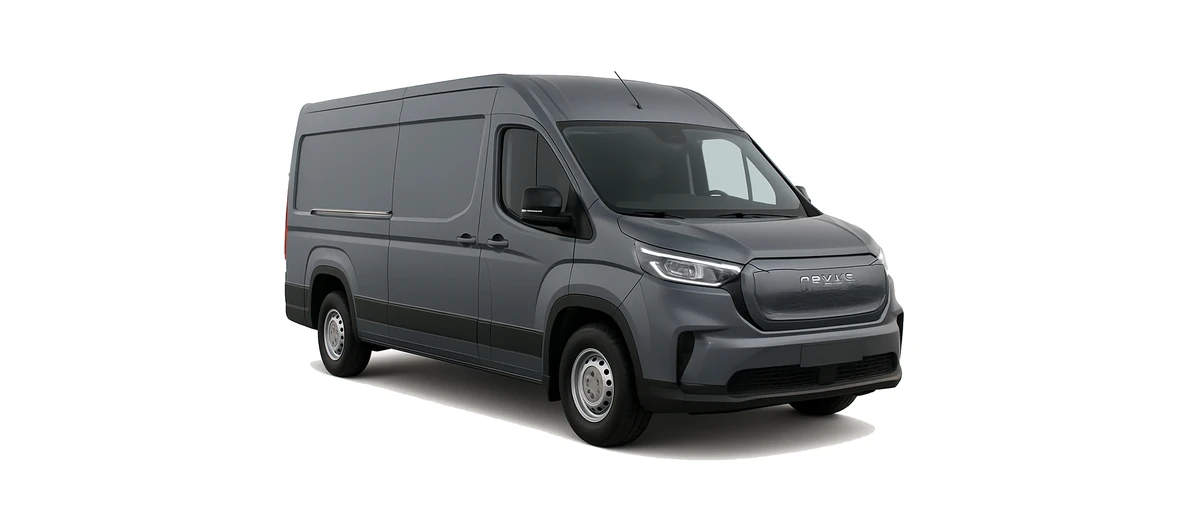
The Maxus eDeliver 9 is a large electric van aimed at operators who need meaningful load space, daily usability and predictable charging. It is the battery-electric version of the Deliver 9 family, so charging information for the diesel Deliver 9 should not be used when planning cables, depot infrastructure or public charging stops.
One important point with the eDeliver 9 is that specifications vary by battery size, body style, model year and market listing. Older UK and Irish material references 51.5kWh, 72kWh, 65kWh chassis-cab and 88/88.55kWh packs, while more recent UK catalogue and leasing data also shows 77kWh, 88kWh and 100kWh variants. For fleets, that means the exact van specification matters before choosing charging hardware or planning duty cycles.
View Maxus eDeliver 9 Charging Cables
Maxus eDeliver 9 Battery and Charging Specifications
The Maxus eDeliver 9 uses a Type 2 connection for AC charging and a CCS Combo 2 connection for DC rapid charging. In practical UK terms, that means a Type 2 to Type 2 Mode 3 cable is the right cable for most untethered home, workplace and public AC charge points, while rapid charging is handled by the tethered CCS cable attached to the rapid charger.
Current 88kWh specification data lists 11kW three-phase AC charging as standard, with 22kW AC charging optional on selected versions. DC rapid charging is commonly listed at around 90kW for 88kWh examples, with a 10-80% charge taking about 51 minutes in suitable conditions. Some recent 100kWh UK listings show DC charging up to 100kW, with 10-80% times in the region of 47-59 minutes depending on charger power and specification.
Because public sources do not all describe the same model-year line-up, the safest approach is to treat these as variant-specific figures rather than universal eDeliver 9 values.
Battery Options
The eDeliver 9 has appeared in several battery configurations. Earlier panel van information commonly includes 51.5kWh, 72kWh and 88.55kWh batteries, with older chassis-cab information also referencing a 65kWh pack. More recent UK catalogue data shows 77kWh, 88kWh and 100kWh variants depending on body, weight category and listing.
This matters for charging because battery size affects how long the van takes to charge, how much energy it needs each night and how often it may need public rapid charging during long routes. A smaller-battery van may be easier to recharge fully overnight but have a shorter working range. A larger-battery version gives more route flexibility but needs more energy and may benefit more from three-phase depot charging.
If you are buying a used eDeliver 9 or adding one to an existing fleet, confirm the battery size from the vehicle documentation, VIN-specific dealer information or the onboard vehicle menus. Do not rely only on the badge, body length or a generic advert description.
AC Charging Speed
AC charging is the most important charging method for many eDeliver 9 operators because vans are often parked for long periods overnight at a depot, yard or driver’s home. Current 88kWh specification sheets list 11kW AC charging as standard and 22kW AC charging as an option on selected variants. Some recent 100kWh listings also show 11kW and 22kW AC scenarios depending on the exact version.
On a typical UK single-phase 7.4kW wallbox, the van will charge more slowly than its 11kW or 22kW three-phase capability. This is not a fault; the vehicle can only use what the supply and charge point can deliver. For a large electric van, single-phase home charging can still work well if the daily mileage is moderate and the van is plugged in for a long overnight dwell period.
Depot users with a three-phase electrical supply will gain the most from the current van’s higher AC capability. An 11kW three-phase charge point can significantly reduce charging time compared with 7.4kW single-phase, while a 22kW unit may be worthwhile where the vehicle has the optional 22kW onboard charger and the site supply supports it.
For AC charging cable selection, a higher-rated Type 2 cable can be used safely: the van and charge point communicate and the vehicle draws only what it can accept. For a working van, many operators prefer a robust three-phase Type 2 cable so it can be used across a wider mix of home, depot and public AC posts.
DC Rapid Charging Speed
For longer routes, emergency top-ups or multi-shift use, the eDeliver 9 uses CCS rapid charging. The CCS cable is normally tethered to the charger, so you do not need to carry a separate rapid charging cable.
Current 88kWh data lists 90kW DC charging and a 10-80% charging time of about 51 minutes. Recent 100kWh leasing data lists up to 100kW DC charging, with 10-80% figures of roughly 47 minutes on a suitable 100kW supply or around 59 minutes on an 80kW supply. Real charging speed will vary according to battery temperature, state of charge, charger availability and whether the charger is sharing power with another vehicle.
For business use, it is usually more efficient to rapid charge only as much as needed to complete the route or reach the depot. Charging from 80-100% on DC is typically slower than the middle part of the battery, so a shorter stop to around 80% is often better than waiting for a full charge during the working day.
Range and Efficiency
Range for the Maxus eDeliver 9 depends heavily on battery, roof height, body length, payload, temperature and speed. Public UK data includes WLTP figures from around the mid-100-mile region on some 77kWh body styles to around or just above 200 miles on selected 88kWh versions, with headline figures in some sources reaching approximately 230 miles depending on the variant and test context.
As with all large vans, real-world efficiency can change dramatically. A high-roof van at motorway speed will use more energy than a lower-roof van on urban delivery routes. Heavy payloads, cold weather, rain, roof-mounted equipment and frequent high-speed driving can all reduce range. Conversely, stop-start urban work may suit an electric van well because regenerative braking can recover some energy during deceleration.
For route planning, fleets should use their own consumption data once the van is in service. After a few weeks, telematics or charger records will give a clearer picture of energy used per route than a brochure figure can provide.
Charging at Home
If an eDeliver 9 is taken home by a driver, the most convenient option is usually a dedicated home wallbox with a Type 2 connection. Many UK home chargers are tethered, meaning the cable is attached to the unit. Untethered chargers require the driver to use their own Type 2 to Type 2 cable.
A 7.4kW home wallbox will not match the van’s three-phase charging figures, but it can still add a useful amount of range overnight. The suitability depends on how far the van travels each day, how long it is parked and whether the driver needs to leave with a full battery every morning.
A 3-pin charger is generally best suited as a backup or occasional charging solution, but can be used regularly if a qualified electrician has confirmed the socket and electrical installation are suitable for sustained EV charging. For a large-battery van such as the eDeliver 9, a domestic socket will be slow and is unlikely to be the best primary charging method for regular commercial use.
Public Charging
For public AC charging, the eDeliver 9 uses a Type 2 cable. Many public AC posts in the UK are untethered, particularly destination chargers in town centres, business parks, hotels and car parks. Carrying a suitable Type 2 cable is therefore important if drivers need to use these chargers while parked between jobs.
For rapid and ultra-rapid charging, use CCS chargers. Although the van may connect to a charger rated higher than 90kW or 100kW, it will only draw up to its own limit and according to the charging curve. A 150kW or 350kW charger does not mean the van will charge at that power.
Because the eDeliver 9 is a large van, public charging planning should also consider access. Some rapid charging sites are tight for long-wheelbase or high-roof vehicles, and some bays are designed mainly around cars. Fleets should identify reliable van-friendly rapid chargers on regular routes rather than leaving charging stops to chance.
Vehicle-Specific Features
The eDeliver 9’s charging port is reported on current dealer and European material as being at the front of the vehicle, behind or near the Maxus badge. A front charging port can be helpful at public chargers because the van can often drive forwards into the bay, although cable reach will still depend on charger layout.
Vehicle-to-load capability is confirmed on current 88kWh specification sheets and recent 100kWh data as exterior V2L, with interior V2L optional on some 88kWh specifications. This can be useful for powering tools or equipment, but it should not be assumed to be present on every historic eDeliver 9. If V2L is important to your operation, check the exact vehicle specification before purchase.
Reliable UK data reviewed for this guide does not confirm vehicle-to-grid or vehicle-to-home capability, and it does not confirm a user-facing heat pump or battery preconditioning function. Battery thermal management is referenced in some specification material, but that should not be treated as the same thing as a confirmed driver-selectable preconditioning feature.
Charging Tips
- Confirm the exact variant: battery size, AC charger rating and body style all affect charging plans.
- Use a Type 2 cable for AC charging: this is the correct connection for UK home, depot and public AC posts.
- Consider three-phase depot charging: 11kW or optional 22kW AC charging is most useful where the site supply supports it.
- Plan rapid stops around 10-80%: this is usually the most time-efficient charging window on a working day.
- Allow for payload and roof height: a loaded high-roof van will generally use more energy than a lighter, lower vehicle.
- Check charger access: not all public charging bays are convenient for large vans.
Frequently Asked Questions
What charging cable does the Maxus eDeliver 9 use?
For AC charging, the Maxus eDeliver 9 uses a Type 2 connection. A Type 2 to Type 2 Mode 3 cable is suitable for untethered home, workplace and public AC charge points. For DC rapid charging, the van uses CCS Combo 2, and the cable is attached to the rapid charger.
Does every Maxus eDeliver 9 charge at the same speed?
No. Charging speed varies by model year and specification. Current 88kWh data shows 11kW AC as standard and 22kW as an option on selected variants, but older guides may quote lower AC speeds for earlier versions. Always check the exact vehicle.
How long does rapid charging take?
Current 88kWh data lists around 51 minutes for a 10-80% DC rapid charge. Some recent 100kWh listings show roughly 47-59 minutes depending on charger output and vehicle specification. Conditions at the charger can affect these times.
Can I charge the eDeliver 9 from a normal 3-pin plug?
It may be possible with the right equipment, but it will be slow for a large electric van. A 3-pin charger is generally best suited as a backup or occasional charging solution, but can be used regularly if a qualified electrician has confirmed the socket and electrical installation are suitable for sustained EV charging.
What This Means for Drivers
The Maxus eDeliver 9 can be a practical electric van for businesses that plan charging properly. The key is to avoid treating every eDeliver 9 as the same. Battery size, body configuration and onboard AC charger rating make a real difference to overnight charging, route planning and public charging strategy.
For most operators, the best setup is dependable overnight AC charging, supported by CCS rapid charging when routes exceed the usual daily range. A suitable Type 2 cable should be kept with the vehicle for untethered AC posts, while depot charging should be matched to the actual van specification and site electrical capacity.
Looking for a Charging Cable for Maxus eDeliver 9?
We offer Maxus eDeliver 9 charging cables for UK home, workplace and public AC charging, including Type 2 options suitable for untethered charge points.
View Maxus eDeliver 9 Charging Cables
Please note that this information is intended as a guide. Charging specifications may change due to model and year of manufacture. For precise information, always refer to your vehicle user manual.

