
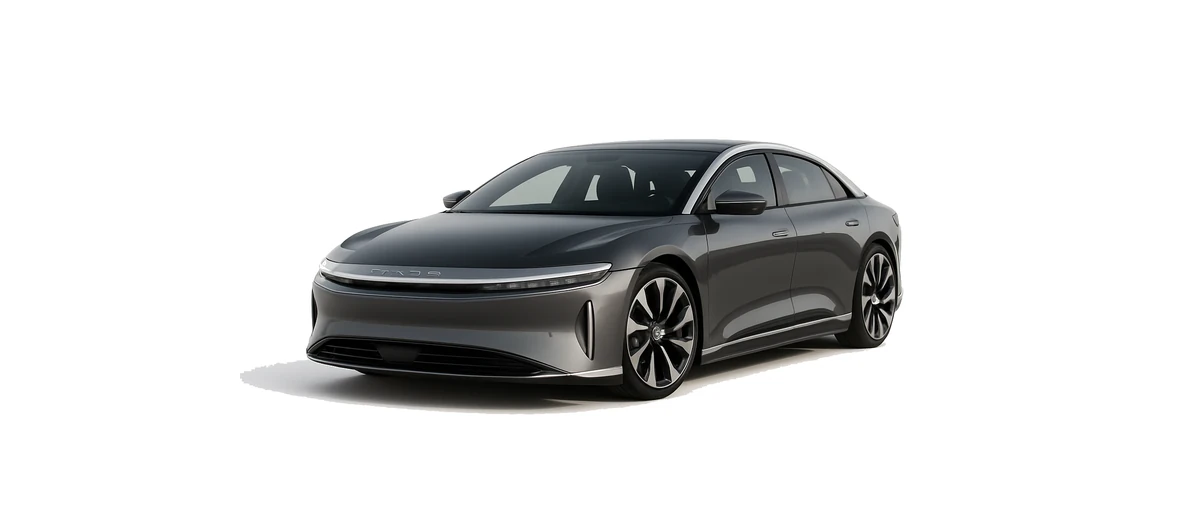
The Lucid Air is a pure battery-electric luxury saloon with exceptional range, very large battery options and unusually strong charging capability. For UK drivers, however, there is an important reality check: current European Lucid Air variants are listed by EV Database as not available in the United Kingdom. That means a Lucid Air seen on UK roads is likely to be a private import, a temporary vehicle, or part of a future availability scenario rather than a standard UK-market right-hand-drive model.
That matters for charging. European-market Lucid Air models are listed with Type 2 AC charging and CCS Combo 2 DC rapid charging, which aligns with UK and European public charging infrastructure. A North American import may not have the same inlet arrangement, so owners should verify the exact charge port before buying a cable or relying on a particular public charger type.
This guide explains what UK-based Lucid Air owners and prospective importers need to know about home charging, public charging, rapid charging speeds and choosing the correct cable.
View Lucid Air Charging Cables
Lucid Air Battery and Charging Specifications
The Lucid Air is a BEV only; no plug-in hybrid version is covered by the current research data. Battery size, range and DC charging speed vary significantly by trim and model year, so it is important not to treat all Air models as having the same charging performance.
| Item | European-spec Lucid Air data |
|---|---|
| Vehicle type | Pure battery-electric luxury saloon / sedan |
| UK availability context | Current Air variants are listed as United Kingdom not available; UK cars should be treated mainly as private imports or future availability cases |
| AC charging port | Type 2 on European-market cars |
| DC rapid charging port | CCS Combo 2 on European-market cars |
| Maximum AC charging | Up to 22 kW where a suitable three-phase supply is available |
| Maximum DC charging | Up to 210 kW, 250 kW or 300 kW depending on variant |
| Typical DC 10-80% time | About 26-27 minutes under suitable conditions, depending on variant |
For UK owners, the key first step is confirming whether the car is European-spec or a North American import. A European Type 2/CCS2 car is straightforward to charge in the UK. A North American vehicle may require specialist advice before cable or public-charging assumptions are made.
Battery Options
Current European Lucid Air data shows several battery sizes. These are large packs by EV standards, which is one reason the car can offer such long driving range. It also means home charging time can be lengthy if the vehicle is charged from a low state of charge on a normal UK single-phase wallbox.
| Variant | Usable battery capacity | Notes |
|---|---|---|
| Lucid Air Pure RWD MY26 | 88 kWh | European EV Database listing |
| Lucid Air Touring MY26 | 96 kWh | European EV Database listing |
| Lucid Air Grand Touring MY25-26 | 117 kWh | Long-range variant with the highest listed WLTP range |
| Lucid Air Sapphire MY25-26 | 118 kWh | Performance-focused variant with a very large battery |
Because battery capacity differs across the range, charging times and energy costs will also differ. A Grand Touring or Sapphire has a considerably larger battery than an Air Pure, so it will take more energy to charge from a low state of charge to full.
AC Charging Speed
European-spec Lucid Air variants are listed with up to 22 kW AC charging through a Type 2 inlet. This is higher than many EVs, but UK drivers should understand the practical limitation: most UK homes have single-phase electricity, and a typical dedicated home wallbox will charge at up to 7.4 kW rather than 22 kW.
At 7.4 kW, the Lucid Air will charge perfectly well, but not at its maximum AC capability. This is still convenient for overnight top-ups, especially if the car is plugged in regularly rather than allowed to fall to a very low battery level. For a large battery version, a full 0-100% charge on a 7.4 kW wallbox may take a long time, so daily charging habits matter more than headline battery size.
To use the Air’s full 22 kW AC capability, the owner would need access to a suitable three-phase charge point and a three-phase-capable installation. This is more common at commercial premises, some workplaces and some public AC charging locations than at ordinary UK homes. If you do have three-phase power at home or work, the Lucid Air’s 22 kW AC capability can be a genuine advantage because it reduces AC charging time significantly.
EV Database lists approximate 0-100% Type 2 22 kW charging times of around 4 hours 45 minutes for the Pure, 5 hours 15 minutes for the Touring, 6 hours 15 minutes for the Grand Touring and 6 hours 30 minutes for the Sapphire. Real timings can vary with temperature, state of charge, charger output and vehicle conditions.
DC Rapid Charging Speed
DC rapid charging is where the Lucid Air is especially capable, provided you use a powerful enough CCS charger and the car is in the right condition to accept high power. European data lists different peak DC charging speeds by variant:
- Lucid Air Pure RWD MY26: up to 210 kW DC, with an indicative 10-80% time of about 26 minutes.
- Lucid Air Touring MY26: up to 250 kW DC, with an indicative 10-80% time of about 27 minutes.
- Lucid Air Grand Touring MY25-26: up to 300 kW DC, with an indicative 10-80% time of about 27 minutes.
- Lucid Air Sapphire MY25-26: up to 300 kW DC, with an indicative 10-80% time of about 27 minutes.
For the fastest motorway stops, Grand Touring and Sapphire drivers should look for high-power CCS chargers rated at around 300-350 kW where available. Pure and Touring models have lower listed peak limits, so they do not need a 350 kW unit to reach their stated maximum, although using a high-power charger can still be convenient if it is available and priced sensibly.
As with all EVs, peak charging power is not held from 10% all the way to 80%. Charging power tapers as the battery fills, particularly above about 80%, so long journeys are usually fastest when planned around shorter 10-80% rapid charging stops rather than waiting for 100% on a DC charger.
Range and Efficiency
The Lucid Air is known for very high range, but the exact figure depends on the variant, wheels, conditions and driving style. European data lists a headline WLTP range of up to 596 miles for the Grand Touring, with an estimated real-world range of up to around 447 miles in EV Database data.
Those are exceptional figures, but they should be treated as best-case or variant-specific rather than universal across every Lucid Air. The Sapphire, for example, is a high-performance version and is listed with a lower WLTP range than the Grand Touring despite having a similarly large battery. Pure and Touring versions also have different battery capacities and charging limits.
In UK driving, motorway speed, cold weather, rain, headwinds, tyre choice and cabin heating can all reduce range. The Lucid Air’s large battery gives it a useful buffer, but owners should still plan winter motorway journeys conservatively and use the car’s navigation-based charging planning where available.
Charging at Home
For most UK owners, a dedicated home wallbox will be the most convenient way to charge a Lucid Air. A 7.4 kW single-phase Type 2 wallbox is the normal domestic setup and is compatible with European-spec Type 2 cars. It will not make use of the car’s full 22 kW AC capability, but it is still suitable for routine overnight charging.
If you regularly cover high mileage or own one of the larger-battery versions, you may want to investigate whether three-phase charging is available at your home or workplace. A 22 kW AC charge point can make a meaningful difference with a vehicle as large-batteried as the Lucid Air, but it requires the right electrical supply and installation.
A 3-pin charger is generally best suited as a backup or occasional charging solution, but can be used regularly if a qualified electrician has confirmed the socket and electrical installation are suitable for sustained EV charging. With a battery as large as the Lucid Air’s, a 3-pin socket will add range slowly, so it is not the most practical main charging method for most owners.
Before buying a home charging cable, confirm the vehicle’s inlet. European-spec Lucid Air models should use a Type 2 AC cable. If the car is a North American import, do not assume it has the same connector arrangement without checking the vehicle and seeking specialist advice where needed.
Public Charging
For European-spec cars, public AC charging in the UK will generally use Type 2. Many destination chargers provide 7 kW, 11 kW or 22 kW AC depending on the site. The Lucid Air can benefit from 22 kW AC where available, provided the charge point supplies it and the vehicle is the European-spec version with the listed 22 kW onboard AC capability.
For rapid and ultra-rapid charging, European-spec Lucid Air models use CCS Combo 2. This is the standard connector for most UK rapid charging hubs. The main practical advice is to match the charger to the car’s capability. A 50 kW rapid charger will work, but it will be much slower than the car can accept. For long-distance driving, a high-power CCS unit is preferable.
Lucid Air entries in EV Database list Plug & Charge support for current European variants, but actual availability depends on charger network support, vehicle software, market setup and account configuration. UK owners of imports should check compatibility with the networks they intend to use.
Vehicle-Specific Features
Current European Lucid Air entries list a heat pump as standard equipment. A heat pump can help reduce heating-related energy use compared with less efficient cabin heating systems, particularly in cooler weather, although real-world benefit depends on conditions and driving pattern.
Battery preconditioning is also listed for current European entries, including automatic navigation-based preconditioning. This is useful before DC rapid charging because a battery at the right temperature can usually charge faster and more consistently. For best results on a long journey, use the car’s navigation to route to a rapid charger rather than simply arriving unplanned with a cold battery.
The Lucid Air uses a dedicated EV platform and high-voltage architecture. Public data varies by trim and model year, so it is better to focus on the practical outcome: the Air is capable of very high DC charging speeds when paired with a suitable charger and when conditions allow.
Charging Tips
- Confirm the charge port first: European-spec cars should be Type 2 and CCS Combo 2, but North American imports may differ.
- Do not expect 22 kW at most UK homes: a typical single-phase wallbox will provide up to 7.4 kW.
- Consider three-phase if available: 22 kW AC is useful for a car with a large battery, especially at workplaces or commercial premises.
- Use high-power CCS chargers on long trips: Grand Touring and Sapphire can use up to 300 kW in suitable conditions, while Pure and Touring have lower listed peaks.
- Plan around 10-80% rapid charging: charging to 100% on DC usually takes disproportionately longer because power tapers at higher states of charge.
- Use navigation preconditioning: when supported and correctly configured, it can help the car prepare the battery for faster rapid charging.
Frequently Asked Questions
Is the Lucid Air officially available in the UK?
Current European EV Database entries list Lucid Air variants as not available in the United Kingdom. UK drivers should therefore treat the Air mainly as a private-import or future-availability case unless Lucid confirms an official UK launch for the model.
What charging cable does a Lucid Air need?
A European-spec Lucid Air uses Type 2 for AC charging and CCS Combo 2 for DC rapid charging. For home and public AC charging, a Type 2 cable is the relevant cable. If the vehicle is a North American import, check the inlet before buying anything.
Can the Lucid Air charge at 22 kW at home?
Only if the property has a suitable three-phase supply and a compatible 22 kW charge point. Most UK homes use single-phase electricity, where a dedicated wallbox typically charges at up to 7.4 kW.
How fast can the Lucid Air rapid charge?
It depends on the variant. European data lists up to 210 kW for the Pure, 250 kW for the Touring and 300 kW for Grand Touring and Sapphire models. Indicative 10-80% charging times are around 26-27 minutes in suitable conditions.
Should I charge a Lucid Air to 100% on a rapid charger?
For long journeys, it is usually more time-efficient to charge from around 10% to 80% and continue driving, because DC charging slows as the battery becomes fuller. Charging to 100% can be useful before a very long leg, but it is rarely the quickest public charging strategy.
What This Means for Drivers
The Lucid Air is one of the most capable long-range electric saloons, but UK charging advice has to start with vehicle origin. If your car is European-spec, Type 2 AC and CCS Combo 2 DC charging should make it compatible with the UK’s mainstream EV charging infrastructure. If it is a North American import, verify the connector and charging compatibility before relying on UK cable or charger assumptions.
For daily use, a 7.4 kW home wallbox will suit many drivers, even though it falls short of the Air’s listed 22 kW AC maximum. For owners with access to three-phase charging, the Air’s high AC capability becomes much more useful. On longer trips, the car’s large battery, high DC charging limits and battery preconditioning make high-power CCS hubs the best fit.
Looking for a Charging Cable for Lucid Air?
If you have confirmed that your Lucid Air is a European-spec Type 2 vehicle, choose a suitable Type 2 charging cable for home and public AC charging; if your car is a private import from another market, check the charge port carefully before ordering.
View Lucid Air Charging Cables
Please note that this information is intended as a guide. Charging specifications may change due to model and year of manufacture. For precise information, always refer to your vehicle user manual.

