
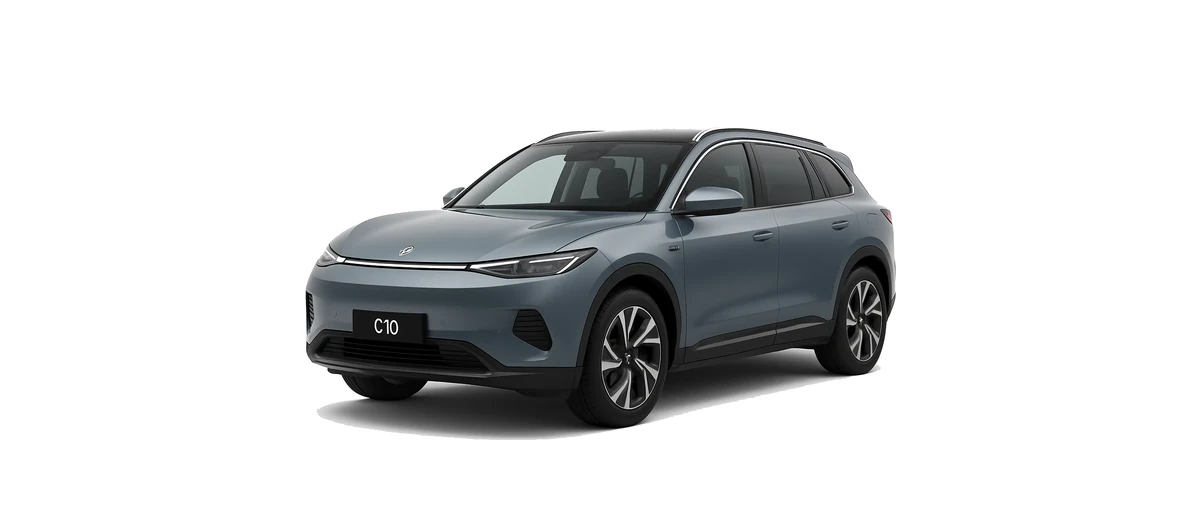
The Leapmotor C10 is a large five-seat SUV that has entered the UK market in more than one electrified form. For many drivers, the key distinction is whether their C10 is the 69.9 kWh battery-electric vehicle, or the C10 Hybrid EV range-extender version with a smaller plug-in battery and a petrol generator. Both can be plugged in, but they do not have identical charging behaviour, battery sizes or rapid charging figures.
This guide explains what UK Leapmotor C10 owners need to know about home charging, public charging and cable choice. It is especially important with the C10 because UK sources list different AC charging speeds depending on variant and specification. Rather than assuming one universal figure, the safest approach is to identify your exact C10 model, check the vehicle order sheet or registration/VIN, and then choose a charging cable that suits both the car and the chargers you intend to use.
View Leapmotor C10 Charging Cables
Leapmotor C10 Battery and Charging Specifications
UK-market Leapmotor C10 charging information should be treated by powertrain. The main battery-electric C10 uses a 69.9 kWh battery and is rated at up to 263 miles WLTP in UK material. Independent EV data sources estimate real-world range at around 220 miles, depending on temperature, driving style, speed and load.
The C10 Hybrid EV, also described as a range-extender or REEV, is different. Its wheels are driven electrically, but it has a 1.5-litre petrol engine that works as a generator. UK press information lists a 28.4 kWh LFP battery and a WLTP all-electric range of 94 miles. It is still a plug-in vehicle, but charging times and energy use should not be compared directly with the larger-battery BEV.
| Version | Battery | AC charging | DC rapid charging | Connector |
|---|---|---|---|---|
| C10 69.9 kWh BEV | 69.9 kWh listed in UK material | Check exact variant: UK sources show 6.6 kW and 11 kW listings | Up to around 84 kW; about 44 minutes for 10-80% in EV Database data | Type 2 AC, CCS Combo 2 DC |
| C10 Hybrid EV / REEV | 28.4 kWh LFP battery in UK press information | 6.6 kW | 65 kW; 30-80% in 18 minutes in UK press information | Type 2 AC, CCS Combo 2 DC |
Battery Options
The 69.9 kWh BEV is the version most drivers will associate with the C10 as a pure electric SUV. This is the model with the longest all-electric range in the current UK C10 context, with official WLTP range up to 263 miles. For everyday ownership, it is the version most likely to be charged overnight at home and topped up on longer journeys using CCS rapid chargers.
The Hybrid EV range-extender version has a much smaller battery, but it is still intended to be plugged in. If most of your daily mileage fits within its electric range, you can cover many journeys on battery power before the petrol generator is needed. However, because official data does not state a gross and usable battery split for the 28.4 kWh pack, it is best not to treat that figure as a directly comparable usable-capacity value.
You may also see references online to larger-capacity or 800-volt C10 versions in Europe. Unless your UK vehicle documentation confirms those specifications, they should not be used for cable or charging planning for a UK C10.
AC Charging Speed
AC charging is the area where C10 owners should pay closest attention. All UK C10 versions relevant here use a Type 2 AC connection, but the onboard charger rating varies by version or is listed differently across credible UK sources.
For the 69.9 kWh BEV, some UK listings show 6.6 kW AC charging, while others identify an 11 kW version or an 11 kW charging variant. EV Database UK also lists 11 kW AC for the 69.9 kWh BEV. Because of this, it is better to confirm your exact vehicle rather than assume every C10 BEV charges at the same AC speed.
For the C10 Hybrid EV, UK press information gives a 6.6 kW onboard charger. This means it will not take advantage of an 11 kW AC supply beyond its own onboard limit.
For cable selection, a Type 2 to Type 2 cable is the standard choice for UK home charge points and many public destination chargers. A higher-rated Type 2 cable does not force the vehicle to charge faster; the car, charger and supply agree the safe charging rate. A three-phase 32A Type 2 cable is the most future-proof public-charging option, especially if you may use three-phase destination chargers or later change vehicle, but many UK homes are single-phase and will typically be limited to around 7.4 kW or to the vehicle’s own 6.6 kW or 11 kW onboard charger limit.
DC Rapid Charging Speed
For rapid charging, the C10 uses the CCS Combo 2 connector. The charging port is listed by industry sources as being at the left rear of the vehicle, although owners should always familiarise themselves with their own car before arriving at a charger.
The 69.9 kWh BEV has relatively modest peak rapid charging compared with some newer electric SUVs. EV Database UK lists a maximum DC rate of around 84 kW and estimates roughly 44 minutes for a 10-80% rapid charge. Some manufacturer-style or retail data quotes a 30-80% charging time of around 30 minutes, which is a different state-of-charge window and should not be confused with a 10-80% session.
The C10 Hybrid EV has separate official figures: 65 kW DC charging and a 30-80% time of 18 minutes. Because the battery is much smaller than the BEV’s, the timing is not directly comparable.
Range and Efficiency
The BEV’s official WLTP range of up to 263 miles is useful for comparison, but real-world results will vary. Motorway driving, cold weather, roof boxes, heavy loads and frequent short trips can all reduce range. A real-world estimate of around 220 miles for the 69.9 kWh BEV is a sensible planning figure, though some drivers will see more or less depending on use.
The C10 Hybrid EV’s 94-mile WLTP electric range is unusually long for a plug-in range-extender style vehicle, but the same caveats apply. If you charge regularly and your daily mileage is modest, you may use mostly electric driving. On longer trips, the petrol generator provides additional flexibility, but regular charging remains important if you want to maximise electric running.
Charging at Home
For most C10 owners, home charging will be the most convenient and cost-effective option. A dedicated home charge point with a Type 2 socket or tethered Type 2 lead is preferable to relying on a domestic socket. It can be scheduled overnight, may integrate with off-peak electricity tariffs and is designed for sustained EV charging.
On a typical UK single-phase 7.4 kW home charge point, the C10 BEV will usually take the best part of an overnight period to charge from low to full, depending on its onboard charger rating, starting percentage and charging losses. If your BEV is an 11 kW AC version, it will only benefit fully from that speed where an 11 kW three-phase AC supply is available. If your vehicle is limited to 6.6 kW, it will not exceed that even when connected to a higher-powered AC post.
The Hybrid EV’s smaller battery makes home top-ups shorter. With a 6.6 kW onboard charger, a full charge from low is likely to be achievable within a few hours, depending on conditions and usable battery capacity.
A 3-pin charger is generally best suited as a backup or occasional charging solution, but can be used regularly if a qualified electrician has confirmed the socket and electrical installation are suitable for sustained EV charging. Avoid using extension leads, damaged sockets or unknown outdoor supplies for EV charging.
Public Charging
Public AC charging is commonly found at workplaces, hotels, car parks, supermarkets and town-centre locations. Many of these chargers are untethered, so you will need your own Type 2 to Type 2 cable. This is where choosing the correct cable matters: a single-phase cable may be sufficient for many home and local AC needs, while a three-phase 32A cable gives the broadest compatibility with faster AC posts, subject to the C10’s onboard charger.
For longer journeys in the BEV, plan around CCS rapid chargers and aim to arrive with a sensible buffer. Charging from around 10% to 80% is usually more time-efficient than charging to 100% on DC, because charging speed typically slows at higher battery percentages. With the C10 BEV’s 84 kW-class rapid charging, a coffee-and-rest-break charging stop is realistic, but it is not among the fastest-charging electric SUVs.
For the Hybrid EV, rapid charging may still be useful if you want to restore electric range quickly, but some owners may rely more on home charging and the range-extender generator for longer trips. Use the Hybrid EV’s own 65 kW and 30-80% figures rather than BEV rapid-charging assumptions.
Vehicle-Specific Features
The C10 BEV’s UK specification includes a heat pump facility as part of its dual-zone electric air conditioning, which can help manage cabin heating more efficiently in colder weather. Battery preconditioning is also listed for the 69.9 kWh BEV by EV Database, which can help prepare the battery for rapid charging in suitable conditions.
Vehicle-to-load capability is also listed for the BEV and referenced in technical material for the Hybrid EV. V2L can allow the vehicle battery to power compatible external electrical devices where the correct equipment and vehicle settings are used. However, V2G and V2H support should not be assumed for the C10, as UK confirmation for those functions has not been found.
Charging Tips
- Confirm your exact C10: Check whether you have the 69.9 kWh BEV or the Hybrid EV range-extender before comparing charge times.
- Check the onboard charger: For BEV models, verify whether your car is listed as 6.6 kW or 11 kW AC using the order sheet, registration or VIN.
- Use Type 2 for AC charging: A Type 2 to Type 2 cable is the normal cable for untethered UK AC public chargers and socketed home units.
- Consider a three-phase cable: It is the most future-proof option for public AC charging, although your car and supply still set the actual speed.
- Rapid charge efficiently: In the BEV, plan DC stops around 10-80% where possible rather than waiting for 100%.
- Protect range in winter: Use scheduled charging, cabin pre-heating while plugged in and sensible motorway speeds to reduce energy use.
Frequently Asked Questions
What charging cable does the Leapmotor C10 use?
For AC charging, the Leapmotor C10 uses a Type 2 connection. For DC rapid charging, it uses CCS Combo 2. A Type 2 to Type 2 cable is the usual cable for untethered UK home and destination chargers.
Is every Leapmotor C10 a pure electric car?
No. UK information covers both the 69.9 kWh battery-electric C10 and the C10 Hybrid EV range-extender version. The Hybrid EV can be plugged in and driven electrically, but it also has a petrol generator.
Does the Leapmotor C10 charge at 6.6 kW or 11 kW on AC?
It depends on the version and listing. UK data for the BEV includes both 6.6 kW and 11 kW references, while the Hybrid EV is listed at 6.6 kW. Check your exact vehicle details before choosing a cable purely on AC speed.
How fast does the Leapmotor C10 rapid charge?
For the 69.9 kWh BEV, EV Database UK lists up to around 84 kW DC and approximately 44 minutes for 10-80%. Manufacturer-style data often quotes 30-80% in around 30 minutes. The Hybrid EV is listed separately at 65 kW DC and 30-80% in 18 minutes.
Should I buy a single-phase or three-phase Type 2 cable?
A single-phase cable may suit many UK home charging situations. A three-phase 32A Type 2 cable is more future-proof for public AC charging and possible future vehicles, but the C10 will only charge at the rate allowed by its onboard charger and the charging point.
What This Means for Drivers
The Leapmotor C10 is not a one-size-fits-all charging case. The BEV and Hybrid EV versions have different batteries and charging figures, and even the BEV’s AC charging capability is listed differently across UK sources. The practical answer is to choose a Type 2 cable suitable for your charging habits, confirm your exact onboard charger rating, and use CCS rapid charging strategically on longer trips. For most owners, regular home charging plus a reliable Type 2 cable for public AC posts will cover the majority of day-to-day use.
Looking for a Charging Cable for Leapmotor C10?
We offer Leapmotor C10 charging cables for UK home and public AC charging, including Type 2 options to suit different charging setups.
View Leapmotor C10 Charging Cables
Please note that this information is intended as a guide. Charging specifications may change due to model and year of manufacture. For precise information, always refer to your vehicle user manual.

