
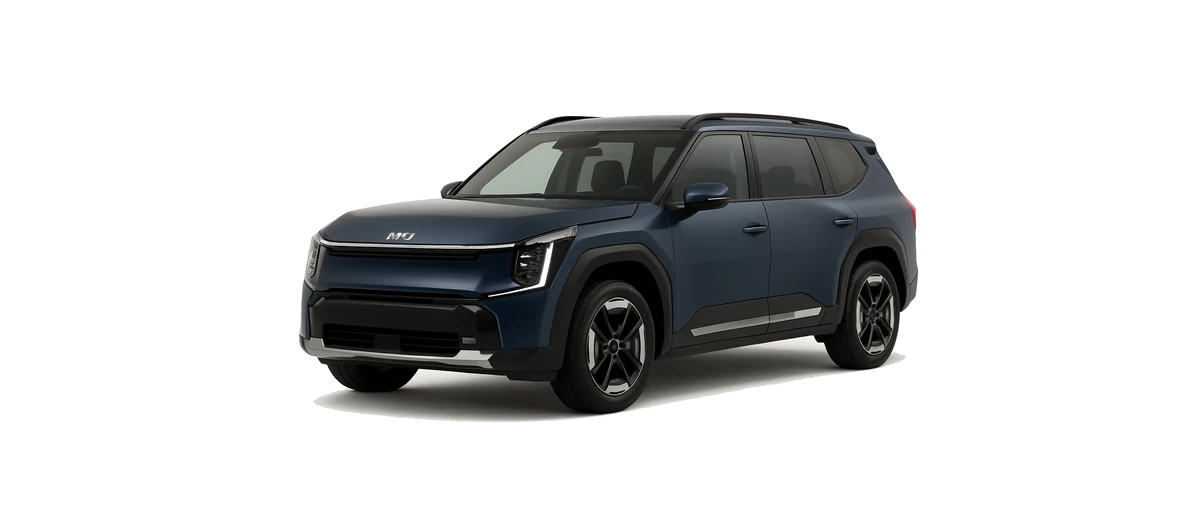
The Kia EV9 is a large, seven-seat electric SUV with one of the bigger battery packs currently available in a mainstream UK electric car. In the current UK range checked in June 2026, Kia lists a 99.8 kWh lithium-ion polymer battery across the EV9 line-up, including Air RWD, GT-Line AWD, GT-Line S AWD and the separately listed EV9 GT AWD. That large battery is central to the ownership experience: it gives the EV9 a strong touring range, but it also means home charging times are longer than they would be in a smaller EV.
For UK drivers, the key points are straightforward. The Kia EV9 uses a Type 2 connection for AC charging and CCS Combo 2 for DC rapid charging. It has an 11 kW onboard AC charger, although most UK homes with single-phase electricity will charge at up to 7.4 kW from a typical wallbox. On suitable high-power public chargers, Kia quotes up to 210 kW DC charging and a 10-80% rapid charge time of 24 minutes, subject to charger capability, battery temperature and weather conditions.
Kia EV9 Battery and Charging Specifications
The UK-market Kia EV9 is a battery electric vehicle, not a plug-in hybrid. It has no petrol or diesel engine and Kia UK lists it as producing 0 g/km CO2. Current UK specifications show the EV9 using Kia’s E-GMP dedicated EV platform with an 800-volt charging architecture, which is one reason the vehicle can achieve very quick rapid charging when connected to the right DC charger.
In practical terms, EV9 owners need to understand the difference between AC and DC charging. AC charging is what you normally use at home, at workplaces and at many destination chargers. The car’s onboard charger converts AC power into DC power for the battery, and in the EV9 this onboard AC capability is listed at 11 kW. DC rapid charging bypasses the onboard AC charger and feeds the battery directly through the CCS connector, allowing much higher charging speeds at motorway services and rapid charging hubs.
The EV9’s charging port arrangement is the standard UK and European EV setup: Type 2 for AC charging and CCS Combo 2 for DC rapid charging. For home and destination charging, that means a Type 2 cable is the correct cable type where the charger is untethered. For rapid charging, CCS cables are normally attached to the charger, so you do not usually bring your own DC cable.
Battery Options
Kia UK currently lists a 99.8 kWh battery for the UK EV9 range and for the EV9 GT. EV Database UK estimates usable capacity at around 96.0 kWh for the 99.8 kWh versions. The usable capacity figure is a helpful real-world reference because EVs generally reserve a small part of the battery to protect long-term battery health.
It is worth being careful with international information about the EV9, because specifications can vary by market and model year. For the current UK specification checked, the smaller battery pack sometimes mentioned in global EV9 coverage should not be assumed to apply to UK cars. UK buyers and owners should refer to their own vehicle documentation if they need confirmation for a particular car, especially if it is an import or an earlier specification.
A battery of this size is excellent for long-distance use and family travel, but it changes how you should think about charging. A small top-up at home may be quick, while a full 0-100% charge from low battery on a standard single-phase wallbox can take much of the day or overnight plus additional time. Most owners will not need to charge from empty to full regularly, but the large capacity is still important when planning home charging routines.
AC Charging Speed
The Kia EV9’s onboard AC charger is listed at 11 kW. On a three-phase AC supply, an 11 kW charge point can make better use of that capability. EV Database UK estimates that an 11 kW three-phase charge can take around 10 hours 30 minutes from 0-100%, while Kia UK gives an AC charging time of 9 hours 05 minutes from 10-100% at 230V/48A.
Most UK homes, however, are single-phase. A typical home wallbox in the UK is therefore more likely to provide up to 7.4 kW. At that rate, EV Database UK estimates a full 0-100% charge at around 15 hours 15 minutes. In daily use, that is less daunting than it sounds, because most drivers charge only the energy they have used rather than filling the battery from empty every night.
For example, if you return home with 45% remaining and set the car to charge to 80%, you are only adding a portion of the EV9’s battery capacity. That kind of top-up is much more manageable on a 7.4 kW home charger and can often be completed overnight, depending on when you plug in and what charge limit you choose.
DC Rapid Charging Speed
Rapid charging is where the EV9’s 800-volt architecture becomes especially useful. Kia quotes a maximum DC charging rate of up to 210 kW and an official 10-80% rapid charging time of 24 minutes. That is a strong figure for a large electric SUV, but it depends on using a suitable high-power 800V charger capable of delivering the required power.
Real charging sessions vary. Battery temperature, outside temperature, the charger’s condition, the number of vehicles using the site, and the car’s state of charge all affect the result. The fastest charging speeds are usually seen at lower to mid battery percentages, while charging typically slows significantly as the battery approaches 80% and beyond. For that reason, long motorway journeys are often quicker if you charge from a low state of charge to around 70-80%, then continue driving, rather than waiting for a full charge.
In colder weather, the EV9’s confirmed battery pre-conditioning is particularly useful. Kia UK confirms pre-conditioning for the EV9, including manual activation through the infotainment system or Kia Connect depending on conditions. Where possible, setting a DC fast charger as the destination in the vehicle navigation, or manually enabling pre-conditioning when appropriate, can help the battery reach a better temperature before you arrive.
Range and Efficiency
The highest WLTP figure in the UK EV9 range is 349 miles for the Air RWD. AWD versions are lower: Kia UK lists the GT-Line AWD at 316 miles, the GT-Line S AWD at 313 miles and the EV9 GT AWD at 316 miles. These figures are official laboratory test results and are useful for comparison, but real-world range will depend on driving style, speed, weather, tyres, payload and terrain.
EV Database UK estimates real-world range at around 275 miles for the 99.8 kWh EV9 versions. That is a useful planning figure for mixed conditions, although individual results will vary. Like most large SUVs, the EV9 will usually use more energy at motorway speeds than it does in slower urban or mixed driving. Cold weather, roof boxes, full passenger loads and heavy use of heating can also reduce range.
The standard heat pump across the UK EV9 range is a helpful efficiency feature, particularly in cooler conditions. It can reduce the energy required for cabin heating compared with a simple resistance heater, although it does not remove the normal winter range reduction entirely.
Charging at Home
For most Kia EV9 owners, a dedicated Type 2 home wallbox will be the most convenient way to charge. A tethered wallbox has the cable permanently attached, which is simple for daily use. An untethered wallbox uses a separate Type 2 cable, which can be useful if you want a cleaner-looking installation or want to carry the same cable for public destination charging.
Because the EV9 has a large battery, charging speed matters. A 7.4 kW home charger is normally the realistic expectation for a single-phase UK property. If your home has three-phase electricity, an installer may be able to advise whether an 11 kW AC charger is suitable, allowing the EV9 to use more of its onboard AC capability.
Smart charging is also worth using where available. Charging overnight on a suitable EV electricity tariff can reduce costs, while scheduled charging lets you set the EV9 to reach your chosen limit before departure. Many owners choose an everyday charge limit below 100%, such as 80%, and only charge higher before a long trip. Always follow the guidance in the vehicle handbook for battery care and charge limits.
A 3-pin charger is generally best suited as a backup or occasional charging solution, but can be used regularly if a qualified electrician has confirmed the socket and electrical installation are suitable for sustained EV charging. For the EV9 specifically, a normal 3-pin plug will be very slow because of the battery size, so it is not the most practical main charging method for most owners.
Public Charging
For public AC charging, the Kia EV9 uses a Type 2 connection. Many destination chargers at hotels, car parks, workplaces and town centres are untethered, so you will need your own Type 2 cable. The actual speed may be limited by the charger, the site supply or the car’s onboard AC charger. If a post offers 7 kW, the EV9 will charge at around that level even though the car can accept up to 11 kW AC.
For DC rapid and ultra-rapid charging, the EV9 uses CCS Combo 2. These chargers have their own thick CCS cable attached, so cable selection is not normally an issue. Instead, the important step is choosing the right charger. To get close to the EV9’s headline 210 kW capability, look for a high-power charger rated above that level and capable of supporting 800V vehicles. Lower-powered rapid chargers will still work if compatible, but the session will take longer.
On long trips, route planning makes the biggest difference. Choose charging hubs with multiple high-power units where possible, arrive with the battery warm and at a sensible state of charge, and avoid relying on a single charger if you have a tight schedule. If you only need enough energy to reach the next stop or your destination, stopping at around 80% can often save time because charging speed typically reduces above that point.
Vehicle-Specific Features
The Kia EV9 has several charging-related features that are worth understanding. Battery pre-conditioning is confirmed and is especially useful before DC rapid charging in cold weather. Pre-conditioning helps prepare the battery for faster charging, although it still depends on conditions and does not guarantee the maximum charging rate every time.
Vehicle-to-load, or V2L, is also listed as standard across the EV9 range. V2L allows the car to power suitable appliances or devices, for example when camping or using equipment away from mains power. It is not the same as powering your home or exporting electricity to the grid. Kia UK states that its UK EVs currently support V2L only, not V2G or V2H. Also note that while V2L capability is listed across the range, Kia’s specification tables show the external V2L adapter on selected trims such as GT-Line S and EV9 GT, so equipment supplied may vary by version.
The standard heat pump is another useful feature for UK conditions, helping improve heating efficiency. Combined with sensible charging habits and pre-conditioning before rapid charging, it makes the EV9 better suited to year-round electric family travel.
Charging Tips
- Use a dedicated wallbox at home: A 7.4 kW Type 2 wallbox is the usual choice for single-phase UK homes and is far more practical than relying on a 3-pin plug.
- Check whether you have three-phase power: If you do, the EV9’s 11 kW AC capability may be useful with the right installation.
- Pre-condition before rapid charging: In cold weather, use the vehicle navigation or manual pre-conditioning where available before arriving at a DC fast charger.
- Do not chase 100% on every journey: For rapid charging stops, charging to around 80% is often quicker unless you genuinely need more range.
- Carry a Type 2 cable: It is useful for untethered public AC chargers, hotels, workplaces and destination charging.
- Plan around charger capability: The EV9’s fastest charging requires a suitable high-power 800V charger, not just any rapid charger.
Frequently Asked Questions
What charging cable does the Kia EV9 use?
The Kia EV9 uses Type 2 for AC charging. For public DC rapid charging it uses CCS Combo 2, and the CCS cable is normally attached to the rapid charger.
Can the Kia EV9 charge at 22 kW AC?
The UK EV9’s onboard AC charger is listed at 11 kW, so it will not make full use of a 22 kW AC post. It may still charge from a 22 kW Type 2 post, but the car’s onboard charger limits the AC charging rate.
How long does the Kia EV9 take to charge at home?
On a typical UK 7.4 kW single-phase wallbox, EV Database UK estimates around 15 hours 15 minutes for a 0-100% charge. Most daily charging sessions will be shorter because you are usually topping up rather than charging from empty.
How fast can the Kia EV9 rapid charge?
Kia quotes up to 210 kW DC and a 10-80% time of 24 minutes, but this depends on a suitable high-power 800V charger, battery temperature, weather and other real-world conditions.
Does the Kia EV9 support V2L?
Yes, V2L capability is listed for the EV9. It can power suitable devices and appliances, but it should not be confused with V2G or V2H, which Kia UK does not currently list for UK EV owners.
What This Means for Drivers
The Kia EV9 is well suited to drivers who need a spacious electric SUV with genuine long-distance ability. Its 99.8 kWh battery gives it strong range potential, while the 800V architecture and up to 210 kW DC charging capability can make motorway stops impressively short when the right charger and conditions are available.
At home, the main thing to remember is that the EV9’s battery is large. A 7.4 kW wallbox is still a very practical solution for most owners, but full charges take time, so it is best to think in terms of regular top-ups and planned overnight charging rather than waiting until the battery is nearly empty. For public charging, a Type 2 cable covers AC destination charging, while CCS rapid chargers handle high-speed motorway top-ups.
Looking for a Charging Cable for Kia EV9?
If you need a compatible Type 2 cable for home, workplace or public AC charging, we have a dedicated Kia EV9 charging cable category to help you choose the right option for your vehicle and charging setup.
Please note that this information is intended as a guide. Charging specifications may change due to model and year of manufacture. For precise information, always refer to your vehicle user manual.

