
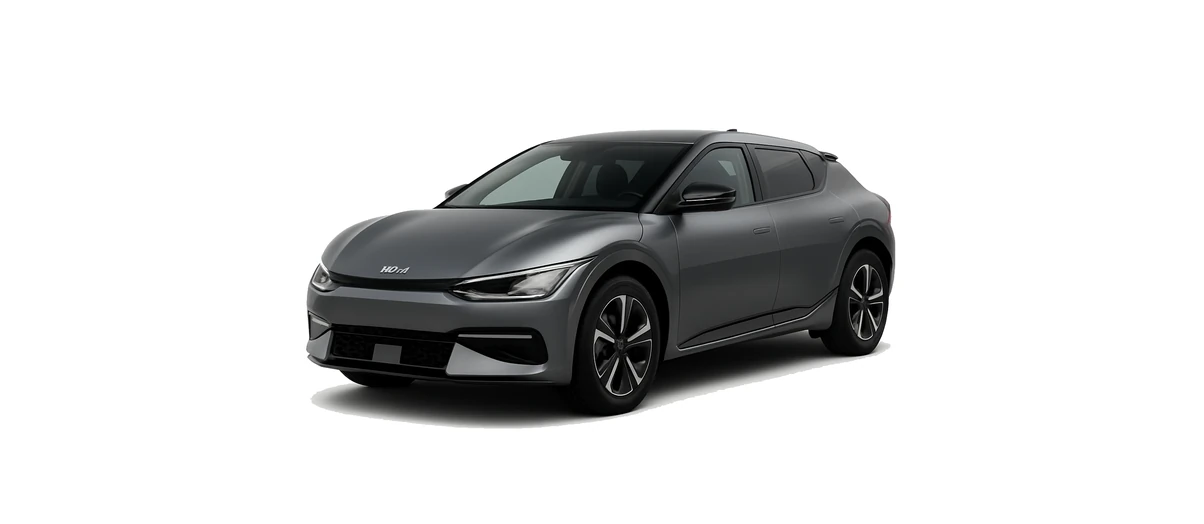
The Kia EV6 is a pure battery-electric crossover built on Hyundai Motor Group’s E-GMP dedicated EV platform. It is best known for combining practical family-car usability with very fast 800 V DC rapid charging, making it one of the more capable long-distance EVs in its class when it is connected to the right ultra-rapid charger.
For everyday UK ownership, however, most EV6 charging is likely to be much simpler: a Type 2 wallbox at home, often at up to 7.4 kW on a single-phase supply, with occasional CCS rapid charging on longer trips. This guide explains the key charging details for the Kia EV6, including battery versions, AC and DC charging speeds, cable selection, range expectations and useful vehicle-specific features.
Kia EV6 Battery and Charging Specifications
The UK-market Kia EV6 uses a Type 2 inlet for AC charging and a CCS Combo 2 connection for DC rapid charging. In UK and European specification, the charge port is located at the rear-right of the vehicle. For home and destination charging, you will typically use a Type 2 cable or a tethered Type 2 wallbox. For rapid and ultra-rapid charging, the CCS cable is normally permanently attached to the public charger.
Current UK EV6 models use an 11 kW AC on-board charger. That figure is the maximum AC rate the car can accept, but many UK homes have single-phase electricity, where a 7.4 kW wallbox is the more common practical maximum. On DC, the EV6’s 800 V architecture allows very high charging speeds when connected to a suitable high-power charger. Kia quotes a 10-80% DC charging time of 18 minutes on an appropriate 800 V ultra-rapid charger delivering at least 260 kW, with EV Database listing a maximum DC charging rate of up to 263 kW for current models.
Battery Options
It is important not to assume that every Kia EV6 on UK roads has the same battery. Current facelift UK EV6 models listed in 2026 use an 84.0 kWh lithium-ion polymer battery in RWD and AWD forms. EV Database estimates usable capacity for the current 84 kWh non-GT models at around 80.0 kWh. The current EV6 GT is also listed by Kia UK with an 84.0 kWh battery, although usable capacity for the GT should be treated cautiously unless confirmed separately.
Many used Kia EV6 examples in the UK are pre-facelift long-range cars built before the facelift changeover. These earlier long-range EV6 models used a 77.4 kWh gross battery, with EV Database listing usable capacity at approximately 74 kWh. The important point for cable selection is that both the earlier 77.4 kWh and current 84.0 kWh EV6 use Type 2 AC and CCS DC charging, so the connector type is the same.
If you are identifying your own car, the model year, registration date, trim, Kia documentation and infotainment vehicle information can help. As a simple guide, facelift EV6 models available from late 2024 onwards are associated with the 84.0 kWh battery, while many 2022 to August 2024 long-range cars are 77.4 kWh versions.
AC Charging Speed
The Kia EV6 can accept up to 11 kW on AC. Kia quotes a 10-100% AC charging time of 7 hours 35 minutes on an 11 kW three-phase charger for the current 84 kWh EV6 and EV6 GT. This is useful at some workplaces, hotels, commercial sites and three-phase domestic installations, but it is not the normal setup for most UK homes.
In many UK households, a dedicated single-phase 7.4 kW wallbox is the realistic maximum. At this rate, charging a current 84 kWh EV6 from empty to full may take roughly overnight, with EV Database indicating about 12 hours 45 minutes for the 84 kWh RWD/AWD models. In practice, most drivers do not regularly arrive home at 0% or charge all the way to 100%, so typical top-ups are usually much shorter.
A 3-pin charger is generally best suited as a backup or occasional charging solution, but can be used regularly if a qualified electrician has confirmed the socket and electrical installation are suitable for sustained EV charging. For a vehicle with a large battery such as the EV6, a proper home wallbox is normally more convenient, safer and faster for routine charging.
DC Rapid Charging Speed
DC charging is where the Kia EV6 stands out. Its E-GMP platform and 800 V architecture allow the car to make very effective use of powerful CCS ultra-rapid chargers. On a suitable charger, Kia quotes 10-80% in 18 minutes, provided the charger can support the necessary high voltage and deliver at least around 260 kW. Real-world charging speed still depends on charger capability, battery temperature, state of charge and site conditions.
On a lower-powered 50 kW rapid charger, the EV6 will still charge via CCS, but the stop will take much longer. A 150 kW charger can also be very useful, though it may not deliver the headline 18-minute 10-80% session. For the fastest motorway stops, the best approach is to arrive at a compatible ultra-rapid charger with roughly 10-20% battery and leave at around 80%, because charging power usually tapers significantly above 80%.
Battery preconditioning is confirmed for the EV6, and current models are listed with navigation-based automatic preconditioning. This can help prepare the battery before a planned DC fast charge, especially in colder weather, improving the chance of achieving stronger charging performance when you arrive.
Range and Efficiency
Current UK Kia EV6 range figures vary by drivetrain, trim and wheel size. Kia lists up to 361 miles WLTP combined for the most efficient current RWD Air and GT-Line models on 19-inch wheels. The RWD GT-Line S on 20-inch wheels is listed at up to 347 miles. Current AWD models are listed at up to 339 miles for GT-Line and 324 miles for GT-Line S, while the EV6 GT is listed at 279 miles WLTP combined.
WLTP figures are useful for comparison, but real-world range depends on speed, temperature, driving style, terrain, tyre choice, wheel size and use of heating or air conditioning. EV Database estimates around 280 miles of real-world range for the current 84 kWh RWD EV6 and around 270 miles for the current 84 kWh AWD version in average conditions. Cold winter motorway driving will usually reduce range, while slower urban and mixed driving in mild weather can be more efficient.
Charging at Home
For most EV6 owners, the easiest charging routine is to plug in at home overnight. A dedicated Type 2 wallbox lets you schedule charging for off-peak electricity rates, set a preferred charge limit and start each day with the range you need. Because the EV6 has a large battery, the convenience of home charging makes a significant difference to ownership.
If your wallbox is tethered, the cable is permanently attached and you simply plug it into the EV6’s Type 2 port. If your wallbox is untethered, you will need a separate Type 2 to Type 2 charging cable. A 32 amp cable is the usual choice for 7.4 kW single-phase home charging, while an 11 kW three-phase setup requires a suitable three-phase Type 2 cable and installation.
Many owners set a daily charging limit below 100% for routine use and only charge to full before longer journeys. The exact charge limit you choose depends on your driving pattern, energy tariff and personal preference, but regular overnight top-ups are generally easier on planning than waiting until the battery is nearly empty.
Public Charging
Public charging falls into two broad categories for the EV6: AC destination charging and DC rapid charging. AC destination chargers are common at car parks, hotels, shopping centres and workplaces. These normally use Type 2 connections and may require you to bring your own cable. The EV6 can use these chargers up to its 11 kW AC limit, although the actual speed depends on the charger and supply.
For longer journeys, CCS rapid and ultra-rapid chargers are the key. The EV6’s charging performance is strongest on high-power chargers that can support its 800 V system. When route planning, it can be worth choosing reliable ultra-rapid hubs rather than simply stopping at the first available charger, particularly if you want the shortest possible break.
Remember that the charger display may not show the peak charging rate for long. A healthy rapid-charging session rises and falls as the car manages battery temperature and state of charge. This is normal, and the total time from 10-80% is usually more important than the highest number briefly shown on the charger.
Vehicle-Specific Features
The Kia EV6 includes several features that affect charging and energy use. Vehicle-to-load, or V2L, is confirmed across the current UK EV6 range, although equipment differs by trim. Kia lists V2L capability for Air and GT-Line, while GT-Line S and GT include V2L capability with an adapter plus a 3-pin socket. V2L can power compatible external electrical devices, but it should not be confused with vehicle-to-grid or vehicle-to-home operation.
V2G and V2H support should not be assumed for the UK EV6. EV Database lists V2H and V2G as not supported, and Kia UK materials confirm V2L rather than domestic backup or grid export capability.
The heat pump is also not universal. Kia UK lists a Heat Pump pack for GT-Line S, while the EV6 GT includes a heat pump as standard. If you are buying used or comparing trims, check the vehicle specification rather than assuming every EV6 has one.
Charging Tips
- Use Type 2 for home and destination charging. The EV6 has an 11 kW AC on-board charger, but many UK homes will charge at up to 7.4 kW on single phase.
- Choose CCS ultra-rapid chargers for the quickest journey stops. The EV6 performs best on high-power chargers that can support its 800 V architecture.
- Arrive low, leave around 80%. For rapid charging, a 10-80% session is usually more time-efficient than charging beyond 80%.
- Use battery preconditioning before fast charging. This is particularly helpful in cold weather when battery temperature can limit charging speed.
- Check which battery your car has. Current facelift cars use an 84.0 kWh battery, while many earlier long-range EV6 models use a 77.4 kWh battery.
- Carry the right public charging cable. Many AC public chargers are untethered, so a Type 2 to Type 2 cable is useful even if you mainly charge at home.
Frequently Asked Questions
What charging cable does the Kia EV6 use?
The Kia EV6 uses a Type 2 connection for AC charging and CCS Combo 2 for DC rapid charging. For home wallboxes and many public AC charge points, a Type 2 to Type 2 cable is the correct cable type unless the charger is tethered.
Can the Kia EV6 charge at 22 kW AC?
No. The EV6’s AC on-board charger is rated at up to 11 kW. A 22 kW public AC charge point can still be used, but the car will not take the full 22 kW.
How long does the Kia EV6 take to charge at home?
On an 11 kW three-phase AC charger, Kia quotes 10-100% in 7 hours 35 minutes for the current 84 kWh EV6. On a typical UK 7.4 kW single-phase home wallbox, a full charge will take longer, with around 12 hours 45 minutes indicated for current 84 kWh models by EV Database.
Is the 18-minute rapid charging time guaranteed?
No. The 18-minute 10-80% figure requires a suitable 800 V ultra-rapid charger delivering at least around 260 kW, and charging speed is affected by battery temperature, state of charge and charger conditions.
Do all Kia EV6 models have the 84.0 kWh battery?
No. Current facelift UK models use an 84.0 kWh battery, but earlier UK long-range EV6 cars used a 77.4 kWh battery.
What This Means for Drivers
The Kia EV6 is unusually capable on long journeys because it can charge extremely quickly on the right CCS ultra-rapid charger. That said, the everyday ownership experience is still built around straightforward Type 2 charging. For most UK drivers, a 7.4 kW home wallbox will provide easy overnight charging, while a Type 2 cable is useful for untethered public AC chargers.
The main point is to match the charging method to the situation. Use home charging for routine daily range, destination charging when parked for several hours, and high-power CCS charging for longer trips. If you own or are buying a used EV6, check whether it is a 77.4 kWh pre-facelift model or an 84.0 kWh facelift model, but remember that the charging connector choice remains Type 2 and CCS.
Looking for a Charging Cable for Kia EV6?
If you need a suitable cable for home, workplace or public AC charging, choose a Type 2 charging cable matched to your charging setup and the Kia EV6’s 11 kW AC capability.
Please note that this information is intended as a guide. Charging specifications may change due to model and year of manufacture. For precise information, always refer to your vehicle user manual.

