
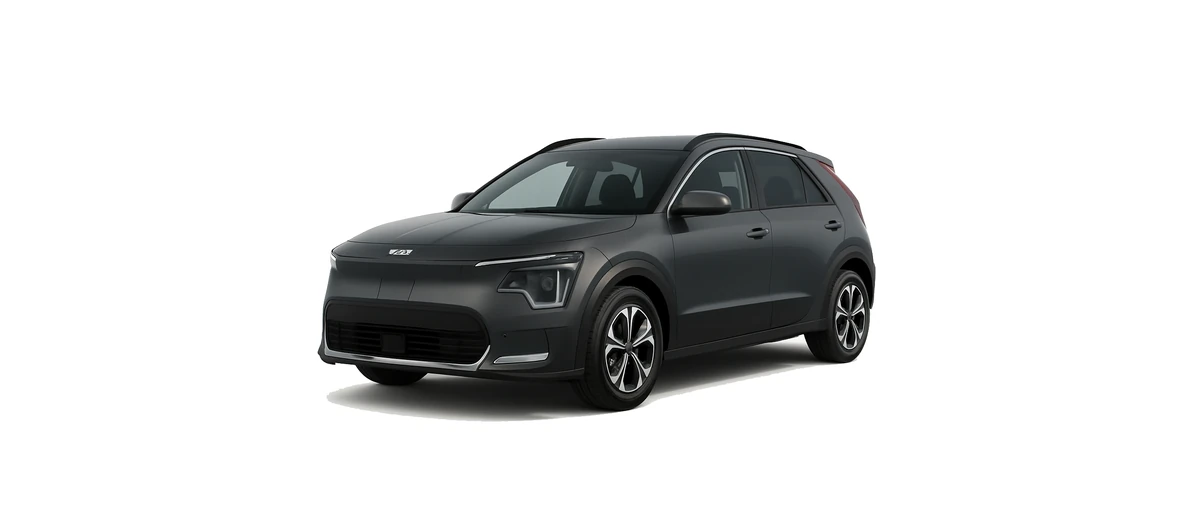
The Kia e-Niro is the battery-electric version of the first-generation Kia Niro crossover. In the UK it was sold before being replaced by the second-generation Kia Niro EV in 2022, so it is important not to mix e-Niro charging information with newer Niro EV specifications or with the separate Niro Hybrid and Niro Plug-in Hybrid models.
This guide focuses on the discontinued UK-market Kia e-Niro. It explains the key differences between the 39 kWh and 64 kWh versions, the standard 7.2 kW AC charging setup, the less common 11 kW three-phase AC option on some 64 kWh cars, and what cable type you need for home and public charging.
View Kia e-Niro Charging Cables
Kia e-Niro Battery and Charging Specifications
The Kia e-Niro uses a Type 2 connector for AC charging and a CCS Combo 2 connector for DC rapid charging. The charge port is positioned at the front-centre of the vehicle, which can be convenient at many UK public charging bays, although bay layout still varies from site to site.
For most UK owners, the most important specification is the onboard AC charger. The standard figure for the e-Niro is 7.2 kW single-phase AC charging. This means that, even if you plug into a faster public AC post, the car will normally only draw up to its own onboard limit. Some later or higher-spec 64 kWh e-Niro examples were available with an 11 kW three-phase onboard charger, but this should be checked against the individual vehicle’s specification rather than assumed.
On DC rapid charging, the 64 kWh e-Niro can charge at up to around 77 kW in suitable conditions, while the 39 kWh version has a lower DC peak of around 44 kW. As with all EVs, the actual speed you see depends on battery temperature, state of charge, charger capability and the car’s charging curve.
Battery Options
UK e-Niro models are commonly discussed as either the 39 kWh or 64 kWh version. These names refer to the marketed battery sizes, but usable capacity figures are slightly different.
The smaller-battery e-Niro has a usable capacity of about 39.2 kWh, with a nominal battery size listed at around 42.0 kWh. It was generally associated with lower-powered versions of the car and later UK ‘2’ grade examples. WLTP range is listed at around 180 miles, while a more realistic mixed-use figure is closer to about 145 miles depending on conditions and driving style.
The long-range e-Niro has a usable capacity of about 64.0 kWh, with an estimated nominal capacity of around 67.5 kWh. This is the version many UK drivers think of when they refer to the Kia e-Niro, and it is the most common case for charging guides. WLTP range is around 282–283 miles depending on source and rounding, while real-world range is often closer to about 230 miles in mixed driving.
If you have just bought a used e-Niro, do not rely only on the model name. Check the vehicle documents, original order specification, infotainment information where available, or the trim and battery details supplied by the seller. This matters because the battery size affects range, DC rapid charging speed and full-charge time.
AC Charging Speed
For normal home and destination charging, the Kia e-Niro uses Type 2 AC charging. The standard onboard charger is 7.2 kW single-phase, which suits the typical UK 7 kW home wallbox very well.
Approximate full-charge times from empty to full are around 6 hours 30 minutes for the 39 kWh version on a 7.2 kW AC charger, and around 10 hours 30 minutes for the 64 kWh version on the same type of charger. In everyday use, most owners will not be charging from 0% to 100%; topping up overnight from a partial state of charge is usually much quicker.
Some 64 kWh e-Niro cars were available with an optional or trim-specific 11 kW three-phase AC onboard charger. If fitted, and if connected to a suitable three-phase AC charge point, this can reduce a full charge to roughly 7 hours for the 64 kWh car. However, three-phase charging is not common in ordinary UK domestic settings, and not every 64 kWh e-Niro has this capability.
For cable selection, a Type 2 cable rated at least 32A single-phase is suitable for 7 kW charging. An 11 kW or 22 kW three-phase Type 2 cable can also be used with the e-Niro and may be useful on public AC posts, but the car will only draw the power its onboard charger supports.
DC Rapid Charging Speed
For longer journeys, the e-Niro uses CCS rapid charging. The 64 kWh version can reach a peak of about 77 kW DC under favourable conditions. On a high-power CCS charger, a 10–80% charge takes about 46 minutes according to EV Database figures, although public guides often round similar sessions to around 50 minutes or slightly longer depending on the exact start and end percentage.
The 39 kWh e-Niro has a lower DC peak of about 44 kW. Its 10–80% rapid charge time is still listed at roughly 47 minutes, because the smaller battery needs less energy overall but accepts power at a lower peak rate.
Plugging the 64 kWh e-Niro into a 150 kW or 350 kW rapid charger will not make the car charge above its own limit. It may still be worthwhile if that is the available charger, but the e-Niro’s charging hardware and battery management determine the maximum rate. Rapid charging also slows as the battery fills, so the most useful rapid-charging window is usually up to around 80%.
Range and Efficiency
The 64 kWh Kia e-Niro earned a strong reputation in the UK because it offered practical range in a compact crossover body. A WLTP figure of around 282–283 miles made it competitive for its time, and a real-world figure of around 230 miles is a sensible planning estimate for mixed driving.
The 39 kWh version is better viewed as a shorter-range e-Niro. Its WLTP figure of around 180 miles and real-world estimate of about 145 miles can still work well for commuting, local travel and predictable daily routes, but it needs more planning on longer motorway journeys.
Range varies with speed, temperature, tyre condition, load, road type and use of heating or air conditioning. Cold weather can noticeably reduce efficiency, especially on shorter journeys where the cabin and battery start cold. The heat pump was optional on the 64 kWh e-Niro and not universal, so winter efficiency can vary between individual cars.
Charging at Home
A dedicated 7 kW home wallbox is the most practical home-charging option for most Kia e-Niro owners. It matches the standard 7.2 kW single-phase onboard charger closely and allows easy overnight charging. For the 64 kWh model, a full charge from empty may take around 10 hours 30 minutes, but a normal daily top-up will often take far less time.
If you have an untethered home charger, you will need a compatible Type 2 charging cable. If your charger is tethered, the cable is permanently attached to the unit, so you may still want a separate Type 2 cable for public AC charging.
A 3-pin domestic charger is generally best suited as a backup or occasional charging solution, but can be used regularly if a qualified electrician has confirmed the socket and electrical installation are suitable for sustained EV charging. Standard domestic sockets were not designed primarily for repeated high-load EV charging, so professional electrical advice is important if you intend to rely on this method.
Owners who believe they have an 11 kW-capable 64 kWh e-Niro should remember that using 11 kW AC at home normally requires a suitable three-phase supply and compatible charge point. Most UK homes are single-phase, so many e-Niro owners will see no benefit from installing equipment beyond the car and property’s practical limits.
Public Charging
On public AC charge points, the e-Niro uses a Type 2 cable. Many UK destination chargers are untethered, meaning you bring your own cable. These are common at supermarkets, town-centre car parks, hotels, workplaces and leisure locations. A 32A Type 2 cable is therefore a useful item to keep in the car.
On rapid and ultra-rapid chargers, the cable is normally tethered to the charging unit and plugs into the e-Niro’s CCS port. For motorway journeys, CCS rapid charging is the right choice because it bypasses the onboard AC charger and supplies DC power directly to the battery system.
When planning a longer route, it is sensible to aim for rapid charging stops that fit naturally into your journey rather than waiting until the battery is very low. Charging from roughly 10% to 80% is usually more time-efficient than charging to 100% on a rapid charger, because the final part of the battery fills more slowly.
Vehicle-Specific Features
The first-generation Kia e-Niro is a 400 V battery-electric crossover, not one of Kia’s later dedicated E-GMP models. It does not use the newer Kia Niro EV’s 64.8 kWh battery specification, and it should not be described using later-model charging features.
Heat pump availability depends on version and specification. It is listed as optional on the 64 kWh e-Niro, while the 39 kWh listing does not show it as fitted. If winter efficiency is important to you, check the individual car rather than assuming all examples have the same equipment.
Battery preconditioning is not listed as available for the first-generation e-Niro, so owners should not expect route-based battery preparation before arriving at a rapid charger. In cold weather, rapid charging may be slower until the battery is warm enough to accept higher power.
Vehicle-to-load, vehicle-to-grid and vehicle-to-home functions are not supported on the first-generation e-Niro according to the available specification data. Those features are associated with other or newer Kia EVs and should not be carried over to this model.
Charging Tips
- Identify your battery first: 39 kWh and 64 kWh e-Niro models have different range and DC charging characteristics.
- Assume 7.2 kW AC unless confirmed otherwise: 11 kW AC charging applies only to certain 64 kWh examples where fitted.
- Choose the right Type 2 cable: a 32A single-phase Type 2 cable is suitable for 7 kW charging; a three-phase cable is also compatible but will not force the car to charge faster.
- Use CCS for long trips: rapid charging is best for motorway and intercity journeys.
- Expect slower charging in winter: cold batteries and high states of charge can reduce rapid-charging speed.
- Do not compare directly with the newer Niro EV: the 2022-on successor has different equipment and specifications.
Frequently Asked Questions
Is the Kia e-Niro a plug-in hybrid?
No. The Kia e-Niro is a battery-electric vehicle. The Niro Plug-in Hybrid is a separate model with different charging hardware and a much smaller battery.
What charging cable does the Kia e-Niro use?
For AC charging, the e-Niro uses a Type 2 cable. For DC rapid charging, it uses CCS Combo 2, and the cable is normally attached to the rapid charger.
Can every Kia e-Niro charge at 11 kW AC?
No. The standard AC charging figure is 7.2 kW single-phase. Some 64 kWh cars had an optional or trim-specific 11 kW three-phase onboard charger, but this should be verified for the individual vehicle.
How long does the 64 kWh Kia e-Niro take to rapid charge?
In suitable conditions, the 64 kWh e-Niro can charge from 10–80% in about 46 minutes on a high-power CCS charger. Real sessions may be longer depending on temperature, charger output and battery state of charge.
Does the Kia e-Niro support V2L?
No. The first-generation e-Niro is not listed as supporting V2L, V2G or V2H. Do not assume features from newer Kia electric models apply to it.
What This Means for Drivers
For most UK Kia e-Niro owners, charging is straightforward once the exact version is understood. A 7 kW home wallbox and Type 2 cable suit the standard 7.2 kW onboard charger, while CCS rapid charging covers longer journeys. The 64 kWh model offers the longest range and the higher DC peak, while the 39 kWh model remains practical for shorter daily use.
The main point is to avoid assuming all e-Niro cars are the same. Check whether you have the 39 kWh or 64 kWh battery, and whether your 64 kWh example is one of the less common cars with 11 kW AC charging. That will help you choose the right cable, interpret public charger speeds accurately and plan trips with realistic expectations.
Looking for a Charging Cable for Kia e-Niro?
If you need a replacement or spare Type 2 cable for the Kia e-Niro, choose a cable that matches how you charge most often, such as a 32A Type 2 cable for home and public AC charging.
View Kia e-Niro Charging Cables
Please note that this information is intended as a guide. Charging specifications may change due to model and year of manufacture. For precise information, always refer to your vehicle user manual.

