
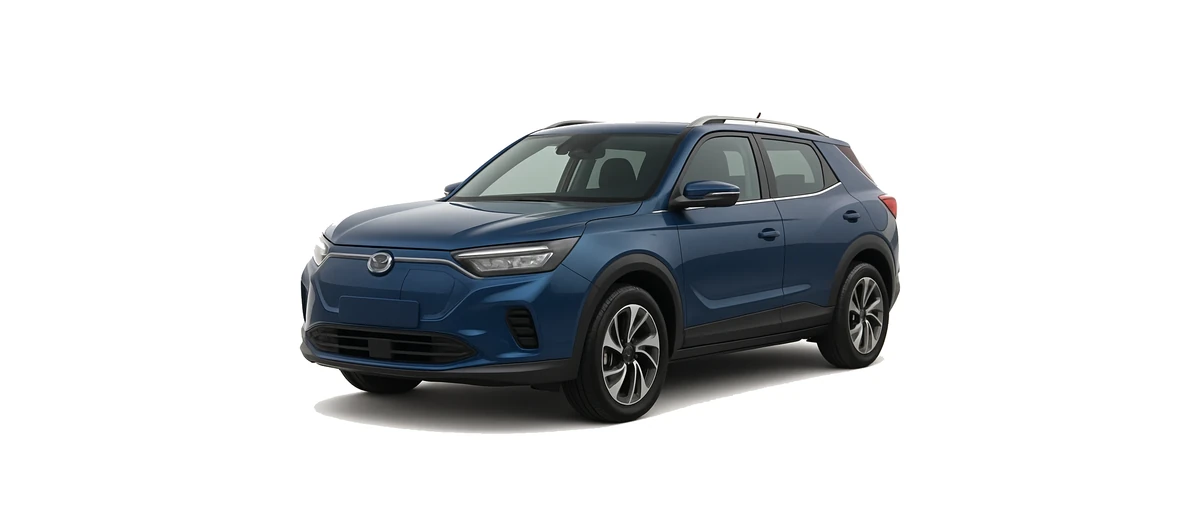
The KGM Korando E-Motion, originally sold in the UK under SsangYong branding and later associated with KGM/SsangYong, is a pure electric compact SUV that is now most relevant to used-car buyers and existing owners. Current UK Korando listings focus on petrol models, but the Korando E-Motion remains an interesting used EV thanks to its practical SUV body, 61.5 kWh battery and official WLTP combined range of up to 211 miles in historical UK brochure data.
For charging, the key point is straightforward: the Korando E-Motion uses a Type 2 connection for AC charging and a CCS Combo 2 connection for DC rapid charging. It is not an 11 kW or 22 kW AC-charging EV; available UK data points to a 6.6 kW single-phase onboard charger. That makes cable choice and home charging expectations especially important.
View KGM Korando E-Motion Charging Cables
KGM Korando E-Motion Battery and Charging Specifications
The Korando E-Motion is a battery-electric vehicle, not a plug-in hybrid. It does not use petrol for propulsion and does not have a range-extender engine. UK-market cars were offered in trims such as ELX, Ventura and Ultimate, although equipment details can vary by model year and individual used-car specification.
The charging port is the European-standard Type 2 / CCS Combo 2 arrangement. For slower AC charging at home, work or public destination chargers, the upper Type 2 part of the socket is used. For rapid charging, the larger CCS connector is used, with the DC rapid charger’s tethered cable plugging into the full port.
- Vehicle type: pure battery-electric compact SUV
- Battery: 61.5 kWh lithium-ion / lithium-ion polymer pack, according to historical UK data
- Official WLTP combined range: up to 211 miles
- Typical real-world range: around 180 miles, depending on conditions and driving style
- AC charging port: Type 2
- DC rapid charging port: CCS Combo 2
- Onboard AC charger: 6.6 kW single-phase
- Indicative rapid charging: sources vary, but a 10-80% stop is commonly quoted at around 36-40 minutes or a little over, depending on charger and conditions
Battery Options
Unlike some electric SUVs, the UK Korando E-Motion is best understood as having one main battery option: a 61.5 kWh high-voltage lithium-ion battery pack. Historical UK brochure material confirms this gross battery capacity across the range.
It is worth being cautious with usable battery capacity figures. Some third-party sources estimate usable capacity in the mid-50 kWh region, but this is not clearly confirmed as an official UK figure. For ownership planning, the more useful figures are the official 211-mile WLTP combined range and the more realistic expectation that many drivers will see less than that in mixed UK use, particularly in winter or at motorway speeds.
AC Charging Speed
AC charging is where cable choice matters most. The KGM Korando E-Motion has a 6.6 kW single-phase onboard AC charger. This means a typical UK 7 kW home wallbox is a sensible match, but the car will be limited by its onboard charger rather than taking the full output available from some charge points.
In practical terms, a full 0-100% charge from a 7 kW home charger is likely to take roughly 10-11 hours, depending on the starting battery level, charger behaviour, ambient temperature and charging losses. Most owners will not regularly charge from completely empty to full, so overnight top-ups are generally straightforward.
A 32A single-phase Type 2 cable is sufficient for the Korando E-Motion’s maximum AC charging rate. Choosing an 11 kW or 22 kW three-phase cable will not make the vehicle charge at 11 kW or 22 kW, because the limitation is inside the vehicle. However, some owners still choose a higher-rated cable for future-proofing or for use with another EV, provided the cable is compatible with the charge point and vehicle.
DC Rapid Charging Speed
For longer journeys, the Korando E-Motion uses the CCS rapid-charging standard. You do not need to carry your own cable for CCS rapid charging, because rapid chargers have tethered cables attached.
Rapid-charging figures for the Korando E-Motion are reported differently depending on the source. Some historical brochure and review material refers to higher rapid-charging capability and 20-80% times of around the low-30-minute region, while other charge-data sources list a maximum closer to 74 kW and around 36 minutes for 10-80%. Some reviews describe a 10-80% top-up as taking just over 40 minutes.
The best real-world approach is to plan around 10-80% rapid-charging stops rather than expecting a single fixed peak speed throughout the session. Like most EVs, the Korando E-Motion will usually charge fastest when the battery is at a lower state of charge, then slow down as the battery fills. Charging from 80% to 100% on a rapid charger can take disproportionately longer, so it is usually best reserved for situations where you genuinely need the extra range.
Range and Efficiency
The official WLTP combined range for the Korando E-Motion is up to 211 miles, with historical brochure data also quoting a higher city-focused WLTP figure. In everyday UK driving, a more cautious planning figure of around 180 miles is sensible for mixed use, although your result will vary.
Range is affected by speed, temperature, tyres, payload, road conditions and how much cabin heating or air conditioning is used. Motorway driving in cold or wet weather will reduce range, while urban and suburban driving at lower speeds is usually more efficient. As with any used EV, battery condition and maintenance history can also influence how confidently the car delivers its expected range.
Charging at Home
For most Korando E-Motion owners, home charging will be the most convenient and cost-effective way to run the vehicle. A dedicated 7 kW Type 2 home charge point is the ideal setup. It gives a charging rate close to the car’s 6.6 kW onboard limit and allows the vehicle to be topped up overnight.
If you have off-peak electricity pricing, setting the vehicle or charger to charge during cheaper hours can significantly reduce running costs. Because the Korando E-Motion has a usable day-to-day range for commuting, school runs and local driving, many owners will only need to add a partial charge each night rather than fully charging the battery.
A 3-pin charger is generally best suited as a backup or occasional charging solution, but can be used regularly if a qualified electrician has confirmed the socket and electrical installation are suitable for sustained EV charging. Standard domestic sockets were not originally designed for repeated high-load EV charging over many hours, so a professionally installed wallbox is normally the better long-term option.
Public Charging
When using public AC chargers, the Korando E-Motion will normally require your own Type 2 cable unless the unit is tethered. A 32A single-phase Type 2 cable is the correct practical choice for supporting the car’s AC capability. Three-phase AC posts are safe to use if compatible, but the car will still charge at its single-phase 6.6 kW limit rather than at the full advertised output of the post.
For motorway and long-distance charging, look for CCS rapid chargers. Because rapid charging slows at higher battery percentages, a common strategy is to arrive with a lower state of charge, charge to around 70-80%, then continue the journey. This is often quicker than waiting for a full 100% charge at each stop.
Public-charging reliability and pricing vary across UK networks, so it is worth using route-planning apps and checking recent charger status before arriving. If you are buying a used Korando E-Motion, setting up accounts or contactless payment options with the networks you use most can make longer trips much easier.
Vehicle-Specific Features
The Korando E-Motion is an electric derivative of the Korando SUV rather than a model widely described as being built on a dedicated EV-only platform. Its appeal is therefore more about familiar SUV practicality, a useful battery size and accessible used pricing than cutting-edge ultra-fast charging.
Heat-pump or range-enhancing heating references are most clearly associated with Ultimate trim in UK launch and brochure material. If you are relying on this feature for winter efficiency, check the exact trim and equipment of the individual car rather than assuming every Korando E-Motion has it.
Reliable Korando E-Motion-specific confirmation was not found for vehicle-to-load, vehicle-to-grid, vehicle-to-home or battery preconditioning features, so these should not be assumed when planning ownership or charging stops.
Charging Tips
- Choose the right AC cable: a Type 2 cable is required for public AC charging, and a 32A single-phase cable supports the car’s maximum AC rate.
- Do not expect 11 kW AC charging: three-phase AC posts will not overcome the vehicle’s 6.6 kW onboard charger limit.
- Use a 7 kW home wallbox where possible: it is well matched to the Korando E-Motion and convenient for overnight charging.
- Rapid charge efficiently: on longer journeys, plan around 10-80% CCS stops instead of waiting for 100% unless needed.
- Check used-car specification: trim, heating system details and included charging cables can vary between vehicles.
- Protect your cable: keep it dry when stored, avoid driving over it and check connectors periodically for damage or debris.
Frequently Asked Questions
What charging cable does the KGM Korando E-Motion use?
It uses a Type 2 cable for AC charging at home, work and many public destination chargers. For rapid charging, it uses the CCS Combo 2 connector, and the cable is attached to the rapid charger.
Can the Korando E-Motion charge at 11 kW or 22 kW AC?
No. Available UK data lists a 6.6 kW single-phase onboard AC charger. It can use many public AC charge points, but it will not charge at 11 kW or 22 kW simply because the post is rated that way.
How long does home charging take?
From a typical UK 7 kW wallbox, a full 0-100% charge is usually around 10-11 hours depending on conditions. Normal overnight top-ups from a partially depleted battery will often take less time.
How fast is rapid charging?
Rapid-charging claims vary by source. As a practical guide, plan for a 10-80% CCS stop in roughly the 36-40-minute range or slightly over, depending on charger output, battery temperature and state of charge.
Is the Korando E-Motion a plug-in hybrid?
No. It is a pure battery-electric vehicle, so it is charged from an external power source and driven by electric power only.
What This Means for Drivers
The KGM Korando E-Motion is a practical used electric SUV with a useful 61.5 kWh battery and enough range for many UK households. The most important charging detail is its 6.6 kW single-phase AC limit. A 7 kW home wallbox and a 32A single-phase Type 2 cable are the natural match, while three-phase AC capability should not be assumed.
For longer trips, CCS rapid charging is available, but it is best to treat the published figures cautiously and plan realistic 10-80% stops. If you approach the car as a comfortable, practical used EV rather than an ultra-fast-charging long-distance specialist, its charging setup is easy to understand and manage.
Looking for a Charging Cable for KGM Korando E-Motion?
If you need a compatible Type 2 cable for home or public AC charging, We sell charging cables suitable for the KGM Korando E-Motion, including options appropriate for its 6.6 kW single-phase onboard charger.
View KGM Korando E-Motion Charging Cables
Please note that this information is intended as a guide. Charging specifications may change due to model and year of manufacture. For precise information, always refer to your vehicle user manual.

