
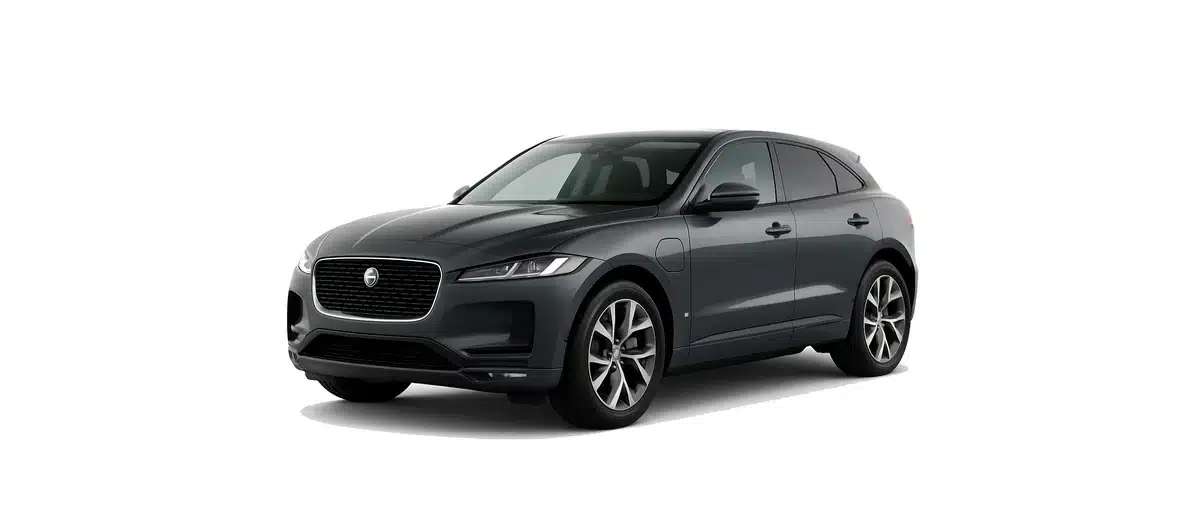
The Jaguar F-Pace is a mid-size luxury SUV, but only some versions are designed to plug in. This guide is specifically for the Jaguar F-Pace P400e plug-in hybrid, not petrol, diesel, mild-hybrid or SVR versions of the F-Pace. It is also separate from the Jaguar I-Pace, which is a fully electric vehicle with different charging behaviour.
For UK used-car buyers and owners, the most important first step is to confirm whether the vehicle is the P400e PHEV and which model-year specification it uses. Earlier facelift-era P400e cars used a 17.1 kWh battery and were quoted at up to 33 miles of WLTP electric range. Later MY24 cars received a larger 19.2 kWh battery, with Jaguar quoting around 40 miles WLTP TEL electric range. Both use Type 2 AC charging and CCS Combo 2 DC rapid charging, but their battery capacities and charging figures are not identical.
View Jaguar F-Pace Charging Cables
Jaguar F-Pace Battery and Charging Specifications
The chargeable UK-market F-Pace is the F-Pace P400e, a plug-in hybrid combining a 2.0-litre petrol engine with a 105 kW electric motor. Jaguar UK specifications list a combined output of 404 PS and 640 Nm, with all-wheel drive and an automatic gearbox. Because it is a PHEV rather than a battery-electric vehicle, the battery is relatively small compared with a full EV, but it is large enough for many local journeys when charged regularly.
The charging port supports Type 2 AC charging for home wallboxes and most UK public AC posts, plus CCS Combo 2 DC charging for rapid charging. This is a useful advantage, as many plug-in hybrids are AC-only. However, the F-Pace P400e’s DC charging speed is modest compared with a full electric SUV, so rapid charging is best viewed as a convenience feature rather than the main way to run the car.
| Specification | Jaguar F-Pace P400e |
|---|---|
| Vehicle type | Plug-in hybrid electric vehicle, not a BEV |
| AC connector | Type 2 |
| DC connector | CCS Combo 2 |
| Maximum AC charging | Around 7 kW |
| Maximum DC charging | Up to 32 kW on earlier cars; up to 35 kW on later UK specifications |
| Quoted WLTP electric range | Up to 33 miles on earlier cars; around 40 miles on MY24/later cars |
Battery Options
There are two key battery specifications to be aware of when looking at the F-Pace P400e in the UK used market.
Early facelift / MY21-MY23 P400e: Jaguar launch information for the facelifted F-Pace P400e quoted a 17.1 kWh lithium-ion battery and up to 33 miles WLTP electric range. Later technical data for this pre-MY24 pack lists a usable capacity of around 13.6 kWh. These cars were introduced with the 2021 model year facelift and are common in the used market.
MY24/later P400e: Jaguar later increased the battery’s energy storage capacity to 19.2 kWh. UK technical data from 2024 lists a usable capacity of 15.39 kWh and an electric range figure of around 40 miles WLTP TEL. If you are comparing cars, this later battery is one of the main reasons to check the exact model year, registration date, handbook or vehicle specification sheet.
Because Jaguar F-Pace production and new UK allocation have ended, most buyers will now be looking at used examples. Do not assume that every F-Pace P400e has the same battery or electric range figure.
AC Charging Speed
For everyday ownership, AC charging is the most relevant method. The F-Pace P400e can charge at up to around 7 kW from a suitable home wallbox or public AC charge point. If connected to a higher-rated untethered AC post, such as an 11 kW or 22 kW unit, the car will still draw only what its onboard charger can accept.
Jaguar UK technical data gives a 7 kW home charger or wallbox time of 2 hours 30 minutes to 100% for the later 15.39 kWh usable battery. Earlier 13.6 kWh usable cars were listed at around 2 hours 16 minutes to 100%, with Jaguar launch material also quoting around 1 hour 40 minutes from 0-80% using a 7 kW wallbox.
For UK home and public AC charging, you need a Type 2 charging cable unless the charge point is tethered with its own cable. A 5 m charging cable length is listed in Jaguar UK technical data, and many owners find this a practical everyday length for driveways, garages and public charging bays.
DC Rapid Charging Speed
Unlike many plug-in hybrids, the Jaguar F-Pace P400e can use CCS rapid chargers. For earlier launch-era P400e models, Jaguar quoted up to 32 kW DC charging. For later UK specifications, Jaguar lists a maximum DC charging rate of 35 kW, with an official 0-80% charge time of 30 minutes on a 50 kW DC charger.
This can be helpful if you arrive with a low battery and want to add electric range during a stop. However, it is important to set expectations. A 32-35 kW peak rate is low by modern BEV standards, and the F-Pace P400e’s small battery means rapid charging is not usually the most cost-effective or convenient way to run the car. For most owners, charging at home overnight, at work, or while parked at a destination will make more sense.
DC rapid chargers are tethered, so you do not use your own Type 2 cable for CCS rapid charging. You plug the charger’s CCS connector directly into the vehicle’s charging port.
Range and Efficiency
The official electric range depends on the model year. Earlier F-Pace P400e cars were quoted at up to 33 miles WLTP, while later MY24 cars were quoted at around 40 miles WLTP TEL. Real-world electric range will vary with temperature, speed, route, driving style, tyre condition, cabin heating or air conditioning use, and how much of the battery is available at the start of the journey.
As a plug-in hybrid, the F-Pace P400e is at its best when the battery is charged regularly. Short commutes, school runs and local errands can make good use of electric driving, while the petrol engine provides flexibility for longer trips. If the car is rarely plugged in, it will behave more like a conventional petrol SUV carrying extra hybrid hardware, which reduces the benefit of choosing the P400e in the first place.
Charging at Home
A dedicated 7 kW home wallbox is the most convenient charging option for many F-Pace P400e owners. It gives predictable charging times, can often be scheduled for cheaper off-peak electricity tariffs, and avoids depending on public chargers for a relatively small PHEV battery.
If your wallbox is untethered, you will need a Type 2 charging cable. If it is tethered, the cable is permanently attached to the unit and you simply plug it into the car. For homes with more than one EV or PHEV, an untethered unit can offer useful flexibility, provided each vehicle has the correct cable.
A 3-pin charger is generally best suited as a backup or occasional charging solution, but can be used regularly if a qualified electrician has confirmed the socket and electrical installation are suitable for sustained EV charging. Standard domestic sockets were not primarily designed for repeated high-load charging sessions, so professional electrical advice is important before relying on one day to day.
Public Charging
For public AC charging in the UK, the F-Pace P400e uses a Type 2 connection. Many public AC units are untethered, so you bring your own cable. These chargers may be rated at 7 kW, 11 kW or 22 kW, but the vehicle will limit charging to around 7 kW.
Destination charging is often the best public charging scenario for this car. Supermarkets, hotels, leisure centres, workplaces and town-centre car parks can let you add useful electric range while the car is already parked. Because a full AC charge can take only a few hours, this fits the P400e’s plug-in hybrid battery size well.
For rapid charging, use tethered CCS DC chargers. The F-Pace P400e can use them, but it does not charge at the high speeds associated with current full EVs. If you are on a motorway journey, it may be more practical to continue in hybrid mode than to stop solely for a small amount of electric range, depending on charger cost and journey plans.
Vehicle-Specific Features
The key vehicle-specific charging feature of the F-Pace P400e is that it combines normal plug-in hybrid flexibility with both AC and DC charging capability. The Type 2 port covers everyday home and destination charging, while the CCS Combo 2 inlet gives access to rapid chargers when useful.
Another important feature is the model-year split. The early 17.1 kWh battery and later 19.2 kWh battery affect the official electric range and the published charge-to-full time. Used buyers should ask the seller for the vehicle’s specification, check the handbook, or confirm the exact model year rather than relying only on the badge.
It is also worth remembering that many F-Pace models do not have any charging socket at all. Petrol, diesel and mild-hybrid versions are not plug-in vehicles and do not require EV charging cables.
Charging Tips
- Check you have the P400e: Only the F-Pace P400e plug-in hybrid uses an external charging cable.
- Use a Type 2 cable for AC charging: This is the correct connection for UK home wallboxes and most public AC posts.
- Do not overbuy based on charge-post rating: A 22 kW AC post will not make the F-Pace P400e charge at 22 kW.
- Charge little and often: Regular top-ups help make the most of the PHEV battery.
- Use CCS rapid charging selectively: It is useful, but the 32-35 kW peak rate is modest.
- Check model year when buying used: Earlier and later P400e cars have different battery and range figures.
- Keep the cable accessible: If the cable is buried under luggage, you are less likely to plug in during short stops.
Frequently Asked Questions
Is the Jaguar F-Pace fully electric?
No. The chargeable F-Pace sold in the UK is the F-Pace P400e plug-in hybrid. It has a petrol engine, an electric motor and a rechargeable battery. The Jaguar I-Pace is the fully electric Jaguar SUV.
What charging cable does the Jaguar F-Pace P400e use?
For AC charging, it uses a Type 2 cable. For DC rapid charging, it uses a tethered CCS Combo 2 connector supplied by the rapid charger.
How long does the F-Pace P400e take to charge at home?
On a 7 kW wallbox, Jaguar lists around 2 hours 30 minutes to 100% for the later 15.39 kWh usable battery. Earlier cars with the smaller usable capacity were listed at around 2 hours 16 minutes to 100%.
Can the F-Pace P400e use rapid chargers?
Yes. It supports CCS DC charging. Earlier cars were quoted at up to 32 kW, while later UK technical data lists up to 35 kW and an official 0-80% time of 30 minutes on a 50 kW DC charger.
Do all Jaguar F-Pace models need charging cables?
No. Only the P400e plug-in hybrid has an external charging socket. Petrol, diesel, mild-hybrid and SVR versions do not use EV charging cables.
What This Means for Drivers
The Jaguar F-Pace P400e is best approached as a premium plug-in hybrid that rewards regular charging. If you can charge at home or at work, the official electric range is enough to cover many short journeys without using much petrol. If you rarely plug in, you will miss much of the benefit.
For cable selection, the answer is straightforward: UK AC charging requires a Type 2 cable, while rapid charging uses the CCS cable attached to the charger. The main ownership detail is not the connector, but the model-year specification. Early and later F-Pace P400e cars differ in battery size and quoted electric range, so it is worth confirming exactly which version you own or intend to buy.
Looking for a Charging Cable for Jaguar F-Pace?
If you need a compatible Type 2 cable for your Jaguar F-Pace P400e, We offer Jaguar F-Pace charging cable options for home and public AC charging.
View Jaguar F-Pace Charging Cables
Please note that this information is intended as a guide. Charging specifications may change due to model and year of manufacture. For precise information, always refer to your vehicle user manual.

