
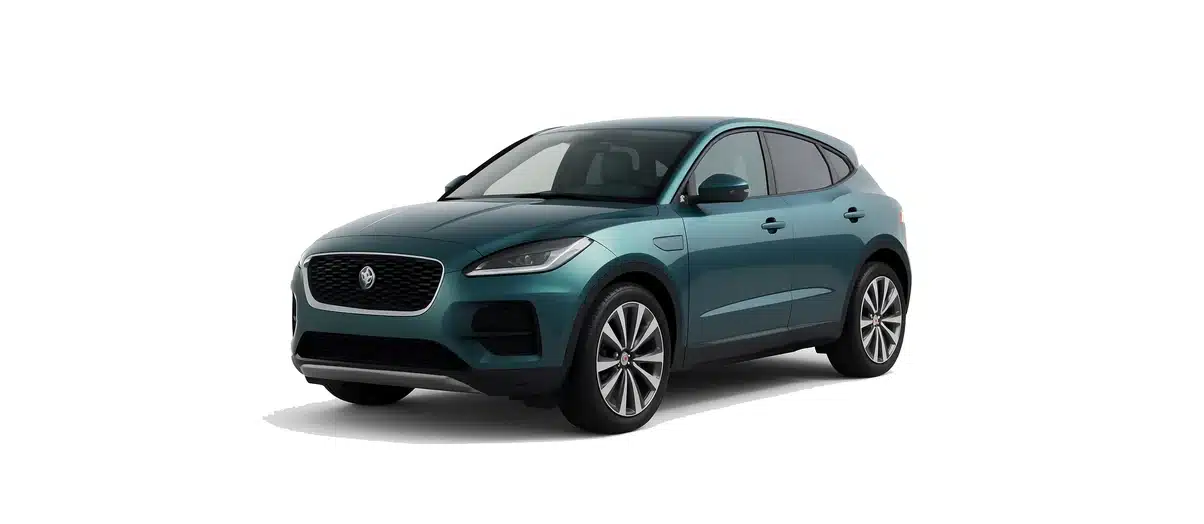
The Jaguar E-Pace is a compact SUV that needs a little care when discussing charging, because not every E-Pace is a plug-in vehicle. In the UK, the plug-in hybrid versions were sold as the E-Pace Electric Hybrid, most commonly badged P300e after the 2020 facelift, with later UK technical data using the P270e name by April 2024. Petrol, diesel and mild-hybrid E-Pace models do not plug in and do not use an EV charging cable.
This guide is therefore written specifically for the Jaguar E-Pace PHEV models: the P300e and later P270e plug-in hybrids. These cars combine a petrol engine with an electric rear axle motor and a relatively small plug-in battery, giving useful electric-only driving for local trips without making the E-Pace a fully electric car. For used buyers, the key points are to confirm that the car is actually the plug-in hybrid version, check which charging cables are included, and understand the difference between Type 2 AC charging and CCS rapid charging.
View Jaguar E-Pace Charging Cables
Jaguar E-Pace Battery and Charging Specifications
UK-market Jaguar E-Pace plug-in hybrid models use a Type 2 connection for AC charging and a CCS Combo 2 connection for DC rapid charging. The upper Type 2 section is used for home wallboxes and public AC posts, while the lower CCS pins are used when connecting to a compatible rapid charger with its own tethered DC cable.
| Vehicle type | Plug-in hybrid compact SUV, not a fully electric car |
|---|---|
| Relevant UK plug-in versions | E-Pace Electric Hybrid, P300e and later P270e |
| AC charging connection | Type 2 |
| DC rapid charging connection | CCS Combo 2 |
| Maximum AC charging rate | 7 kW, according to Jaguar UK technical data |
| Maximum DC charging rate | Up to 32 kW, according to Jaguar UK technical data |
| Typical 7 kW AC full charge time | About 2 hours 12 minutes to 100% |
| Quoted DC rapid charging time | 0-80% in 30 minutes on a 50 kW DC charger |
Because the E-Pace PHEV has a much smaller battery than a battery-electric SUV, its charging sessions are usually short. The aim is normally to start each day with a full battery for commuting, school runs and local journeys, then rely on the petrol engine for longer trips when needed.
Battery Options
There are some differences in how Jaguar presented E-Pace PHEV battery figures across model years. At the 2020 facelift launch, Jaguar referred to the P300e as having a 15 kWh lithium-ion battery and a WLTP electric range of up to 34 miles. Later UK technical specifications focus on usable battery capacity rather than gross capacity.
For October 2023 UK P300e technical data, Jaguar listed an 11.6 kWh usable battery capacity. In April 2024 UK P270e technical data, the usable battery capacity was listed as 11.5 kWh. These figures are close enough that day-to-day charging behaviour should feel broadly similar, but they are worth noting when comparing adverts and specification sheets for used examples.
As with any used plug-in hybrid, battery condition, charging history, tyre choice, weather and driving style can all influence the electric range you see in practice. If you are buying used, it is sensible to check the dashboard range estimate after a full charge, but remember that this estimate is based partly on recent driving.
AC Charging Speed
For normal UK charging, the Jaguar E-Pace PHEV is best thought of as a 7 kW AC car. Jaguar’s UK figures state that the E-Pace can charge from a 7 kW AC home charger in about 2 hours 12 minutes to 100%, with later technical data also quoting around 1.4 hours to 80%.
The cable you need for most home wallboxes and untethered public AC posts is a Type 2 to Type 2 Mode 3 cable. Jaguar owner charging guidance refers to a Mode 3 Type 2 cable for AC charging; a 5 metre cable is commonly suitable for driveway, workplace and public charging layouts, although some owners prefer a longer cable depending on where the charge port sits in relation to their parking space.
Using an 11 kW or 22 kW public AC post will not make the E-Pace PHEV charge at 11 kW or 22 kW if the car itself is limited to the quoted 7 kW AC rate. The charge point can offer more power than the car is able to accept, but the vehicle’s onboard charger controls the actual AC charging speed.
DC Rapid Charging Speed
One unusual feature of the Jaguar E-Pace plug-in hybrid is that Jaguar quotes DC rapid charging capability. Many PHEVs only support AC charging, but E-Pace P300e and P270e technical information confirms CCS DC charging, with a maximum vehicle charge rate of 32 kW.
Jaguar quotes a 0-80% charging time of 30 minutes when using a 50 kW DC charger. It is important not to read this as a full battery-electric road-trip experience. The E-Pace PHEV has a small battery compared with a BEV, so rapid charging is more about quickly adding local electric range than making repeated motorway charging stops in the way a pure EV driver might.
You do not normally need to carry a separate DC rapid charging cable. CCS rapid chargers use a tethered cable attached to the charging unit. For the E-Pace, your own portable cable is mainly for AC charging: home wallboxes where the unit is untethered, workplace charging and public Type 2 AC posts.
Range and Efficiency
Jaguar’s quoted WLTP electric range varies slightly by model year and specification. Early P300e launch material quoted up to 34 miles. October 2023 UK P300e data quoted an electric range of around 36.0-38.5 miles, while April 2024 P270e UK data listed a WLTP Equivalent All Electric Range of around 36-37 miles.
Those figures make the E-Pace PHEV well suited to drivers who can charge regularly and complete many shorter journeys using electric power. The biggest benefits usually come from plugging in at home overnight or during the evening, then using electric mode for daily errands and commuting.
In colder weather, at higher speeds or on hilly routes, the electric range may be lower than WLTP figures suggest. Conversely, gentle urban driving in mild weather can make the plug-in hybrid system feel particularly effective. The petrol engine remains available for longer journeys, so the charging strategy is less about avoiding every fuel stop and more about making the most of the battery whenever it is convenient to charge.
Charging at Home
For most E-Pace PHEV owners, a dedicated 7 kW home wallbox is the most convenient charging option. It matches the car’s quoted AC capability, gives predictable charging times and avoids relying on public infrastructure for routine top-ups. With a full charge taking roughly 2 hours 12 minutes from a 7 kW AC charger, many owners will be able to recharge the battery fully in the evening rather than needing to leave it plugged in all night.
If your wallbox is untethered, you will need a Type 2 to Type 2 charging cable. If your wallbox is tethered and already has a Type 2 plug attached, you may not need a separate cable at home, but you will still need one for many public AC charge points.
A 3-pin domestic charger is generally best suited as a backup or occasional charging solution, but can be used regularly if a qualified electrician has confirmed the socket and electrical installation are suitable for sustained EV charging. For a plug-in hybrid with a modest battery size, a domestic charger may be workable in some situations, but a properly installed wallbox remains the more robust and convenient long-term home charging option.
Public Charging
For public AC charging, the E-Pace PHEV uses a Type 2 to Type 2 Mode 3 cable. This is the cable you connect between the car and an untethered AC post at locations such as supermarkets, car parks, hotels, workplaces and some destination chargers. Charging speed will depend on the car, the post and conditions, but Jaguar’s quoted AC figure for the E-Pace PHEV is 7 kW.
For rapid charging, look for a CCS charger and use the charger’s tethered CCS cable. Jaguar’s figure of 0-80% in 30 minutes on a 50 kW DC charger is useful if you want to recover electric range while stopping for a coffee or while shopping. However, because the battery is small, it may not always be worth occupying a rapid charger if a slower AC post is available and your stop is long enough.
Used buyers should also check charging cable storage and accessories when viewing a car. Some examples may include the original Mode 3 cable, while others may be missing it. If a domestic Mode 2 cable is present, confirm that it is suitable for UK use and in good condition.
Vehicle-Specific Features
The E-Pace PHEV sits on Jaguar’s Premium Transverse Architecture introduced with the 2020 facelift. In plug-in hybrid form, it combines a 1.5-litre three-cylinder petrol engine with an electric rear axle drive motor. Jaguar technical information lists the rear electric motor at 109 PS / 80 kW, giving the plug-in hybrid version all-wheel-drive capability through its petrol and electric powertrain layout.
The most distinctive charging feature is its CCS DC capability. This is not something to assume on every plug-in hybrid, so it gives the E-Pace added flexibility. At the same time, it should not be confused with the Jaguar I-Pace, which is a fully electric car with a much larger battery and different charging use case. E-Pace and I-Pace specifications should not be mixed when choosing cables or comparing charging times.
There is no need to assume specialist features such as vehicle-to-load power export, vehicle-to-grid operation, a heat pump or model-specific battery preconditioning unless they are confirmed for the individual vehicle by official documentation or a VIN-specific check.
Charging Tips
- Check the badge and charge port first: only E-Pace Electric Hybrid, P300e and P270e plug-in hybrid models use charging cables.
- Choose Type 2 for AC charging: a Type 2 to Type 2 Mode 3 cable is the key cable for untethered wallboxes and public AC posts.
- Do not expect 11 kW or 22 kW AC speeds: the E-Pace PHEV is quoted at 7 kW AC, even if the charge point can supply more.
- Use CCS only at rapid chargers: DC rapid chargers have their own tethered CCS cable, so you do not carry a separate CCS cable.
- Charge little and often: plug-in hybrids work best when the battery is topped up regularly, especially if your daily mileage fits within the electric range.
- Check used-car accessories: verify whether a Mode 3 cable is included and inspect any supplied cable for wear or damage.
Frequently Asked Questions
Is the Jaguar E-Pace a fully electric car?
No. The E-Pace plug-in versions are petrol plug-in hybrids. They can drive on electric power for shorter journeys, but they also have a petrol engine. Many E-Pace models are not plug-in vehicles at all.
Which cable does the Jaguar E-Pace PHEV need?
For UK home and public AC charging, the E-Pace PHEV uses a Type 2 to Type 2 Mode 3 cable. DC rapid charging uses the tethered CCS cable attached to the rapid charger.
How long does the Jaguar E-Pace take to charge at home?
Jaguar quotes around 2 hours 12 minutes to charge to 100% from a 7 kW AC home charger, with later technical data also quoting around 1.4 hours to 80%.
Can the Jaguar E-Pace PHEV rapid charge?
Yes, unusually for a PHEV, Jaguar quotes CCS DC rapid charging. The stated maximum DC rate is 32 kW, with 0-80% taking 30 minutes on a 50 kW DC charger.
Will a 22 kW public charger charge the E-Pace faster?
Not beyond the car’s own AC limit. Jaguar UK material quotes 7 kW AC charging for the E-Pace PHEV, so a higher-rated AC post will not make it charge at 22 kW.
What This Means for Drivers
The Jaguar E-Pace P300e and P270e are best suited to drivers who can charge frequently and want to cover regular short trips on electric power while keeping petrol flexibility for longer journeys. The charging setup is straightforward once you confirm you have the plug-in hybrid model: Type 2 for AC charging, CCS for rapid charging, and a realistic expectation that 7 kW AC is the normal everyday charging rate.
For used buyers, the main checklist is simple. Confirm the car is an Electric Hybrid, P300e or P270e rather than a petrol, diesel or mild-hybrid E-Pace. Check the charge port, inspect any supplied cables, and make sure a suitable Type 2 cable is available for your home or public charging routine. The E-Pace PHEV’s DC charging ability is a useful bonus, but its real strength is convenient local electric driving when it is charged regularly.
Looking for a Charging Cable for Jaguar E-Pace?
We offer charging cables suitable for the Jaguar E-Pace P300e and P270e plug-in hybrid, including Type 2 options for home wallboxes and public AC charging.
View Jaguar E-Pace Charging Cables
Please note that this information is intended as a guide. Charging specifications may change due to model and year of manufacture. For precise information, always refer to your vehicle user manual.

