
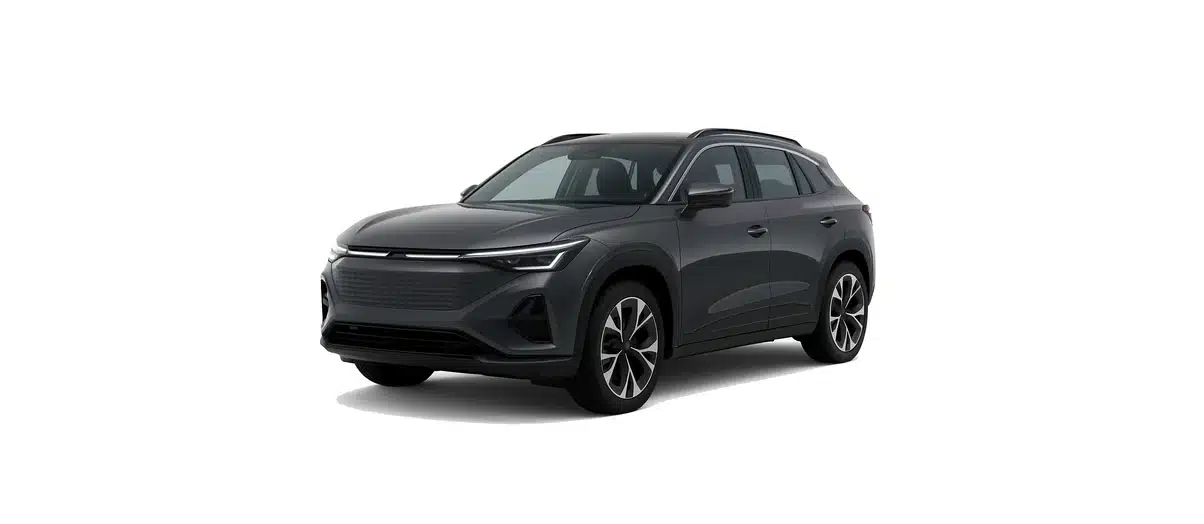
The Jaecoo 7 is a mid-size SUV sold in the UK with more than one powertrain, so the first point to check is which version you have. This charging guide applies to the Jaecoo 7 SHS-P plug-in hybrid, because that is the version with an external charging socket. Petrol and SHS-H self-charging hybrid versions of the Jaecoo 7 are not plug-in vehicles and do not need an EV charging cable.
For the Jaecoo 7 SHS-P, the key points are relatively straightforward: it uses a Type 2 connection for AC charging, supports CCS rapid charging, has an officially listed 18.3 kWh LFP battery, and offers up to 56 miles of WLTP electric range. In everyday UK use, a more realistic electric-only figure is likely to be lower, often around the high-40-mile region depending on temperature, route and driving style.
Jaecoo 7 Battery and Charging Specifications
The chargeable Jaecoo 7 is the SHS-P plug-in hybrid. It combines a 1.5-litre turbo petrol engine with an electric drive system, an LFP traction battery and a hybrid transmission. Unlike a pure electric car, it can continue driving using petrol once the usable electric range has been depleted, but regular charging is still important if you want to get the best from the plug-in hybrid system.
| Vehicle | Jaecoo 7 SHS-P plug-in hybrid |
|---|---|
| Battery capacity | 18.3 kWh gross LFP battery |
| Official electric range | Up to 56 miles WLTP |
| Likely real-world electric range | Approximately 45-50 miles in favourable everyday use |
| AC charging connector | Type 2 |
| DC rapid charging connector | CCS Combo 2 |
| UK AC charging guidance | Likely around 3.3 kW, subject to UK specification confirmation |
| DC charging capability | Up to 40 kW where supported |
There is some specification variation in published information. UK review and dealer material commonly refers to 3.3 kW AC charging, while some European technical information lists 6.6 kW AC. For UK owners, it is safest to assume the car may be limited to around 3.3 kW on AC unless the latest UK handbook, brochure or vehicle-specific documentation confirms otherwise.
Battery Options
The Jaecoo 7 SHS-P plug-in hybrid is listed with an 18.3 kWh LFP battery. That is a sizeable battery for a plug-in hybrid and helps explain the official 56-mile WLTP electric range claim. However, the available research does not clearly confirm the usable battery capacity, so charging calculations should be treated as estimates rather than exact figures.
The broader Jaecoo 7 range also includes non-plug-in models. If you are choosing accessories, ordering a cable or comparing charging times, make sure the vehicle is the SHS-P plug-in hybrid. A petrol Jaecoo 7 or SHS-H self-charging hybrid will not have the same charging requirements because it does not plug in externally.
AC Charging Speed
For home wallboxes and most destination chargers, the Jaecoo 7 SHS-P uses a Type 2 AC charging cable. UK guidance should be cautious on speed: several UK sources indicate the onboard AC charger is around 3.3 kW, which means a full or near-full charge may take roughly 6-7 hours. That makes overnight charging at home a natural fit.
A 7 kW home wallbox is still useful, but it will not necessarily make the Jaecoo 7 SHS-P charge at 7 kW. The wallbox can offer more power than the car can accept; the vehicle’s onboard charger decides the actual AC charging rate. If the UK vehicle is limited to around 3.3 kW, it will draw only that amount even when plugged into a 7 kW charge point.
For cable selection, a 32A Type 2 cable is a sensible choice because it is compatible with common UK single-phase public and home AC charge points. Even if the car only draws around 3.3 kW, the cable is appropriately rated and gives flexibility when using public posts. The cable should be Type 2 to Type 2 for untethered home wallboxes and most public AC chargers.
DC Rapid Charging Speed
One of the more unusual features of the Jaecoo 7 SHS-P is that it supports DC rapid charging through a CCS Combo 2 connector. Many plug-in hybrids are AC-only, so CCS capability gives the Jaecoo 7 more flexibility on longer journeys or when you need a quick battery top-up away from home.
Published information indicates DC charging capability of up to 40 kW. Official material refers to a 30-80% DC top-up taking around 20 minutes, although some UK commentary has quoted longer times. Because reported figures vary, it is better not to rely on a precise rapid-charging time for every situation. Charging speed will depend on battery temperature, state of charge, charger output and the car’s charging management.
For routine use, AC charging at home or work will usually be cheaper and more convenient than regular rapid charging. The battery is relatively small compared with a battery-electric SUV, so a rapid charger may be helpful occasionally, but it is unlikely to be the main charging method for most owners.
Range and Efficiency
The official WLTP electric range for the Jaecoo 7 SHS-P is up to 56 miles. That is a strong figure for a plug-in hybrid SUV and may cover many local journeys if the car is charged regularly. In real-world UK driving, however, expect the electric range to vary. Independent UK review commentary suggests around 45-50 miles may be a more realistic expectation in everyday conditions.
Cold weather, motorway speeds, heavy acceleration, hills, cabin heating, air conditioning and tyre condition can all reduce electric range. Conversely, urban and suburban driving with gentle acceleration tends to suit plug-in hybrids well. If you can charge at home and most of your journeys are within the electric range, the petrol engine may be used much less often.
Charging at Home
Home charging is usually the most practical way to run a plug-in hybrid. With the Jaecoo 7 SHS-P, plugging in overnight should be enough to return the battery to full or near-full charge for the next day, especially if the UK AC charging rate is around 3.3 kW.
If you have a tethered wallbox with a Type 2 plug, you can connect directly to the vehicle. If your wallbox is untethered, you will need a Type 2 charging cable. A 32A Type 2 cable is a good all-round choice because it suits common UK AC charging infrastructure even if the Jaecoo 7 draws less than the cable’s maximum rating.
A 3-pin portable charger is generally best suited as a backup or occasional charging solution, but can be used regularly if a qualified electrician has confirmed the socket and electrical installation are suitable for sustained EV charging. Standard domestic sockets were not originally designed for repeated long-duration EV charging loads, so a dedicated wallbox is normally the better long-term option.
Public Charging
For public AC charging, use a Type 2 cable where the post is untethered. Many UK destination chargers at supermarkets, hotels, workplaces and town-centre car parks require drivers to bring their own cable. The Jaecoo 7 SHS-P should connect in the same way as other Type 2 plug-in vehicles.
For rapid charging, you do not use your own Type 2 cable. CCS rapid chargers have a tethered cable attached to the unit. You connect the CCS plug directly to the car’s rapid-charging inlet. Because the Jaecoo 7 SHS-P is a plug-in hybrid with an 18.3 kWh battery, public rapid charging may be most useful for occasional top-ups rather than routine daily charging.
Vehicle-Specific Features
The Jaecoo 7 SHS-P stands out among plug-in hybrids because it combines a useful electric range with CCS rapid charging. That makes it more flexible than many PHEVs, particularly for drivers who want to maximise electric running during longer days away from home.
Vehicle-to-load capability is also confirmed in available specification data, with official European information listing V2L at 3.3 kW and UK review coverage describing a three-pin socket in the boot. V2L can be useful for powering certain external devices where appropriate, but it should not be confused with vehicle-to-grid or home backup systems. V2G and V2H capability are not confirmed for the UK Jaecoo 7 SHS-P.
Charging Tips
- Check your version first: only the SHS-P plug-in hybrid needs a charging cable.
- Choose Type 2 for AC charging: this is the relevant cable type for home and public AC charging.
- Do not assume 7 kW AC charging: UK information suggests the car may be limited to around 3.3 kW on AC.
- Use CCS for rapid charging: rapid chargers have tethered CCS cables, so you do not need to bring your own rapid-charging cable.
- Charge little and often: topping up regularly helps you make the most of the electric range.
- Plan around real-world range: the 56-mile WLTP figure is a guide, not a guarantee.
Frequently Asked Questions
Is the Jaecoo 7 a fully electric car?
No. In the UK, the chargeable Jaecoo 7 is the SHS-P plug-in hybrid. It has a petrol engine, an electric motor system and an external charging socket. It should not be described as a pure electric car.
Do all Jaecoo 7 models need a charging cable?
No. Petrol and SHS-H self-charging hybrid versions do not plug in externally. Charging cable advice applies only to the Jaecoo 7 SHS-P plug-in hybrid.
What charging cable does the Jaecoo 7 SHS-P use?
For AC charging, the Jaecoo 7 SHS-P uses a Type 2 connection. A Type 2 to Type 2 cable is suitable for untethered home wallboxes and most public AC charging posts.
Will a 7 kW wallbox charge the Jaecoo 7 SHS-P at 7 kW?
Not necessarily. UK information commonly points to around 3.3 kW AC charging, although some European data lists a higher figure. If the UK vehicle is limited by its onboard charger, a 7 kW wallbox will not force it to charge faster.
Can the Jaecoo 7 SHS-P rapid charge?
Yes. The Jaecoo 7 SHS-P supports CCS rapid charging, with published data indicating up to 40 kW. Reported 30-80% charging times vary, so real-world rapid-charging performance should be treated as situational.
What This Means for Drivers
The Jaecoo 7 SHS-P is best approached as a plug-in hybrid that rewards regular charging. If you can charge at home or work, the official 56-mile electric range gives the potential for many shorter journeys to be completed mostly on electric power. The main cable choice is simple: use a Type 2 cable for AC charging, ideally a 32A Type 2 cable for broad compatibility.
The biggest point to manage is charging-speed expectation. A 7 kW wallbox is convenient, but the UK SHS-P may charge at around 3.3 kW on AC depending on specification. That is still perfectly workable for overnight charging, especially with an 18.3 kWh battery. CCS rapid charging adds flexibility, but most owners are likely to find home or workplace AC charging more economical for daily use.
Looking for a Charging Cable for Jaecoo 7?
If you have the Jaecoo 7 SHS-P plug-in hybrid, choose a Type 2 cable for home and public AC charging; if you have a petrol or SHS-H model, you do not need an EV charging cable.
Please note that this information is intended as a guide. Charging specifications may change due to model and year of manufacture. For precise information, always refer to your vehicle user manual.

