
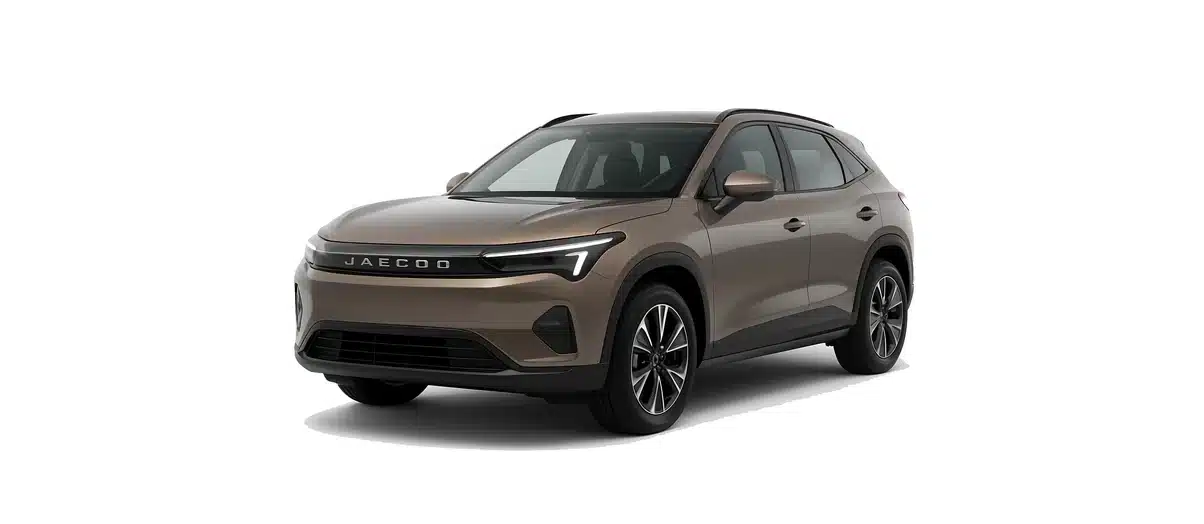
The Jaecoo 5 name needs a little care in the UK, because it can refer to the petrol compact SUV as well as the battery-electric version. For charging purposes, this guide is about the all-electric model marketed in the UK as the Jaecoo E5 Electric, also referred to by some data sources as the Jaecoo 5 EV.
The electric Jaecoo E5 is a compact SUV/crossover with a Type 2 AC charging connection for home and destination charging, plus a CCS Combo 2 connection for DC rapid charging. UK information points to a single battery pack for both Pure and Luxury trims, with a quoted WLTP range of up to 248 miles. In everyday UK use, especially on faster roads or in colder weather, drivers should plan around a more conservative real-world range.
This guide explains the Jaecoo E5 Electric charging setup, how long home charging is likely to take, what to expect from public rapid chargers, and which cable type UK owners should look for.
Jaecoo 5 Battery and Charging Specifications
For the UK electric model, the key charging specification is straightforward: the Jaecoo E5 Electric / Jaecoo 5 EV uses Type 2 AC charging and CCS Combo 2 DC rapid charging. This is the standard arrangement for most modern UK and European electric cars, so it is compatible with typical home wallboxes, workplace charge points, many public AC units, and the UK’s CCS rapid-charging network.
| Vehicle | Jaecoo E5 Electric / Jaecoo 5 EV |
| Body style | Compact SUV / crossover |
| Battery | About 61.1 kWh gross; around 58.9 kWh usable according to EV data sources |
| Official WLTP range | Up to 248 miles |
| Estimated real-world range | Around 200 miles in mixed use |
| AC charging | Type 2, up to 11 kW where supported |
| Typical UK home charging | Up to 7.4 kW on most single-phase home wallboxes |
| DC rapid charging | CCS Combo 2, commonly quoted in UK sources at up to 80 kW |
| Quoted rapid-charge window | 30-80% in around 27 minutes, depending on charger and conditions |
Before buying accessories, it is worth confirming that your vehicle is the electric E5 / 5 EV and not the petrol Jaecoo 5. The petrol model does not use EV charging cables.
Battery Options
Current UK launch and review information points to one battery size for the Jaecoo E5 Electric Pure and Luxury trims. Most UK sources quote a 61.1 kWh LFP battery, while EV Database lists a very similar 60.9 kWh nominal figure and around 58.9 kWh usable. These should be treated as different reporting methods for the same pack rather than separate battery options.
LFP battery chemistry is commonly used in EVs for its durability and stability characteristics. As with any EV, charging speed and range will vary with battery temperature, ambient temperature, driving style, wheel and tyre specification, road speed and accessory use.
AC Charging Speed
The Jaecoo E5 Electric is quoted with up to 11 kW AC charging. That figure is most relevant when connected to a compatible three-phase AC charge point, such as those found at some workplaces, public car parks, hotels and commercial premises.
Most UK homes have a single-phase electricity supply. In that case, a typical dedicated home wallbox will usually charge at up to 7.4 kW, even though the car itself can accept up to 11 kW on suitable three-phase AC. On a 7.4 kW wallbox, a full charge from low to 100% is likely to take roughly overnight, with sources suggesting around 9.5 to 11 hours depending on the starting percentage, charging losses and conditions.
On an 11 kW three-phase AC charger, a 0-100% charge is listed by EV data sources at around 6 hours 30 minutes. In day-to-day use, many owners will not charge from completely empty to full; topping up from, for example, 30% to 80% will be significantly quicker.
DC Rapid Charging Speed
For longer journeys, the Jaecoo E5 Electric uses the CCS Combo 2 connector for DC rapid charging. UK launch and review sources commonly quote up to 80 kW DC charging, with a 30-80% charge taking around 27 minutes in suitable conditions.
That 30-80% figure is important. Many EVs are advertised with a 10-80% time, but the Jaecoo E5 information most often seen in UK sources uses 30-80%. For that reason, it is better not to compare the headline time directly with cars quoting a wider 10-80% window. Charging from a lower state of charge may take longer overall, and the car will not necessarily hold its peak charge rate for the whole session.
As with all EVs, rapid charging speed depends on the charger’s capability, the battery’s state of charge, battery temperature, weather and how busy or power-limited the charging site is. A high-power charger will not automatically make the car charge faster than the vehicle’s own accepted rate.
Range and Efficiency
The official WLTP range for the UK Jaecoo E5 Electric is quoted at up to 248 miles. WLTP is a useful comparison figure, but real-world range is usually lower, particularly in winter or on long motorway journeys.
For practical route planning, an estimate of around 200 miles in mixed real-world driving is a sensible starting point. In cold motorway use, with cabin heating, rain, headwinds or a fully loaded vehicle, the range may be lower. In slower urban and suburban driving, the car may get closer to its official figure.
For longer trips, it is usually more efficient to plan shorter rapid-charge stops rather than always charging to 100% on a DC charger. Charging typically slows as the battery gets fuller, so the fastest part of a rapid-charge session is usually in the middle of the battery range.
Charging at Home
Home charging is likely to be the easiest and most cost-effective way to run the Jaecoo E5 Electric for many UK owners. A dedicated 7.4 kW home wallbox is the most common domestic setup and will suit the car well, even though the onboard AC charger can accept up to 11 kW where three-phase power is available.
For home charging, you will normally use a Type 2 charging cable if your wallbox is untethered. If your wallbox is tethered, the cable is permanently attached to the charger, so you simply plug it into the car. Many drivers still keep a separate Type 2 cable in the vehicle for public AC charging, as some destination charge points require the driver to provide their own cable.
A 3-pin portable charger can be useful in limited situations, but it is much slower than a wallbox. A 3-pin charger is generally best suited as a backup or occasional charging solution, but can be used regularly if a qualified electrician has confirmed the socket and electrical installation are suitable for sustained EV charging.
If you are installing a home charger, ask your installer to confirm the appropriate circuit, earthing arrangement, load management and cable rating for your property. If you have or are considering a three-phase supply, the Jaecoo’s 11 kW AC capability may be relevant, but most domestic UK installations will remain single-phase.
Public Charging
When using public charging, there are two main scenarios: AC destination charging and DC rapid charging.
Public AC charging is common at car parks, hotels, leisure centres, supermarkets and workplaces. These chargers often use Type 2 sockets and may require your own Type 2 cable. Depending on the charger and electricity supply, the Jaecoo E5 may charge at 7 kW, 11 kW or less. AC charging is best when the car will be parked for a few hours.
DC rapid charging is used for longer journeys and motorway stops. These chargers have a tethered CCS cable attached to the unit, so you do not need to use your own Type 2 cable. Plug in using the CCS connector, start the session through the charging network’s app, contactless payment or RFID method, and monitor progress on the charger or vehicle display.
Because the Jaecoo E5’s UK rapid-charging information is usually quoted as 30-80% in around 27 minutes, a realistic long-distance strategy is to arrive with a moderate state of charge and leave once the charge rate begins to taper significantly, rather than waiting for 100% unless you need it.
Vehicle-Specific Features
The UK electric model is a single-motor, front-wheel-drive BEV with quoted power of 207 PS / 155 kW. The charging port is reported to be positioned on the front offside/right-front wing, which may affect how you park at certain charge points.
Jaecoo material also references Pet Mode and Camping Mode for the EV, features designed to support specific stationary-use scenarios. The vehicle is also reported with vehicle-to-load capability as standard in UK launch information, allowing external electrical devices to be powered in suitable circumstances using the correct equipment and within the vehicle’s output limits.
No heat pump availability has been confirmed in the supplied UK research, and EV data sources list the heat pump as not fitted. Battery preconditioning and V2G/V2H capability should not be assumed unless Jaecoo confirms them in current UK technical documentation.
Charging Tips
- Check the model first: make sure you have the electric Jaecoo E5 / Jaecoo 5 EV, not the petrol Jaecoo 5, before buying charging accessories.
- Choose Type 2 for AC charging: this is the correct cable type for UK home wallboxes and many public AC chargers.
- Expect 7.4 kW at most UK homes: the car can accept up to 11 kW AC, but most domestic wallboxes are single-phase.
- Use CCS for rapid charging: motorway and high-speed public chargers use tethered CCS connectors, so you do not need to bring a separate DC cable.
- Plan around real-world range: the official 248-mile WLTP figure is useful, but around 200 miles is a more cautious mixed-use planning estimate.
- Do not rely on 100% rapid charging: DC charging slows at higher battery percentages, so stopping at around 80% is often quicker on long trips.
- Keep cable length in mind: the reported right-front charging port position may make a longer Type 2 cable more convenient at some public bays.
Frequently Asked Questions
Is the Jaecoo 5 electric?
Not always. In the UK, Jaecoo 5 can refer to the petrol SUV, while the electric version is marketed as the Jaecoo E5 Electric and may also be called the Jaecoo 5 EV by data sources. This charging guide applies to the electric E5 / 5 EV only.
What charging cable does the Jaecoo E5 Electric use?
It uses a Type 2 connection for AC charging. For DC rapid charging, it uses CCS Combo 2, with the rapid charger’s cable attached to the charging unit.
Can the Jaecoo E5 charge at 11 kW at home?
Only if the home has a suitable three-phase supply and compatible charger. Most UK homes use single-phase wallboxes, usually providing up to 7.4 kW.
How long does the Jaecoo E5 take to charge at home?
On a typical 7.4 kW UK home wallbox, a low-to-full charge is likely to take roughly overnight, around 9.5 to 11 hours depending on conditions. On suitable 11 kW three-phase AC charging, EV data sources list around 6 hours 30 minutes from 0-100%.
How fast is rapid charging?
UK sources commonly quote up to 80 kW DC charging and around 27 minutes for 30-80% in suitable conditions. A verified official 10-80% UK figure should not be assumed unless confirmed by the latest Jaecoo documentation.
What This Means for Drivers
The Jaecoo E5 Electric should be simple to live with if you can charge at home or at work. A Type 2 cable covers most AC charging needs, while CCS rapid chargers handle longer journeys. The main point for UK buyers is to be precise about the model name: the Jaecoo 5 badge family includes petrol versions, so charging advice and accessories apply specifically to the E5 Electric / 5 EV.
For daily use, a 7.4 kW home wallbox will be sufficient for most drivers, even though the car is capable of up to 11 kW AC charging on three-phase. For long-distance travel, plan around the commonly quoted 30-80% rapid-charge window and use a realistic mixed-use range estimate rather than relying solely on the headline WLTP figure.
Looking for a Charging Cable for Jaecoo 5?
If you have the Jaecoo E5 Electric / Jaecoo 5 EV, choose a Type 2 charging cable suitable for UK home and public AC charging, with the length and current rating that best match your wallbox and charging routine.
Please note that this information is intended as a guide. Charging specifications may change due to model and year of manufacture. For precise information, always refer to your vehicle user manual.

