
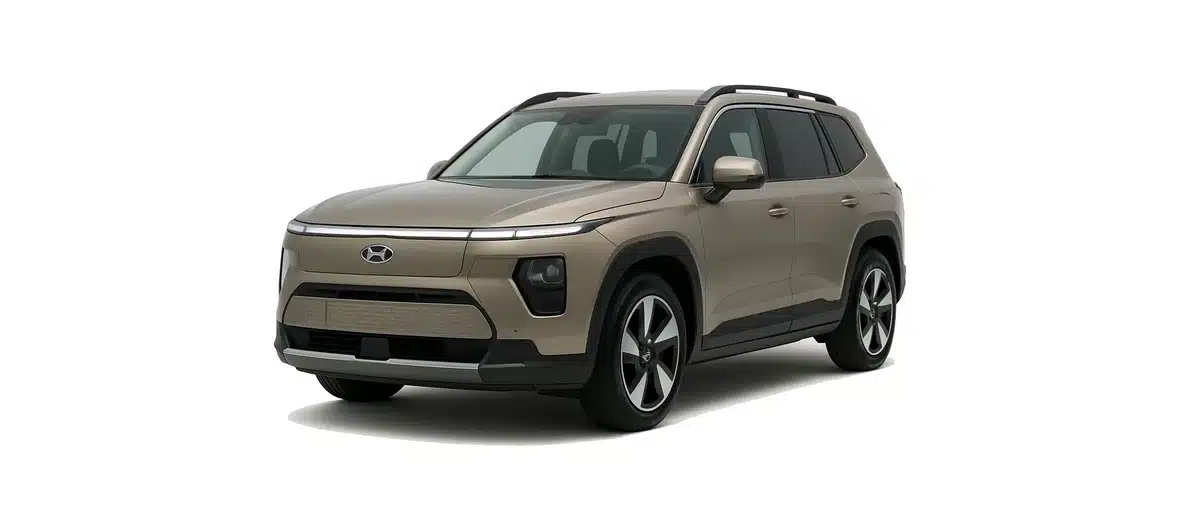
The Hyundai Santa Fe is a large family SUV, and in current UK Plug-in Hybrid form it gives drivers the option of short electric journeys alongside the flexibility of a petrol engine. That makes its charging needs quite different from a fully electric Hyundai such as an IONIQ model. The Santa Fe Plug-in Hybrid is designed mainly for AC charging at home, work or destination charge points, rather than rapid charging on long motorway trips.
This guide focuses on the UK Hyundai Santa Fe Plug-in Hybrid. Hyundai also sells self-charging hybrid Santa Fe models, but those do not plug in and do not use charging cables. If you own or are ordering the plug-in hybrid version, the key points are simple: use a Type 2 AC cable for wallboxes and public AC posts, expect charging to be limited to around 3.6 kW, and plan around convenient top-ups rather than DC rapid charging.
View Hyundai Santa Fe Charging Cables
Hyundai Santa Fe Battery and Charging Specifications
The current UK factory-order Santa Fe Plug-in Hybrid, listed for Model Year 26 in Hyundai UK specification material, is a 1.6T 288PS Plug-in Hybrid 4WD. It is offered in Premium, Ultimate and Calligraphy trims, with a seven-seat layout as standard in the UK MY26 pricing and specification document. Calligraphy models may also be available with an optional six-seat configuration.
For charging, Hyundai UK’s MY26 specification material confirms that the Santa Fe Plug-in Hybrid is supplied with an emergency 3-pin ICCB cable and a Type 2 wallbox charging cable. The car uses a Type 2 AC charging inlet for UK and European plug-in hybrid charging. Unlike a full battery-electric vehicle, it is not a model you should plan to charge on DC rapid chargers.
The current UK MY26 official electric-only range is listed as 33.6 miles. In normal use, a real-world electric range of around 25 miles is a reasonable expectation, depending on route, temperature, speed, load, driving style and how much you use heating or air conditioning.
Battery Options
The Santa Fe Plug-in Hybrid uses a relatively small traction battery compared with a fully electric SUV. Hyundai Europe and Hyundai Poland technical information for the fifth-generation Santa Fe Plug-in Hybrid lists a 13.8 kWh lithium-ion battery. Hyundai UK’s April 2026 MY26 technical and specification document confirms the Plug-in Hybrid powertrain and official electric-only range, but does not appear to list the battery capacity in the same way, so it is sensible to treat 13.8 kWh as the best available manufacturer-backed figure rather than overstate it as a universal UK specification for every car.
Earlier UK fourth-generation Santa Fe Plug-in Hybrid models, launched from 2021, were also listed with a 13.8 kWh battery and a Type 2 charging port. However, range and output figures vary by model year and generation. If you are comparing a used Santa Fe PHEV with a new MY26 car, check the exact registration year, brochure and trim rather than relying on one figure for all Santa Fe Plug-in Hybrid models.
AC Charging Speed
AC charging is the main charging method for the Hyundai Santa Fe Plug-in Hybrid. Hyundai Europe technical data lists the onboard charger at around 3.3 to 3.6 kW depending on supply voltage, and Hyundai Poland states a maximum charging power of 3.6 kW. That means the car will not charge faster just because it is connected to a higher-powered AC charge point.
In practical terms, a 7 kW home wallbox, 11 kW public AC post or 22 kW public AC post can all be suitable if the connector and cable are correct, but the Santa Fe Plug-in Hybrid will only draw up to about 3.6 kW. This is normal for many plug-in hybrids and is not a fault with the cable or charge point.
From low to full, expect roughly 4 to 5 hours on a suitable AC wallbox or public AC post, depending on the state of charge, supply conditions and ambient temperature. Hyundai Poland quotes about 4 hours on AC or wallbox charging, while UK review coverage suggests under five hours from a dedicated charger.
DC Rapid Charging Speed
The Hyundai Santa Fe Plug-in Hybrid is not a car to plan around DC rapid charging. Reliable UK and European information for the Santa Fe PHEV confirms AC Type 2 charging, but does not provide a DC rapid charging specification or a 10-80% rapid-charge time.
For owners, the takeaway is straightforward: use home charging, workplace charging and destination AC posts. On longer journeys, the Santa Fe Plug-in Hybrid can continue as a hybrid once the plug-in battery’s usable electric range has been depleted, so you do not need to interrupt a motorway trip to find a rapid charger in the way a BEV driver might.
Range and Efficiency
The current UK MY26 Santa Fe Plug-in Hybrid has an official electric-only range of 33.6 miles. That figure is useful for comparison, but real-world range will usually be lower. Around 25 miles of electric driving is a sensible working estimate for mixed UK use, although gentle urban driving in mild weather may do better and cold, fast or heavily loaded trips may do worse.
Because the Santa Fe is a large SUV, the best use of the plug-in hybrid system is usually regular short-distance charging. School runs, commuting, local errands and town driving are where the electric range can make the biggest difference. If you charge little and often, the petrol engine may be used less frequently on local trips. If you rarely plug in, the car will behave more like a conventional hybrid and you will miss much of the benefit of choosing the plug-in hybrid version.
When comparing figures online, be careful with older Santa Fe PHEV information. Earlier UK models were commonly quoted at around 36 miles of electric range, while the current UK MY26 figure is 33.6 miles. Always tie range claims to the relevant model year.
Charging at Home
Home charging is the easiest way to get the best from the Hyundai Santa Fe Plug-in Hybrid. A dedicated home wallbox gives you a convenient, safer and neater charging routine than regularly relying on a household socket. Even though many UK home chargers are rated at around 7 kW, the Santa Fe PHEV will only take around 3.6 kW, so a full charge will typically fit comfortably into an evening or overnight window.
For most owners, the routine is simple: plug in when you get home, use any scheduled charging features provided by your charger or energy tariff if appropriate, and start the next day with the battery replenished. Because the battery is much smaller than a fully electric vehicle’s pack, you do not need extremely high charging power for normal daily use.
The 3-pin portable charger is generally best suited as a backup or occasional charging solution, but can be used regularly if a qualified electrician has confirmed the socket and electrical installation are suitable for sustained EV charging. Charging from a domestic socket is slower: Hyundai Poland quotes around 6 hours from a 230 V socket, while UK review coverage suggests around seven hours from a normal three-pin socket. Always use an undamaged socket, avoid extension leads unless specifically rated and approved for EV charging, and stop charging if plugs or sockets become hot.
Public Charging
For public charging, look for AC destination chargers rather than rapid chargers. Supermarkets, hotels, leisure centres, town-centre car parks and workplace car parks are often the most useful locations for a plug-in hybrid like the Santa Fe. If the post is untethered, you will need your own Type 2 charging cable. If it is tethered with a compatible Type 2 connector, you can use the cable attached to the charger.
Do not be concerned if a public AC charger is advertised as 7 kW, 11 kW or 22 kW. The Santa Fe Plug-in Hybrid will manage its own charging rate and draw only what its onboard charger can accept. A higher-rated post will not damage the vehicle; it simply will not make the Santa Fe charge beyond its own AC limit.
Because a full charge takes several hours rather than minutes, public charging makes most sense when the car will be parked anyway. A two-hour stop may add a useful amount of electric range, while a longer stay can often replenish most or all of the battery.
Vehicle-Specific Features
The most important Santa Fe-specific charging feature is its plug-in hybrid layout. It has enough electric range for many local journeys, but it is not designed to charge like a full BEV. Once the battery is depleted, the car can continue operating as a hybrid using the petrol engine and electrified drivetrain.
Hyundai UK’s MY26 information lists both an emergency 3-pin connector cable and a Type 2 wallbox cable as standard on Plug-in Hybrid trims, which is helpful for owners who want immediate charging flexibility. However, cable inclusion can vary on used cars, and accessories may be missing when a vehicle changes hands. If buying used, check that the correct cables are present and in good condition.
The Santa Fe’s large SUV body and seven-seat practicality also affect how drivers use it. It may spend weekdays doing short family journeys and weekends carrying passengers or luggage over longer distances. That pattern suits a plug-in hybrid well, provided you plug in regularly and do not expect rapid-charge behaviour on long trips.
Charging Tips
- Choose Type 2 for everyday charging. A Type 2 cable is the correct choice for home wallboxes and most untethered UK public AC charge points.
- Do not overbuy for speed alone. The car is capped at around 3.6 kW AC charging, even on faster AC posts.
- Charge frequently. The Santa Fe PHEV delivers its biggest benefits when you top up regularly rather than waiting until the battery is empty.
- Use public charging when parked for a while. Destination charging is more useful than short rapid-charge-style stops.
- Check used-car cables. If buying a used Santa Fe Plug-in Hybrid, make sure the Type 2 cable and any portable charger are included, undamaged and suitable for UK use.
- Separate PHEV from hybrid models. The self-charging hybrid Santa Fe does not plug in and does not need a charging cable.
Frequently Asked Questions
What charging cable does the Hyundai Santa Fe Plug-in Hybrid use?
The UK and European Santa Fe Plug-in Hybrid uses Type 2 AC charging. For untethered home wallboxes and public AC posts, you will need a Type 2 charging cable.
Is the Hyundai Santa Fe a fully electric car?
No. The Santa Fe discussed here is a plug-in hybrid. It has a petrol engine and a rechargeable traction battery, allowing short electric journeys and hybrid operation when the battery is depleted.
How fast can the Santa Fe Plug-in Hybrid charge?
Best available Hyundai Europe and Hyundai Poland information lists AC charging at around 3.3 to 3.6 kW. A full charge typically takes around 4 to 5 hours from a suitable wallbox or AC post.
Can I use a 7 kW home charger?
Yes. A 7 kW home wallbox is suitable, but the Santa Fe Plug-in Hybrid will only draw around 3.6 kW. The wallbox can supply more power than the car needs; the vehicle controls the actual charging rate.
Can I rapid charge the Hyundai Santa Fe Plug-in Hybrid?
You should not plan around rapid charging for this model. The confirmed charging use case is AC Type 2 charging at home, work or destination posts, with no reliable DC rapid charging figure provided for the UK/EU Santa Fe PHEV.
How far can it drive on electric power?
The current UK MY26 Santa Fe Plug-in Hybrid is listed with a 33.6-mile official electric-only range. Real-world use is likely to be closer to around 25 miles for many drivers, depending on conditions.
What This Means for Drivers
The Hyundai Santa Fe Plug-in Hybrid is best understood as a convenient family SUV that can cover many local journeys on electric power when charged regularly. It does not need high-speed charging hardware, and it does not benefit from chasing the fastest public chargers. Instead, a reliable Type 2 charging setup at home, plus occasional use of workplace or destination AC posts, is the most practical approach.
If you plug in overnight and top up when parked for longer periods, the Santa Fe PHEV can make good use of its electric range without the planning demands of a full EV. Just remember that charging speed is limited by the car’s onboard AC charger, so a higher-rated AC post will not reduce charging time beyond the vehicle’s own limit.
Looking for a Charging Cable for Hyundai Santa Fe?
If you need a suitable cable for your Hyundai Santa Fe Plug-in Hybrid, We offer Type 2 charging cables for home wallboxes and public AC charging points.
View Hyundai Santa Fe Charging Cables
Please note that this information is intended as a guide. Charging specifications may change due to model and year of manufacture. For precise information, always refer to your vehicle user manual.

