
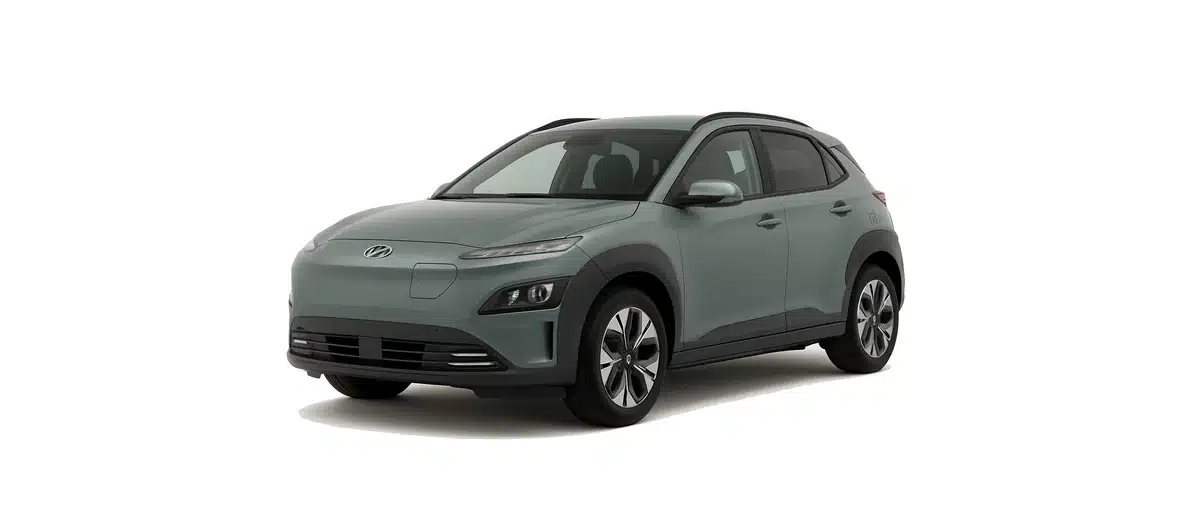
The Hyundai Kona name is used across petrol, hybrid and fully electric models, so the first point is important: this guide is for the Hyundai KONA Electric, the battery-electric version that uses an EV charging cable. Petrol and self-charging hybrid Kona models do not plug in and do not use Type 2 or CCS charging equipment.
For current UK buyers, Hyundai’s Model Year 26.5 KONA Electric range is centred on the 65.4 kWh long-range battery. However, many used Kona Electric models are also on UK roads, including earlier cars with 39 kWh, 64 kWh and 48.4 kWh battery packs. The charging socket may look the same, but battery size, range, charging times and some features can vary significantly depending on the model year and trim.
View Hyundai Kona Charging Cables
Hyundai Kona Battery and Charging Specifications
The current UK Hyundai KONA Electric uses a Type 2 socket for AC charging and CCS Combo 2 for DC rapid charging. This is the standard arrangement for modern UK and European electric cars: the upper Type 2 section is used for home and public AC charging, while the larger CCS connector adds two lower DC pins for rapid chargers.
For the current UK MY26.5 KONA Electric, Hyundai lists a 65.4 kWh lithium-ion polymer battery across Advance, N Line, N Line S and Ultimate trims. The on-board AC charger is listed at 10.4 kW, while DC rapid charging is quoted at up to 101 kW on a suitable CCS charger. Hyundai quotes around 41 minutes from 10-80% in favourable conditions on a 150 kW DC rapid charger.
In practical UK ownership, the key takeaway is that the KONA Electric is well suited to a 7 kW home wallbox and a Type 2 to Type 2 cable for untethered public AC posts. Rapid charging on longer journeys is handled by tethered CCS chargers, so you do not normally need to carry a separate cable for DC rapid charging.
Battery Options
Because the Kona Electric has been sold across more than one generation, it is worth confirming which version you own before comparing range or charging times.
- Current UK MY26.5 KONA Electric: Hyundai’s current UK brochure lists a 65.4 kWh battery for all trims. This is the version most relevant to new UK cars.
- Earlier second-generation models: Some earlier UK and European information included a 48.4 kWh standard-range battery as well as the larger 65.4 kWh pack. Availability varies by market and model year, so used-car buyers should check the vehicle’s documentation.
- Previous-generation Kona Electric: Older UK cars used 39 kWh and 64 kWh battery packs. Hyundai UK previously quoted WLTP ranges of around 180 miles and 278 miles respectively for those earlier models.
The charging connector remains Type 2 / CCS on relevant UK KONA Electric models, but the time needed to add a full charge will differ because the batteries are different sizes. A 39 kWh car does not need as much energy to refill as a 65.4 kWh car, while the larger-battery versions generally offer more driving range between charges.
AC Charging Speed
AC charging is what you use at home, at many workplace chargers and at many public destination chargers. The current KONA Electric’s on-board charger is listed by Hyundai UK at 10.4 kW, with some sources rounding this to 11 kW. In real terms, the car will charge up to the limit of the vehicle, the charge point and the electrical supply.
On a typical UK single-phase home wallbox rated at 7.4 kW, Hyundai quotes approximately 8 hours from 10-100% for the current 65.4 kWh KONA Electric. That makes overnight charging realistic for most owners: plug in in the evening and the car can usually be ready by morning.
On an 11 kW three-phase AC supply, Hyundai quotes around 5 hours 24 minutes from 10-100%, with the car charging at up to around 10 kW. This is most relevant to homes or workplaces with three-phase power, as most UK domestic properties are single-phase and will not supply 11 kW AC charging.
It is also important not to confuse the rating of the public AC post with the speed the car will actually accept. If you connect a KONA Electric to a 22 kW public AC post, it will not charge at 22 kW; it will be limited by its on-board AC charger. A suitable Type 2 to Type 2 cable is still the right cable, but the vehicle sets the upper AC charging rate.
DC Rapid Charging Speed
DC rapid charging is used for longer journeys and motorway stops. The current UK KONA Electric uses the CCS part of its charging port for rapid charging, and the cable is attached to the rapid charger itself. You simply plug the charger’s CCS connector into the vehicle.
For the current 65.4 kWh car, Hyundai quotes a maximum DC charging power of up to 101 kW and a 10-80% charging time of about 41 minutes on a suitable 150 kW CCS charger in good conditions. This is useful for planning: rather than waiting for 100%, most drivers stop at around 80% on rapid chargers because charging usually slows as the battery fills.
The KONA Electric is based on a 400 V EV architecture, so it should not be described as having the same ultra-high-speed 800 V charging behaviour as some other Hyundai electric models. In everyday terms, it is capable of sensible rapid-charging stops, but not the very highest charging speeds seen on some newer premium or dedicated high-voltage EV platforms.
Range and Efficiency
Hyundai’s current UK MY26.5 figures show that range depends on trim and wheel size. The Advance model on 17-inch wheels is listed with a WLTP maximum range of 319 miles. N Line, N Line S and Ultimate trims on 19-inch wheels are listed at 282 miles WLTP. This difference is a useful reminder that official range is not just about battery size; wheels, tyres, specification and efficiency all matter.
Independent real-world estimates for the 65.4 kWh car are lower than the best official WLTP figure, with around 242 miles often a more realistic planning figure depending on temperature, speed, load and driving style. Motorway use in winter will usually consume more energy than urban or mixed driving in mild weather.
For used Kona Electric models, range will depend on the battery version, condition, wheel and tyre setup, and how the car is driven. If you are buying used, check the exact battery size and model year rather than relying on a single Kona Electric range figure.
Charging at Home
For most UK KONA Electric owners, the most convenient setup is a dedicated 7 kW home wallbox. It is faster, safer and more convenient than relying on a domestic socket, and it allows the car to be charged overnight when electricity tariffs may be cheaper.
If your wallbox is untethered, you will need a Type 2 to Type 2 charging cable. This is the same cable used for many public AC charge points, so it is a useful item to keep in the car. If your home charger is tethered, it will already have a cable attached, but many drivers still carry a Type 2 cable for public charging.
A 3-pin domestic charging cable can be useful, but it is generally best suited as a backup or occasional charging solution. It can be used regularly if a qualified electrician has confirmed the socket and electrical installation are suitable for sustained EV charging. Standard household sockets were not originally designed for repeated long-duration high-load EV charging, so a professional check is strongly recommended before making it part of your routine.
Public Charging
Public charging for the KONA Electric falls into two main categories: AC destination charging and DC rapid charging.
For AC destination chargers, such as those in town centres, hotels, gyms, supermarkets or workplaces, you will usually need your own Type 2 to Type 2 cable unless the charger is tethered. These chargers are ideal when the car will be parked for a few hours. A 7 kW AC post can add a useful amount of range during a shopping trip or working day, while an 11 kW post may be faster if the site supply and vehicle allow it.
For DC rapid chargers, including many motorway and trunk-road charging hubs, the charger has its own CCS cable. These are better for longer trips where you want to add energy quickly and continue your journey. Plan around the 10-80% window where possible, as this is typically more time-efficient than charging close to 100% on a rapid charger.
Vehicle-Specific Features
The current UK KONA Electric includes several EV-specific features that can affect comfort and charging convenience. Hyundai’s MY26.5 UK brochure lists a heat pump as standard across current trims, which can help cabin heating efficiency in colder weather compared with relying solely on resistive heating.
Battery conditioning is also confirmed for the second-generation KONA Electric, with battery preparation managed through the navigation system to help the battery reach a more suitable temperature for rapid charging. As with all EVs, charging performance still depends on factors such as battery temperature, state of charge, charger capability and weather conditions.
Vehicle-to-load capability is available on some versions, but it should not be assumed for every car. In the current UK brochure, internal 3-pin V2L is listed for N Line S and Ultimate trims, while Hyundai’s wider information describes V2L capability of up to 3.6 kW. If V2L matters to you, check the exact trim and equipment fitted to your car. Vehicle-to-grid or vehicle-to-home support should not be assumed for the KONA Electric.
Charging Tips
- Check which KONA Electric you own: Battery size and charging figures vary between current and older models.
- Use a Type 2 cable for AC charging: This is the main cable needed for untethered public posts and untethered home wallboxes.
- Do not expect 22 kW AC charging: Even on a 22 kW post, the KONA Electric is limited by its on-board AC charger.
- Use CCS for long trips: Rapid chargers use tethered CCS cables and are the best option for motorway charging stops.
- Precondition when appropriate: Where supported and correctly set through navigation, battery conditioning can help rapid-charging performance.
- Plan winter journeys with a margin: Cold weather, high speeds and wet roads can reduce real-world range.
Frequently Asked Questions
What charging cable does the Hyundai KONA Electric use?
The Hyundai KONA Electric uses a Type 2 connection for AC charging. For untethered home wallboxes and many public AC charge points, you need a Type 2 to Type 2 cable. DC rapid charging uses the CCS connector, and the cable is attached to the rapid charger.
How long does the current Hyundai KONA Electric take to charge at home?
For the current UK 65.4 kWh KONA Electric, Hyundai quotes around 8 hours from 10-100% on a 7.4 kW home wallbox. Actual times can vary depending on starting charge, charger output, temperature and charging settings.
Can the Hyundai KONA Electric charge at 22 kW AC?
No. A 22 kW public AC post can be used if it has the right Type 2 connection, but the KONA Electric will be limited by its on-board AC charger, listed at around 10.4 kW for the current UK car.
How fast is rapid charging?
For the current 65.4 kWh UK model, Hyundai quotes up to 101 kW DC charging and around 41 minutes from 10-80% on a suitable 150 kW CCS charger in good conditions.
Do all Hyundai Kona models plug in?
No. The wider Kona range includes petrol and self-charging hybrid models. This guide applies to the KONA Electric battery-electric model.
What This Means for Drivers
The Hyundai KONA Electric is straightforward to live with if you match the charging method to the journey. For daily use, a 7 kW home wallbox and a Type 2 to Type 2 cable cover most needs. For longer journeys, CCS rapid charging is the right choice, with the current long-range car designed around practical 10-80% charging stops rather than very high 800 V charging speeds.
The main caution is model identification. A current UK MY26.5 KONA Electric has a 65.4 kWh battery, but older cars may have different battery sizes and therefore different range and charging times. Before buying a cable or planning charging routines, check your exact vehicle, trim and model year.
Looking for a Charging Cable for Hyundai Kona?
If you need a suitable Type 2 charging cable for your Hyundai KONA Electric, We provide Hyundai Kona charging cables for home and public AC charging.
View Hyundai Kona Charging Cables
Please note that this information is intended as a guide. Charging specifications may change due to model and year of manufacture. For precise information, always refer to your vehicle user manual.

