
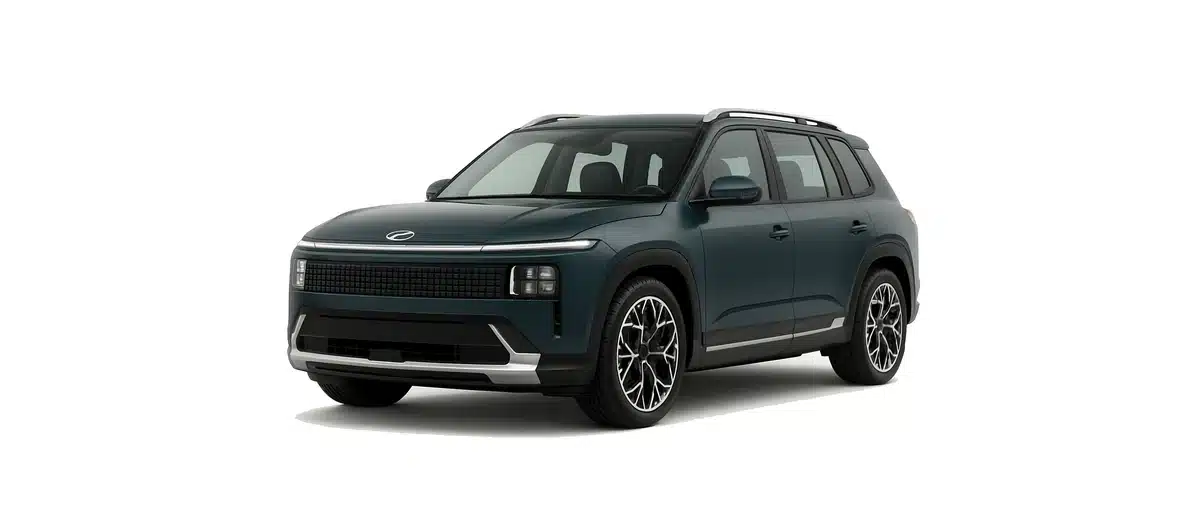
The Hyundai Ioniq 9 is a large three-row electric SUV built on Hyundai’s E-GMP platform. For UK buyers, it is offered as a battery-electric vehicle only, with a large 110.3 kWh gross battery across the MY26 range. That makes it a particularly capable long-distance family EV, but it also means charging habits matter: a very large battery takes longer to refill at home than a smaller hatchback or crossover.
This guide explains how the UK-market Hyundai Ioniq 9 charges at home and in public, what charging cable you need, how its Type 2 and CCS Combo 2 charging setup works, and why regular top-ups are usually more practical than waiting until the battery is nearly empty.
View Hyundai Ioniq 9 Charging Cables
Hyundai Ioniq 9 Battery and Charging Specifications
The UK Hyundai Ioniq 9 uses a Type 2 connection for AC charging and a CCS Combo 2 connection for DC rapid charging. This is the standard arrangement for most modern UK and European electric cars: the upper Type 2 section is used for home wallboxes, workplace chargers and many destination chargers, while the full CCS connector is used at rapid and ultra-rapid charging stations.
Hyundai UK lists a 10.5 kW on-board AC charger for the Ioniq 9. On DC, Hyundai quotes a 10–80% rapid charge time of 24 minutes on a suitable 350 kW CCS charger, with an official maximum DC charging figure of 233 kW in its UK technical information. The car’s 800V fast-charging architecture is a key part of its appeal for long-distance use, especially when paired with high-power motorway and trunk-road charging hubs.
- Vehicle type: battery-electric large three-row SUV
- UK charging port: Type 2 / CCS Combo 2
- Battery: 110.3 kWh gross, with usable capacity estimated at around 106.0 kWh
- AC charging: 10.5 kW on-board charger
- DC rapid charging: up to 233 kW officially quoted by Hyundai UK
- Official rapid charging time: 10–80% in 24 minutes on a suitable 350 kW CCS charger
- Maximum UK WLTP range: up to 385 miles on the Premium RWD version
Battery Options
All UK MY26 Hyundai Ioniq 9 variants use the same 110.3 kWh gross battery pack. Hyundai’s UK range includes rear-wheel-drive and all-wheel-drive versions, with Premium, Ultimate and Calligraphy trims, including a six-seat Calligraphy option. While the battery capacity is shared, range varies by trim, drivetrain, wheel size and performance level.
The longest official UK WLTP figure is up to 385 miles for the Premium 110 kWh 218 PS RWD version. Other UK versions are lower: Hyundai’s UK information places the Ultimate AWD at around 376 miles and Calligraphy versions at around 372 miles, depending on specification. For real-world planning, EV Database UK estimates are around 310 miles for the RWD version, around 305 miles for the AWD version and around 300 miles for the higher-output Performance AWD version.
The important point for owners is that this is a very large EV battery. It gives the Ioniq 9 strong touring potential, but it also means a full recharge on AC power can take a long time. In everyday use, topping up little and often is usually more convenient than running the battery very low and trying to refill it completely overnight.
AC Charging Speed
AC charging is what you will use at home, at many workplaces, at hotels and at slower public charging points. The Hyundai Ioniq 9’s UK specification includes a 10.5 kW on-board charger. Hyundai quotes an estimated 10–100% charging time of around 10 hours from an 11 kW three-phase wallbox.
Most UK homes, however, are single-phase rather than three-phase. That means the typical home wallbox will be rated at up to 7.4 kW. The Ioniq 9 can charge from a 7.4 kW wallbox, but the battery is large enough that a 0–100% charge can take roughly 17 hours in typical estimates. In practice, owners rarely need to charge from completely empty to completely full. A more realistic pattern is to plug in when convenient and add enough range for the next day or the next journey.
For untethered home chargers and many public AC posts, you will need a Type 2 to Type 2 charging cable. A 32 amp Type 2 cable is the normal choice for a 7.4 kW single-phase wallbox. If you regularly use three-phase AC chargers, choosing a suitable three-phase Type 2 cable may allow the car to make use of higher AC power where available, up to the vehicle’s on-board charger limit.
DC Rapid Charging Speed
DC rapid charging is where the Hyundai Ioniq 9’s 800V architecture becomes especially useful. Hyundai UK quotes 10–80% in 24 minutes on a suitable 350 kW CCS charger, with an official maximum DC charging rate of 233 kW. This does not mean the car charges at 350 kW; rather, it can take advantage of high-power CCS infrastructure that can supply the voltage and power needed for fast charging.
Rapid chargers normally have tethered cables, so you do not use your own charging cable for DC charging. You simply plug the charger’s CCS connector into the car. The Ioniq 9’s high peak charging capability makes high-power motorway hubs more worthwhile than lower-power DC chargers when you are travelling long distances and want the shortest possible stop.
As with all EVs, charging speed depends on several conditions, including battery temperature, state of charge, charger output, charger reliability and how many vehicles are sharing the site’s available power. The fastest results are usually seen when arriving at a rapid charger with a warm battery and a relatively low state of charge, then charging to around 80% rather than waiting for the final 20%, which is typically slower.
Range and Efficiency
The headline UK WLTP range for the Hyundai Ioniq 9 is up to 385 miles, but that figure applies to the most range-focused UK specification. All-wheel-drive and higher-trim versions have slightly lower official figures. Real-world range will also vary with driving style, speed, temperature, passengers, luggage, wheel size and use of climate control.
For a large three-row SUV, the Ioniq 9’s range is one of its major strengths. On longer journeys, many drivers will find it more efficient to plan one well-timed high-power rapid charging stop rather than stopping at a slower charger for longer. In colder weather, the standard heat pump can help with cabin heating efficiency, while battery conditioning can help prepare the battery for rapid charging when used appropriately.
Motorway driving is generally less efficient than town or mixed driving, so planning around real-world range rather than the maximum WLTP figure is sensible. If you are carrying a full family load, using roof accessories, driving in winter or travelling at sustained motorway speeds, build in extra margin.
Charging at Home
For most UK Hyundai Ioniq 9 owners, home charging will be the cheapest and most convenient way to run the vehicle. A dedicated 7.4 kW single-phase wallbox is likely to be the everyday charging solution for many households. It allows overnight charging, makes use of off-peak EV electricity tariffs where available, and avoids depending on public charging for routine use.
Because the Ioniq 9 has such a large battery, owners should think in terms of adding miles rather than always filling to 100%. For example, if your daily use is modest, plugging in a few nights per week may be enough. If you cover higher mileage, regular overnight top-ups will help keep the battery comfortably within your preferred range without needing very long charging sessions from a low state of charge.
A standard domestic 3-pin charger is generally best suited as a backup or occasional charging solution, but can be used regularly if a qualified electrician has confirmed the socket and electrical installation are suitable for sustained EV charging. With a battery of this size, 3-pin charging will be very slow, so it is not the most practical primary charging method for most Ioniq 9 owners.
If your property has three-phase electricity, an 11 kW wallbox may reduce AC charging times compared with a 7.4 kW single-phase charger, subject to installation suitability and the vehicle’s 10.5 kW on-board charger limit. Most domestic properties in the UK do not have three-phase supply, so this is more common at workplaces, commercial premises and some destination charging locations.
Public Charging
Public charging for the Hyundai Ioniq 9 falls into two main categories: AC destination charging and DC rapid charging. AC destination chargers often require your own Type 2 cable and are useful when the car will be parked for several hours, such as at a hotel, workplace, town-centre car park or leisure venue.
DC rapid and ultra-rapid chargers use tethered CCS cables. These are the chargers to prioritise on long journeys, especially high-power CCS sites on major routes. The Ioniq 9’s 24-minute 10–80% official rapid charging time makes it well suited to planned road-trip stops, provided the charger is capable, available and working correctly.
When comparing public chargers, it is worth paying attention to charger power. A lower-power DC charger may still be useful, but it will not make the most of the Ioniq 9’s high-speed charging capability. If you need to add a large amount of range quickly, choose a high-power CCS charger where possible.
Vehicle-Specific Features
Hyundai UK confirms the Ioniq 9 includes a standard heat pump and battery conditioning. Battery conditioning is particularly relevant for rapid charging, because a battery that is too cold may not accept high charging power as quickly. Hyundai’s UK material confirms manual battery conditioning, and supporting sources also refer to navigation-based preconditioning.
The UK specification also lists Vehicle-to-Load functionality with an internal 3-pin plug. This can be useful for powering suitable small electrical devices from the vehicle. However, UK customer availability of V2G or V2H as a working feature is not clearly confirmed in the available UK information, so it should not be assumed when choosing or planning home charging equipment.
The Ioniq 9’s UK and European charging port is Type 2 and CCS Combo 2. Owners should avoid confusing this with North American charging-port information, where different connector discussions may apply. For UK use, a Type 2 cable is the relevant AC cable, and CCS is used for rapid charging.
Charging Tips
- Use a Type 2 cable for AC charging: this is the cable you will need for untethered home wallboxes and many public AC charging posts.
- Install a dedicated wallbox if possible: a 7.4 kW home charger is the practical everyday solution for most UK homes.
- Top up regularly: the large battery means full-from-empty home charging takes a long time, so avoid waiting until the battery is very low.
- Use high-power CCS chargers on long trips: the Ioniq 9’s 800V architecture is best used at capable ultra-rapid charging hubs.
- Precondition before rapid charging: in cold weather, use the car’s battery conditioning features before arriving at a rapid charger where appropriate.
- Do not over-focus on 100%: for rapid charging, stopping around 80% is usually much quicker than waiting for a full charge.
- Check your cable rating: choose a Type 2 cable that suits the chargers you use most often, particularly if you regularly access three-phase AC charging.
Frequently Asked Questions
What charging cable does the Hyundai Ioniq 9 use in the UK?
The UK Hyundai Ioniq 9 uses a Type 2 cable for AC charging. For DC rapid charging, it uses the CCS Combo 2 connector on the charger’s tethered cable.
Can the Hyundai Ioniq 9 charge at 22 kW AC?
Hyundai UK lists a 10.5 kW on-board charger, so the car is limited by that on-board charger when using AC charging. A 22 kW public AC post will not mean the Ioniq 9 charges at 22 kW.
How long does the Hyundai Ioniq 9 take to charge at home?
Hyundai quotes around 10 hours for a 10–100% charge from an 11 kW three-phase wallbox. On a typical UK 7.4 kW single-phase home wallbox, a full 0–100% charge is commonly estimated at around 17 hours, although most owners will charge smaller amounts more often.
How fast can the Hyundai Ioniq 9 rapid charge?
Hyundai UK quotes a 10–80% DC charging time of 24 minutes on a suitable 350 kW CCS charger, with an official maximum DC charging figure of 233 kW.
Is the Hyundai Ioniq 9 a plug-in hybrid?
No. UK information describes the Ioniq 9 as an all-electric SUV. No UK plug-in hybrid or range-extender version is indicated in the available UK model information.
What This Means for Drivers
The Hyundai Ioniq 9 is designed for drivers who want the space of a large SUV with the long-distance capability of a modern high-voltage EV. Its large 110.3 kWh battery provides strong range, while its 800V architecture and high-power CCS charging make it well suited to longer journeys when you can access suitable rapid chargers.
For everyday ownership, however, the most important charging setup is still likely to be a Type 2 cable and a 7.4 kW home wallbox. The battery is large, so full charges take time, but regular overnight top-ups can make the Ioniq 9 easy to live with. On road trips, plan around high-power CCS chargers, use battery conditioning when needed, and treat the 10–80% window as the most time-efficient rapid-charging zone.
Looking for a Charging Cable for Hyundai Ioniq 9?
If you need a Type 2 charging cable for home, workplace or public AC charging, choose a cable that matches how and where you expect to charge your Hyundai Ioniq 9.
View Hyundai Ioniq 9 Charging Cables
Please note that this information is intended as a guide. Charging specifications may change due to model and year of manufacture. For precise information, always refer to your vehicle user manual.

