
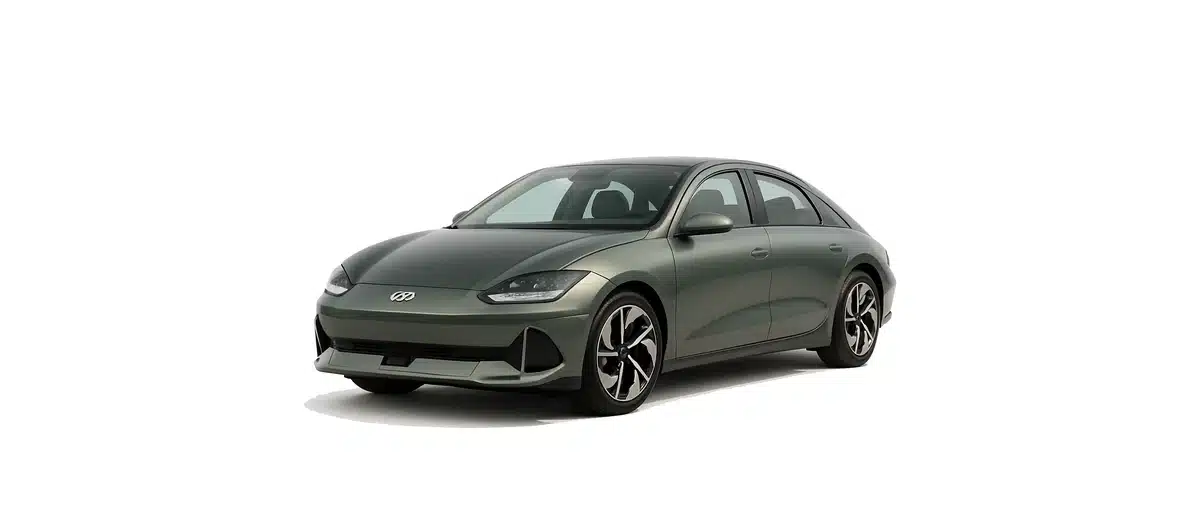
The Hyundai Ioniq 6 is a battery electric saloon built on Hyundai Motor Group’s E-GMP platform. In the current UK Model Year 25 line-up, Hyundai lists the Ioniq 6 with a 77.4 kWh battery in rear-wheel drive and all-wheel drive forms. It is designed to be straightforward to charge at home using a Type 2 wallbox, while also offering very fast public charging when connected to a suitable high-power CCS rapid charger.
For UK drivers, the key point is that the Ioniq 6 has two very different charging personalities. At home, it behaves like most modern EVs: plug it into a 7.4 kW single-phase wallbox overnight and it will be ready for daily use. On the road, its 800 V-class architecture allows it to charge extremely quickly in the right conditions. However, the commonly quoted 350 kW rapid charger figure refers to the charger class used for the headline charging time, not a continuous charging rate that the car itself will hold.
View Hyundai Ioniq 6 Charging Cables
Hyundai Ioniq 6 Battery and Charging Specifications
The UK-market Hyundai Ioniq 6 is a pure battery electric vehicle. It is not a plug-in hybrid, range extender or self-charging hybrid. Charging is via a Type 2 connector for AC charging and a CCS Combo 2 connector for DC rapid charging, which is the standard arrangement for most modern electric cars in the UK and Europe.
Current UK Hyundai data lists an 11 kW / 10.5 kW three-phase on-board AC charger. This means the car can make use of three-phase AC charging where available, although most UK domestic properties are single-phase and will typically use a 7.4 kW home wallbox. For rapid charging, Hyundai quotes 10-80% in as little as 18 minutes on a 350 kW ultra-fast charger, with broader real-world caveats depending on charger output, battery temperature and conditions. Independent EV data commonly lists the vehicle’s peak DC charging capability at around 240 kW rather than 350 kW.
Battery Options
For the current UK Model Year 25 range, Hyundai lists the Ioniq 6 with a 77.4 kWh battery. The UK line-up includes Premium and Ultimate trims, each available in rear-wheel drive or all-wheel drive form. EV Database estimates usable battery capacity at around 74 kWh, which is a useful figure when thinking about practical charging time and energy use.
Hyundai’s current UK figures show the rear-wheel drive Ioniq 6 at up to 338 miles WLTP, while the all-wheel drive version is listed at up to 322 miles WLTP. These figures apply to current UK cars on 20-inch wheels. Some older or non-UK references mention smaller battery versions or different wheel sizes, but those should not be assumed to apply to the current UK range without checking the relevant UK model year specification.
AC Charging Speed
AC charging is what you will use at home, at many workplaces and at some destination chargers. The Ioniq 6 uses a Type 2 charging connection for AC charging. Hyundai lists an 11 kW three-phase on-board charger, and the UK specification gives a 0-100% AC charging time of about 7 hours 10 minutes when the car can receive 11 kW.
In the UK, however, the more common home setup is a single-phase 7.4 kW wallbox. On this type of charger, a full empty-to-full charge for the 77.4 kWh Ioniq 6 is more likely to be in the region of 11 hours 45 minutes. In everyday use, you will rarely be charging from completely empty to completely full, so typical top-ups are much shorter. For example, replenishing the energy used during normal commuting can often be done comfortably overnight or during an off-peak tariff window.
If you have access to three-phase power at home or at work, the Ioniq 6 can benefit from faster AC charging up to its on-board charger limit. For most private UK driveways, though, a 7.4 kW Type 2 wallbox remains the realistic and practical choice.
DC Rapid Charging Speed
DC rapid charging is where the Ioniq 6 stands out. Using a CCS Combo 2 connector, it can access UK public rapid and ultra-rapid charging networks. Hyundai’s 800 V-class E-GMP architecture allows the car to charge very quickly when paired with a suitable high-power charger and when the battery is at the right temperature.
Hyundai states that the Ioniq 6 can charge from 10-80% in as little as 18 minutes on a 350 kW ultra-fast charger. The important detail is that a 350 kW charger rating describes the maximum capability of the charger, not the continuous power the car will draw. The Ioniq 6’s peak charging power is generally quoted at around 240 kW, and the actual rate will vary throughout the session. Like all EVs, it charges fastest at lower states of charge and slows as the battery fills, especially beyond 80%.
Cold weather, a cold battery, charger sharing, site limitations and battery state of charge can all affect results. The Ioniq 6 has battery pre-conditioning as standard in the current UK specification, which can help prepare the battery before a planned rapid charging stop. To get closer to the headline 10-80% time, use the car’s route planning or pre-conditioning functions where available before arriving at an ultra-rapid charger.
Range and Efficiency
The Ioniq 6 is known for its efficient saloon shape, and this helps it travel a long distance from its 77.4 kWh battery. The current UK rear-wheel drive model is listed at up to 338 miles WLTP, while the all-wheel drive model is listed at up to 322 miles WLTP. In real driving, range will vary with speed, temperature, driving style, tyre condition, load and how much heating or air conditioning is used.
A practical real-world figure for the rear-wheel drive 77.4 kWh Ioniq 6 is around 305 miles in favourable mixed conditions, though drivers should expect less in winter motorway use and potentially more in gentle urban or suburban driving. The standard heat pump in the current UK specification can help reduce heating-related energy use compared with relying solely on resistive heating, particularly in cooler weather.
For long journeys, range planning is less about using the full battery every time and more about choosing efficient charging stops. Because the Ioniq 6 can add energy quickly on suitable CCS chargers, shorter 10-80% rapid charging sessions are usually more efficient than waiting for the final 20% on a rapid charger.
Charging at Home
For most UK owners, the best home charging setup for the Hyundai Ioniq 6 is a dedicated Type 2 7.4 kW wallbox. This can be tethered, with the cable permanently attached, or untethered, where you use your own Type 2 to Type 2 charging cable. A tethered unit is convenient because the cable is always ready, while an untethered unit can look neater and gives you flexibility to replace or use different cable lengths.
A 7.4 kW wallbox is well matched to the Ioniq 6 for overnight charging. It also allows you to make better use of off-peak EV electricity tariffs if your charger, car or energy supplier supports scheduled charging. For routine use, many EV drivers set a daily charge limit of around 80% and reserve 100% charges for longer trips, following the vehicle’s in-car guidance and owner manual recommendations.
A 3-pin plug-in charger is generally best suited as a backup or occasional charging solution, but can be used regularly if a qualified electrician has confirmed the socket and electrical installation are suitable for sustained EV charging. A domestic socket charges much more slowly than a wallbox, so it is not the most convenient option for regularly replenishing a large battery from a low state of charge.
Public Charging
When charging away from home, the Ioniq 6 can use Type 2 AC destination chargers and CCS rapid chargers. Type 2 public chargers are common in car parks, hotels, town centres and workplaces. They are useful when the car will be parked for several hours. Depending on the charger and electrical supply, these may offer 7 kW, 11 kW or 22 kW, but the car will only draw up to the limit of its on-board AC charger.
For motorway and long-distance charging, use CCS rapid or ultra-rapid chargers. The Ioniq 6’s charging ability is best demonstrated on high-power chargers that can properly support 800 V-class vehicles. A 350 kW charger gives the car the best chance of reaching its quickest 10-80% charging performance, but a lower-rated charger can still be useful if it is conveniently located and available.
As with any EV, charging speed usually falls significantly after 80%. On a busy journey, it is often quicker overall to stop briefly, charge to around 70-80%, and continue to the next planned charging stop rather than waiting for a near-full battery. This is especially true in a car like the Ioniq 6, which can accept high charging power over the most useful part of the battery range.
Vehicle-Specific Features
The Ioniq 6’s E-GMP platform is one of its most important charging-related features. Its 400 V / 800 V multi-charging capability allows it to work across a wide range of public infrastructure while taking advantage of ultra-rapid chargers when conditions are suitable.
Current UK Premium and Ultimate specifications list a heat pump and battery heating system with pre-conditioning as standard. These features are particularly relevant in the UK climate, where cold battery temperatures can reduce rapid charging speed. Pre-conditioning helps bring the battery closer to an ideal temperature before arriving at a charger, improving the chance of a faster session.
Vehicle-to-Load is also confirmed for the Ioniq 6. Hyundai states output of up to 3.6 kW, and the UK specification lists interior V2L as standard. The exterior V2L adaptor should be treated carefully, as Hyundai’s UK information refers to an optional converter and the specification does not list the exterior adaptor as standard equipment. Vehicle-to-Grid or Vehicle-to-Home capability is not currently promoted for UK customer use on the Ioniq 6.
Charging Tips
- Use a Type 2 wallbox at home: a 7.4 kW single-phase wallbox is the practical maximum for many UK homes and is well suited to overnight charging.
- Choose CCS for rapid charging: the Ioniq 6 uses CCS Combo 2 for DC rapid and ultra-rapid charging.
- Pre-condition before rapid charging: in colder weather, use route planning or battery pre-conditioning before arriving at a rapid charger where possible.
- Do not expect 350 kW continuously: the 350 kW figure refers to the charger class for the headline charging time, not a constant vehicle charging rate.
- Stop at around 80% on long trips: rapid charging slows beyond 80%, so shorter, planned charging stops are often quicker overall.
- Use 100% selectively: for everyday use, an 80% limit is often practical, with 100% reserved for longer journeys in line with Hyundai guidance.
Frequently Asked Questions
What charging cable does the Hyundai Ioniq 6 use?
The Hyundai Ioniq 6 uses a Type 2 connection for AC charging. For public DC rapid charging, it uses a CCS Combo 2 connector, where the cable is normally attached to the rapid charger.
Can the Hyundai Ioniq 6 charge at 350 kW?
Not continuously. Hyundai’s headline 10-80% figure is based on using a 350 kW ultra-fast charger, but the car’s peak charging power is lower, commonly quoted at around 240 kW. Actual charging speed varies during the session.
How long does the Ioniq 6 take to charge at home?
On a typical UK 7.4 kW home wallbox, an empty-to-full charge is likely to take roughly 11 hours 45 minutes. Smaller daily top-ups will take much less time. Where 11 kW three-phase AC charging is available, Hyundai lists a 0-100% time of about 7 hours 10 minutes.
Is the Hyundai Ioniq 6 a hybrid?
No. The UK-market Hyundai Ioniq 6 is a battery electric vehicle. It has no petrol or diesel engine and must be charged from mains electricity.
Does the Hyundai Ioniq 6 have battery pre-conditioning?
Yes. Battery heating with pre-conditioning is listed as standard on current UK Premium and Ultimate models, helping support better rapid charging performance in suitable conditions.
What This Means for Drivers
The Hyundai Ioniq 6 is one of the more capable long-distance EVs on sale in the UK, not because it needs unusual home charging equipment, but because it combines efficient driving with very fast CCS charging potential. At home, it is simple: a Type 2 7.4 kW wallbox will suit most owners. On longer journeys, the car rewards good planning, especially when using high-power chargers and battery pre-conditioning before arrival.
The main thing to understand is the difference between AC and DC charging. AC home charging is steady, convenient and ideal for daily use. DC rapid charging is for journey stops, where the Ioniq 6’s 800 V-class system can deliver short charging breaks when charger capability, battery temperature and state of charge all line up.
Looking for a Charging Cable for Hyundai Ioniq 6?
If you need a suitable Type 2 cable for home, workplace or destination charging, We sell Hyundai Ioniq 6 charging cables to match the car’s UK charging connection.
View Hyundai Ioniq 6 Charging Cables
Please note that this information is intended as a guide. Charging specifications may change due to model and year of manufacture. For precise information, always refer to your vehicle user manual.

