
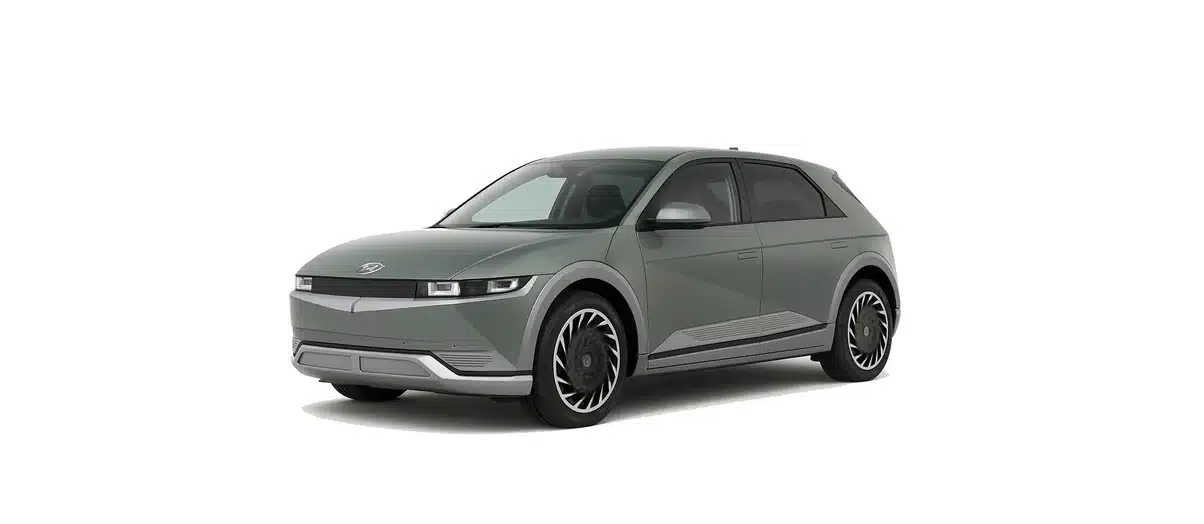
The Hyundai Ioniq 5 is one of the UK’s best-known electric crossovers, combining distinctive styling with a dedicated EV platform and very strong rapid-charging capability. It is a battery electric vehicle, not a plug-in hybrid, so charging habits and cable choice are central to day-to-day ownership.
For current UK facelifted non-N Ioniq 5 models, the main battery options are a 63 kWh Standard Range RWD and 84 kWh Long Range RWD or AWD versions. Earlier used examples may have different battery packs, including 58 kWh, 73 kWh or 77.4 kWh options, so it is worth checking the exact model year and specification if you are buying used.
The key point for UK drivers is that the Ioniq 5 has two very different charging personalities. At home and on most destination chargers, it is an 11 kW Type 2 AC car, usually limited by a typical single-phase UK wallbox to around 7.4 kW. On the road, its 800V E-GMP architecture can make it exceptionally quick on suitable CCS ultra-rapid chargers, especially when battery preconditioning is used correctly.
View Hyundai Ioniq 5 Charging Cables
Hyundai Ioniq 5 Battery and Charging Specifications
Current UK Hyundai Ioniq 5 models use a Type 2 connector for AC charging and a CCS Combo 2 connector for DC rapid charging. The charging port is positioned at the right rear of the vehicle. The onboard AC charger is rated at up to 11 kW, although achieving that AC speed normally requires a three-phase supply.
For DC rapid charging, the Ioniq 5’s headline capability depends on battery version. Current 63 kWh models are listed at around 195 kW maximum DC charging, while current 84 kWh models are listed at around 263 kW maximum DC charging. Under suitable conditions, Hyundai and EV Database UK figures point to a 10–80% rapid charge in about, or as little as, 18 minutes.
Those figures are not guaranteed at every charger. Rapid-charging speed depends on charger output, battery temperature, current state of charge, battery conditioning and how busy the charging site is. Even so, the Ioniq 5 remains one of the stronger long-distance EVs in its class when paired with a suitable ultra-rapid CCS charger.
Battery Options
The current UK facelifted Ioniq 5 range is centred on two battery sizes:
- Standard Range 63 kWh RWD: 63 kWh gross capacity, around 60 kWh usable. Hyundai quotes up to 273 miles WLTP for this version, while EV Database UK estimates around 210 miles of real-world range.
- Long Range 84 kWh RWD: 84 kWh gross capacity, around 80 kWh usable. Hyundai quotes up to 354 miles WLTP for the most efficient current RWD trims, with some trim levels lower. EV Database UK estimates around 275 miles real-world range.
- Long Range 84 kWh AWD: 84 kWh gross capacity, around 80 kWh usable. Hyundai quotes up to 311 miles WLTP for Ultimate AWD and up to 307 miles for N Line and N Line S AWD, while EV Database UK lists a similar estimated real-world range to the RWD version.
It is important not to apply the current 63 kWh and 84 kWh figures to every Ioniq 5 on the used market. Pre-facelift UK cars used other battery sizes, so charging times and range will vary.
AC Charging Speed
For home, workplace and many public destination chargers, the Hyundai Ioniq 5 charges using Type 2 AC. The onboard AC charger is rated at up to 11 kW, but in the UK that headline AC figure is usually only relevant if you have access to a three-phase supply.
Most UK homes are single-phase, and most home wallboxes charge at up to 7.4 kW. At that speed, a current 63 kWh Ioniq 5 takes roughly 9 hours 45 minutes for a full charge, while an 84 kWh version takes roughly 12 hours 45 minutes. In real use, many owners will not charge from empty to full; topping up from, for example, 30% to 80% will take much less time.
On a 22 kW public AC post, the Ioniq 5 will not charge at 22 kW because the car’s onboard AC charger is the limiting factor. With a suitable three-phase Type 2 cable and supply, it can use up to 11 kW AC, but it cannot take the full 22 kW available from the post.
DC Rapid Charging Speed
DC rapid charging is where the Ioniq 5 stands out. Its Hyundai Motor Group E-GMP platform uses 800V architecture and can work with both 400V and 800V DC charging infrastructure. On an appropriate ultra-rapid CCS charger, this allows very fast charging when conditions are right.
For the current UK facelifted range, the 63 kWh Standard Range model is listed at up to around 195 kW DC. The 84 kWh Long Range RWD and AWD versions are listed at up to around 263 kW DC. The often-quoted 10–80% time of around 18 minutes is therefore most relevant when the car is connected to a sufficiently powerful charger, the battery is warm or preconditioned, and the charge session starts at a suitably low state of charge.
In cold weather, or if the battery has not been preconditioned before arriving at a rapid charger, peak power may be lower. It is normal for charging power to taper as the battery fills, so charging from 80% to 100% on a rapid charger can take disproportionately longer than the 10–80% window.
Range and Efficiency
The best current UK WLTP figure for the Ioniq 5 is up to 354 miles, but that applies to specific 84 kWh RWD versions rather than every model. The 63 kWh RWD is quoted at up to 273 miles WLTP, while AWD and some sportier or higher-spec trims have lower official figures.
Real-world range depends on speed, weather, wheel and tyre specification, payload, terrain and cabin heating or cooling use. EV Database UK estimates around 210 miles for the current 63 kWh model and around 275 miles for current 84 kWh models. Motorway driving in winter will usually be less efficient than mixed driving in mild conditions.
For daily use, many owners will find it practical to keep the battery between about 20% and 80% most of the time, charging higher before long journeys when extra range is useful. The Ioniq 5’s fast DC charging means that on longer trips, planned shorter charging stops can be more efficient than always trying to charge to 100%.
Charging at Home
For most UK Ioniq 5 owners, a dedicated Type 2 home wallbox is the most convenient charging method. It allows the car to be plugged in overnight, makes it easier to use cheaper off-peak electricity tariffs where available, and is better suited to regular EV charging than relying on a domestic socket.
A 7.4 kW single-phase wallbox will be enough for many households. Although the Ioniq 5 can accept up to 11 kW AC, most UK homes do not have three-phase power, so the car will usually charge below its maximum AC capability at home. If you do have three-phase at home or at a workplace, an 11 kW-compatible setup can reduce AC charging times.
A 3-pin charger is generally best suited as a backup or occasional charging solution, but can be used regularly if a qualified electrician has confirmed the socket and electrical installation are suitable for sustained EV charging. Domestic sockets were not designed primarily for long-duration high-load EV charging, so it is sensible to treat this option with caution.
Public Charging
For public AC charging, the Ioniq 5 uses a Type 2 cable. Some destination chargers have a tethered cable, but many public AC posts require you to bring your own. A Type 2 to Type 2 cable is therefore a practical item to keep in the car, especially for town-centre, hotel, workplace and car park charging.
For rapid and ultra-rapid public charging, the cable is normally attached to the charger, and the Ioniq 5 uses its CCS Combo 2 inlet. On long motorway journeys, look for high-power CCS chargers if you want to make the most of the car’s rapid-charging capability. A 50 kW rapid charger will work, but it will not deliver the headline Ioniq 5 charging experience.
Battery preconditioning is particularly useful before high-power charging. On the current facelifted UK range, battery heating, battery preconditioning and a heat pump are listed as standard. Hyundai feature information also states that battery preconditioning can be activated remotely via the Bluelink app or from inside the car. In cold UK weather, using the car’s navigation or preconditioning features before arriving at a charger can make a noticeable difference to charging performance.
Vehicle-Specific Features
The Ioniq 5’s dedicated E-GMP platform is one of its major technical advantages. Its 800V architecture supports very high DC charging speeds, while compatibility with 400V and 800V infrastructure helps broaden the range of chargers the car can use.
Heat pump fitment is confirmed as standard on the current UK facelifted range. A heat pump can help improve efficiency in cooler weather by reducing the energy needed for cabin heating compared with more basic heating systems.
Vehicle-to-Load is also confirmed for the Ioniq 5, with output up to 3.6 kW using appropriate equipment and depending on trim or socket arrangement. V2L is intended for powering suitable appliances and equipment. It should not be described as vehicle-to-grid or home-backup functionality, as current UK data lists V2G and V2H as not supported.
Charging Tips
- Choose the right cable for AC posts: a Type 2 to Type 2 cable is the correct cable type for untethered UK public AC chargers.
- Do not over-prioritise 22 kW AC: the Ioniq 5 is limited to 11 kW AC, so a 22 kW post will not make the car charge at 22 kW.
- Use preconditioning before rapid charging: especially in winter, prepare the battery before arriving at an ultra-rapid charger where possible.
- Plan around the 10–80% window: the fastest rapid-charging performance is usually in the lower and middle part of the battery, not near 100%.
- Check your exact battery version: current UK cars use 63 kWh or 84 kWh packs, while older examples may have different capacities.
- Use off-peak home charging where possible: scheduled overnight charging can reduce running costs if you are on a suitable electricity tariff.
Frequently Asked Questions
What charging cable does the Hyundai Ioniq 5 use?
For AC charging, the Hyundai Ioniq 5 uses a Type 2 connection. For DC rapid charging, it uses CCS Combo 2. Public rapid chargers normally have their own tethered CCS cable, while many public AC posts require you to bring a Type 2 to Type 2 cable.
Can the Hyundai Ioniq 5 charge at 22 kW AC?
No. Current UK Ioniq 5 models have an 11 kW onboard AC charger. A 22 kW public AC charger can still be used, but the car will only draw up to its own AC limit, assuming the correct cable and supply are available.
How long does the Hyundai Ioniq 5 take to charge at home?
On a typical 7.4 kW UK home wallbox, current figures suggest around 9 hours 45 minutes for the 63 kWh model and around 12 hours 45 minutes for the 84 kWh models from empty to full. Partial top-ups are much quicker in normal day-to-day use.
How fast can the Hyundai Ioniq 5 rapid charge?
Current 63 kWh versions are listed at around 195 kW maximum DC charging, while current 84 kWh versions are listed at around 263 kW. Under suitable conditions, a 10–80% charge can take about 18 minutes.
Does the Hyundai Ioniq 5 support Vehicle-to-Load?
Yes, V2L is confirmed up to 3.6 kW with suitable equipment and specification. However, V2L is not the same as V2G or V2H, and current UK data does not list vehicle-to-grid or vehicle-to-home support.
What This Means for Drivers
The Hyundai Ioniq 5 is easy to live with if you match your charging setup to how the car is actually used. For everyday UK driving, a Type 2 home wallbox or regular access to public AC charging will cover most needs. The car’s 11 kW AC capability is useful, but most home users will see 7.4 kW unless they have three-phase power.
For longer journeys, the Ioniq 5’s real advantage is its high-power CCS charging capability. The 84 kWh versions in particular can take advantage of ultra-rapid chargers at up to around 263 kW in suitable conditions, making short, well-planned charging stops realistic. Battery preconditioning, charger choice and arriving with the right state of charge are the keys to getting close to the best figures.
Looking for a Charging Cable for Hyundai Ioniq 5?
If you need a Type 2 charging cable for home, workplace or public AC charging, We offer Hyundai Ioniq 5 charging cables suitable for UK charging points.
View Hyundai Ioniq 5 Charging Cables
Please note that this information is intended as a guide. Charging specifications may change due to model and year of manufacture. For precise information, always refer to your vehicle user manual.

