
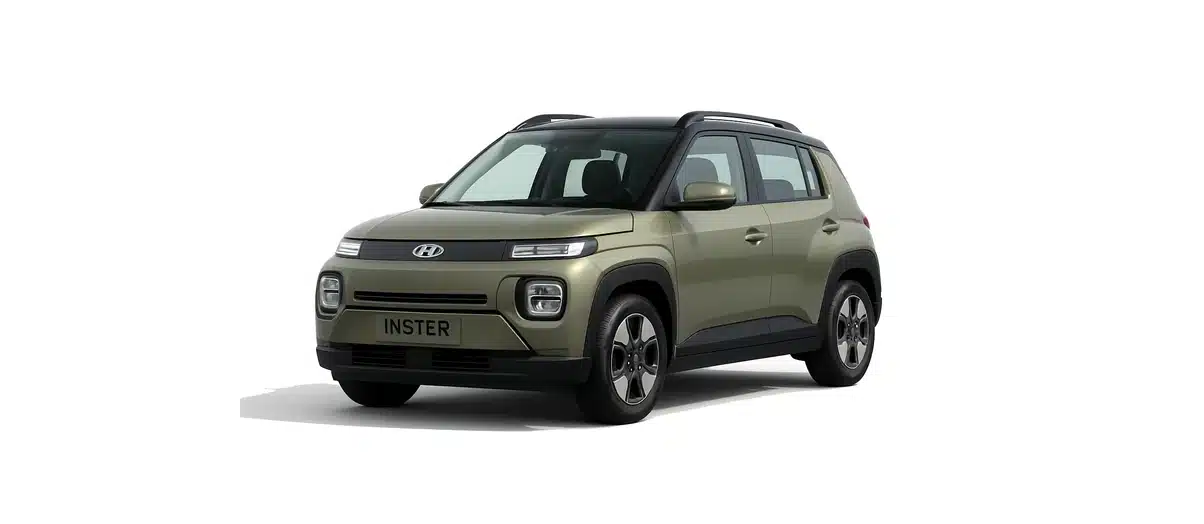
The Hyundai INSTER is a compact all-electric city car with small SUV styling, four-seat practicality and charging figures that make it well suited to UK urban and suburban driving. Unlike some small EVs that feel limited beyond town use, the INSTER combines modest battery sizes with useful AC charging, CCS rapid charging and official WLTP range figures of up to 229 miles depending on battery, trim and wheel size.
For UK owners, the key point is that the INSTER uses the familiar Type 2 connector for AC charging and CCS Combo 2 for DC rapid charging. That means it is compatible with the standard home wallboxes, destination chargers and motorway rapid chargers commonly found across the UK and Europe. However, not every INSTER has the same battery, range or charging peak, so it is worth understanding which version you have before planning charging stops or choosing cables.
View Hyundai INSTER Charging Cables
Hyundai INSTER Battery and Charging Specifications
The UK Hyundai INSTER range is offered as a battery-electric vehicle only. No UK plug-in hybrid or petrol-electric INSTER version was found in the current UK data. The car uses a Type 2 inlet for AC charging and a CCS Combo 2 connection for DC rapid charging, giving it broad compatibility with UK charging infrastructure.
Hyundai lists the INSTER with an on-board AC charger specified at around 10.5 kW, commonly described as up to 11 kW AC. On DC rapid chargers, the maximum charging rate depends on the battery: the 42 kWh Standard Range version is listed at up to 73 kW, while the 49 kWh Long Range version is listed at up to 85 kW. Hyundai quotes around 30 minutes for a 10-80% rapid charge on a suitable high-power CCS charger for both battery versions.
Battery Options
There are two UK battery sizes to be aware of. The INSTER 01 can be specified with a 42 kWh Standard Range battery or an optional 49 kWh Long Range battery. INSTER 02 and INSTER Cross versions use the 49 kWh Long Range battery.
The 42 kWh Standard Range model is officially rated at up to 203 miles WLTP when fitted with 15-inch wheels. EV Database estimates a usable capacity of about 39 kWh and a real-world range of around 155 miles, although actual range will vary with speed, temperature, driving style and use of heating or air conditioning.
The 49 kWh Long Range model provides the highest official range in the INSTER line-up. Hyundai quotes up to 229 miles WLTP for the INSTER 01 with 15-inch wheels, while INSTER 02 and INSTER Cross models on 17-inch wheels are rated at about 223 miles WLTP. EV Database estimates a usable capacity of around 46 kWh and a real-world range of about 185 miles for the Long Range version.
AC Charging Speed
AC charging is what most owners will use most of the time, especially at home, work or overnight destination chargers. The INSTER supports up to around 11 kW AC through its Type 2 connection when connected to a suitable three-phase supply. Hyundai lists 10-100% AC charging times of around 4 hours for the 42 kWh model and about 4 hours 35 minutes for the 49 kWh model when using an 11 kW three-phase wallbox.
Most UK homes are single-phase, so the more realistic home charging figure for many owners is up to 7.4 kW from a dedicated home wallbox. At that speed, EV Database estimates around 6 hours 15 minutes for the 42 kWh model and around 7 hours 30 minutes for the 49 kWh model from empty to full. In day-to-day use, most drivers will not charge from 0-100%; topping up from, for example, 30-80% will take considerably less time.
For untethered home chargers and many public AC posts, you will need a Type 2 to Type 2 charging cable. If your home wallbox is tethered, the cable is already attached to the charger, but a separate Type 2 cable is still useful for public AC charging at supermarkets, workplaces, hotels and town-centre car parks.
DC Rapid Charging Speed
For longer journeys, the INSTER uses CCS rapid charging. The 42 kWh Standard Range version is listed by Hyundai UK at up to 73 kW DC, while the 49 kWh Long Range version is listed at up to 85 kW DC. Hyundai quotes about 30 minutes for a 10-80% charge on a suitable high-power CCS charger.
This is an important point when choosing public chargers. A 100 kW or higher CCS charger is generally enough to reach the INSTER’s UK peak charging rate, assuming the battery temperature, state of charge and charger conditions allow it. Plugging into a 150 kW or 350 kW charger will not make the car exceed its own limit of up to 73 kW or 85 kW, depending on version.
On a 50 kW charger, charging will still work, but it will take longer. Hyundai UK technical data indicates a 10-80% charge on a 50 kW charger is roughly 58 minutes, so for motorway travel a 100 kW-plus CCS unit is usually the better match when available.
Range and Efficiency
The headline WLTP range for the Hyundai INSTER is up to 229 miles, but that figure should not be applied to every version. The 42 kWh INSTER 01 is rated at up to 203 miles WLTP. The 49 kWh INSTER 01 on 15-inch wheels reaches up to 229 miles WLTP, while 49 kWh INSTER 02 and Cross models on 17-inch wheels are closer to 223 miles WLTP.
Real-world range is usually lower than WLTP, especially in winter, at motorway speeds or with frequent short journeys where the cabin needs repeated heating. As a practical planning guide, EV Database estimates around 155 miles for the 42 kWh model and around 185 miles for the 49 kWh model in mixed real-world use. Careful city driving in mild weather may do better, while sustained motorway driving in cold weather may reduce range noticeably.
Charging at Home
For most INSTER owners with off-street parking, a dedicated Type 2 home wallbox will be the most convenient way to charge. It allows the car to be plugged in overnight, supports scheduled charging on suitable tariffs and is designed for repeated high-load EV use. On a typical UK 7.4 kW single-phase wallbox, even the larger 49 kWh battery can usually be recharged comfortably overnight.
If your property has a three-phase electrical supply and a compatible three-phase wallbox, the INSTER can take advantage of its higher AC capability of up to around 11 kW. This is more common at some workplaces and commercial properties than in ordinary domestic homes.
A 3-pin charger is generally best suited as a backup or occasional charging solution, but can be used regularly if a qualified electrician has confirmed the socket and electrical installation are suitable for sustained EV charging. Charging from a domestic socket is much slower than using a wallbox, so it is best viewed as a fallback rather than the main charging method for most households.
Public Charging
The INSTER is straightforward to use on the UK public charging network. For slower public AC posts, use a Type 2 cable. These chargers are common in car parks, workplaces, retail parks and hotels, and are useful when the car will be parked for several hours.
For rapid and ultra-rapid charging, the charger will usually have a tethered CCS cable already attached. You do not need to buy a separate DC rapid charging cable. Simply connect the CCS plug to the car and follow the instructions from the charging network. The INSTER’s own DC charging limit means that a reliable 100 kW-class charger is already a sensible match; higher-powered units may still be convenient, but they will not increase the car’s maximum charging capability.
On longer trips, plan around the 10-80% charging window. Charging is typically fastest in the middle of the battery and slows as the battery approaches a high state of charge. For this reason, it is often quicker to stop briefly and charge to around 80% than to wait for a full 100% charge on a rapid charger.
Vehicle-Specific Features
Hyundai UK lists a heat pump and battery heater as standard on UK INSTER 01 and 02 models, and the INSTER Cross technical release also refers to a battery heating system and high-efficiency heat pump as standard. These features can help the car manage efficiency and battery temperature, particularly in colder UK weather.
Vehicle-to-Load is available on the INSTER at up to 3.6 kW, but UK information indicates that it is trim or pack dependent rather than standard across every version. Owners should check their exact trim, optional packs and handbook before relying on a V2L socket or adaptor. The INSTER should not be described as having V2G or V2H capability based on the available UK information.
Charging Tips
- Choose the right Type 2 cable: A Type 2 to Type 2 cable is the key cable for untethered home wallboxes and public AC charge points.
- Do not overpay for DC capability: DC rapid chargers have their own tethered CCS cables, and the INSTER is capped at up to 73 kW or 85 kW depending on battery.
- Know your battery version: The 42 kWh and 49 kWh cars differ in range and maximum rapid charging power.
- Use 10-80% for road-trip planning: Hyundai quotes around 30 minutes in this window on a suitable high-power CCS charger.
- Pre-heat while plugged in where possible: Using mains power to warm the cabin before departure can help preserve driving range in cold weather.
- Keep a backup option: A suitable 3-pin charging lead can be useful for emergencies or occasional low-mileage charging where the electrical installation has been checked.
Frequently Asked Questions
What charging cable does the Hyundai INSTER use?
The Hyundai INSTER uses a Type 2 connection for AC charging and CCS Combo 2 for DC rapid charging. For most owners, a Type 2 to Type 2 cable is the main cable needed for untethered home and public AC charging.
Can the Hyundai INSTER charge at 11 kW at home?
The car can accept up to around 11 kW AC on a suitable three-phase supply. However, most UK homes are single-phase, where 7.4 kW is normally the practical maximum from a dedicated home wallbox.
How fast does the Hyundai INSTER rapid charge?
Hyundai UK lists the 42 kWh model at up to 73 kW DC and the 49 kWh model at up to 85 kW DC. A 10-80% charge is quoted at around 30 minutes on a suitable high-power CCS charger.
Does every Hyundai INSTER have a 229-mile range?
No. The 229-mile WLTP figure applies to the 49 kWh INSTER 01 with 15-inch wheels. The 42 kWh model is rated at up to 203 miles WLTP, while 49 kWh INSTER 02 and Cross models are about 223 miles WLTP.
Does the Hyundai INSTER have Vehicle-to-Load?
Vehicle-to-Load is available at up to 3.6 kW, but it appears to be trim or pack dependent in the UK rather than standard on every car. Check your specific vehicle specification before relying on it.
What This Means for Drivers
The Hyundai INSTER is a small EV that should be easy to live with if its charging characteristics are understood. At home, a 7.4 kW wallbox is enough for convenient overnight charging for most UK households, while three-phase 11 kW AC charging can be useful where available. On longer trips, the car’s CCS rapid charging is best planned around 100 kW-plus chargers and the 10-80% window, rather than chasing the highest-powered ultra-rapid unit on the site.
The main buying decision for charging accessories is straightforward: a good Type 2 cable is the important item for public AC posts and untethered wallboxes. You do not need a separate rapid charging cable, and you do not need to choose accessories based on unsupported higher DC charging figures. Match the cable to the way you actually charge, and the INSTER’s compact battery sizes should make routine charging simple and predictable.
Looking for a Charging Cable for Hyundai INSTER?
If you need a compatible Type 2 cable for home, workplace or public AC charging, We offer Hyundai INSTER charging cables suitable for everyday UK use.
View Hyundai INSTER Charging Cables
Please note that this information is intended as a guide. Charging specifications may change due to model and year of manufacture. For precise information, always refer to your vehicle user manual.

