
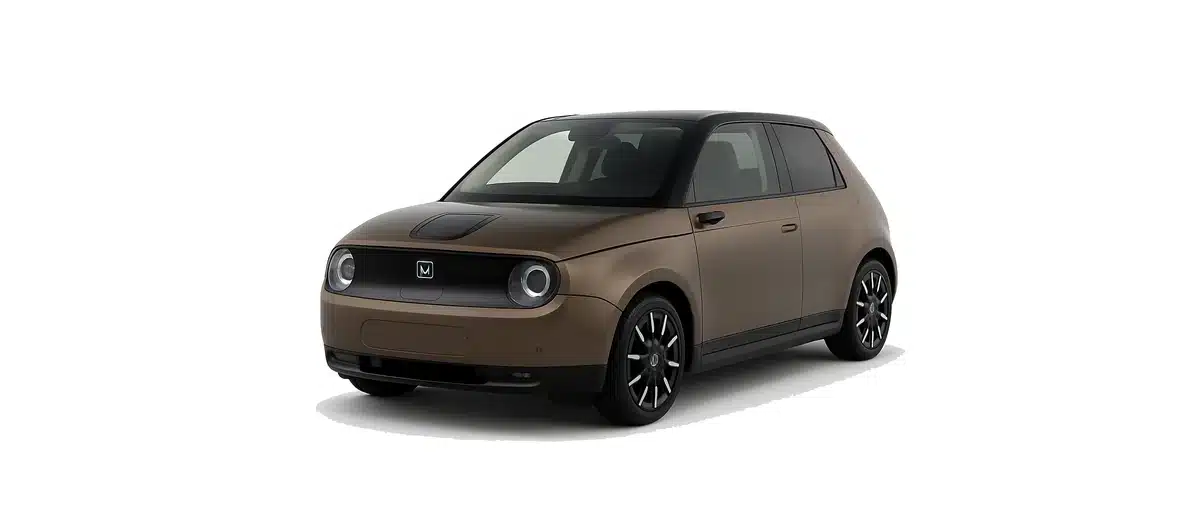
The Honda e is a distinctive 5-door compact electric hatchback designed primarily for city and suburban driving. Sold in the UK and Europe from 2020 and now discontinued as a new model, it remains an appealing used EV for drivers who value compact dimensions, rear-wheel drive, a small turning circle and Honda’s clean interior design. It is a full battery electric vehicle, not a plug-in hybrid, and it uses a front-centre charging inlet with Type 2 AC and CCS Combo 2 DC charging.
For most owners, cable selection is straightforward: a Type 2 to Type 2 cable is the key cable for untethered home and public AC charging. The more important ownership point is understanding the Honda e’s 6.6 kW AC charging limit and relatively small usable battery. A 7 kW home charger is well matched to the car, while faster 11 kW or 22 kW AC posts will not make it charge more quickly.
Honda e Battery and Charging Specifications
The Honda e uses a 35.5 kWh lithium-ion battery pack. Honda’s UK brochure lists this capacity across the Honda e and Honda e Advance versions, while EV Database estimates usable battery capacity at around 28.5 kWh. That means the car has a smaller battery than many newer EVs, which suits urban use but calls for more planning on longer journeys.
Charging is handled through a front-centre inlet. For AC charging, the Honda e uses the Type 2 connector that is standard across most UK and European electric cars. For rapid charging, it uses the CCS Combo 2 connector, where the rapid charger’s cable is tethered to the unit.
- Vehicle type: battery electric vehicle
- Battery capacity: 35.5 kWh gross; around 28.5 kWh usable estimated
- AC charging: Type 2, up to 6.6 kW
- DC rapid charging: CCS Combo 2, with EV Database data indicating up to around 46 kW
- Charging inlet location: front-centre
- UK status: discontinued as a new model, but available used and possibly as limited stock
Battery Options
The Honda e range is simple from a battery point of view. UK-market Honda e and Honda e Advance models use the same 35.5 kWh lithium-ion pack. There is no larger long-range battery option, so trim and wheel choice are more relevant to equipment, performance and quoted range than to battery size.
The standard Honda e is listed with a 100 kW / 136 PS motor, while the Honda e Advance has a higher-output 113 kW / 154 PS motor. Both are rear-wheel drive and are built around a compact EV layout rather than being converted from a petrol model. Honda’s brochure highlights the car’s rear-mounted motor and 50:50 weight distribution, which helps explain why the Honda e feels different from many front-wheel-drive urban EVs.
AC Charging Speed
The Honda e’s onboard AC charger is rated at up to 6.6 kW. In practical UK terms, this means a standard 7 kW single-phase home wallbox is enough to charge the car at its maximum AC rate. Installing an 11 kW or 22 kW AC charge point will not make the Honda e charge faster, because the car’s onboard charger is the limiting factor.
Charge-time figures vary depending on how they are measured. EV Database gives a figure of about 5 hours 15 minutes from empty to full at the car’s maximum AC rate, while Honda’s older brochure quotes around 4.1 hours from low-battery warning to 100%. These figures are not directly comparable because they start from different battery states. For daily use, most owners will rarely charge from completely empty; topping up overnight or during the evening is usually simple.
For cable choice, use a Type 2 to Type 2 charging cable for untethered AC charge points. Some home wallboxes are tethered and already have a cable attached, but many public AC posts and untethered home chargers require the driver to bring their own cable.
DC Rapid Charging Speed
For longer journeys, the Honda e uses CCS rapid charging. Public rapid and ultra-rapid chargers have their own tethered cables, so you do not need to bring a separate DC cable. You simply plug the CCS connector into the car’s front charging port.
There is some variation in published Honda e rapid-charging figures, particularly in older sources. For a cautious UK ownership guide, it is best to think of the Honda e as a 50 kW-class rapid-charging car rather than an ultra-rapid EV. EV Database data indicates a maximum DC charging rate of around 46 kW and a 10-80% rapid charge time of roughly 41 minutes. As with all EVs, the rate will depend on battery state of charge, temperature, charger condition and the charging network.
Because the battery is relatively small, short rapid top-ups are often more useful than waiting for a very high state of charge. Charging normally slows above 80%, so on a journey it can be quicker to charge enough to reach the next stop or destination rather than aiming for 100% at a rapid charger.
Range and Efficiency
Honda’s UK brochure lists up to 137 miles WLTP for the Honda e and Honda e Advance on 16-inch wheels. The Honda e Advance on 17-inch wheels is listed at 131 miles WLTP. This wheel-size difference matters when comparing used cars, because not every Honda e has the same official range figure.
In real-world driving, EV Database estimates around 105 miles. Actual range can be lower in winter, on motorways, in heavy rain, or when using heating and demisting. Around town, where the Honda e is most at home, efficiency is usually more favourable because lower speeds and regenerative braking help conserve energy.
The key planning point is that the Honda e is an urban EV with modest long-distance range. It can handle occasional longer trips, but drivers moving from a petrol car or a larger-battery EV should plan charging stops earlier than they might expect.
Charging at Home
Home charging is likely to be the most convenient way to run a Honda e. A 7 kW home wallbox is well suited to the car because it closely matches the 6.6 kW onboard AC charger. If you return home with a partially depleted battery, an overnight charge will normally be more than enough to restore the car for the following day.
If your wallbox is untethered, you will need a Type 2 to Type 2 cable. If it is tethered, the cable is permanently attached to the charger and you will not need a separate cable at home, although keeping a Type 2 cable in the car is still useful for public AC charging.
A 3-pin domestic charging lead can be useful in some circumstances, but it is slower than a dedicated wallbox. A 3-pin charger is generally best suited as a backup or occasional charging solution, but can be used regularly if a qualified electrician has confirmed the socket and electrical installation are suitable for sustained EV charging.
The Honda e also supports scheduled charging, according to Honda’s UK brochure. This can help owners take advantage of cheaper overnight electricity tariffs where available, provided the home charger and tariff setup are suitable.
Public Charging
Public charging for the Honda e falls into two main categories: AC destination charging and DC rapid charging. AC destination chargers are commonly found in car parks, hotels, workplaces, shopping areas and some town-centre locations. Many are untethered, which is why a Type 2 to Type 2 cable is the main cable Honda e owners should carry.
When using AC posts rated at 7 kW, 11 kW or 22 kW, the Honda e will still charge at up to 6.6 kW. A 22 kW post is not harmful, but it will not deliver 22 kW to this car. The limit is set by the vehicle’s onboard charger.
DC rapid chargers are the right choice for longer journeys or quick top-ups. These chargers use a tethered CCS connector, so cable selection is not something the driver needs to solve. Given the Honda e’s charging behaviour and battery size, a reliable 50 kW rapid charger is usually a sensible match. Ultra-rapid chargers can be used if compatible and available, but the Honda e will only draw what the car can accept.
Vehicle-Specific Features
The Honda e was designed as a compact electric car rather than adapted from a combustion-engine platform. It has a rear-mounted motor, rear-wheel drive and a very tight wheel-centre turning radius listed by Honda at 4.3 metres. These traits make it particularly well suited to urban streets, parking and short local journeys.
Honda’s brochure lists Single Pedal Control, which allows stronger deceleration when lifting off the accelerator. This can make stop-start urban driving smoother and may help recover some energy through regenerative braking, although it should not be viewed as a way to dramatically extend range on every journey.
The Honda e also has active battery heating and cooling listed in Honda’s brochure. This is battery thermal management, but it should not be confused with navigation-based rapid-charge battery preconditioning. EV Database lists battery preconditioning as not available, so owners should not assume the car will automatically prepare the battery for maximum rapid-charging speed before arrival at a charger.
Charging Tips
- Use a Type 2 cable for everyday public AC charging. Untethered posts are common in the UK, so carrying the right cable avoids inconvenience.
- Do not pay extra expecting faster AC charging. The Honda e is limited to 6.6 kW AC, even when connected to faster AC posts.
- Use rapid charging strategically. On longer journeys, shorter CCS top-ups can be more time-efficient than charging well beyond 80%.
- Plan winter trips with extra margin. Cold weather, heating use and motorway speeds can reduce practical range.
- Check wheel size when comparing used cars. Honda lists different WLTP range figures for 16-inch and 17-inch wheel versions.
- Keep the front charging port area clear. Because the inlet is at the front centre, parking position and cable reach can matter at some public chargers.
Frequently Asked Questions
What charging cable does the Honda e need?
For untethered AC charging, the Honda e uses a Type 2 to Type 2 cable. This is the standard cable for many UK and European public AC charge points and untethered home wallboxes.
Can the Honda e use a 7 kW home charger?
Yes. A 7 kW single-phase home charger is a good match because the Honda e’s onboard AC charger is rated at up to 6.6 kW.
Will an 11 kW or 22 kW charger make the Honda e charge faster?
No. The Honda e can connect to compatible AC posts, but it will still be limited by its 6.6 kW onboard AC charger.
Does the Honda e rapid charge?
Yes. The Honda e uses CCS Combo 2 rapid charging. EV Database data indicates around 46 kW maximum DC charging and roughly 41 minutes for a 10-80% charge, although real charging times vary.
What is the real-world range of the Honda e?
Honda’s WLTP figures are up to 137 miles for 16-inch wheel versions and 131 miles for the Advance on 17-inch wheels. EV Database estimates real-world range at around 105 miles, with driving style, route and weather making a noticeable difference.
What This Means for Drivers
The Honda e is best understood as a premium-feeling used urban EV with simple charging requirements. It does not need a complicated cable setup, and it does not benefit from high-power AC charging. A 7 kW home wallbox and a Type 2 to Type 2 cable cover most everyday charging needs, while CCS rapid charging is available for longer journeys and short top-ups.
The main ownership compromise is range. The small battery helps keep the car compact and agile, but it means motorway trips and cold-weather journeys need more planning than they would in a larger-battery EV. For drivers whose routine is mostly local, with home charging available, the Honda e remains a charming and practical electric hatchback.
Looking for a Charging Cable for Honda e?
If you need a suitable Type 2 charging cable for home or public AC charging, choose a cable that matches the Honda e’s Type 2 connection and your preferred length for everyday use.
Please note that this information is intended as a guide. Charging specifications may change due to model and year of manufacture. For precise information, always refer to your vehicle user manual.

