
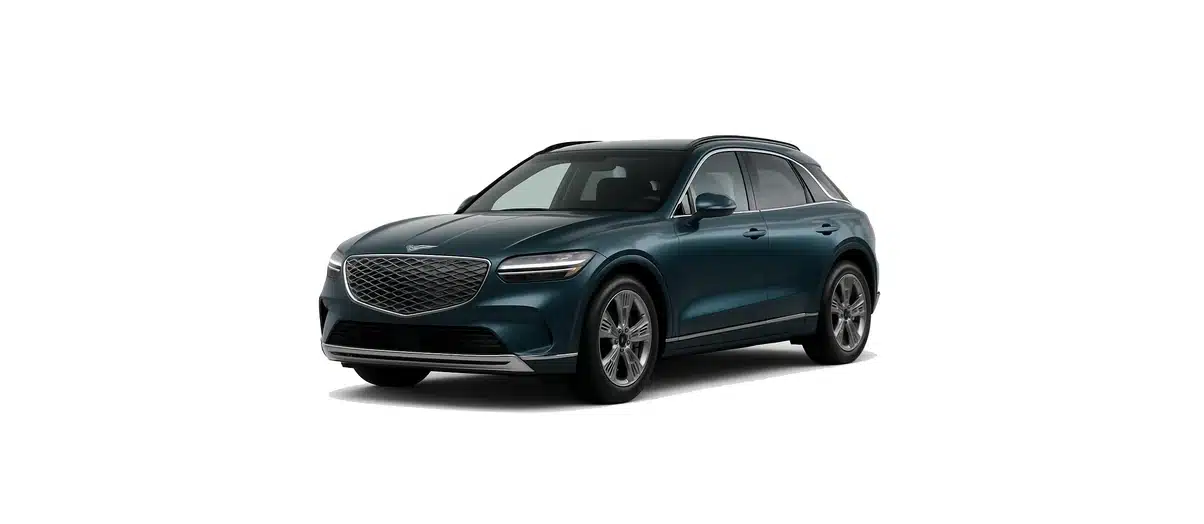
The Genesis GV70 name needs a little care when discussing charging. In the UK, the standard GV70 is a petrol SUV and does not use an EV charging cable. This guide is for the Genesis Electrified GV70, the battery-electric version of the GV70 SUV.
For UK owners and used buyers, there is also an important model-year split. Current MY25 Electrified GV70 models use an 84 kWh battery, while earlier UK Electrified GV70 Sport models sold before the facelift used a 77.4 kWh battery. Both use a Type 2 connector for AC charging and CCS2 for DC rapid charging, but range, battery capacity and some equipment details differ.
View Genesis GV70 Charging Cables
Genesis GV70 Battery and Charging Specifications
The chargeable Genesis GV70 is the Electrified GV70, a fully electric SUV with dual-motor all-wheel drive in current UK form. The latest UK model is listed with a total output of 360 kW / 490 PS and an 84 kWh lithium-ion battery. Genesis UK lists the car with a Type 2 AC charging connection and CCS2 DC rapid charging capability, which is the standard arrangement for most modern UK and European electric cars.
For AC charging, the current UK specification states 7 kW single-phase and 11 kW three-phase onboard charging. This distinction matters because many UK homes have single-phase electricity, meaning a home wallbox will usually charge at up to around 7.4 kW rather than the full 11 kW. The 11 kW figure is most relevant where three-phase AC power is available, such as some workplaces, commercial sites and a smaller number of homes.
For rapid charging, Genesis lists maximum DC charging capability at up to 240 kW. The car may be used on 350 kW-class ultra-rapid chargers, but that does not mean the vehicle itself charges at 350 kW. The official 10-80% DC charging claim is around 19 minutes under suitable conditions.
Battery Options
The current UK Electrified GV70, available to order from June 2025 as the MY25 facelift/update, uses an 84 kWh battery. EV Database UK estimates usable capacity at around 80 kWh. Genesis UK lists WLTP combined range at up to 298 miles for the Pure grade, with Dynamic and Luxury grades listed at up to 287 miles, reflecting differences such as specification and wheels.
Earlier UK Electrified GV70 Sport models, sold from October 2022 to June 2025, used a 77.4 kWh battery. EV Database UK estimates usable capacity at around 74 kWh. If you are buying a used Electrified GV70, it is worth checking the registration date, exact model year and specification rather than assuming all cars have the same battery.
This distinction is especially important when planning long journeys or comparing charging times. A larger battery can offer more potential range, but it may also take more energy to refill from low to full. In day-to-day use, however, most owners charge based on routine rather than regularly using the entire battery capacity.
AC Charging Speed
The Genesis Electrified GV70 uses a Type 2 connection for AC charging. This is the connector used for most UK home wallboxes and many public destination chargers. For home and public AC charging, a suitable Type 2 charging cable is the correct choice.
On the current UK model, the onboard AC charger is rated at 7 kW on single-phase power and 11 kW on three-phase power. Genesis UK states that AC wallbox charging from 10-100% at 11 kW takes around 7 hours 35 minutes. Independent estimates for 0-100% at 11 kW are closer to 8 hours 45 minutes, which is a useful guide if you are thinking in terms of a full charge from empty.
In a typical UK home with a single-phase 7.4 kW wallbox, charging will be slower than the 11 kW three-phase figure. That is not a problem for most owners, because overnight charging can still add a substantial amount of range. For example, plugging in during the evening and leaving the car connected until morning will usually be more than enough for normal commuting and local driving.
It is not necessary to buy a 22 kW cable or charger on the assumption that the Electrified GV70 will accept 22 kW AC. The car’s onboard AC charging limit is 11 kW three-phase or 7 kW single-phase, so a higher-rated AC supply will not make the vehicle charge at 22 kW.
DC Rapid Charging Speed
For motorway stops and longer journeys, the Electrified GV70 uses its CCS2 connector for DC rapid and ultra-rapid charging. This is where the car’s high-voltage charging architecture becomes useful. UK specifications refer to 400 V / 800 V charging technology and a 697 V operating voltage, helping the vehicle make effective use of suitable high-power chargers.
Genesis quotes a 10-80% DC charging time of around 19 minutes on a suitable ultra-rapid charger. The maximum DC charging capability is listed at 240 kW. As with all EVs, the real charging speed depends on several conditions, including charger output, charger availability, battery temperature, state of charge and the vehicle’s charging curve.
For the fastest stops, it is usually best to arrive at a rapid charger with a lower state of charge and to charge to around 80% rather than 100%. Charging normally slows at higher battery percentages, so the final 20% can take disproportionately longer. On a long trip, two shorter 10-80% style charging stops may be quicker than waiting for a single full charge.
Range and Efficiency
The current MY25 Electrified GV70 has a UK WLTP combined range of up to 298 miles in Pure specification and up to 287 miles in Dynamic and Luxury grades. EV Database UK estimates real-world range at around 235 miles for the MY25 model. Real-world range will vary according to temperature, speed, terrain, tyre choice, wheel size, driving style and use of cabin heating or air conditioning.
In winter, motorway driving at higher speeds will usually reduce range compared with mild-weather mixed driving. In urban and suburban use, regenerative braking and lower average speeds can help the car travel further per kWh. The standard heat pump on the current UK model should also help reduce heating-related energy use compared with relying solely on resistive heating, although actual benefit depends on conditions.
For daily use, many owners will not need to charge to 100%. A common approach is to keep the battery within a comfortable middle range for regular driving, then charge higher before a longer journey. Always follow the guidance in the vehicle handbook for battery care and recommended charging limits.
Charging at Home
Home charging is usually the most convenient way to run an electric GV70. A dedicated home wallbox provides safer, faster and more convenient charging than relying on a domestic socket, and it allows owners to take advantage of off-peak electricity tariffs where available.
For most UK homes, a 7.4 kW single-phase wallbox is the practical choice. The Electrified GV70 can accept around 7 kW on single-phase AC, so this setup aligns well with the car’s UK specification. If you have access to three-phase power, an 11 kW wallbox can make use of the vehicle’s higher AC charging capability.
A 3-pin domestic charger is generally best suited as a backup or occasional charging solution, but can be used regularly if a qualified electrician has confirmed the socket and electrical installation are suitable for sustained EV charging. Domestic sockets were not originally designed for repeated high-load EV charging over many hours, so proper inspection and safe use are important.
The UK price list references both a Type 2 Mode 3 public charging cable and a Type 2-to-UK 3-pin domestic ICCB cable. If you are buying a used car, check which cables are present, in good condition and suitable for your charging setup.
Public Charging
Public AC charging is useful at workplaces, hotels, town centres, car parks and destinations where the car will be parked for several hours. These chargers normally use Type 2 AC. Some have a tethered cable, while others require you to bring your own Type 2 cable.
Rapid and ultra-rapid public charging uses the CCS2 connection and is the best option for long journeys. A CCS charger has its own tethered cable, so you do not need to bring a separate DC cable. When choosing a charger, look for a high-power unit if you want to make the most of the Electrified GV70’s rapid charging capability, but remember that real speeds will vary.
For reliable journey planning, it is sensible to identify more than one charging option on your route. Ultra-rapid chargers can be busy at peak travel times, and some locations may have individual units out of service. Arriving with a realistic buffer makes public charging less stressful.
Vehicle-Specific Features
The current UK Electrified GV70 includes a standard heat pump and Battery Conditioning 2.0. Genesis says the battery conditioning system can activate automatically when a fast charger is set as a destination or waypoint in the navigation system, and it can also be manually activated where available. This is particularly useful in colder weather, because a battery at a suitable temperature is more likely to accept higher rapid charging speeds.
Vehicle-to-Load is available on the current UK model as an optional Vehicle-to-Load Pack rather than standard equipment across all cars. The pack includes an interior socket and external adaptor, with maximum output around 3.68 kW. If V2L matters to you, confirm that the specific car has the option fitted. Vehicle-to-Grid and Vehicle-to-Home support should not be assumed, as UK data checked does not list V2G or V2H support for this model.
The charging port is positioned at the front of the vehicle, which can be convenient at some public charging bays but may require a little thought when parking at tethered chargers with short cables.
Charging Tips
- Choose the right cable: use a Type 2 cable for home and public AC charging.
- Do not expect 22 kW AC: the Electrified GV70 is limited to 7 kW single-phase or 11 kW three-phase AC charging.
- Use CCS for rapid charging: DC rapid and ultra-rapid charging is handled through the CCS2 connector.
- Precondition before rapid charging: on current models, set a rapid charger in the navigation or use manual battery conditioning where available.
- Charge to 80% on long trips: this is often quicker than waiting for 100% because charging slows at higher states of charge.
- Check used-car details: MY22-24 cars have a 77.4 kWh battery, while current MY25 cars have an 84 kWh battery.
Frequently Asked Questions
Is every Genesis GV70 electric?
No. In the UK, the standard Genesis GV70 is a petrol SUV. The chargeable version is the Genesis Electrified GV70.
What charging cable does the Genesis Electrified GV70 use?
It uses a Type 2 cable for AC charging at home and at many public destination chargers. For DC rapid charging, it uses a CCS2 connector with the charger’s tethered cable.
Can the Genesis Electrified GV70 charge at 22 kW AC?
No. Current UK specifications list 7 kW single-phase and 11 kW three-phase AC charging. A 22 kW AC charger will not make the car charge at 22 kW.
How fast can it rapid charge?
Genesis lists maximum DC charging capability at up to 240 kW, with a 10-80% charge in around 19 minutes on a suitable ultra-rapid charger and in favourable conditions.
Does the Electrified GV70 have V2L?
V2L is optional on the current UK price list via a Vehicle-to-Load Pack. It should not be assumed to be fitted to every car.
What This Means for Drivers
The Genesis Electrified GV70 is a capable long-distance electric SUV when paired with the right charging habits. At home, most UK drivers will use a 7.4 kW single-phase wallbox and a Type 2 charging cable. Where three-phase AC is available, the car can use up to 11 kW. On longer journeys, CCS2 ultra-rapid charging gives the car its strongest charging performance, especially when battery conditioning is used before arrival.
The main thing is to identify the exact vehicle. A petrol GV70 does not need charging equipment, an earlier Electrified GV70 Sport has a 77.4 kWh battery, and the current MY25 Electrified GV70 has an 84 kWh battery. Once that is clear, cable selection is straightforward: Type 2 for AC charging and CCS2 for rapid charging.
Looking for a Charging Cable for Genesis GV70?
We offer charging cables suitable for the Genesis Electrified GV70, including Type 2 options for home wallboxes and public AC charging. Choose a cable that matches your charging setup and the car’s 7 kW single-phase / 11 kW three-phase AC capability.
View Genesis GV70 Charging Cables
Please note that this information is intended as a guide. Charging specifications may change due to model and year of manufacture. For precise information, always refer to your vehicle user manual.

