
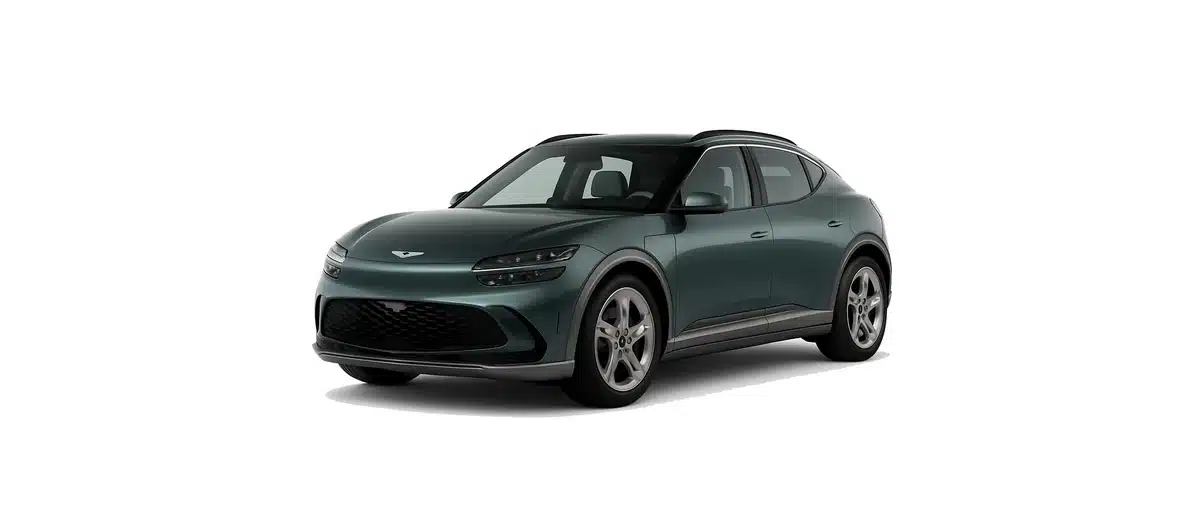
The Genesis GV60 is a mid-size electric SUV/crossover built on Hyundai Motor Group’s dedicated E-GMP electric vehicle platform. In the UK, the current updated MY25 GV60 range is fully electric and is available in RWD Pure, AWD Sport and AWD Performance trims. It is not a plug-in hybrid; it is a battery electric vehicle that relies on mains electricity and public charging infrastructure.
One of the GV60’s headline strengths is its high-voltage charging capability. Genesis describes the car as using a 400 V / 800 V multi-charging system, and the current UK figures quote DC rapid charging at up to 240 kW, with a 10-80% charge possible in 18 minutes under the right conditions. In day-to-day UK ownership, however, most charging will still be done more calmly at home using a Type 2 wallbox, typically at around 7 kW to 7.4 kW on a single-phase domestic supply.
This guide explains what UK GV60 drivers need to know about battery sizes, AC and DC charging, home charging, public charging and choosing the right cable.
View Genesis GV60 Charging Cables
Genesis GV60 Battery and Charging Specifications
The current UK Genesis GV60 uses a Type 2 connector for AC charging and a CCS Combo 2 connector for DC rapid charging. This is the standard arrangement for most modern European-market electric cars: the upper Type 2 section is used for home and public AC charging, while the full CCS socket is used when connecting to rapid and ultra-rapid DC chargers.
For the updated MY25 UK range, Genesis lists an 84 kWh battery across Pure, Sport and Performance trims. EV Database estimates the usable capacity at around 80 kWh. Official UK charging information lists 11 kW AC charging and up to 240 kW DC rapid charging. Genesis also quotes a 10-100% AC charging time of 7 hours 35 minutes where the right AC supply is available, and a 10-80% DC rapid charge time of 18 minutes when using a suitable 350 kW ultra-rapid charger.
Those figures are useful, but they need a little UK context. Many UK homes have single-phase electricity, so a typical home wallbox will usually charge at up to 7 kW or 7.4 kW rather than the car’s maximum 11 kW AC capability. The faster AC figure generally requires a compatible three-phase supply and an appropriate three-phase charge point.
Battery Options
For the current UK MY25 GV60 line-up, the important figure is the 84 kWh gross battery fitted to all three trims. The estimated usable capacity is around 80 kWh. This applies to the updated RWD Pure, AWD Sport and AWD Performance models in the current UK range.
Used buyers should be aware that earlier MY22-24 GV60 models are different. EV Database records previous UK GV60 variants as having used a 77.4 kWh gross battery, with a usable capacity of around 74 kWh. These earlier cars were available before the updated MY25 range and may have different range figures and charging estimates.
In practical terms, if you are checking charging times, range, or battery capacity for a specific GV60, it is worth confirming whether the car is the updated 84 kWh model or an earlier 77.4 kWh example. Mixing the figures can make charging expectations inaccurate.
AC Charging Speed
The Genesis GV60’s AC charging is handled through its Type 2 socket. The current UK specification lists AC charging at up to 11 kW, with the onboard charger described as supporting around 7 kW on single-phase and up to around 10.5-11 kW on a suitable three-phase supply.
For most UK owners, the practical home charging default will be a 7 kW or 7.4 kW Type 2 wallbox. At that speed, a full charge from low to full will usually be an overnight job. EV Database suggests a full charge on a typical UK single-phase home supply may take around 12 hours 45 minutes, although real charging time will depend on the starting battery percentage, wallbox output, electrical supply and temperature.
If you have access to three-phase charging, such as at some workplaces, commercial premises or certain public AC charge points, the GV60 can make better use of its 11 kW AC capability. Genesis quotes 10-100% in 7 hours 35 minutes for the current UK car under suitable conditions.
DC Rapid Charging Speed
DC rapid charging is where the GV60’s E-GMP platform has a major advantage. The current UK manufacturer figure is up to 240 kW DC, with a 10-80% charge possible in 18 minutes. Genesis notes that this headline time requires a 350 kW ultra-rapid charger, and those chargers are not available at every UK charging location.
On a long journey, the best approach is usually to arrive at a high-power CCS charger with a reasonably low battery state of charge, charge to around 70-80%, and then continue. Like most EVs, the GV60 charges fastest when the battery is in the right temperature window and at a lower-to-mid state of charge. Charging speed slows significantly above 80%, so charging from 80% to 100% at a rapid charger can take disproportionately longer.
The GV60 also has standard battery preconditioning on the current UK specification, referred to in Genesis materials as Battery Conditioning 2.0. This can help prepare the battery for faster charging when conditions allow. In colder weather especially, battery temperature can make a noticeable difference to rapid-charging performance.
Range and Efficiency
Official WLTP range varies by trim. For the current UK MY25 GV60, Genesis lists up to 348 miles for the RWD Pure, 318 miles for the AWD Sport and 311 miles for the AWD Performance. The 348-mile figure should therefore not be treated as a universal figure for every GV60.
Real-world range will vary with speed, temperature, route, tyre choice, payload and driving style. EV Database estimates the current MY25 real-world range at around 260 miles for the Pure, 250 miles for the Sport and 245 miles for the Performance. These are useful planning figures for mixed driving, but any individual journey can be higher or lower.
Motorway driving in winter, for example, will usually reduce efficiency compared with slower urban or suburban driving in mild weather. The GV60’s standard heat pump on the current UK pricelist can help manage cabin heating efficiency, but it does not remove the normal seasonal variation that affects all electric cars.
Charging at Home
For most GV60 drivers, home charging will be the easiest and most cost-effective way to run the car. A dedicated Type 2 home wallbox lets you plug in overnight and start the next day with the charge level you need. If your home has a standard single-phase supply, a 7 kW or 7.4 kW wallbox is likely to be the practical limit, even though the car can accept more AC power on a three-phase supply.
Many owners do not need to charge from empty to full every night. A common routine is to set a charge limit for daily use, then charge higher before a long journey. The exact best setting depends on your mileage and preferences, but avoiding unnecessary 100% charges can be a sensible habit for regular day-to-day use unless you need the full range.
A 3-pin charger is generally best suited as a backup or occasional charging solution, but can be used regularly if a qualified electrician has confirmed the socket and electrical installation are suitable for sustained EV charging. Because a domestic 3-pin plug charges much more slowly than a wallbox, it is not the most convenient option for most GV60 owners with a large battery.
Public Charging
For public AC charging, the Genesis GV60 uses a Type 2 to Type 2 cable when the charge point is untethered. Many UK destination chargers at hotels, car parks, supermarkets and workplaces require drivers to bring their own cable. These AC chargers are useful when the car will be parked for several hours.
For rapid and ultra-rapid charging, the cable is normally tethered to the charger. You simply connect the charger’s CCS plug to the GV60’s CCS port. This is the type of charging to use for motorway stops and longer journeys where you want to add a large amount of range quickly.
To get close to the GV60’s best rapid-charging performance, look for high-power CCS chargers, ideally in the 150 kW to 350 kW class. The official 18-minute 10-80% figure is based on a 350 kW ultra-rapid charger and suitable battery conditions, so slower chargers or a cold battery will usually mean a longer stop.
Vehicle-Specific Features
The Genesis GV60 includes several charging-related features that are worth knowing about. The charging door is electrically operated, heated and illuminated, and it includes a charging indicator. This is a small detail, but it can make plugging in easier in poor weather or low light.
The current UK GV60 also has a standard heat pump and standard battery conditioning. These features can support more efficient winter operation and better preparation for rapid charging, although actual results still depend on temperature, journey pattern and charger availability.
Vehicle-to-Load is available through an optional Vehicle-To-Load Pack on UK cars. This can allow the vehicle battery to power external electrical devices where the car is appropriately equipped. It should not be assumed to be standard on every GV60. Vehicle-to-Grid and Vehicle-to-Home support should not be treated as available for the GV60, as the data available does not support those features for the UK model.
Charging Tips
- Use a Type 2 cable for AC charging: Keep a Type 2 to Type 2 cable in the car for untethered public AC charge points.
- Use CCS for rapid charging: DC rapid chargers have tethered CCS connectors, so you do not need your own DC cable.
- Plan around 10-80% on long trips: The GV60 is at its fastest on suitable rapid chargers in the lower-to-mid battery range.
- Choose the right charger speed: A 350 kW charger is needed for the official 18-minute 10-80% claim, but a good 150 kW+ charger can still be useful.
- Remember the UK home charging limit: Most single-phase homes will charge at about 7 kW to 7.4 kW, not 11 kW.
- Check used car specifications: Earlier GV60 models used a 77.4 kWh gross battery, so confirm the model year and battery before relying on current MY25 figures.
Frequently Asked Questions
What charging cable does the Genesis GV60 use?
The Genesis GV60 uses a Type 2 connection for AC charging. For untethered public AC charge points, you will need a Type 2 to Type 2 cable. DC rapid charging uses the CCS Combo 2 connector, and the cable is normally attached to the rapid charger.
How fast can the Genesis GV60 charge at home?
On a typical UK single-phase home wallbox, the GV60 will usually charge at around 7 kW or 7.4 kW. The car can accept up to 11 kW AC on a suitable three-phase supply, but that is not the standard setup in most UK homes.
How long does it take to rapid charge the Genesis GV60?
Genesis quotes 10-80% in 18 minutes for the current UK GV60 when using a suitable 350 kW ultra-rapid charger and when conditions are right. On lower-powered chargers, or if the battery is cold, charging will usually take longer.
What is the range of the Genesis GV60?
For the current UK MY25 range, official WLTP range is up to 348 miles for the RWD Pure, 318 miles for the AWD Sport and 311 miles for the AWD Performance. Real-world estimates are lower, at roughly 260 miles for Pure, 250 miles for Sport and 245 miles for Performance, depending on conditions.
Does the Genesis GV60 support Vehicle-to-Load?
Vehicle-to-Load is available via an optional Vehicle-To-Load Pack on UK cars. It should not be assumed to be fitted to every GV60. Vehicle-to-Grid and Vehicle-to-Home support are not listed as available.
What This Means for Drivers
The Genesis GV60 is one of the more capable EVs for rapid charging, especially when paired with a high-power CCS ultra-rapid charger. Its 800 V-capable charging architecture means it can add range very quickly on the right equipment, making it well suited to longer trips.
Even so, everyday ownership is likely to revolve around a home Type 2 wallbox. For most UK households, that means charging at around 7 kW to 7.4 kW overnight rather than using the car’s full 11 kW AC capability. The most practical setup for many drivers is therefore simple: charge at home for daily use, carry a Type 2 cable for public AC charging, and use CCS ultra-rapid chargers for longer journeys.
Looking for a Charging Cable for Genesis GV60?
If you need a suitable Type 2 cable for home or public AC charging, choose a cable that matches how and where you charge your Genesis GV60, including whether you use single-phase or three-phase charge points.
View Genesis GV60 Charging Cables
Please note that this information is intended as a guide. Charging specifications may change due to model and year of manufacture. For precise information, always refer to your vehicle user manual.

