
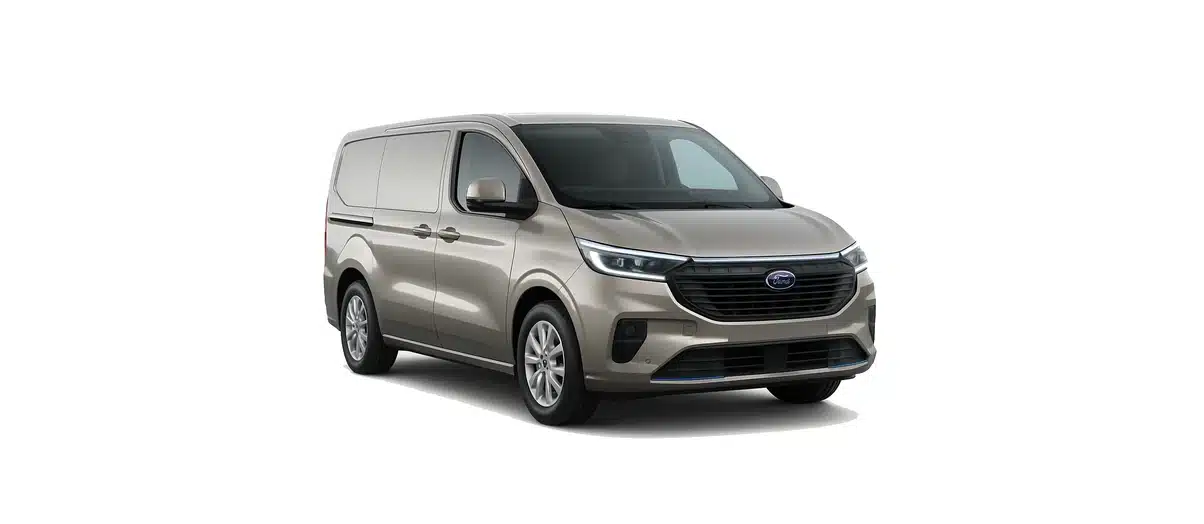
The Ford Transit Custom name now covers more than one type of vehicle, so the first step in choosing the right charging cable is identifying which version you have. A diesel Transit Custom is not a plug-in vehicle. A Transit Custom Plug-In Hybrid, often referred to as the Transit Custom PHEV, has a petrol engine and a small rechargeable battery for electric driving. The all-electric van is the Ford E-Transit Custom, which uses a much larger traction battery and can use both AC charging and DC rapid charging.
This guide focuses on the UK-market plug-in models: the Transit Custom PHEV and the E-Transit Custom. It explains the practical differences between them, what Type 2 charging means, when CCS rapid charging applies, and how newer 2026 E-Transit Custom battery data differs from earlier launch specifications.
View Ford Transit Custom Charging Cables
Ford Transit Custom Battery and Charging Specifications
For charging purposes, there are two main plug-in versions to separate:
- Ford E-Transit Custom: the fully electric BEV version, with a large underfloor battery, AC charging for home, depot and destination charging, and DC rapid charging for longer journeys.
- Ford Transit Custom Plug-In Hybrid: a PHEV with a smaller battery intended for shorter electric trips and regular top-ups, using AC charging only according to Ford technical data reviewed.
Ford’s 2026 European technical specification lists the E-Transit Custom with a 71 kWh usable battery. Earlier launch and 2024-2025 material listed a 64 kWh usable battery. That matters because range, charging time and route-planning expectations are different between the earlier and later specifications.
For the Transit Custom PHEV, Ford’s 2026 technical data lists an 11.8 kWh usable battery. Ford UK consumer material presents a targeted electric-only range of 23-35 miles, while the 2026 European technical specification quotes up to 55 km WLTP, which is around 34 miles. In day-to-day van use, payload, weather, driving style and heating demand will all affect how much of that electric range is achieved.
Battery Options
The all-electric E-Transit Custom has had more than one published battery specification. If you are buying a cable for your own van, the cable type is likely to remain straightforward for AC charging, but the battery size affects how long the vehicle needs to be plugged in.
- E-Transit Custom 2026 model year: Ford’s EU technical data lists a 71 kWh usable battery for rear-wheel-drive and all-wheel-drive versions. The same data quotes up to 373 km WLTP range for RWD and up to 348 km WLTP for AWD, depending on configuration.
- Earlier E-Transit Custom launch / 2024-2025 specification: Ford material listed a 64 kWh usable battery and up to 337 km WLTP range. Some information has changed over time, so used-van buyers should check the exact vehicle specification, ideally by VIN or official documentation.
- Transit Custom Plug-In Hybrid: the PHEV uses an 11.8 kWh usable battery in the 2026 technical specification. It is designed to be charged frequently and used for local electric running where possible, while retaining combustion-engine flexibility.
The key point is that there is no single universal Ford Transit Custom battery size. The van family includes diesel, plug-in hybrid and fully electric models.
AC Charging Speed
AC charging is the type of charging used at most homes, depots, workplaces and many public destination chargers. Both the E-Transit Custom and the Transit Custom PHEV use AC charging, but they do not charge at the same power level.
The E-Transit Custom supports up to 11 kW AC charging in Ford technical specifications. On a suitable three-phase 11 kW AC charge point, Ford’s 2026 EU technical data quotes around 4 hours 40 minutes for a 10-80% charge. On a more typical single-phase 7.4 kW UK home or depot wallbox, the same data quotes around 6 hours 42 minutes for 10-80%.
Earlier 64 kWh E-Transit Custom material quoted different figures, including around 6.7 hours for 10-100% at 11 kW and around 10.1 hours at 7.4 kW. If you operate a mixed fleet of older and newer vans, it is worth recording which vans have which battery specification so charging schedules are realistic.
The Transit Custom PHEV charges more slowly because its onboard AC charging capability is lower and its battery is much smaller. Ford’s 2026 technical data indicates about 3.6 kW AC charging, with 10-100% taking around 3.9 hours. In practice, that makes the PHEV well suited to overnight charging, workplace top-ups and plugging in whenever it is parked between jobs.
For AC charging, a Type 2 Mode 3 cable is the relevant cable type for most UK untethered charge points. Ford also states that a Mode 3 cable is supplied as standard with Ford Pro all-electric and plug-in hybrid vehicles, although owners of used vans should check whether the original cable is still present and suitable for their charging needs.
DC Rapid Charging Speed
DC rapid charging applies to the all-electric Ford E-Transit Custom, not to the Transit Custom PHEV based on the Ford technical data reviewed. The PHEV is an AC-charging vehicle and should not be expected to use public rapid chargers.
For the E-Transit Custom, Ford’s 2026 technical specification lists DC charging at up to 125 kW and quotes a 10-80% rapid charge time of about 29 minutes. Earlier 64 kWh material included different charging-time information, so check the model year and any applicable software or vehicle updates before relying on a specific rapid-charge figure for an individual van.
Most UK rapid and ultra-rapid chargers have the DC cable attached to the charger. That means E-Transit Custom drivers normally do not buy a separate DC rapid charging cable. The owner’s AC cable is mainly for home, workplace, depot and untethered public AC charging.
For UK and European rapid charging, the E-Transit Custom is expected to use Type 2 AC charging and CCS Combo 2 DC rapid charging. Because accessible Ford material confirms the AC and DC charging performance more clearly than the exact inlet wording, owners should check the vehicle inlet or handbook if they need absolute confirmation before purchase.
Range and Efficiency
The latest published 2026 E-Transit Custom data quotes up to 373 km WLTP for rear-wheel-drive versions, which is approximately 232 miles, and up to 348 km WLTP for all-wheel-drive versions. Earlier 64 kWh specifications quoted up to 337 km WLTP. These are laboratory figures, so real-world range will vary.
Medium vans are especially sensitive to operating conditions. A lightly loaded van on slower urban and suburban routes may be more efficient than a fully loaded van on cold motorway journeys. Roof racks, ladders, towing, tyre pressures, heating use and frequent high-speed driving can all reduce range.
The Transit Custom PHEV’s electric range is much shorter, but that is normal for a plug-in hybrid. Its value comes from charging often and using electric miles for predictable local routes, site visits, school runs, low-speed urban work or short commutes. Once the battery is depleted, the combustion engine continues to provide driving flexibility.
Charging at Home
For many owners and operators, home or depot charging will be the most convenient way to run a plug-in Transit Custom. A dedicated 7.4 kW home wallbox is usually the practical option for single-phase UK properties. For the E-Transit Custom, this can add a substantial amount of range overnight. For the PHEV, it is more than enough for a full overnight recharge in normal circumstances.
Businesses with three-phase electrical supplies may be able to install 11 kW AC charge points, which can make better use of the E-Transit Custom’s maximum AC charging capability. However, installation capacity, load management, parking layout and vehicle dwell time are just as important as the headline kW rating.
A 3-pin EV charger can be useful, but it is generally best suited as a backup or occasional charging solution. It can be used regularly if a qualified electrician has confirmed the socket and electrical installation are suitable for sustained EV charging. This is particularly important for vans, because they may be plugged in for long periods and used as working vehicles where reliability matters.
For daily use, a properly installed wallbox is normally the more robust and convenient choice. It also avoids relying on domestic sockets, extension leads or unsuitable outdoor arrangements.
Public Charging
Public charging depends heavily on which Transit Custom you have. If you drive the E-Transit Custom, you can use public AC chargers and, where compatible, DC rapid chargers. If you drive the Transit Custom PHEV, public AC charging may be useful when parked for a few hours, but rapid charging should not be part of your plan.
Untethered AC posts are common at workplaces, hotels, car parks and some public charging locations. These are the places where a Type 2 Mode 3 cable is needed. For a van, cable length and durability are worth considering because the charge point may not always be ideally positioned relative to the van’s charging inlet.
Rapid charging is more relevant for E-Transit Custom drivers covering longer distances or operating away from base. On route, a 10-80% rapid charge stop is usually more efficient than charging to 100%, because charging speed often slows at higher battery percentages. For fleets, the best strategy is often to return to base with enough charge remaining, then use lower-cost depot AC charging during downtime.
Vehicle-Specific Features
Ford states that its Vapour-Injected Heat Pump technology is fitted as standard to every E-Transit Custom. A heat pump can help improve energy efficiency in colder conditions by reducing the energy required for cabin heating compared with less efficient heating methods. This confirmation applies to the E-Transit Custom; it should not automatically be assumed for the PHEV unless separately confirmed for that model.
Ford also describes cabin preconditioning while the vehicle is plugged in. This can be useful because warming or cooling the cabin before departure can reduce the amount of battery energy used at the start of a journey. However, cabin preconditioning is not the same as confirmed battery preconditioning for faster DC rapid charging, so it is best not to assume rapid-charging preconditioning unless verified for the exact vehicle.
Optional Pro Power Onboard is available in relevant Ford material for the E-Transit Custom and Transit Custom PHEV, providing up to 2.3 kW to power tools or equipment on site. This is a useful mobile power feature, but it should not be confused with vehicle-to-grid or vehicle-to-home capability, which was not clearly confirmed in the research data reviewed.
Charging Tips
- Identify the vehicle first: check whether you have a diesel Transit Custom, Transit Custom PHEV or E-Transit Custom BEV before buying charging accessories.
- Choose Type 2 for AC charging: for most UK untethered AC charge points, a Type 2 Mode 3 cable is the relevant cable for the plug-in Transit Custom models.
- Do not plan rapid charging for the PHEV: the Transit Custom Plug-In Hybrid is an AC-charging plug-in hybrid, not a DC rapid-charging electric van.
- Use downtime intelligently: depot parking, overnight stops and job-site dwell time can all be used to top up the van.
- Check used vans carefully: older E-Transit Custom vans may have the 64 kWh usable battery, while newer 2026 technical data refers to 71 kWh usable capacity.
- Think about cable length: vans are larger than cars, so a longer cable can be useful where charge points are awkwardly placed.
Frequently Asked Questions
Is every Ford Transit Custom electric?
No. The Transit Custom range includes diesel models, the Transit Custom Plug-In Hybrid and the fully electric Ford E-Transit Custom. Only the plug-in hybrid and the E-Transit Custom need EV charging cables.
What cable does the Ford Transit Custom PHEV need?
For AC charging at home, work and untethered public charge points, the Transit Custom PHEV uses a Type 2 Mode 3 charging cable. It charges at around 3.6 kW according to Ford’s 2026 technical data.
What cable does the Ford E-Transit Custom need?
For AC charging, the E-Transit Custom is suited to a Type 2 Mode 3 cable. For DC rapid charging, public rapid chargers normally have tethered CCS cables, so a separate DC cable is not normally required.
Can the Transit Custom Plug-In Hybrid use rapid chargers?
Ford technical data reviewed for the PHEV states AC charging. It should not be described as supporting DC rapid charging.
How long does the E-Transit Custom take to charge?
For the 2026 71 kWh usable battery version, Ford’s EU technical data quotes about 4 hours 40 minutes from 10-80% at 11 kW AC, about 6 hours 42 minutes at 7.4 kW AC, and about 29 minutes from 10-80% on DC rapid charging at up to 125 kW. Earlier 64 kWh vans have different published figures.
What This Means for Drivers
The Ford Transit Custom is best approached as a vehicle family rather than a single EV. If you have the E-Transit Custom, you need to think like an electric van driver: plan home or depot AC charging, carry the right Type 2 cable for untethered posts, and use CCS rapid charging when longer routes require it. If you have the Transit Custom PHEV, your goal is different: charge little and often so that as many local miles as possible are covered electrically.
For fleets, the practical charging plan should be based on route length, parking time, electrical supply and whether vans return to base. For private owners, a dedicated wallbox and a suitable Type 2 cable will cover most everyday charging needs. In both cases, checking the exact model, battery specification and charging inlet before buying accessories helps avoid confusion.
Looking for a Charging Cable for Ford Transit Custom?
Browse suitable charging cables for the Ford Transit Custom Plug-In Hybrid and Ford E-Transit Custom, and choose the right Type 2 cable for home, workplace and public AC charging.
View Ford Transit Custom Charging Cables
Please note that this information is intended as a guide. Charging specifications may change due to model and year of manufacture. For precise information, always refer to your vehicle user manual.

