
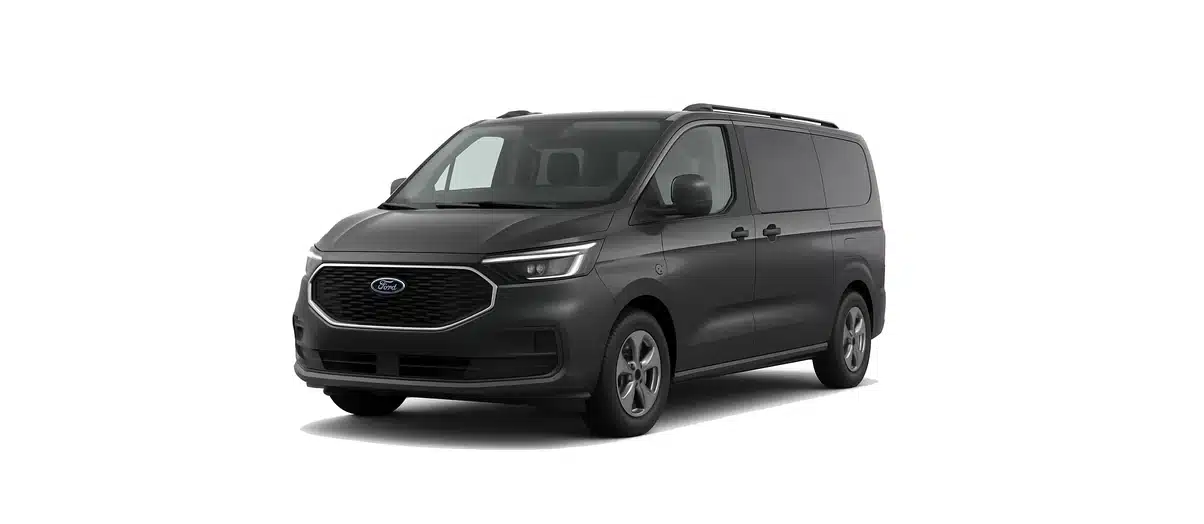
The Ford Tourneo Custom is a practical large MPV and people carrier, available in the UK with several different powertrains. That makes charging advice slightly different from a straightforward single-model electric car guide. Some Tourneo Custom models are diesel and do not plug in at all, while the plug-in range includes the Tourneo Custom Plug-In Hybrid and the fully electric E-Tourneo Custom.
For charging-cable purposes, the key question is: which Tourneo Custom do you have? The plug-in hybrid uses Type 2 AC charging for its smaller battery and is best thought of as a short electric-distance vehicle with petrol-hybrid flexibility. The E-Tourneo Custom is the full battery-electric model, using Type 2 AC charging at home or on public AC posts, plus CCS rapid charging for longer journeys.
View Ford Tourneo Custom Charging Cables
Ford Tourneo Custom Battery and Charging Specifications
The current UK Tourneo Custom family includes all-electric, plug-in hybrid and diesel versions. The charging specifications below apply only to the plug-in models: the Tourneo Custom PHEV and the E-Tourneo Custom BEV.
| Model | Battery | AC charging | DC rapid charging | Connector |
|---|---|---|---|---|
| Tourneo Custom Plug-In Hybrid | 11.8 kWh usable | Up to around 3.6 kW | Not specified for DC rapid charging | Type 2 AC |
| E-Tourneo Custom BEV | Current 2026 material lists 71 kWh usable | Up to 11 kW AC, supply dependent | Up to 125 kW CCS | Type 2 AC / CCS Combo 2 |
Ford material for earlier E-Tourneo Custom launch versions referred to a 64 kWh usable battery and a different rapid-charging time. Current UK 26.5MY/2026 information points to 71 kWh usable battery versions, so owners should check their vehicle’s model year, trim and documentation when comparing published figures.
Battery Options
The Tourneo Custom Plug-In Hybrid uses an 11.8 kWh usable battery. Ford describes this as offering up to around 32 miles of electric-only driving, depending on specification and conditions. This makes it useful for school runs, local commuting, town work, hotel transfers and low-emission urban journeys, while retaining the petrol-hybrid powertrain for longer trips.
The E-Tourneo Custom is the fully electric version. Current 2026 Ford information lists a 71 kWh usable battery for E-Tourneo Custom models, with range varying by body length, drivetrain, trim and equipment. Some older 2024/2025 information refers to a 64 kWh usable battery, so avoid assuming that every E-Tourneo Custom has the same battery size.
This distinction matters when choosing a cable. Both plug-in models use a Type 2 connection for AC charging, but the E-Tourneo Custom has much greater battery capacity and also supports CCS rapid charging. The PHEV does not need to be treated like a rapid-charging EV.
AC Charging Speed
AC charging is the main everyday charging method for both plug-in versions of the Tourneo Custom.
For the E-Tourneo Custom BEV, Ford’s current technical information lists an 11 kW onboard AC charger. To achieve 11 kW, the charging point must be on a suitable three-phase supply. Most UK homes have single-phase electricity, so a typical home wallbox will charge at up to 7.4 kW. Ford’s current 2026 data quotes approximately 4 hours 40 minutes for a 10-80% AC charge at 11 kW, or about 6 hours 42 minutes at 7.4 kW.
For the Tourneo Custom PHEV, manufacturer data gives a 10-100% charge time of about 3.9 hours at 3.6 kW. A higher-rated cable or faster public AC post will not make the PHEV charge beyond the limit of its onboard charger, although using a robust Type 2 cable still gives flexibility across home, workplace and public AC charging.
In practical UK terms, a 7.4 kW home wallbox is the natural default for many E-Tourneo Custom owners. A three-phase workplace or commercial premises may allow the BEV to use its 11 kW AC capability, which can be helpful for shuttle operators, taxi fleets, hotels or businesses running multiple passenger vehicles.
DC Rapid Charging Speed
DC rapid charging applies to the E-Tourneo Custom BEV, not the plug-in hybrid. The BEV uses the CCS Combo 2 connector for UK and European rapid chargers. Current 2026 Ford technical data lists DC charging at up to 125 kW, with a 10-80% rapid charge taking around 29 minutes in suitable conditions.
That peak speed depends on the charger, battery temperature, state of charge and the vehicle’s charging curve. As with most EVs, charging is usually fastest at lower battery percentages and slows as the battery fills. For long-distance travel, it is often more time-efficient to rapid charge from roughly 10-80% rather than waiting for 100% at a public rapid charger.
Older E-Tourneo Custom launch material quoted about 39 minutes for a 10-80% rapid charge on the earlier 64 kWh usable specification. If you are comparing used vehicles or older brochures, check the exact model-year information rather than mixing figures across different versions.
Range and Efficiency
Ford’s current European information indicates that the E-Tourneo Custom BEV can achieve up to roughly 341 km WLTP for rear-wheel-drive versions, equivalent to about 212 miles, with AWD versions lower at up to around 315 km depending on specification. A commonly quoted UK headline is around 209 miles WLTP. Real-world range will usually be lower than WLTP, particularly in winter, at motorway speeds or with a full passenger load.
Independent UK EV data for a 71 kWh E-Tourneo Custom variant estimates around 155 miles of real-world range. That is not a WLTP figure, but it is a useful reminder that a large MPV has different energy demands from a small hatchback. Body length, L1 or L2 configuration, wheel size, weather, speed, heating use and payload can all affect efficiency.
For the PHEV, the electric-only range is intended for shorter local driving. If you can charge regularly, many daily journeys may be completed with little or no petrol use. On longer trips, the vehicle operates as a hybrid once the usable electric range has been depleted.
Charging at Home
Home charging is usually the most convenient and cost-effective way to run either plug-in Tourneo Custom. For the PHEV, overnight charging on a suitable wallbox easily covers the smaller battery. For the E-Tourneo Custom, a 7.4 kW wallbox can add a substantial amount of range overnight and is the realistic default for most UK households.
If your wallbox is untethered, you will need a Type 2-to-Type 2 charging cable. If it is tethered, the cable is built into the charger. For the BEV, a 32 amp Type 2 cable is generally the practical choice for 7.4 kW single-phase charging. If you regularly use three-phase AC posts and want to access up to 11 kW, you will need a compatible three-phase Type 2 cable and a suitable charging point.
For the PHEV, the onboard AC charging rate is lower, so a higher-rated cable will not reduce charging time beyond the vehicle’s limit. However, many owners still choose a cable that can also be used with other Type 2 vehicles, especially in households or businesses with more than one plug-in car.
A 3-pin charger is generally best suited as a backup or occasional charging solution, but can be used regularly if a qualified electrician has confirmed the socket and electrical installation are suitable for sustained EV charging. For routine use, a dedicated EV wallbox is usually safer, faster and more convenient.
Public Charging
On public AC charging posts, both the Tourneo Custom PHEV and E-Tourneo Custom BEV use a Type 2 charging cable. Many destination chargers in car parks, hotels, leisure centres and workplaces are untethered, so carrying your own cable is important.
For the E-Tourneo Custom, AC public charging is useful when parked for several hours. Examples include charging during a work shift, at a hotel overnight, during a family day out or while the vehicle is parked at a depot. Three-phase AC posts may allow the BEV to charge at up to 11 kW if all equipment is compatible.
For motorway and long-distance use, the E-Tourneo Custom’s CCS rapid charging is the faster option. Rapid and ultra-rapid chargers have their own tethered cables, so you do not use your Type 2 cable for CCS charging. Plug in using the charger’s CCS connector and follow the network’s payment or app instructions.
The PHEV should not be presented as a CCS rapid-charging vehicle. It is best charged from home, workplace or public AC points using Type 2.
Vehicle-Specific Features
The E-Tourneo Custom is built on Ford’s next-generation Tourneo Custom and Transit Custom platform, with the battery mounted under the floor. Ford Europe states that the E-Tourneo Custom features a standard heat pump, which can help with cabin heating efficiency in colder conditions. This confirmation applies to the BEV in the source material checked; it should not automatically be assumed for every PHEV version.
Ford also lists Pro Power Onboard, or exportable 2.3 kW power, as an optional feature on Tourneo Custom and E-Tourneo Custom material. Where fitted, this can be useful for camping equipment, tools or passenger devices. It is not the same as confirmed vehicle-to-grid or vehicle-to-home capability.
Because Tourneo Custom is offered in different body lengths, trims and model years, specifications can vary. This is especially important when comparing current 71 kWh BEV models with earlier 64 kWh E-Tourneo Custom material.
Charging Tips
- Identify your model first: diesel versions do not plug in, the PHEV uses Type 2 AC, and the E-Tourneo Custom uses Type 2 AC plus CCS rapid charging.
- Use a wallbox for regular home charging: it is the most practical option for both PHEV and BEV owners.
- Choose the right Type 2 cable: a 32 amp cable suits typical 7.4 kW UK home and public AC charging; three-phase use requires a compatible three-phase cable.
- Do not expect PHEV rapid charging: the plug-in hybrid is an AC-charging vehicle in the manufacturer data reviewed.
- Rapid charge the BEV on longer journeys: CCS charging is the E-Tourneo Custom’s best option when you need to continue quickly.
- Plan around payload and weather: a full people carrier in winter will use more energy than a lightly loaded vehicle in mild conditions.
- Check model-year details: battery size and charging figures differ between early launch information and current 2026 specifications.
Frequently Asked Questions
Does the Ford Tourneo Custom use a Type 2 charging cable?
Yes, the plug-in Tourneo Custom models use Type 2 for AC charging. The PHEV uses Type 2 AC, while the E-Tourneo Custom uses Type 2 AC and also has CCS Combo 2 for DC rapid charging.
Can the Ford Tourneo Custom PHEV use rapid chargers?
The PHEV charging data reviewed is AC only. It should not be treated as a CCS rapid-charging vehicle. Use a Type 2 AC cable for home, workplace and public AC posts.
How fast can the E-Tourneo Custom charge at home?
On a typical UK single-phase 7.4 kW wallbox, current Ford data quotes about 6 hours 42 minutes for a 10-80% AC charge. The vehicle can support up to 11 kW AC where a suitable three-phase supply and charging equipment are available.
How fast is E-Tourneo Custom rapid charging?
Current 2026 Ford technical information lists up to 125 kW DC rapid charging and around 29 minutes for a 10-80% charge in suitable conditions. Earlier 64 kWh launch material used different figures, so check the exact model year.
What cable do I need for public charging?
For untethered public AC posts, you need a Type 2-to-Type 2 cable. CCS rapid chargers for the E-Tourneo Custom have their own tethered cable, so you do not need to supply a separate cable for rapid charging.
What This Means for Drivers
The Ford Tourneo Custom range needs a little more care than many EV guides because the name covers diesel, plug-in hybrid and fully electric versions. If you have the PHEV, charging is simple: use Type 2 AC charging regularly to make the most of the 11.8 kWh usable battery and local electric range. Faster AC posts or higher-rated cables will not override the vehicle’s onboard charging limit.
If you have the E-Tourneo Custom, think in two layers. For everyday charging, use a home wallbox, workplace charger or public AC post with a Type 2 cable. For long family trips, airport runs, taxi work or shuttle use, plan around CCS rapid charging, ideally stopping in the efficient mid-range of the battery rather than waiting for a full 100% charge on the road.
Either way, the right charging setup makes the Tourneo Custom easier to live with. Match the cable to the vehicle, the supply and how you actually use the MPV.
Looking for a Charging Cable for Ford Tourneo Custom?
We offer Ford Tourneo Custom charging cables for compatible plug-in hybrid and E-Tourneo Custom models, including Type 2 options for home, workplace and public AC charging.
View Ford Tourneo Custom Charging Cables
Please note that this information is intended as a guide. Charging specifications may change due to model and year of manufacture. For precise information, always refer to your vehicle user manual.

