
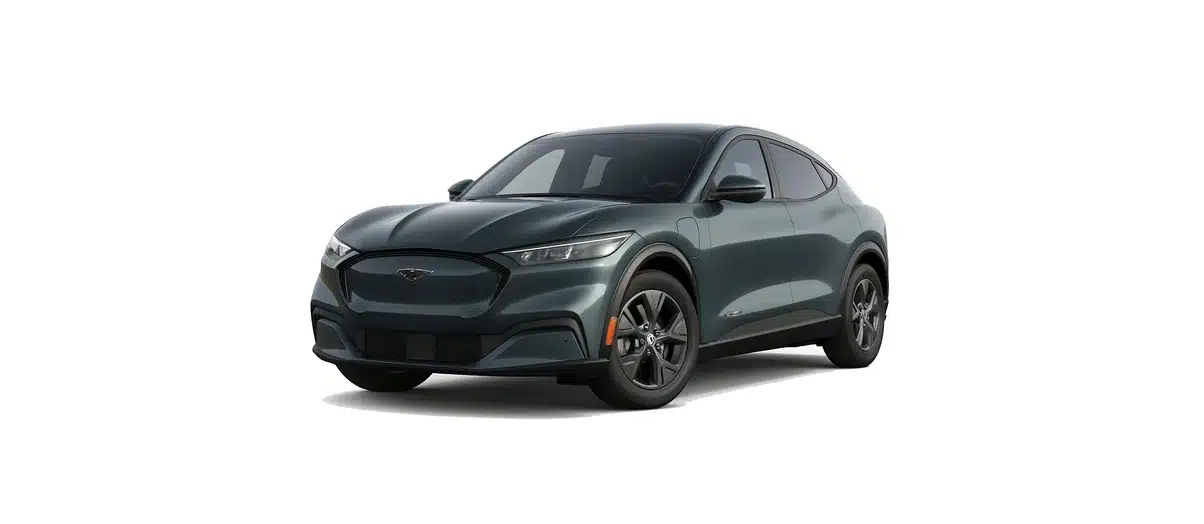
The Ford Mustang Mach-E is an all-electric SUV / crossover, not a plug-in hybrid. For UK drivers, charging is straightforward once you know which version you own: Standard Range or Extended Range, rear-wheel drive or all-wheel drive, and whether it is a current MY25 car or an earlier model.
That distinction matters because published battery capacities, charging times and equipment details have changed over the Mach-E’s life. Current UK MY25 information lists Type 2 AC charging, CCS Combo 2 rapid charging, an 11 kW AC on-board charger where a suitable three-phase supply is available, and DC rapid charging at up to 150 kW. However, most UK home installations are single-phase, so the practical home charging rate is typically up to 7.4 kW from a dedicated wallbox.
View Ford Mustang Mach-E Charging Cables
Ford Mustang Mach-E Battery and Charging Specifications
UK and European Mustang Mach-E models use a Type 2 connector for AC charging and a CCS Combo 2 connector for DC rapid charging. In practice, this means you use a Type 2 charging cable for most home wallboxes and untethered public AC chargers, while rapid and ultra-rapid DC chargers usually have a tethered CCS cable attached to the charger.
| Item | Ford Mustang Mach-E UK charging detail |
|---|---|
| Vehicle type | Battery-electric SUV / crossover |
| AC charging connector | Type 2 |
| DC rapid charging connector | CCS Combo 2 |
| Maximum AC charging | Up to 11 kW on a suitable three-phase AC supply |
| Typical UK home wallbox charging | Up to 7.4 kW on most single-phase installations |
| Maximum DC rapid charging | Up to 150 kW peak, depending on version and conditions |
| Charging port location | Left-side front flank, ahead of the front door area |
Ford UK states that a Mode 3 public charging cable is supplied with the car, while a Mode 2 domestic charging cable is described as optional. If buying a used Mach-E, it is still worth checking exactly which cables are included, as accessories can be lost, replaced or removed during ownership changes.
Battery Options
The Mustang Mach-E has been sold with more than one battery configuration, and this is where owners need to be careful. It is not accurate to apply one battery capacity to every Mach-E. Current MY25 figures from EV Database UK differ from some earlier 2021-2024 published figures.
| Current MY25 variant | Battery information | Range context |
|---|---|---|
| Select SR RWD / Standard Range | Estimated 78.0 kWh gross, 72.6 kWh usable | WLTP up to around 292 miles; EVDB real-world estimate about 235 miles |
| Premium RWD / Extended Range | Estimated 98.7 kWh gross, 88.0 kWh usable | Ford UK markets up to 600 km / about 373 miles WLTP for RWD Extended Range; EVDB real-world estimate about 295 miles |
| Premium AWD / Extended Range | Estimated 98.7 kWh gross, 88.0 kWh usable | WLTP generally lower than RWD; EVDB real-world estimate about 270 miles |
Used-car buyers should be especially cautious. Earlier Standard Range and Extended Range cars may be listed with different battery figures, and some older Extended Range models are commonly shown with around 91 kWh usable capacity. If you are planning charging times or comparing vehicles, use the figures for your exact model year and trim.
AC Charging Speed
The Mustang Mach-E can AC charge at up to 11 kW when connected to a suitable three-phase supply. This is useful at some workplaces, commercial locations and three-phase domestic properties, but it is not what most UK homes will deliver.
Most UK home wallboxes are single-phase and rated at up to 7.4 kW. On that type of charger, the car’s 11 kW capability does not make the charge faster because the supply is the limiting factor. EV Database UK estimates that a current MY25 Standard Range Mach-E takes roughly 11 hours 45 minutes from empty to full at 7.4 kW, while an Extended Range model takes roughly 14 hours. On an 11 kW three-phase AC charger, those estimates fall to around 7 hours 45 minutes and 9 hours 30 minutes respectively.
For cable selection, a Type 2 to Type 2 cable is the correct cable for untethered AC public charge points and many untethered home wallboxes. A three-phase 11 kW cable can still be used on a single-phase 7.4 kW charge point; the car and charger will simply negotiate the appropriate charging rate.
DC Rapid Charging Speed
For long journeys, the Mustang Mach-E uses CCS rapid charging. Current MY25 variants are listed with DC charging at up to 150 kW, but that is a peak figure rather than a speed the car will hold throughout the session. Battery temperature, state of charge, charger output and site conditions all affect the real charging rate.
EV Database UK lists approximate 10-80% rapid charging times of around 32 minutes for the MY25 Standard Range version and around 37 minutes for the MY25 Extended Range versions under suitable conditions. Ford’s own rapid-charging claims are broadly in a similar range, depending on version.
On a road trip, it is usually better to plan DC rapid charging around 10-80% stops rather than 0-100%. Charging generally slows significantly above 80%, so using more frequent, shorter rapid charging stops can be quicker than waiting for the last 20% at a high-power charger.
Range and Efficiency
Ford UK markets the current RWD Extended Range Mustang Mach-E with up to 600 km, or about 373 miles, of WLTP range. EV Database UK lists a similar high-end WLTP figure for the MY25 Premium RWD depending on configuration, with an estimated real-world range of about 295 miles. The Standard Range MY25 Select SR RWD is listed with a WLTP figure of about 292 miles and a real-world estimate of about 235 miles.
Real-world range will vary. Motorway speeds, winter temperatures, heavy rain, roof boxes, tyre choice, wheel size and cabin heating can all reduce efficiency. Around town and in mild weather, the Mach-E may get closer to its best range. On cold, wet motorway trips, it is sensible to plan more conservatively.
For MY25 cars, Ford Europe has confirmed a standard heat pump. A heat pump can help reduce the energy needed for cabin heating in suitable conditions, although it does not remove the normal winter range reduction that all EVs can experience.
Charging at Home
For most owners, home charging is the most convenient and cost-effective way to run a Mustang Mach-E. A dedicated 7.4 kW wallbox will usually add enough range overnight for everyday use, even on the larger Extended Range battery.
If you are choosing between tethered and untethered home charging, the decision is mainly about convenience and tidiness. A tethered wallbox has its own cable permanently attached, so you simply plug in when you park. An untethered wallbox uses your own Type 2 cable, which can also be carried for public AC charging.
A 3-pin domestic charger is generally best suited as a backup or occasional charging solution, but can be used regularly if a qualified electrician has confirmed the socket and electrical installation are suitable for sustained EV charging. A standard domestic socket charges much more slowly than a wallbox and should not be treated as a direct substitute for a properly installed EV charge point unless the installation has been professionally assessed.
Many owners schedule charging overnight to take advantage of off-peak electricity tariffs. The Mach-E’s larger battery makes smart scheduling particularly useful: you may not need to charge to 100% every night, and keeping a regular daily limit below full can be a practical approach for routine commuting.
Public Charging
Public charging falls into two main categories: AC destination charging and DC rapid charging. AC chargers are common in car parks, hotels, workplaces and town centres. Many are untethered, so you need your own Type 2 cable. Charging speed may be 7 kW, 11 kW or 22 kW at the post, but the Mach-E will only take up to its AC limit and the supply available.
DC rapid and ultra-rapid chargers are different. They use CCS and almost always have a heavy tethered cable attached to the charger. You do not use your own Type 2 cable for DC charging. These are the chargers to look for on motorway journeys or when you need to add range quickly.
Current MY25 entries are listed by EV Database UK with Plug & Charge and Autocharge support, although availability depends on network compatibility and account setup. If you rely on these features, check the charging network’s current instructions before travelling.
Vehicle-Specific Features
The Mustang Mach-E charging port is positioned on the left-side front flank, behind the near-side front wheel area and ahead of the driver’s door area. This position is worth remembering when approaching public chargers, as bay layout and cable reach can vary.
For MY25 cars, a heat pump is confirmed as standard, and EV Database UK lists battery preconditioning. Battery preconditioning can help prepare the battery for faster DC charging when the navigation and vehicle systems know a rapid charger is the destination. As with all such systems, the benefit depends on temperature, route planning and charger conditions.
EV Database UK lists Vehicle-to-Load, Vehicle-to-Home and Vehicle-to-Grid support as not available on current MY25 Mustang Mach-E entries. Unless Ford publishes a UK-specific feature update, owners should not assume the car can power external appliances, a home, or export energy back to the grid.
Charging Tips
- Know your exact version: Standard Range and Extended Range models have different battery sizes and charging times.
- Do not confuse 11 kW AC with normal UK home charging: the car can accept up to 11 kW AC, but most UK home wallboxes are limited to 7.4 kW single-phase.
- Carry a Type 2 cable: it is useful for untethered public AC chargers and untethered home charge points.
- Use CCS for rapid charging: DC rapid chargers use their own tethered CCS cable.
- Aim for 80% on rapid chargers: charging above 80% is usually slower and often less efficient for journey planning.
- Precondition where possible: on cars with battery preconditioning, using the built-in navigation to route to a rapid charger may help charging performance.
- Check used-car equipment: cables, heat pump availability and battery figures can differ between model years.
Frequently Asked Questions
Is the Ford Mustang Mach-E a plug-in hybrid?
No. The Mustang Mach-E is a battery-electric vehicle. It has no petrol or diesel engine and is charged from an external electricity supply.
What charging cable does the Ford Mustang Mach-E use in the UK?
UK and European Mustang Mach-E models use a Type 2 connector for AC charging. For DC rapid charging, the car uses CCS Combo 2, with the rapid charger’s own tethered cable.
Can the Mustang Mach-E charge at 22 kW AC?
No, not at the full 22 kW rate. The car’s AC on-board charger is listed at up to 11 kW where a suitable three-phase supply is available. If plugged into a 22 kW AC post, it will charge at up to the car’s AC limit, subject to conditions.
How long does the Mustang Mach-E take to charge at home?
On a typical UK 7.4 kW home wallbox, current MY25 estimates are roughly 11 hours 45 minutes for the Standard Range battery and roughly 14 hours for the Extended Range battery from empty to full. Most drivers do not arrive home at 0%, so everyday top-ups are usually much shorter.
Does every Mustang Mach-E have a heat pump?
No. Ford Europe confirms a standard heat pump for the 2025 line-up, but earlier UK cars may differ. If you are buying used, check the specification of the exact car.
Does the Mustang Mach-E support V2L, V2H or V2G?
Current MY25 EV Database UK entries list V2L, V2H and V2G as not supported. Do not assume these functions are available unless Ford confirms them for UK vehicles.
What This Means for Drivers
The Ford Mustang Mach-E is easy to live with as an EV, provided you match your charging expectations to the version you own and the charging equipment you use. At home, most UK owners should think in terms of 7.4 kW overnight charging rather than the car’s maximum 11 kW AC capability. On the road, CCS rapid charging and sensible 10-80% stops are the best way to cover longer distances efficiently.
The key is not to rely on one universal Mach-E specification. MY25 Standard Range and Extended Range cars have different usable battery capacities, and earlier vehicles may have different battery figures and equipment. Check your exact trim and model year, carry the right Type 2 cable for AC charging, and use CCS rapid chargers when you need quick long-distance top-ups.
Looking for a Charging Cable for Ford Mustang Mach-E?
We offer Ford Mustang Mach-E charging cables suitable for UK Type 2 AC charging, including options for home wallboxes and untethered public charge points.
View Ford Mustang Mach-E Charging Cables
Please note that this information is intended as a guide. Charging specifications may change due to model and year of manufacture. For precise information, always refer to your vehicle user manual.

