
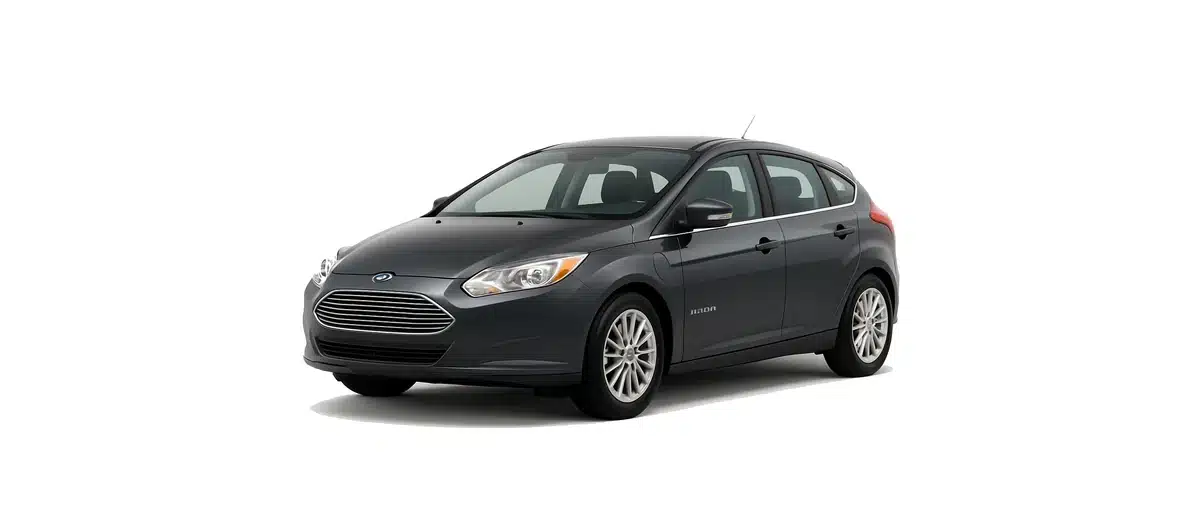
The Ford Focus name can be confusing when it comes to EV charging. Most Ford Focus models on UK roads are petrol, diesel or 48V mild-hybrid cars, and they do not plug in. That includes the mainstream Ford Focus EcoBoost Hybrid, which charges its small 48V battery through driving and regenerative braking rather than from an external charging point.
The charging-relevant model is the rare Ford Focus Electric, a battery-electric version of the Focus hatchback sold in limited numbers. Even then, there are important differences between early cars and later European update models. Early UK/EU Focus Electric examples are generally associated with a Type 1 AC inlet, a 23 kWh battery and no DC rapid charging. Later 2017-era Focus Electric information refers to a larger 33.5 kWh battery and CCS rapid charging, but UK data is less consistent, so owners should check the vehicle, handbook and charge flap before buying a cable.
View Ford Focus Charging Cables
Ford Focus Battery and Charging Specifications
The key point is that “Ford Focus” is not enough information to choose a charging cable. If you have a normal Focus hatchback, estate or mild-hybrid model, there is no external charging socket and no EV cable is required. If you have a Focus Electric, cable choice depends on the exact version.
| Model / version | Battery | AC charging | DC rapid charging | Typical cable consideration |
|---|---|---|---|---|
| Ford Focus petrol, diesel or EcoBoost Hybrid | Not a plug-in EV battery | Not applicable | Not applicable | No EV charging cable required |
| Early Ford Focus Electric, around 2013-2015 | 23.0 kWh nominal; around 19.6 kWh usable estimate | Type 1 AC, up to about 6.6 kW | Not supported | Type 1-to-Type 2 cable for UK public AC posts |
| Later Focus Electric update, around 2017-2018 | 33.5 kWh reported | Reported to charge from a 32A AC point in around 5 hours | CCS rapid charging reported, around 0-80% in 30 minutes | Check the physical inlet before ordering |
Because Focus Electric numbers were low and published UK information varies by source and model year, it is sensible to verify the car by VIN, registration data, handbook and the actual charge-port shape.
Battery Options
Early Ford Focus Electric cars listed by EV Database UK use a 23.0 kWh battery, with an estimated usable capacity of around 19.6 kWh. These cars were built on a converted third-generation Focus platform rather than a dedicated EV architecture. The battery packaging sits under and behind the rear-seat area, which affects practicality compared with a conventional Focus.
A later European update was reported with a 33.5 kWh battery. Industry coverage at the time described this as a significant improvement over the earlier pack, with a claimed range of up to about 225 km, or roughly 140 miles, on older test-cycle-style figures. However, this later version should not be assumed for every UK Focus Electric. If you are buying parts or choosing a cable for a 2017-era car, inspect the charge inlet and check documentation first.
AC Charging Speed
The early Focus Electric is listed with 6.6 kW single-phase AC charging. On a suitable 7 kW home wallbox, the vehicle will usually be limited by its onboard charger, so it will charge at around 6.6 kW rather than using the full theoretical wallbox output. EV Database UK gives an approximate empty-to-full AC charging time of about 3 hours 30 minutes for the early 23 kWh car.
For UK public AC charging, early cars need particular care. Many public AC posts in the UK provide a Type 2 socket, but the early Focus Electric uses a Type 1 vehicle inlet. That means owners typically need a Type 1-to-Type 2 charging cable: Type 1 at the car end and Type 2 at the post end. A Type 2-to-Type 2 cable, commonly used by newer EVs, is not suitable for those early Type 1 Focus Electric models.
The later 33.5 kWh update was reported as charging from a 32A AC point in around five hours. That suggests broadly similar single-phase AC charging behaviour, but the exact connector should be confirmed on the vehicle before making a cable choice.
DC Rapid Charging Speed
DC rapid charging is where the biggest Focus Electric difference appears. The early 23 kWh Focus Electric is listed as not supporting rapid charging. It is an AC-only EV, so journey planning must be based around home charging, workplace charging and destination AC charging rather than motorway rapid chargers.
Later 2017-era European Focus Electric information refers to CCS rapid charging, with reports of around 0-80% in approximately 30 minutes and rapid-charge capability of up to about 50 kW. CCS-equipped cars should have the larger combined inlet with the lower DC pins as well as the upper AC section. If your Focus Electric has only a Type 1 AC socket, it cannot use CCS rapid charging.
Do not assume that a rapid charger will help unless your exact vehicle has the correct CCS inlet and the car supports DC charging. This is especially important if you are considering an older used Focus Electric for longer trips.
Range and Efficiency
There is no single WLTP range figure that should be applied across the Ford Focus Electric line-up. Early information commonly uses older NEDC figures or independent real-world estimates. EV Database UK lists the early 23 kWh Focus Electric with an official NEDC figure of 101 miles and an estimated real-world range of around 65 miles.
In everyday use, range will depend on battery health, speed, temperature, terrain, tyres and how much cabin heating or air conditioning is used. Because these vehicles are now older and were sold in small numbers, battery condition matters more than brochure figures. A well-kept car used mainly for local driving may still suit short commutes and urban trips, while a degraded pack or frequent high-speed driving can reduce usable range noticeably.
The later 33.5 kWh update was reported with a claimed range of up to around 140 miles on an older test-cycle basis. Treat this as a model-specific claim rather than a figure for all Focus Electric cars.
Charging at Home
For a Focus Electric, home charging is usually the most convenient option. A 7 kW single-phase home wallbox is a good match for the early car’s 6.6 kW onboard AC charger and should provide predictable overnight charging. Even if the wallbox can supply slightly more power than the car can accept, the car will simply charge at the rate it supports.
For early Type 1 cars, the home charging setup may involve either a tethered Type 1 wallbox or an untethered Type 2 wallbox used with the correct Type 1-to-Type 2 cable. Many modern UK wallboxes are Type 2-focused, so owners of older Type 1 EVs should check compatibility before installation or cable purchase.
A 3-pin charger is generally best suited as a backup or occasional charging solution, but can be used regularly if a qualified electrician has confirmed the socket and electrical installation are suitable for sustained EV charging. Charging from a domestic plug is slower than a wallbox and should be approached carefully, particularly with older sockets, extension leads or unknown wiring.
Public Charging
Public charging for a Ford Focus Electric depends entirely on which version you have. Early Type 1 AC-only cars can use many public AC posts if you carry the correct Type 1-to-Type 2 cable. These posts are commonly found in town centres, workplaces, car parks, hotels and supermarkets. They are useful when the car is parked for a few hours.
However, early cars cannot use DC rapid charging, even if the charger has a CCS plug. The vehicle lacks the necessary DC rapid-charge hardware. For those cars, route planning should focus on distances that can be comfortably covered on a charge, with AC charging available at the destination if needed.
If you have a later CCS-equipped Focus Electric, public rapid charging may be possible. Look for the physical CCS inlet on the car rather than relying only on the Focus badge or registration year. A CCS inlet has an upper AC section and two larger DC pins below. If in doubt, consult a Ford dealer, vehicle handbook or specialist EV technician.
Vehicle-Specific Features
The Focus Electric was not a ground-up EV. It was an electric conversion of the standard Focus hatchback platform, which helps explain some of its strengths and limitations. It retains familiar Focus hatchback proportions and driving characteristics, but packaging the battery into an existing platform reduces boot space compared with a conventional Focus.
Ford UK guidance for older electric Ford vehicles notes that earlier Focus Electric models used a 5-pin Type 1 charge inlet and are not compatible with current Ford Type 2 cables. This is one of the most important compatibility points for owners, because newer Ford EVs and many modern public-charging cables use Type 2 connections.
The ordinary Ford Focus EcoBoost Hybrid should not be confused with the Focus Electric. It is a 48V mild hybrid, not a plug-in hybrid, so it does not use a charging cable and cannot be charged from a wallbox or public charger.
Charging Tips
- Identify the car first: most UK Ford Focus models are not plug-in vehicles and need no EV cable.
- Check the charge flap: early Focus Electric cars usually use Type 1 AC; later CCS-equipped cars have a different inlet.
- Do not buy a Type 2-to-Type 2 cable for an early Type 1 car: it will not connect to the vehicle inlet.
- Plan around AC charging if you have the early 23 kWh model: it does not support DC rapid charging.
- Use a 7 kW wallbox where possible: the early car will charge at up to around 6.6 kW, which suits overnight charging.
- Check battery health: age, mileage and battery condition can affect range significantly.
- Verify later cars carefully: the 33.5 kWh CCS version is reported in European sources, but should be confirmed on the individual vehicle.
Frequently Asked Questions
Is every Ford Focus an electric car?
No. Most Ford Focus models in the UK are petrol, diesel or mild-hybrid vehicles. They do not have an external charging socket and do not need an EV cable.
Does the Ford Focus EcoBoost Hybrid plug in?
No. The Ford Focus EcoBoost Hybrid is a 48V mild hybrid. Its small battery is charged through the engine and regenerative braking, not from a home wallbox or public charge point.
Which cable does an early Ford Focus Electric need?
Early UK/EU Focus Electric models are generally listed with a Type 1 AC inlet. For untethered UK public AC posts, they normally require a Type 1-to-Type 2 charging cable.
Can the early Ford Focus Electric use rapid chargers?
No. The early 23 kWh Focus Electric is listed as AC-only, with no DC rapid charging support. It cannot rapid charge just because a public charger is available nearby.
Did any Ford Focus Electric models have CCS?
Later European update information for the Focus Electric refers to a 33.5 kWh battery and CCS rapid charging. Because UK information is not as straightforward as it is for many newer EVs, check the exact car’s inlet, handbook and VIN before relying on CCS compatibility.
How long does a Ford Focus Electric take to charge at home?
For the early 23 kWh Focus Electric, a suitable 7 kW home wallbox should allow charging at up to around 6.6 kW, with an empty-to-full time of roughly 3 hours 30 minutes according to EV Database UK. Real charging time depends on starting charge, temperature and battery condition.
What This Means for Drivers
The Ford Focus charging question is really a compatibility question. If you have a normal Focus, including an EcoBoost Hybrid, you do not need a charging cable. If you have an early Focus Electric, cable selection is more specific than for many modern EVs: you are likely looking for a Type 1-to-Type 2 cable for public AC charging, and you should not plan around DC rapid charging.
If you have, or are considering buying, a later Focus Electric with the larger battery and CCS capability, do not assume compatibility from the model name alone. Check the charge-port shape and supporting documentation. With an older, low-volume EV such as this, the safest approach is to confirm the exact vehicle before ordering equipment or planning longer journeys.
Looking for a Charging Cable for Ford Focus?
We sell Ford Focus charging cable options, but it is especially important to confirm whether your car is a Focus Electric and whether it has a Type 1 AC inlet or a later CCS-style inlet before ordering.
View Ford Focus Charging Cables
Please note that this information is intended as a guide. Charging specifications may change due to model and year of manufacture. For precise information, always refer to your vehicle user manual.

