
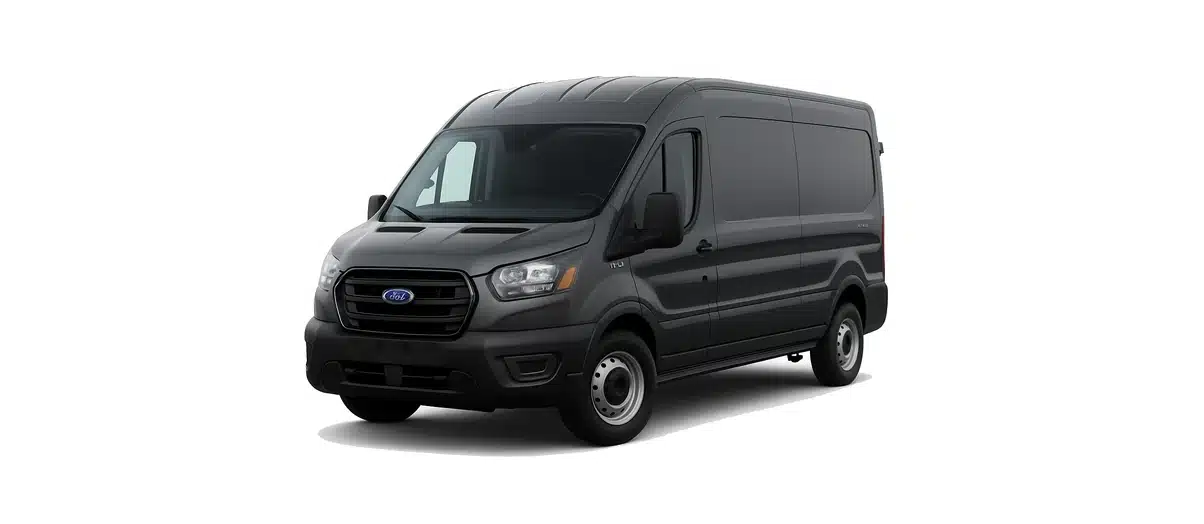
The Ford E-Transit is the fully electric version of Ford’s large Transit van, designed for trade, fleet, delivery and depot-based use. In the UK it is offered in several commercial body configurations, including van, Double Cab-in-Van and Chassis Cab forms, so charging and range expectations can vary more than they would with a typical passenger car.
The most important point for owners and fleet managers is to identify which E-Transit battery version they are dealing with. Current UK information refers to a 68 kWh usable Standard Range battery and an 89 kWh usable Enhanced or Extended Range battery. These versions differ in range, AC charging capability and DC rapid charging speed, so it is worth confirming the exact vehicle specification before planning home, workplace or depot charging.
View Ford E-Transit Charging Cables
Ford E-Transit Battery and Charging Specifications
The Ford E-Transit is a battery-electric vehicle, not a plug-in hybrid or range-extender. UK and European E-Transit models use a Type 2 connection for AC charging and CCS Combo 2 for DC rapid charging. In practice, this means a Type 2 Mode 3 cable is used for untethered home, workplace and destination charge points, while public rapid and ultra-rapid chargers normally have their own tethered CCS cable.
Charging capability depends on the battery and model year. The 68 kWh Standard Range version is generally quoted at around 11 kW AC and up to 115 kW DC. The newer 89 kWh Enhanced or Extended Range version is associated with up to 22 kW AC and up to 180 kW DC. These are vehicle maximums; the actual charging speed also depends on the charge point, battery temperature, state of charge, payload use and conditions.
Battery Options
Current UK-market E-Transit material shows two usable battery capacities. The Standard Range battery is listed at 68 kWh usable energy. Ford’s current UK range figures for this version are typically quoted at around 166 to 196 miles WLTP, depending on configuration.
The Enhanced or Extended Range battery is listed at 89 kWh usable energy. This version is linked with the highest E-Transit range figures, with Ford quoting around 211 to 249 miles WLTP depending on body, specification and operating conditions. The headline 249-mile figure should not be applied to every E-Transit, as it relates to favourable enhanced-range configurations rather than all vans.
This distinction matters for businesses. A short-wheelbase or lower-roof van running local deliveries may have a different energy profile from a larger, heavier van carrying tools, stock or conversion equipment. Payload, roof height, speed, weather and use of heating all affect real-world range.
AC Charging Speed
AC charging is most relevant for home, workplace and depot charging. Many UK home charge points are 7.4 kW single-phase units. These are convenient for overnight charging, but they will not use the full AC capability of either E-Transit version where higher-rate charging is supported.
For the 68 kWh Standard Range E-Transit, Ford material has commonly quoted an AC charging rate of around 11 kW on a suitable three-phase supply. Older Ford technical information also referenced a full AC charge taking about 8 hours on an 11 kW three-phase wallbox, or around 11.5 hours on a 7.4 kW single-phase wallbox.
For the 89 kWh Enhanced or Extended Range version, Ford media information quotes up to 22 kW AC charging, with a 0 to 100% charge in under six hours where a suitable 22 kW three-phase AC charger is available. This is particularly useful for fleets that need faster turnaround between shifts, but it requires both the right vehicle version and the right electrical infrastructure.
For many van operators, the best AC solution is a planned depot setup: 7.4 kW where vehicles sit overnight, 11 kW where three-phase supply and vehicle compatibility make sense, or 22 kW for enhanced-range vans that can take advantage of it.
DC Rapid Charging Speed
DC rapid charging uses the CCS connector and is most useful during longer working days, regional journeys or when a van needs to return to service quickly. The Standard Range E-Transit is quoted at up to 115 kW DC, with current UK figures indicating a 10 to 80% charge in about 37 minutes. Older technical material may use slightly different state-of-charge windows, so it is better to treat the latest 10 to 80% figure as the current headline reference.
The 89 kWh Enhanced or Extended Range version raises the peak DC charging rate to up to 180 kW and is quoted at around 28 minutes for a 10 to 80% charge. To approach that peak, the charger needs to be capable of delivering the required power. A 150 kW-plus public charger is usually sufficient for the Standard Range model, while the 89 kWh version benefits from 180 kW-class chargers where available.
As with any EV, the fastest rates are not maintained for the whole charging session. Charging normally slows as the battery becomes fuller, so rapid charging to 80% is usually more time-efficient than waiting for 100% unless the extra range is genuinely needed.
Range and Efficiency
Range is one of the areas where E-Transit owners need to be especially realistic. Ford’s WLTP figures are useful for comparison, but commercial vans are highly sensitive to configuration and use. A high-roof van loaded with materials and driven at motorway speeds in winter will not match the most favourable laboratory figure.
For the 68 kWh Standard Range model, current UK figures are around 166 to 196 miles WLTP depending on specification. For the 89 kWh Enhanced or Extended Range model, Ford quotes around 211 to 249 miles WLTP. In real-world fleet planning, it is sensible to build in a margin rather than scheduling routes to the absolute maximum published figure.
Businesses should consider daily mileage, access to depot charging, driver breaks, payload and seasonal variation. For predictable urban routes, the Standard Range battery may be suitable. For longer regional work or heavier daily use, the 89 kWh version may provide more operational flexibility.
Charging at Home
Some E-Transit drivers will charge at home, particularly sole traders and small business users who take the van home overnight. A dedicated 7.4 kW home charge point is usually the most practical domestic option in the UK. It provides a safer, faster and more convenient setup than relying on a standard domestic socket, although it will be slower than the vehicle’s maximum AC rate where 11 kW or 22 kW charging is supported.
A 3-pin charger is generally best suited as a backup or occasional charging solution, but can be used regularly if a qualified electrician has confirmed the socket and electrical installation are suitable for sustained EV charging. This is especially important for a large electric van with a sizeable battery, because long charging sessions place a continuous load on the circuit.
For business use, it is also worth considering metering, reimbursement and parking arrangements. If the van is charged at an employee’s home, accurate energy tracking may be needed for expenses. If several vans are taken home, a standardised charging policy can help avoid confusion.
Public Charging
Public charging for the E-Transit falls into two main categories: AC destination charging and DC rapid charging. AC destination charging is useful when the van is parked for several hours, such as at a client site, hotel, public car park or workplace. If the charger is untethered, the driver will need a Type 2 Mode 3 cable.
DC rapid charging is the preferred option for quick top-ups during a working day. The E-Transit uses CCS for this, and rapid chargers normally have the cable attached. Drivers should select chargers based on the vehicle version: a 115 kW-capable Standard Range van does not need an ultra-high-power charger to reach its quoted peak, while the 89 kWh version can make better use of 180 kW-class equipment.
Fleet route planning should take charger reliability into account. A rapid charger on paper is not always available when needed, so regular routes should include backup options. For time-critical deliveries, checking live charger status before departure can prevent avoidable delays.
Vehicle-Specific Features
One useful E-Transit feature for trades and mobile workers is Pro Power Onboard, where specified. Ford describes this as providing up to 2.3 kW of exportable power from the vehicle battery for tools and equipment. It can be very useful on sites without convenient mains access, but it should not be described as vehicle-to-grid, vehicle-to-home or whole-home backup charging.
Owners should verify that Pro Power Onboard is fitted to the specific vehicle, especially when buying used or ordering a particular business configuration. It may be available or optional depending on model and specification.
A vapour-injected heat pump has been confirmed by Ford media information for the enhanced-range E-Transit. However, it should not be assumed to be fitted to every older or Standard Range vehicle. If cold-weather efficiency is a key requirement, check the exact vehicle specification.
Charging Tips
- Confirm the battery first: establish whether the van has the 68 kWh Standard Range battery or the 89 kWh Enhanced/Extended Range battery before planning charging times.
- Match the charger to the van: Standard Range models are typically around 11 kW AC and 115 kW DC, while enhanced-range models may support 22 kW AC and 180 kW DC.
- Use depot charging where possible: vans that return to base overnight are ideal candidates for scheduled AC charging.
- Do not rely on the headline range: body size, roof height, payload, weather and driving speed all affect achievable range.
- Carry the right AC cable: a Type 2 Mode 3 cable is needed for untethered AC charge points.
- Check cable inclusion: older Ford material referred to an 8-metre Mode 3, 32 amp cable being supplied, but inclusion should be confirmed on current orders and used vehicles.
- Rapid charge efficiently: for most journeys, charging to around 80% is quicker than waiting for a full battery.
Frequently Asked Questions
What charging cable does the Ford E-Transit use?
For UK and European AC charging, the Ford E-Transit uses a Type 2 connection. For DC rapid charging, it uses CCS Combo 2. A Type 2 Mode 3 cable is used with untethered AC charge points, while CCS rapid chargers usually have their own tethered cable.
Can every Ford E-Transit charge at 22 kW AC?
No. The 22 kW AC figure is associated with the 89 kWh Enhanced or Extended Range version. Standard Range models are generally quoted at around 11 kW AC, and many UK home chargers are 7.4 kW single-phase, which is slower than both higher AC ratings.
How fast can the Ford E-Transit rapid charge?
The 68 kWh Standard Range version is quoted at up to 115 kW DC, with a 10 to 80% charge in about 37 minutes. The 89 kWh Enhanced or Extended Range version is quoted at up to 180 kW DC, with a 10 to 80% charge in about 28 minutes. Actual speeds depend on charger power, conditions and battery state of charge.
Does the Ford E-Transit have vehicle-to-home charging?
Vehicle-to-home or vehicle-to-grid charging is not confirmed for the E-Transit in the data used here. Pro Power Onboard, where fitted, provides up to 2.3 kW of exportable power for tools and equipment, but it should not be treated as a whole-home backup system.
Is the 249-mile range available on every Ford E-Transit?
No. The 249-mile WLTP figure relates to favourable 89 kWh Enhanced or Extended Range configurations. Standard Range versions are quoted lower, and real-world range depends on van body, load, weather, driving style and route.
What This Means for Drivers
For most E-Transit users, charging planning should start with the duty cycle. If the van covers predictable local routes and returns to base each night, a 7.4 kW, 11 kW or 22 kW AC setup may cover daily use with minimal disruption. If the van needs quick turnaround or longer regional work, access to reliable CCS rapid charging becomes more important.
The key is not to treat all E-Transit models as identical. The 68 kWh and 89 kWh versions have different charging capabilities and different range expectations. A well-matched charging setup can make the van easier to run, reduce downtime and help drivers start each day with the range they need.
Looking for a Charging Cable for Ford E-Transit?
If you need a compatible Type 2 charging cable for your Ford E-Transit, We offer Ford E-Transit charging cable options for home, workplace and destination charging.
View Ford E-Transit Charging Cables
Please note that this information is intended as a guide. Charging specifications may change due to model and year of manufacture. For precise information, always refer to your vehicle user manual.

