
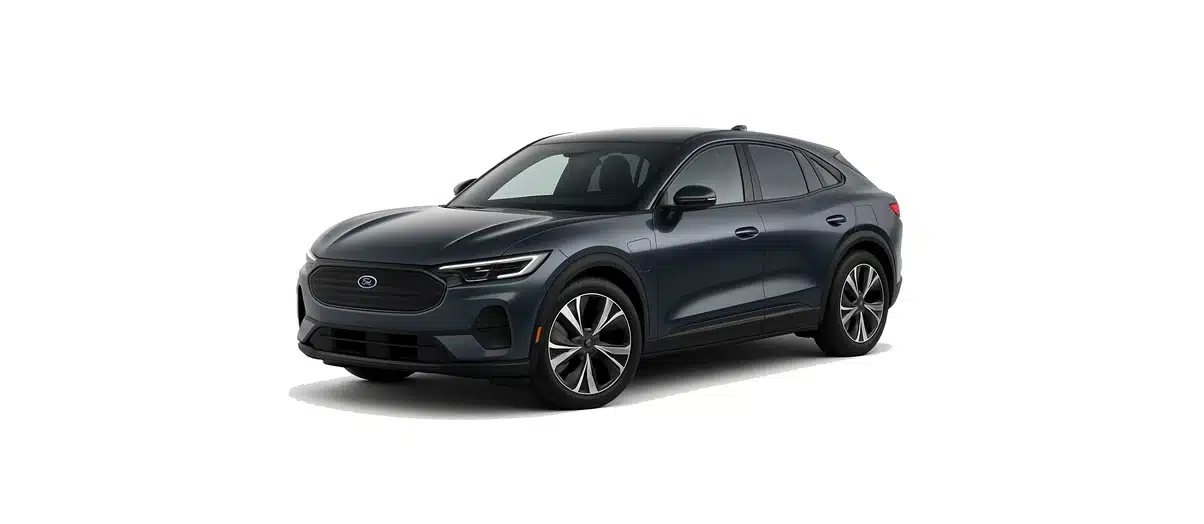
The modern UK-market Ford Capri is an all-electric coupe-SUV, not a plug-in hybrid and not to be confused with the historic petrol Capri. For charging purposes, the good news is simple: UK and European Capri models use a Type 2 connection for AC charging and a CCS Combo 2 connection for DC rapid charging. That means home wallboxes and untethered public AC charge points use a Type 2 charging cable, while motorway rapid and ultra-rapid chargers normally have their own tethered CCS cable.
The more complicated part is identifying which Capri battery and model-year specification you have. Public information shows a change between earlier UK MY25-style figures and newer MY26 listings. Ford UK’s customer price list effective 1 January 2026 still lists 52 kWh, 77 kWh and 79 kWh usable battery options, while current EV Database UK MY26 listings show a revised line-up with 58 kWh, 79 kWh and 77 kWh usable packs. Because of that, it is best to check your vehicle’s order paperwork, handbook, app or dealer information before relying on one universal range or rapid-charging figure.
View Ford Capri Charging Cables
Ford Capri Battery and Charging Specifications
Across the researched UK Ford Capri variants, the cable selection is consistent. The Capri has a Type 2 AC inlet and CCS Combo 2 DC rapid-charging connection, with the charge port located at the right-side rear of the vehicle. Ford also states that the Capri comes with a Type 2 Mode 3 cable for AC public charging, although owners should still check what was supplied with their exact car, especially on used or nearly-new vehicles.
All versions researched use an 11 kW AC onboard charger. In practical UK home-charging terms, however, most domestic properties have a single-phase supply, so the usual wallbox maximum is 7.4 kW. To use the full 11 kW AC capability, you need a compatible three-phase supply and a suitable 11 kW charge point.
For rapid charging, the Capri uses tethered CCS chargers. Peak DC charging power depends on battery, drive configuration and model year. It should not be assumed that every Capri can charge at the highest published 185 kW figure.
Battery Options
The Capri is best treated as a variant-checker model because the battery figures differ depending on whether you are looking at earlier MY25-style UK information or newer MY26 listings.
| Variant / listing | Usable battery | Notes |
|---|---|---|
| Standard Range RWD MY26 | 58 kWh | Listed as an LFP battery by EV Database UK, with up to 288 miles WLTP depending on specification. |
| Extended Range RWD MY26 | 79 kWh | Listed with up to 390 miles WLTP in the most favourable test configuration. |
| Extended Range AWD MY26 | 77 kWh | Listed with up to 368 miles WLTP depending on specification. |
| Earlier UK MY25 Standard Range RWD | 52 kWh | Ford UK price list information shows 242 miles WLTP for Style and 231 miles for Premium. |
| Earlier UK MY25 Extended Range RWD | 77 kWh | Ford UK price list information shows up to 389 miles WLTP for Select and 369 miles for Premium. |
| Earlier UK MY25 Extended Range AWD | 79 kWh | Ford UK price list information shows 346 miles WLTP for Premium AWD. |
This means two Capri owners could both describe their car as a Standard Range RWD, yet have different usable battery capacities depending on model year. The updated MY26 Standard Range is particularly important because it is listed as a 58 kWh usable LFP pack, whereas earlier UK information showed a 52 kWh usable Standard Range battery.
AC Charging Speed
AC charging is the type of charging you will use at home, at many workplaces and at untethered public destination chargers. The Ford Capri’s researched AC charging capability is up to 11 kW via Type 2.
On a typical UK single-phase 7.4 kW home wallbox, a full charge will usually take overnight. The exact time depends on battery size, starting percentage, weather, charging losses and whether the car is set to charge to 80%, 90% or 100%. As a rough guide, the Standard Range versions will be quicker to fill than the Extended Range versions, but most owners will not regularly charge from completely empty to completely full.
If you use an untethered public AC charge point, you will need a Type 2 charging cable. A 32 amp Type 2 cable is the normal choice for making full use of a 7.4 kW single-phase charger. For 11 kW three-phase AC charging, the charge point, supply and cable must all be compatible with three-phase charging.
DC Rapid Charging Speed
DC rapid charging is mainly for long journeys and higher-mileage days. The Capri uses CCS Combo 2 rapid chargers, and these units normally have a heavy tethered cable attached, so you do not use your own Type 2 cable for rapid charging.
The useful rapid-charging window is usually 10-80%. This is because the charging rate tends to slow significantly after around 80% to protect the battery and manage heat. For a motorway stop, charging to 80% and continuing your journey is often quicker than waiting for the final 20%.
Current MY26 EV Database UK listings show the Standard Range RWD at up to 105 kW DC, with a 10-80% time of about 27 minutes. The Extended Range RWD is listed at around 183 kW, with a 10-80% time of roughly 29-30 minutes. The Extended Range AWD is listed at up to 185 kW, with a 10-80% time of about 28 minutes. Earlier Ford UK MY25 figures differ, with the 52 kWh Standard Range listed at 145 kW and 25 minutes 10-80%, the 77 kWh Extended Range RWD listed at 135 kW and 28 minutes, and the 79 kWh Extended Range AWD listed at 185 kW and 26 minutes.
In real use, rapid-charging speed depends on charger output, battery temperature, state of charge, site load and whether battery preconditioning has been used.
Range and Efficiency
The longest WLTP figure in the researched data is up to 390 miles for the MY26 Extended Range RWD in favourable specification. EV Database UK estimates real-world range at around 290 miles for that version. The MY26 Extended Range AWD is listed with up to 368 miles WLTP and an estimated real-world range of around 275 miles, while the MY26 Standard Range RWD is listed with up to 288 miles WLTP and an estimated real-world range of around 215 miles.
WLTP figures are useful for comparing cars, but they are not a promise of what you will see on every trip. Cold weather, motorway speed, roof boxes, heavy loads, wet roads and frequent acceleration can reduce efficiency. In warmer conditions and on slower A-road or urban journeys, the Capri may be able to travel closer to its official figure.
Charging at Home
For most Ford Capri drivers, home charging will be the cheapest and most convenient way to run the car. A dedicated 7.4 kW Type 2 wallbox is the usual domestic recommendation in the UK. It allows the car to recharge while parked overnight and can be paired with smart charging schedules or off-peak electricity tariffs where available.
Although the Capri can accept up to 11 kW AC, that higher speed generally requires a three-phase electrical supply. Most UK homes do not have this as standard. If you do have three-phase, an 11 kW wallbox may reduce charging time, but the installation must be assessed by a qualified installer.
A 3-pin charger is generally best suited as a backup or occasional charging solution, but can be used regularly if a qualified electrician has confirmed the socket and electrical installation are suitable for sustained EV charging. Standard domestic sockets were not primarily designed for repeated long-duration high-load charging, so professional checks are important.
Public Charging
Public charging falls into two main categories: AC destination charging and DC rapid charging. AC destination charging is common at hotels, supermarkets, town-centre car parks and workplaces. Many of these units are untethered, so you plug in with your own Type 2 cable.
DC rapid and ultra-rapid charging is used on longer journeys. These chargers have tethered CCS cables, so you simply connect the charger’s cable to the Capri’s CCS port. The car may support Plug & Charge on current MY26 variants according to EV Database UK, using ISO 15118-2, but availability also depends on the charging network and account setup.
When planning a long journey, it is sensible to choose chargers that can deliver at least the peak rate your specific Capri variant can use. However, a higher-rated charger will not force the car to charge above its own limit. For example, a Standard Range MY26 listed at 105 kW will not charge at 185 kW simply because it is connected to a 350 kW charger.
Vehicle-Specific Features
Ford states that the Capri has navigation-linked battery preconditioning. When the car is navigating to a selected DC fast charger, it can prepare the battery on the way. This helps the battery reach a suitable temperature for faster charging, particularly in cold weather.
A heat pump is listed as an option in Ford UK’s January 2026 customer price list, so it should not be assumed to be standard on every car. If fitted, a heat pump can help improve heating efficiency in colder conditions compared with relying only on resistive heating.
Ford also describes Pro Power Onboard / V2L-style output, with 2.3 kW available at the charge port and a 220 V output in the boot, with an optional cable required. Because equipment can vary by trim and options, owners should confirm whether their exact car has the required feature and accessory. V2G and V2H capability should not be assumed; the researched data lists vehicle-to-grid and vehicle-to-home support as not available.
Charging Tips
- Check your model year and battery. A MY25 Standard Range and MY26 Standard Range may have different usable battery capacities and charging figures.
- Use Type 2 for AC charging. This applies to home wallboxes and most untethered public AC chargers.
- Use CCS for rapid charging. Rapid chargers are tethered, so you use the cable attached to the charger.
- Plan rapid stops around 10-80%. Charging beyond 80% is often slower and less time-efficient on a journey.
- Use navigation for rapid chargers. Selecting a DC charger in the car’s navigation can allow battery preconditioning to work.
- For LFP Standard Range owners, check the handbook. Ford’s European information indicates LFP technology can allow regular charging to 100%, but UK owner guidance should be confirmed in the vehicle handbook or app.
Frequently Asked Questions
What charging cable does the Ford Capri use?
The Ford Capri uses a Type 2 cable for AC charging. For DC rapid charging, it uses CCS Combo 2, and the rapid charger normally provides the tethered cable.
Can the Ford Capri charge at 11 kW at home?
The car’s researched AC onboard charger is rated at up to 11 kW, but most UK homes are single-phase and usually charge at up to 7.4 kW with a suitable wallbox. 11 kW AC charging generally requires a compatible three-phase supply.
Does every Ford Capri rapid charge at 185 kW?
No. Peak DC charging varies by battery, drivetrain and model year. Current MY26 listings show the Standard Range at up to 105 kW, Extended Range RWD at around 183 kW and Extended Range AWD at up to 185 kW.
Is the Ford Capri a hybrid?
No. The modern UK Ford Capri is a battery-electric vehicle only.
Does the Ford Capri have battery preconditioning?
Ford states that the Capri has navigation-linked battery preconditioning for selected DC fast chargers, helping prepare the battery before arrival.
What This Means for Drivers
For cable choice, the Ford Capri is straightforward: choose Type 2 for AC charging and use tethered CCS chargers for rapid charging. For charging expectations, it is more important to know your exact variant and model year. Earlier UK MY25-style figures and newer MY26 listings do not use one identical battery line-up, and rapid-charging speeds vary from around 105 kW to 185 kW depending on version.
For daily use, a 7.4 kW home wallbox will suit most UK Capri owners well, even though the car can accept 11 kW AC where three-phase charging is available. For longer trips, plan around the 10-80% rapid-charging window and use the car’s navigation to help battery preconditioning work where supported.
Looking for a Charging Cable for Ford Capri?
If you need a compatible Type 2 cable for home, workplace or public AC charging, choose a cable that matches how and where you charge your Ford Capri, including whether you need single-phase or three-phase capability.
View Ford Capri Charging Cables
Please note that this information is intended as a guide. Charging specifications may change due to model and year of manufacture. For precise information, always refer to your vehicle user manual.

