
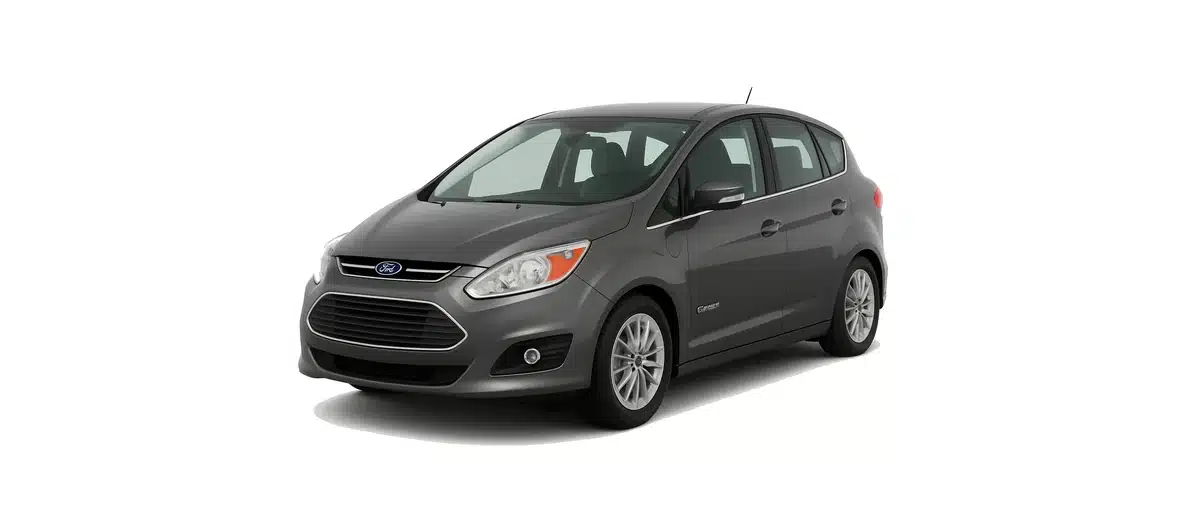
The Ford C-Max needs a little more explanation than many other vehicles in an EV charging guide. Most Ford C-Max and Grand C-Max models sold in the UK were petrol or diesel compact MPVs and do not have a charging port at all. If you own one of those standard UK-market cars, you do not need an EV charging cable.
The charging information in this guide applies specifically to the Ford C-Max Energi, a plug-in hybrid version sold mainly in North America for model years 2013 to 2017. Any examples in the UK are likely to be imports, or they may appear in listings where the name “Ford C-Max” is used broadly. The C-Max Energi is a PHEV, not a full battery-electric car: it has a petrol engine as well as a small plug-in battery for short electric journeys.
Because of that, cable selection is mainly about identifying the vehicle correctly and matching the car’s Type 1 AC inlet. A faster wallbox or public AC post will not make the C-Max Energi charge beyond its on-board charger limit, and DC rapid chargers are not relevant because the vehicle does not have a DC rapid-charge port.
View Ford C-Max Charging Cables
Ford C-Max Battery and Charging Specifications
For UK drivers, the most important specification is not a battery size or charging speed; it is whether the car is actually a plug-in model. A normal UK Ford C-Max petrol or diesel has no charging socket and cannot be charged from an EV cable. The Ford C-Max Energi, by contrast, is the plug-in hybrid version and is the model that charging cable guidance applies to.
| Vehicle | Ford C-Max Energi PHEV only |
|---|---|
| Standard UK Ford C-Max | Petrol/diesel models; no EV charging port |
| Charging inlet | Type 1 AC on C-Max Energi imports |
| AC charging capability | Up to around 3.3 kW, limited by the on-board charger |
| DC rapid charging | Not supported |
| Typical cable for UK public AC posts | Type 1 to Type 2 cable |
Before buying a cable, visually check the charging inlet on your vehicle. A C-Max Energi should have a Type 1 vehicle-side socket. A UK public AC charge point will usually have a Type 2 outlet, so the correct untethered cable is normally Type 1 at the car end and Type 2 at the charge point end.
Battery Options
The plug-in Ford C-Max Energi is listed with a 7.6 kWh lithium-ion battery pack, with usable capacity quoted by EV-focused sources at around 5.4 kWh. This applies only to the Energi PHEV, not to the ordinary UK C-Max range.
That battery size is small compared with modern full electric cars, which is normal for an older plug-in hybrid. The aim is to cover local trips and reduce petrol use on shorter journeys, while the petrol engine remains available for longer drives. For many owners, this means frequent short charging sessions at home or work are more useful than searching for high-power chargers.
AC Charging Speed
The Ford C-Max Energi uses AC charging through a Type 1 inlet and has an on-board charger rated at around 3.3 kW. In practical terms, that means a 16A AC charging supply is generally enough to reach the car’s maximum AC charging rate.
Ford owner information for the C-Max Energi refers to a 240 V charging station taking about 2.5 hours to fully charge an empty battery. Other charging data sources suggest roughly 2 hours from a 16A AC point. Real-world timing can vary with supply voltage, battery state, temperature, and whether the battery is completely empty, but the key point is simple: the C-Max Energi is not a high-power AC charging vehicle.
A 32A Type 1 to Type 2 cable may be physically compatible if it is the correct connector type, but it should not be expected to make the car charge faster. The car decides how much AC power it can accept, and for the C-Max Energi that limit is around 3.3 kW.
DC Rapid Charging Speed
The Ford C-Max Energi does not support DC rapid charging. It does not have a CCS or CHAdeMO rapid-charge inlet, so the 10–80% rapid-charging figures often quoted for modern electric cars do not apply.
This is not usually a major drawback for this vehicle because it is a plug-in hybrid with a petrol engine. The most suitable charging pattern is to top up the battery on AC power when parked, rather than planning journeys around rapid-charging stops. If you arrive at a motorway rapid charger, the tethered CCS or CHAdeMO connector will not connect to a C-Max Energi’s Type 1 AC socket.
Range and Efficiency
There is no appropriate UK WLTP electric range figure to quote for the Ford C-Max Energi in the same way you might for a current UK-market plug-in vehicle. US sources for the C-Max Energi commonly refer to an electric-only range of around 19 to 20 miles, but this should be treated as a North American published figure rather than a WLTP number.
In everyday use, electric range will depend on driving style, route, temperature, heating and demisting use, tyre condition, payload and battery age. As an older PHEV with a relatively small battery, the C-Max Energi is best viewed as a car that can handle short local journeys or parts of a commute on electricity when regularly charged. Longer trips will involve the petrol engine.
Charging at Home
Home charging is usually the most convenient option for a Ford C-Max Energi. Because the battery is small and the on-board charger is limited to around 3.3 kW, an overnight session is more than enough for a full top-up, and even shorter evening charging sessions may be sufficient for typical local use.
If you use a dedicated home charge point with a Type 2 socket, you will normally need a Type 1 to Type 2 cable for a C-Max Energi. If your home charge point is tethered, the connector on the end of the tethered lead must match the car. Many UK tethered home chargers have a Type 2 vehicle connector, which would not suit a Type 1 C-Max Energi without changing the charging arrangement.
A portable Type 1 3-pin charging unit may also be used where appropriate. However, a 3-pin charger is generally best suited as a backup or occasional charging solution, but can be used regularly if a qualified electrician has confirmed the socket and electrical installation are suitable for sustained EV charging. Avoid using damaged sockets, extension leads, multi-socket adaptors or any setup that becomes warm in use.
Public Charging
For UK public charging, focus on untethered AC charge points rather than rapid chargers. Untethered public AC posts normally provide a Type 2 socket on the charge point. A Ford C-Max Energi with a Type 1 vehicle inlet therefore needs a Type 1 to Type 2 cable.
Do not buy a Type 2 to Type 2 cable for a C-Max Energi unless you have independently confirmed that your specific car has been converted or is different from the published Type 1 specification. For the Energi models covered by available charging data, Type 1 is the vehicle-side connector.
Public AC posts rated at 7 kW, 11 kW or 22 kW may still be usable if they are untethered and compatible, but the car will only take the power it can accept. A 22 kW post will not turn the C-Max Energi into a 22 kW charging car. Expect charging behaviour closer to the vehicle’s 3.3 kW AC limit.
Vehicle-Specific Features
The defining feature of the Ford C-Max Energi for charging purposes is its position as an older plug-in hybrid derivative of the C-Max family. It is not the same as the standard UK C-Max, and it should not be treated like a modern full EV with large battery capacity and rapid-charging capability.
Owners should pay particular attention to import status. A vehicle brought into the UK from North America may have equipment, labelling and documentation that differ from typical UK-market cars. If you have recently bought a used C-Max and are unsure whether it is an Energi, look for the charging port, check the vehicle documents and confirm the connector shape before ordering a cable.
Charging Tips
- Confirm the model first: a standard UK Ford C-Max petrol or diesel does not need an EV charging cable.
- Check the socket visually: the C-Max Energi is associated with a Type 1 AC inlet, but UK imports should always be checked before purchase.
- Choose the right public cable: for most UK untethered AC posts, a C-Max Energi needs Type 1 to Type 2, not Type 2 to Type 2.
- Do not pay for speed you cannot use: a 16A cable is generally sufficient for the car’s on-board charger limit.
- Avoid rapid-charger assumptions: CCS and CHAdeMO rapid chargers are not useful for this vehicle.
- Charge little and often: with a small PHEV battery, regular top-ups can help maximise electric driving on short trips.
Frequently Asked Questions
Is the Ford C-Max an electric car?
Most UK Ford C-Max models are not electric or plug-in hybrid vehicles. They are petrol or diesel cars and do not have a charging port. The charging guidance applies to the Ford C-Max Energi, a plug-in hybrid sold mainly in North America.
What charging cable does a Ford C-Max Energi need in the UK?
For an untethered UK AC charge point, the Ford C-Max Energi normally needs a Type 1 to Type 2 charging cable: Type 1 for the car and Type 2 for the charge point.
Will a 32A cable charge the C-Max Energi faster?
Not beyond the vehicle’s limit. The C-Max Energi’s on-board AC charger is around 3.3 kW, so a 32A cable or higher-rated AC post should not be expected to reduce charging time compared with a suitable 16A setup.
Can the Ford C-Max Energi use DC rapid chargers?
No. The C-Max Energi does not support DC rapid charging and does not have a CCS or CHAdeMO inlet.
How long does the Ford C-Max Energi take to charge?
From an empty battery, published guidance suggests roughly 2 to 2.5 hours on a 240 V / 16A-style AC charging supply. Actual time may vary depending on conditions and the battery’s starting state of charge.
What This Means for Drivers
If you own a normal UK Ford C-Max, the answer is straightforward: it does not charge, so you do not need an EV cable. If you own a Ford C-Max Energi import, cable choice is also straightforward once the car is correctly identified. You are looking for Type 1 AC charging, usually through a Type 1 to Type 2 cable for UK public and untethered home charge points.
The C-Max Energi is best charged at home, at work or during longer parked periods. Its small plug-in hybrid battery makes rapid charging unnecessary and unsupported, while its modest AC charging rate means a compatible cable matters more than a high power rating. Confirm the inlet, choose the correct connector type, and treat charging as a regular top-up habit rather than a high-speed refuelling stop.
Looking for a Charging Cable for Ford C-Max?
If you have confirmed that your vehicle is a Ford C-Max Energi plug-in hybrid with a Type 1 charging inlet, We can help you choose a suitable Type 1 cable for UK home and public AC charging.
View Ford C-Max Charging Cables
Please note that this information is intended as a guide. Charging specifications may change due to model and year of manufacture. For precise information, always refer to your vehicle user manual.

