
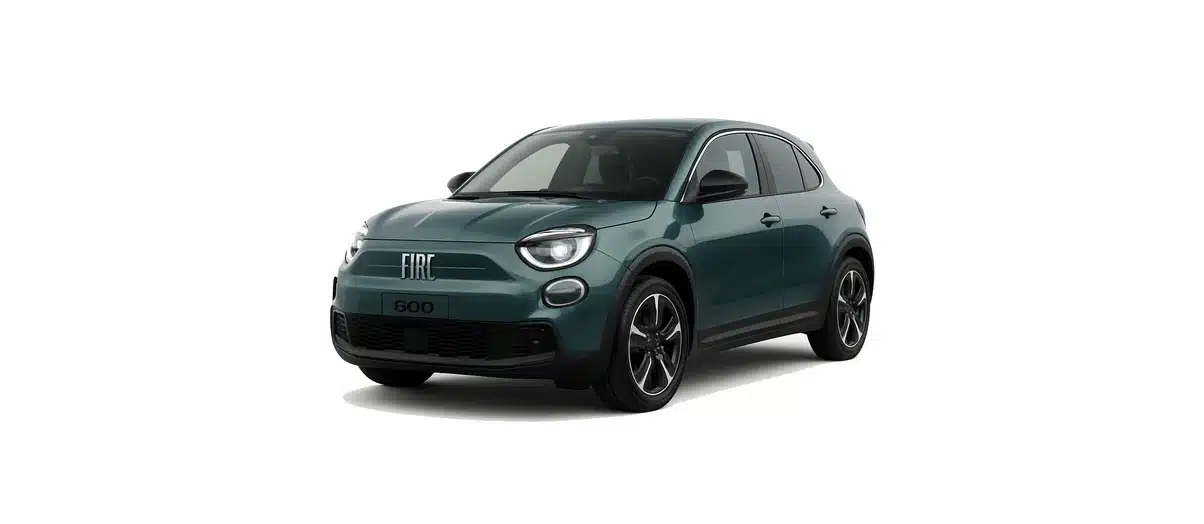
The Fiat 600e is the all-electric version of Fiat’s 5-door compact crossover, sitting above the smaller 500e while keeping a practical footprint for UK roads. It should not be confused with the Fiat 600 Hybrid, which is a separate mild-hybrid model and does not use an external charging cable. If you own or are considering the 600e, the key charging point to understand is simple: the car has an 11kW AC on-board charger, but most UK homes are single-phase and will normally charge it at up to 7.4kW from a typical home wallbox.
That does not make home charging difficult. With a usable battery capacity of around 50.8kWh and a Type 2 AC charging connection, the 600e is well suited to overnight charging. On longer journeys, it uses the UK and European-standard CCS Combo 2 connector for DC rapid charging, with Fiat quoting up to 100kW DC charging capability. This guide explains the practical charging speeds, cable choices and ownership considerations for UK Fiat 600e drivers.
View Fiat 600e Charging Cables
Fiat 600e Battery and Charging Specifications
UK-market Fiat 600e models are currently listed by Fiat UK as all-electric 54kWh versions, with Pop, Icon and La Prima trims shown on the live Fiat UK pages at the time of the research data. Some older Fiat and Stellantis documents refer to earlier trim names such as (600e)RED and La Prima, so trim names and equipment should be checked against the latest Fiat UK configurator before publication or purchase decisions.
| Vehicle | Fiat 600e |
|---|---|
| Vehicle type | Battery-electric 5-door compact crossover / small SUV |
| Battery | 54kWh gross, approximately 50.8–51kWh usable/net |
| Official WLTP range | Up to 254 miles, depending on specification |
| Estimated real-world range | About 190 miles in mixed use, according to EV Database |
| AC charging | Type 2, up to 11kW |
| DC rapid charging | CCS Combo 2, up to 100kW |
| Charging port location | Left rear, according to EV Database |
Battery Options
The Fiat 600e is listed with one main battery option in the UK research data: a 54kWh gross battery pack with around 50.8–51kWh usable or net capacity. No alternative UK-market battery size was found for the 600e in the supplied sources.
That places the 600e in a useful middle ground for a compact electric crossover. It has more capacity than many short-range urban EVs, while remaining small and efficient enough for day-to-day commuting, school runs, shopping trips and regular local driving. For many owners, a full battery will cover several days of normal use, particularly if charging is available at home.
AC Charging Speed
The Fiat 600e has an 11kW AC on-board charger. This is the maximum AC rate the car can accept when connected to a suitable three-phase AC charge point. Fiat quotes a 0–100% AC charging time of around 5 hours 45 minutes at 11kW.
In the UK, however, most domestic electricity supplies are single-phase. A typical home wallbox will therefore charge at up to 7.4kW rather than 11kW. On a 7.4kW home or public AC charger, a full charge from empty is closer to about 8 hours 15 minutes. In real use, most drivers do not regularly arrive home at 0% and charge to 100%, so everyday top-ups are usually much shorter.
For cable choice, the 600e uses a Type 2 AC connection. A 32A single-phase Type 2 cable is suitable for the common 7.4kW UK home wallbox scenario. If you have access to three-phase AC charging, or want a cable that can make use of 11kW AC posts where available, a three-phase Type 2 cable rated appropriately for 11kW or above is the more flexible option.
DC Rapid Charging Speed
For longer journeys, the Fiat 600e uses CCS Combo 2 DC rapid charging. Fiat quotes up to 100kW DC charging and a 20–80% rapid-charge time of about 27 minutes. Other charging databases estimate that a typical 10–80% session is around 28–30 minutes, depending on conditions.
It is important not to mix these figures. Fiat’s 27-minute figure refers to 20–80%, not 10–80%. Charging from 10% starts from a lower state of charge and may take slightly longer overall. Equally, charging above 80% on a rapid charger usually becomes much slower, because the car reduces charging power to protect the battery. On motorway journeys, it is normally quicker to charge to around 80% and continue driving than to wait for 100% unless you genuinely need the extra range.
The 600e does not have battery preconditioning for rapid charging according to EV Database, so DC charging speeds may be more dependent on battery temperature and conditions than in EVs that can actively prepare the battery before arriving at a rapid charger.
Range and Efficiency
Fiat lists the 600e with an official WLTP combined range of up to 254 miles. Stellantis technical data also shows closely related WLTP figures of around 252–254 miles depending on specification. As with any EV, WLTP range is a laboratory figure and should be treated as a comparison benchmark rather than a guaranteed everyday result.
EV Database estimates a real-world combined range of about 190 miles for the Fiat 600e. Your own result will depend on driving speed, weather, road type, tyre choice, load, cabin heating or air conditioning use, and how efficiently you drive. Winter motorway journeys will usually use more energy than gentle urban driving in mild weather.
The Fiat 600e is listed by EV Database and EVKX as having a standard heat pump. A heat pump can help improve cabin heating efficiency in cooler conditions compared with relying solely on resistive heating, although real-world benefit still depends on temperature and journey pattern.
Charging at Home
For most UK Fiat 600e owners, home charging will be the most convenient and cost-effective way to run the car. A dedicated 7.4kW Type 2 home wallbox is likely to be the normal setup, even though the car itself can accept up to 11kW AC. This is because most UK homes do not have three-phase power.
At 7.4kW, the 600e can still be charged overnight from a low battery to full. If you plug in after the evening commute and use a suitable off-peak electricity tariff, the car can often be ready by the next morning. For typical daily mileage, you may only need to replace a portion of the battery, so the charging session could be only a few hours.
A 3-pin charger is generally best suited as a backup or occasional charging solution, but can be used regularly if a qualified electrician has confirmed the socket and electrical installation are suitable for sustained EV charging. Standard domestic sockets were not primarily designed for continuous high-load EV charging, so it is wise to avoid using an unknown, old or damaged socket for long charging sessions.
If you are arranging a home charge point installation, check the wallbox connector type, cable length, parking position and whether you want a tethered or untethered unit. With an untethered wallbox, you will need your own Type 2 charging cable. With a tethered wallbox, the cable is permanently attached to the charger.
Public Charging
Public AC charging for the Fiat 600e uses the same Type 2 connection as home charging. Many destination chargers at supermarkets, hotels, town centres and workplaces are AC posts, often requiring you to use your own Type 2 cable. Depending on the charger and electricity supply, these may provide 7kW, 11kW or 22kW, but the 600e will only take up to its own 11kW AC limit.
For rapid and ultra-rapid charging, use CCS chargers. These have the DC cable attached to the charging unit, so you do not need to provide your own rapid-charging cable. The 600e can charge at up to 100kW DC where charger capability, battery temperature and state of charge allow.
On a long trip, plan charging stops around the 10–80% window where possible. This is usually the most time-efficient part of the charging curve. If a route planner suggests arriving at a charger with a low battery percentage, allow a sensible buffer, especially in cold weather, heavy rain, strong headwinds or on high-speed routes.
Vehicle-Specific Features
The Fiat 600e uses Stellantis e-CMP underpinnings and a 400V electrical architecture. It has a front-wheel-drive electric powertrain rated at 115kW, equivalent to around 154–156hp depending on how figures are rounded in different sources.
In charging terms, the most relevant feature is the 11kW AC on-board charger. This is useful when connected to three-phase public AC posts or three-phase home/workplace supplies, but many UK owners will still experience the car primarily as a 7.4kW home-charging EV.
According to EV Database, the Fiat 600e does not support Plug & Charge. It is also listed as not supporting vehicle-to-load, vehicle-to-grid or vehicle-to-home functionality. These omissions are not unusual in this vehicle class, but they are worth noting if you are comparing the 600e with EVs that offer external power output or bidirectional charging features.
Charging Tips
- Choose the right cable for your use: a Type 2 cable is required for untethered AC chargers. For most UK home charging, 32A single-phase is sufficient; for wider compatibility with 11kW AC, consider a suitable three-phase Type 2 cable.
- Do not worry about the 11kW versus 7.4kW difference at home: a 7.4kW wallbox is still fast enough for practical overnight charging.
- Use rapid charging strategically: on long journeys, charging from around 10–80% is usually quicker than waiting for 100%.
- Keep WLTP range in context: the official 254-mile figure is a useful comparison number, but real-world range may be closer to about 190 miles in mixed conditions.
- Check the charger before you park: AC posts may need your own cable, while CCS rapid chargers have a tethered cable attached.
- Look after the cable: keep connectors clean, dry and off the ground where possible, and avoid tightly kinking the cable when storing it.
Frequently Asked Questions
What charging cable does the Fiat 600e use?
The Fiat 600e uses a Type 2 connector for AC charging. For DC rapid charging, it uses the CCS Combo 2 connector, which is the standard rapid-charging format for most modern EVs in the UK and Europe.
Can the Fiat 600e charge at 11kW at home?
Only if the property has a suitable three-phase supply and compatible charging equipment. Most UK homes are single-phase, so the 600e will typically charge at up to 7.4kW from a home wallbox.
How long does the Fiat 600e take to charge at home?
At 11kW AC, Fiat quotes about 5 hours 45 minutes for a 0–100% charge. On a typical 7.4kW UK home wallbox, a full charge from empty is closer to about 8 hours 15 minutes. Normal daily top-ups are usually shorter.
How fast does the Fiat 600e rapid charge?
The Fiat 600e supports up to 100kW DC rapid charging. Fiat quotes around 27 minutes for 20–80%, while a typical 10–80% session is commonly estimated at around 28–30 minutes depending on source, charger and conditions.
Does the Fiat 600 Hybrid need a charging cable?
No. The Fiat 600 Hybrid is a separate mild-hybrid model and is not externally chargeable. Only the battery-electric Fiat 600e uses EV charging cables.
What This Means for Drivers
The Fiat 600e is straightforward to charge once you understand the difference between its 11kW AC capability and the 7.4kW limit of most UK home wallboxes. In everyday use, a 7.4kW wallbox is still entirely suitable for overnight charging, while a Type 2 cable gives access to untethered public AC chargers. For longer trips, CCS rapid charging at up to 100kW means the car can add a useful amount of range during a short stop, especially if you plan around the 10–80% charging window.
The main practical takeaway is that you do not need to chase 11kW home charging unless your property already supports it or you are installing a three-phase setup for wider reasons. For most owners, the right Type 2 cable, sensible home charging routine and occasional CCS rapid charging will cover the vast majority of journeys.
Looking for a Charging Cable for Fiat 600e?
We offer Fiat 600e charging cables for UK home and public AC charging, including Type 2 options suited to common 7.4kW wallboxes and higher-capability AC charge points.
View Fiat 600e Charging Cables
Please note that this information is intended as a guide. Charging specifications may change due to model and year of manufacture. For precise information, always refer to your vehicle user manual.

