
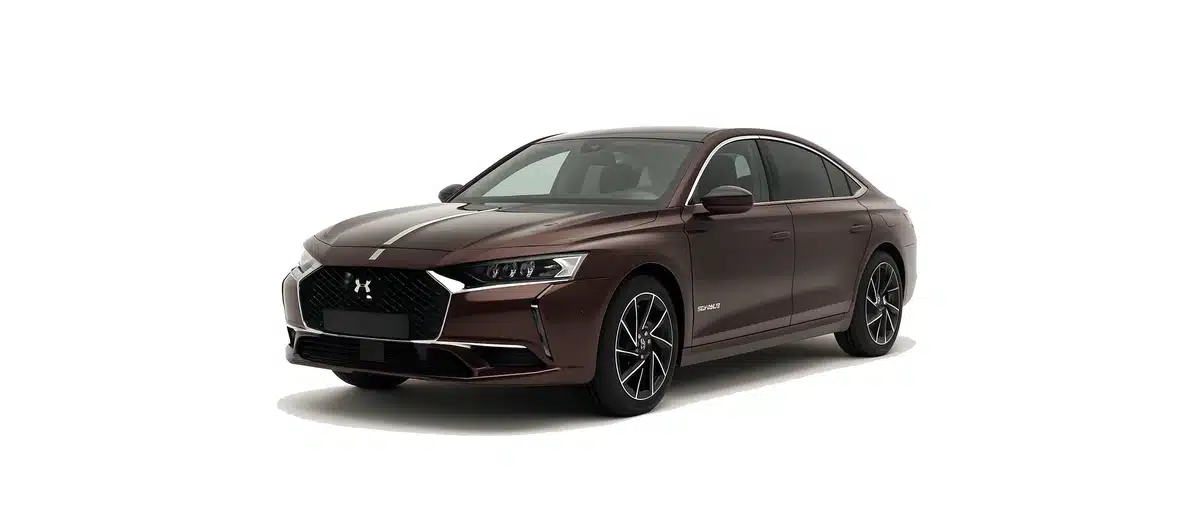
The DS 9 E-Tense is a plug-in hybrid large saloon, not a fully electric car. That distinction matters when you are planning how to charge it. Rather than relying on DC rapid charging in the way a battery-electric vehicle might, the DS 9 E-Tense is designed around Type 2 AC charging, home wallbox use and regular top-ups of its relatively compact traction battery.
As a used-car choice, the DS 9 E-Tense needs a little extra care when comparing specifications. UK launch cars included the E-Tense 225 plug-in hybrid, while later UK price and specification material listed E-Tense 250 and E-Tense 4×4 360 versions. Battery size, quoted electric range and some software details vary by variant and model year, so it is worth checking the exact car before buying a cable or comparing charging times.
View DS 9 E-Tense Charging Cables
DS 9 E-Tense Battery and Charging Specifications
The DS 9 E-Tense uses a Type 2 charging connection for AC charging. Official material refers to a 7.4 kW on-board charger, or a 7 kW wallbox charging capability depending on the source and model year. In practical UK terms, that means a standard single-phase 7 kW home charge point is the right match for the car’s maximum AC charging ability.
The charging flap is located at the rear-left of the vehicle according to the DS 9 handbook. The handbook also describes Mode 2 domestic charging and Mode 3 AC charging, but the key point for most owners is simple: for day-to-day use, a Type 2 connection is the correct format.
Because the DS 9 E-Tense is a plug-in hybrid with a petrol engine as well as electric drive, its charging pattern is different from a long-range electric car. Many owners will charge at home overnight, use electric power for shorter journeys, and rely on the petrol engine for longer trips when needed.
Battery Options
There is not one single battery and range figure that applies to every UK DS 9 E-Tense. Early UK launch and 2021 specification material for the E-Tense 225 quoted an 11.9 kWh lithium-ion battery, with Stellantis material describing this as an 11.9 kWh usable battery. UK launch information gave a WLTP electric range of around 33 to 34 miles, while the 2021 UK price and specification guide showed approximately 33 to 38 miles depending on configuration.
Earlier E-Tense 4×4 360 information also referred to an 11.9 kWh lithium-ion battery, with similar WLTP electric range figures in some 2021/2022 material. However, later UK specifications list a different figure, so it is best not to assume that all 360 cars are the same.
Later UK material, including May 2023 price and specification information, listed the E-Tense 250 with a 15.6 kWh lithium-ion battery. Its WLTP combined electric range was quoted at 43 to 52 miles depending on Vehicle High or Vehicle Low configuration. The later E-Tense 4×4 360 was also listed with a 15.6 kWh battery, with a WLTP combined electric range of 39 miles.
If you are buying a used DS 9 E-Tense, the safest approach is to identify the exact version from the registration, VIN, handbook pack, original order sheet or manufacturer specification. This is especially important if you are comparing electric range claims between an early E-Tense 225 and a later E-Tense 250.
AC Charging Speed
The DS 9 E-Tense’s confirmed charging capability is AC charging via a Type 2 connector, with a practical maximum of around 7 kW to 7.4 kW. This means a 7 kW home wallbox is usually the fastest and most convenient charging option.
For earlier 11.9 kWh versions, official sources give charging times of roughly 1 hour 30 minutes to 1 hour 45 minutes for a full 0-100% charge, depending on the exact source and model year. For later 15.6 kWh UK specification cars, the quoted 0-100% charging time is about 2 hours 25 minutes using a 7 kW wallbox.
It is also worth understanding the difference between the rating of a charge point and the charging limit of the car. If you plug a DS 9 E-Tense into an 11 kW or 22 kW three-phase AC public post, the car will not charge at 11 kW or 22 kW. It will still be limited by its on-board AC charger, so charging speed will remain around the 7 kW level where the supply and cable support it.
DC Rapid Charging Speed
No confirmed CCS or DC rapid-charging specification was found for the DS 9 E-Tense. The official handbook information reviewed identifies Type 2 AC charging rather than CCS rapid charging, and the available DS/Stellantis specification material focuses on wallbox and public AC charging times.
For that reason, it is best to treat the DS 9 E-Tense as an AC-charge plug-in hybrid rather than a car intended for motorway rapid-charger stops. A public rapid charger may have a high-power DC connector, but that does not mean the DS 9 E-Tense can use DC rapid charging. For this car, public charging is mainly about Type 2 AC posts at destinations such as car parks, hotels, workplaces and some supermarkets.
Range and Efficiency
The headline electric range depends on which DS 9 E-Tense you have. Early E-Tense 225 cars were quoted at around 33 to 38 miles WLTP depending on specification, while later E-Tense 250 cars were quoted at up to 52 miles WLTP in favourable configuration. Later E-Tense 4×4 360 UK specification material quoted 39 miles WLTP combined electric range.
Real-world electric range will vary with temperature, speed, driving style, cabin heating or cooling use, route profile and how often the petrol engine is called upon. Short urban and suburban journeys are usually where a plug-in hybrid like the DS 9 E-Tense makes most sense, because regular charging can allow many local trips to be completed with minimal petrol use.
On faster roads, in cold weather or on longer journeys, expect the petrol engine to play a greater role. That is normal for a PHEV and is one reason why daily charging habits matter more than occasional high-speed charging.
Charging at Home
Home charging is likely to be the most practical way to run a DS 9 E-Tense efficiently. A 7 kW dedicated wallbox matches the car’s AC charging limit well and should be capable of fully charging the battery in a few hours, depending on the battery version and starting state of charge.
If your wallbox is untethered, you will need a Type 2 to Type 2 Mode 3 charging cable. If your wallbox is tethered, the cable is permanently attached to the charger, so you may only need a separate cable for public AC charging. Used cars are sometimes sold with one cable, two cables or no cable at all, so check what is included before assuming you are ready to charge.
A 3-pin charger is generally best suited as a backup or occasional charging solution, but can be used regularly if a qualified electrician has confirmed the socket and electrical installation are suitable for sustained EV charging. For everyday convenience, however, a properly installed wallbox is usually a better long-term solution because it is faster, neater and designed for regular EV charging loads.
The DS 9 handbook also describes deferred charging, which can be set through the vehicle touchscreen or the MyDS app. This is useful if you want to charge during cheaper overnight electricity periods, provided your energy tariff and home charger setup support that approach.
Public Charging
For public charging, the cable most DS 9 E-Tense owners need is a Type 2 to Type 2 Mode 3 cable. This is the standard cable used with many untethered AC charge points across the UK, including posts found in town-centre car parks, workplace locations, leisure venues and longer-stay parking areas.
Because the car’s AC charging limit is around 7 kW to 7.4 kW, there is no charging-speed benefit from seeking out a 22 kW AC post over a 7 kW post, unless the 22 kW post is simply the available option. The DS 9 E-Tense will draw only what its on-board charger allows.
Public charging can still be useful, especially if you are parked for a couple of hours. For example, an early 11.9 kWh car may be able to recover most or all of its usable electric range during a long lunch stop or shopping trip if connected to a suitable AC post. A later 15.6 kWh car will take longer from empty, but a destination charge can still add useful electric miles before the return journey.
Vehicle-Specific Features
The DS 9 E-Tense includes several plug-in hybrid features that are worth knowing about. Official launch material describes energy recovery and a driver-selectable B mode, which can increase regenerative braking effect compared with normal driving mode. This can be helpful in urban traffic and on downhill sections, although it is not a replacement for plugging in.
The car also has an E-Save function, which can reserve battery energy for later use. This is particularly useful if you want to save electric driving for a town centre, low-emission zone or the final part of a journey where quiet, zero-tailpipe-emission running is most valuable.
Some later DS 9 models built from March 2023 may have the DS IRIS infotainment system. As a result, menu layouts and app-related instructions can differ between early and later cars. If the touchscreen instructions in an online guide do not match your vehicle, check the handbook or the DS manual resources for your build date.
Charging Tips
- Confirm the exact variant. Battery and range figures differ between E-Tense 225, E-Tense 250 and E-Tense 4×4 360 models, and also by model year.
- Use the right cable. A Type 2 to Type 2 Mode 3 cable is the usual choice for untethered home wallboxes and public AC charge points.
- Do not expect 22 kW charging. Even on a 22 kW AC post, the DS 9 E-Tense is limited by its own on-board charger.
- Charge little and often. PHEVs are at their best when the battery is topped up regularly, especially before short local journeys.
- Check used-car cable supply. Make sure you know whether the car comes with a Mode 2 domestic cable, a Mode 3 Type 2 public charging cable, or both.
- Use deferred charging where useful. Timed charging can help align charging with off-peak electricity periods.
Frequently Asked Questions
Is the DS 9 E-Tense fully electric?
No. The DS 9 E-Tense is a plug-in hybrid. It combines a 1.6-litre PureTech petrol engine with electric drive. E-Tense 225 and E-Tense 250 versions use one electric motor, while the E-Tense 4×4 360 uses two electric motors.
What charging cable does the DS 9 E-Tense use?
For most UK public AC charge points and untethered wallboxes, the DS 9 E-Tense uses a Type 2 to Type 2 Mode 3 charging cable.
Can the DS 9 E-Tense use DC rapid chargers?
No confirmed DC rapid-charging or CCS specification was found in the reviewed official information. The DS 9 E-Tense should be treated as a Type 2 AC charging plug-in hybrid.
How long does the DS 9 E-Tense take to charge?
Earlier 11.9 kWh versions are quoted at roughly 1 hour 30 minutes to 1 hour 45 minutes for a full charge, depending on source and model year. Later 15.6 kWh UK specification cars are quoted at about 2 hours 25 minutes from 0-100% on a 7 kW wallbox.
Will a 22 kW public charger charge it faster?
No, not beyond the car’s own AC charging limit. A 22 kW AC post may be usable with the right Type 2 cable, but the DS 9 E-Tense will still charge at around its 7 kW to 7.4 kW on-board limit.
What This Means for Drivers
The DS 9 E-Tense is best understood as a refined plug-in hybrid saloon that rewards regular AC charging. If you can charge at home and top up on public AC posts when parked for longer periods, it can cover many shorter journeys using electric power while still offering petrol flexibility for longer distances.
The most important points are to identify your exact model year and variant, choose a suitable Type 2 cable, and avoid assuming that rapid-charging figures or 22 kW AC claims apply. For most owners, a 7 kW wallbox and a good-quality Type 2 to Type 2 cable will be the most relevant charging setup.
Looking for a Charging Cable for DS 9 E-Tense?
We offer DS 9 E-Tense charging cables for home and public AC charging, including Type 2 options suitable for untethered wallboxes and UK public charge points.
View DS 9 E-Tense Charging Cables
Please note that this information is intended as a guide. Charging specifications may change due to model and year of manufacture. For precise information, always refer to your vehicle user manual.

