
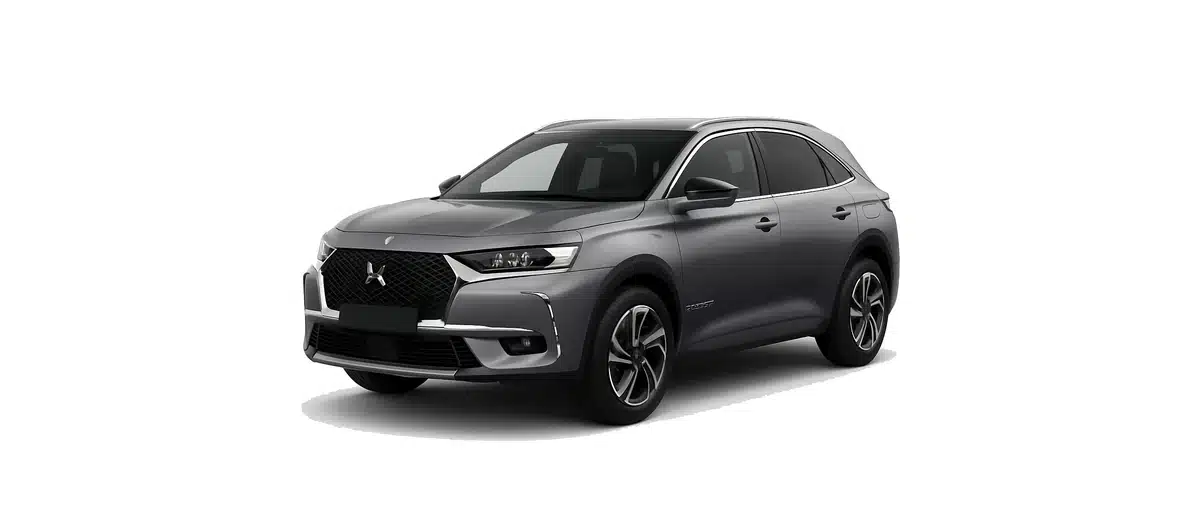
The DS 7 Crossback E-Tense is a premium plug-in hybrid SUV, not a full battery-electric vehicle. That distinction matters when you are choosing a charging cable or planning how to use public chargers. Unlike a pure EV, the DS 7 Crossback E-Tense uses a relatively small rechargeable battery for local electric driving and a petrol engine for longer journeys once the electric range is depleted.
UK used-car listings can be slightly confusing because DS changed the naming during the model’s life. Earlier cars were sold as the DS 7 Crossback E-Tense, while later facelift models were marketed as DS 7 E-Tense. You may also see versions described as E-Tense 225, E-Tense 4×4 300 or E-Tense 4×4 360. The charging connector is the key constant: this model uses Type 2 AC charging. It does not use CCS rapid charging.
This guide explains what DS 7 Crossback E-Tense owners need to know about battery sizes, charging speeds, home charging, public charging and selecting the correct Type 2 cable.
View DS 7 Crossback E-Tense Charging Cables
DS 7 Crossback E-Tense Battery and Charging Specifications
The DS 7 Crossback E-Tense is a plug-in hybrid petrol-electric SUV. Depending on the version, it combines a 1.6-litre petrol engine with either one electric motor in the front-wheel-drive E-Tense 225 or additional electric drive in the 4×4 versions. The purpose of the plug-in system is to allow short journeys on electric power while retaining petrol flexibility for longer trips.
| Vehicle type | Plug-in hybrid electric vehicle (PHEV) |
|---|---|
| Charging inlet | Type 2 AC |
| DC rapid charging | Not applicable for this model |
| Typical AC charging capability | Up to around 7.4kW where supported by the vehicle and charging equipment |
| Official electric range | Varies by year and version; up to 43 miles WLTP in some later official data |
| Real-world electric range | Often around the mid-20-mile region, depending on conditions and use |
Because DS literature varies by model year and version, it is worth checking your V5C, handbook, original specification sheet or dealer listing before assuming a single battery size or charge time applies to every DS 7 E-Tense.
Battery Options
There are two main battery-capacity contexts for UK buyers to understand.
Earlier DS 7 Crossback E-Tense models, approximately 2020 to 2022: official DS/Stellantis material for Crossback-era E-Tense 225 and E-Tense 4×4 300 models quotes a 13.2kWh rechargeable lithium-ion battery. The E-Tense 225 was quoted at up to around 34 miles of WLTP electric range, while E-Tense 4×4 300 figures varied slightly depending on specification and approval wording.
Facelift New DS 7 E-Tense models: later UK price and specification guides list a 14.2kWh total battery capacity for E-Tense 225, E-Tense 4×4 300 and E-Tense 4×4 360 versions. A later UK guide archive lists the E-Tense 225 as having 14.2kWh total and 12.9kWh usable capacity. This later data should not automatically be applied to every earlier Crossback-badged car.
In practical ownership terms, both battery sizes are modest compared with a full EV. The benefit is that a home charge can usually replenish the battery within a few hours, making regular short electric journeys realistic if you plug in often.
AC Charging Speed
The DS 7 Crossback E-Tense charges using AC power through a Type 2 connector. Official and archived UK figures are not perfectly uniform across every year and version, so it is best to treat charge-time claims with care.
Early DS 7 Crossback E-Tense 225 and 4×4 material quoted charging from a 32A wallbox using a 7.4kW Type 2 cable in around 1 hour 45 minutes. Later New DS 7 UK data lists different results: a July 2023 UK guide gives a 0-100% wallbox time of 3 hours 45 minutes for E-Tense 225, but around 1 hour 55 minutes for E-Tense 4×4 300 and 4×4 360. A later 2024 UK guide archive lists E-Tense 225 at around 1 hour 55 minutes on a 7.4kW wallbox.
The important point for cable selection is that a Type 2 charging cable rated for 32A single-phase use is the sensible choice for most UK owners. It will support up to 7.4kW single-phase AC charging where the vehicle, wallbox and installation allow it. Some references suggest particular versions or situations may charge at a lower AC rate, so a higher-rated cable will not force the car to charge faster than its onboard charger permits.
DC Rapid Charging Speed
DC rapid charging is not applicable to the DS 7 Crossback E-Tense. This is an AC-only plug-in hybrid with a Type 2 charging inlet. It is not equipped like a battery-electric car with a CCS rapid-charging connection.
That means there is no meaningful 10-80% rapid-charge time to plan around. If you stop at a motorway service area, the high-power CCS chargers used by full EVs are not relevant for this vehicle. For longer journeys, the DS 7 Crossback E-Tense relies on its petrol engine once the plug-in electric range has been used.
Range and Efficiency
Official WLTP electric range varies by version, wheel size, trim and model year. Crossback-era models were typically quoted around the mid-30-mile region, while later New DS 7 E-Tense data lists figures up to 43 miles WLTP for some E-Tense 225 specifications. The E-Tense 4×4 300 and 4×4 360 versions have their own official range figures, generally around the high-30s to low-40s for 300 versions and slightly lower for some 360 data.
In day-to-day UK driving, real-world electric range is likely to be lower than the best official figure. Around 26 miles is a reasonable expectation for many mixed-use scenarios, though results will depend on temperature, speed, driving style, use of cabin heating or air conditioning, tyre condition and how much of the journey is on faster roads.
To get the best from the plug-in hybrid system, treat the battery as something to use frequently rather than save for rare occasions. Charging overnight or whenever the car is parked for several hours can significantly reduce petrol use on commutes, school runs and local journeys.
Charging at Home
A dedicated 7kW home wallbox is the most practical charging setup for the DS 7 Crossback E-Tense. It is convenient, weather-resistant when properly installed, and usually quicker and safer than relying on a domestic socket. If your wallbox is untethered, you will need a Type 2 to Type 2 cable. If it is tethered, the cable is permanently attached to the charger and you simply plug it into the car.
Because the DS 7 Crossback E-Tense has a relatively small PHEV battery, home charging can be fitted naturally around daily life. Many owners will plug in after arriving home and have the battery replenished well before the next morning. Depending on the exact model year and variant, a full charge from a wallbox may be roughly in the 1 hour 45 minutes to 1 hour 55 minutes region, while some official E-Tense 225 data lists around 3 hours 45 minutes.
Charging from a 3-pin domestic socket is possible in the sense that DS handbook information refers to domestic Mode 2 charging, but it should not be treated as the default daily solution without proper checks. A 3-pin charger is generally best suited as a backup or occasional charging solution, but can be used regularly if a qualified electrician has confirmed the socket and electrical installation are suitable for sustained EV charging.
Public Charging
For public charging, focus on AC destination chargers rather than rapid chargers. These are commonly found in car parks, hotels, shopping centres, workplaces and some town-centre locations. Many of these charge points are untethered, which means you need to bring your own Type 2 cable.
A Type 2 cable rated for 32A single-phase charging is a good match because it covers the common 7kW AC charging scenario. You can also connect to many 22kW AC posts, but the DS will only draw what its onboard AC charger allows; the post rating does not mean the car will charge at 22kW.
When planning journeys, remember that public charging is less essential for this PHEV than it is for a full EV. If an AC charger is available while you are parked for lunch, work or shopping, it can be useful. If not, the petrol engine provides the long-distance fallback. You do not need to plan around high-power rapid chargers or 10-80% battery stops.
Vehicle-Specific Features
The DS 7 Crossback E-Tense’s charging behaviour is defined by its PHEV layout and Type 2 AC inlet. It is designed for regular top-ups rather than rapid motorway charging. Depending on equipment and app availability, DS has offered remote cabin pre-heating or cooling through MyDS/e-Remote services, which can be useful before setting off while the vehicle is plugged in.
The main vehicle-specific issue for used buyers is identification. A car advertised as a DS 7 Crossback E-Tense may be an earlier Crossback-badged model, while a later car may simply be listed as DS 7 E-Tense. Check whether it is the E-Tense 225, E-Tense 4×4 300 or E-Tense 4×4 360, and check the model year, because the published battery and charging figures are not identical across all versions.
Charging Tips
- Choose the right connector: the DS 7 Crossback E-Tense uses a Type 2 AC charging inlet.
- Do not buy for DC rapid charging: CCS rapid-charging cables and 10-80% charging plans are not relevant for this model.
- Use a 32A Type 2 cable: this is the practical choice for 7kW home wallboxes and many UK public AC posts.
- Check your exact version: E-Tense 225, 4×4 300 and 4×4 360 versions have different official figures.
- Plug in often: PHEVs deliver their best economy when the battery is charged regularly.
- Use petrol for longer trips: once the electric range is depleted, the vehicle operates as a hybrid petrol SUV.
- Consider cable length: 5 metres suits many driveways, while 10 metres can be useful where the charge point is further from the car’s inlet.
Frequently Asked Questions
Is the DS 7 Crossback E-Tense a full electric car?
No. It is a plug-in hybrid. It has a rechargeable battery for short electric driving, but it also has a petrol engine for longer journeys.
What charging cable does the DS 7 Crossback E-Tense need?
It uses a Type 2 AC charging connector. For most UK owners using home wallboxes and public AC charge points, a Type 2 to Type 2 cable rated for 32A single-phase charging is the most suitable choice.
Can the DS 7 Crossback E-Tense use rapid chargers?
No. The DS 7 Crossback E-Tense does not use DC rapid charging. It charges via Type 2 AC only, so CCS rapid chargers are not applicable.
How long does it take to charge?
It depends on the exact version and model year. Some official Crossback-era figures quote around 1 hour 45 minutes from a 32A wallbox, while later UK data shows around 1 hour 55 minutes for some versions and around 3 hours 45 minutes for a particular E-Tense 225 listing. Check the documentation for your exact car if you need a precise figure.
What is the electric range?
Official WLTP figures vary by version and year, with some later specifications quoting up to 43 miles. In real driving, many owners should expect less than the best official figure, often around the mid-20-mile region depending on conditions.
What This Means for Drivers
The DS 7 Crossback E-Tense is easiest to live with when you view it as a plug-in hybrid that benefits from frequent AC charging. It does not need the same charging strategy as a full EV, and it should not be matched with rapid-charging expectations. A 7kW home wallbox, a suitable Type 2 cable and a habit of plugging in regularly are the key ingredients.
If you are buying used, pay close attention to the exact version. Earlier Crossback-badged cars generally sit in the 13.2kWh battery context, while later DS 7 E-Tense models use 14.2kWh total battery figures in UK literature. The E-Tense 225, 4×4 300 and 4×4 360 also have different published charge times and electric-range figures. The connector choice, however, remains straightforward: Type 2 AC.
Looking for a Charging Cable for DS 7 Crossback E-Tense?
We offer Type 2 charging cables suitable for DS 7 Crossback E-Tense owners using UK home wallboxes and public AC charge points; choose a cable length and rating that suits your driveway, parking position and charging routine.
View DS 7 Crossback E-Tense Charging Cables
Please note that this information is intended as a guide. Charging specifications may change due to model and year of manufacture. For precise information, always refer to your vehicle user manual.

