
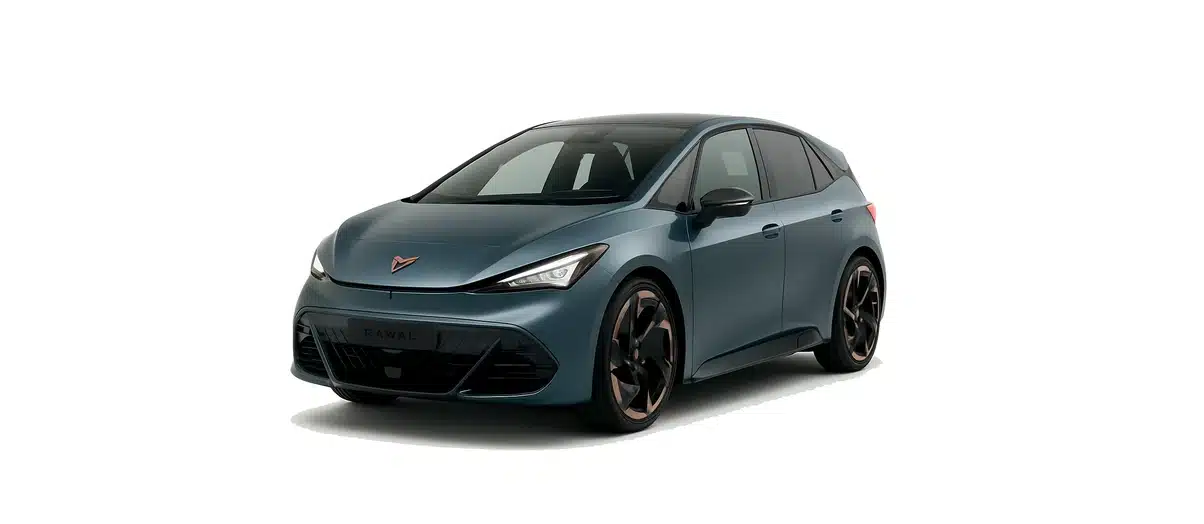
The Cupra Raval is CUPRA’s compact 5-door electric hatchback, positioned as a smaller urban EV below the Born. For UK drivers, the key charging point is that the Raval range is expected to include two quite different battery families: a smaller 37 kWh version aimed at city use, and 52 kWh versions with longer range and faster rapid-charging capability.
That difference matters when choosing a charging cable and planning journeys. At home or work, Raval models are listed with up to 11 kW AC charging, so a Type 2 cable is the important everyday cable. On longer trips, the 52 kWh models are the more capable rapid-charging versions, while the 37 kWh Origin is listed with a lower DC charging rate and a longer 10–80% charging time.
This guide explains what UK drivers need to know about Cupra Raval home charging, public charging, battery options and cable selection, using the currently available UK and European pre-launch data.
View Cupra Raval Charging Cables
Cupra Raval Battery and Charging Specifications
The Cupra Raval is a 100% electric vehicle, not a plug-in hybrid. UK information describes it as a compact electric hatchback with front-wheel drive, built on the Volkswagen Group’s compact MEB+ urban EV platform.
For charging, the Raval is expected to use a Type 2 connection for AC charging and CCS Combo 2 for DC rapid charging in Europe. CUPRA UK confirms the AC and DC charging power figures, while the visible socket-type confirmation comes from EV Database data for the 52 kWh model. In practical UK ownership terms, that means you should plan around a Type 2 cable for home, workplace and many public AC charge points, and CCS rapid chargers for motorway and destination rapid charging.
Headline charging figures are currently variant-dependent. The 37 kWh Origin is listed by CUPRA UK with 11 kW AC charging, up to 50 kW DC charging and a 10–80% DC time of around 60 minutes. The 52 kWh models are listed with 11 kW AC charging, up to 105 kW DC charging and an estimated 10–80% rapid-charge time of about 24 minutes.
Battery Options
The Raval range is expected to be split between a smaller 37 kWh battery and larger 52 kWh versions. This is one of the most important things to understand before comparing charging times, because the two packs are aimed at different use cases.
The 37 kWh Origin is listed by CUPRA UK as having a 37 kWh net-capacity LFP battery. UK information suggests a WLTP range of around 186 miles, with 11 kW AC charging and up to 50 kW DC charging. CUPRA’s UK page shows the Origin as coming later, with availability to order from September 2026 at the time of the published information.
The 52 kWh models cover variants such as V1, V2, V2 Launch Edition, VZ and VZ Extreme. CUPRA’s catalogue lists battery capacity as 51.5 kWh usable and 55 kWh gross for these versions, while EV Database gives a very similar usable figure. UK WLTP range figures are up to 277 miles for the 211 PS versions and around 273 miles for the VZ Extreme 226 PS model on the UK page, although exact range depends on specification, wheel size, tyres and equipment.
In short, the 37 kWh Raval is best understood as the urban and lower-cost option, while the 52 kWh versions are better suited to drivers who expect more frequent longer journeys and regular public rapid charging.
AC Charging Speed
AC charging is the type of charging you are most likely to use at home, at work and at many public destination chargers. The Cupra Raval is listed with up to 11 kW AC charging, although the actual speed you see depends on the charge point, your cable and the electrical supply.
Most UK homes have a single-phase supply, so a typical dedicated home wallbox will charge at up to around 7 kW or 7.4 kW. That is likely to be the everyday charging setup for many Raval drivers. If you have access to a compatible three-phase supply, such as at some workplaces or commercial sites, the Raval’s 11 kW onboard AC charging capability can be used more fully.
A 22 kW public AC post will not make the Raval charge at 22 kW. The car’s onboard AC charger is the limiting factor, so it will charge at up to 11 kW where the supply and cable support it. This is normal for many compact EVs and does not affect DC rapid charging, which uses a different system.
For cable selection, a Type 2 charging cable is the correct choice for AC charging. A 32 amp single-phase Type 2 cable is a common choice for UK home and public AC charging. Drivers who regularly use three-phase 11 kW AC posts may prefer a three-phase Type 2 cable so the car can use its higher AC capability where available.
DC Rapid Charging Speed
DC rapid charging is used at motorway services, rapid charging hubs and some larger public charging locations. For the Cupra Raval, the rapid-charging difference between the 37 kWh and 52 kWh versions is significant.
The 37 kWh Origin is listed by CUPRA UK with up to 50 kW DC charging and a 10–80% time of about 60 minutes. That makes sense for a smaller urban EV, but it is not the version to choose if your regular driving involves frequent long-distance motorway trips with short rapid-charging stops.
The 52 kWh versions are listed with up to 105 kW DC charging and an estimated 10–80% time of around 24 minutes. CUPRA’s own catalogue describes this as an estimate, so it should be treated as a useful planning figure rather than a guaranteed result every time you plug in.
Charging speed depends on several factors, including the charger’s output, the vehicle’s state of charge, battery temperature, charger sharing arrangements and vehicle software. As with most EVs, the fastest speeds are usually seen when the battery is at a lower state of charge and conditions are favourable. Charging will normally slow as the battery becomes fuller, which is why the 10–80% window is often the most efficient part of a rapid-charging stop.
Range and Efficiency
Published UK range figures for the Raval vary by battery and variant. The 37 kWh Origin is listed at around 186 miles WLTP. The 52 kWh 211 PS versions are shown at up to 277 miles WLTP, while the VZ Extreme 226 PS is shown at around 273 miles on the UK page.
WLTP figures are useful for comparing models, but real-world range will usually be lower, particularly in winter or at sustained motorway speeds. EV Database estimates a real-world range of about 205 miles for the 52 kWh model. Actual results will depend on temperature, driving speed, route type, cabin heating or cooling, tyre choice, payload and driving style.
For day-to-day use, many drivers will not need to charge from empty to full. A common ownership pattern is to plug in at home or work and keep the battery within a comfortable operating window for the week ahead. For longer journeys, the 52 kWh versions should give more flexibility, both because of their longer range and because their rapid-charging performance is stronger than the 37 kWh Origin.
Charging at Home
Home charging is usually the most convenient and cost-effective way to run an EV in the UK. For the Cupra Raval, a dedicated Type 2 wallbox is the ideal setup for regular home charging. Most UK home wallboxes provide up to around 7 kW on a single-phase supply, which is enough to add a substantial amount of range overnight.
If you have a three-phase domestic or workplace supply, an 11 kW-capable charging point may allow the Raval to charge more quickly on AC. However, many UK homes are single-phase, so check your property’s electrical setup before assuming that 11 kW AC charging will be available at home.
A 3-pin portable charger can be useful, but it is generally best suited as a backup or occasional charging solution. It can be used regularly if a qualified electrician has confirmed the socket and electrical installation are suitable for sustained EV charging. Standard household sockets were not originally designed for frequent high-load EV charging over many hours, so a properly installed wallbox is the safer and more practical long-term solution.
When charging at home, many drivers set charging schedules to take advantage of off-peak electricity tariffs. If you have solar panels, smart charging can also help you use more of your own generation, depending on your charger and energy setup.
Public Charging
For public charging, the Raval will use two main charging types. Public AC chargers generally require your own Type 2 cable, while rapid and ultra-rapid DC chargers usually have a tethered CCS cable attached to the unit.
At public AC posts, the Raval can charge at up to 11 kW where the charger, cable and supply support it. On many 7 kW posts, it will charge at the lower 7 kW rate. On 22 kW AC posts, the car is still limited by its onboard AC capability, so expect up to 11 kW rather than 22 kW.
For rapid charging, use CCS public chargers. The 52 kWh Raval versions are the ones listed with up to 105 kW DC charging and the short estimated 10–80% time. The 37 kWh Origin, by contrast, is listed at up to 50 kW DC and around 60 minutes for 10–80%, so journey planning should allow for longer stops.
For motorway journeys, it is often quicker overall to charge to around 80% and continue driving rather than waiting for the final 20%, because charging speed typically reduces at higher battery percentages. This is especially relevant at busy rapid hubs where charger availability and session time both matter.
Vehicle-Specific Features
The Cupra Raval’s most important ownership feature is its split battery strategy. The smaller 37 kWh LFP version is designed around urban use, lower cost and everyday practicality, while the 52 kWh models provide the stronger range and charging package for drivers who travel further.
The Raval’s compact size should make it well suited to city parking, commuting and short regular journeys. That type of usage pairs well with home or workplace charging, where the car can be topped up little and often without relying heavily on public infrastructure.
For drivers considering a 52 kWh Raval, the combination of up to 277 miles WLTP range on selected versions and 105 kW DC charging should make occasional longer trips more straightforward. The VZ Extreme is shown with a slightly lower UK WLTP figure than the longest-range 211 PS versions, which is a reminder that trim, wheels and equipment can affect efficiency.
Charging Tips
- Choose the right Type 2 cable: for most UK owners, a Type 2 cable suitable for 7 kW home and public AC charging is the essential everyday cable.
- Consider three-phase use: if you regularly charge at workplaces or public AC posts offering 11 kW three-phase charging, choose a cable that supports that use case.
- Do not expect 22 kW AC: a 22 kW AC post will not make the Raval charge faster than its onboard AC limit of up to 11 kW.
- Separate the battery versions: the 37 kWh Origin and 52 kWh models have very different DC charging expectations.
- Rapid charge in the efficient window: for longer journeys, plan around 10–80% rapid-charging stops where practical.
- Allow for real-world conditions: cold weather, high speeds and a heavily loaded car can reduce range and affect charging time.
- Use scheduled charging: if you have a home charger and off-peak tariff, scheduled charging can reduce running costs.
Frequently Asked Questions
What charging cable does the Cupra Raval use?
For AC charging, the Cupra Raval is expected to use a Type 2 charging cable. For DC rapid charging, it uses the CCS Combo 2 standard in Europe, with the rapid charger’s tethered cable normally provided at the charging unit.
Can the Cupra Raval charge at 22 kW AC?
No. The Raval is listed with up to 11 kW AC charging. It can use a 22 kW AC post, but the car will not charge faster than its onboard AC limit.
How fast does the Cupra Raval charge at home?
At a typical UK 7 kW home wallbox, the Raval should comfortably charge overnight for most daily use. If a suitable three-phase 11 kW supply is available, the car may charge more quickly on AC, subject to the charge point and cable.
How long does rapid charging take?
It depends on the battery version. The 37 kWh Origin is listed at around 60 minutes for 10–80% DC charging, while the 52 kWh versions are listed at about 24 minutes under suitable conditions.
Is the Cupra Raval a plug-in hybrid?
No. The Cupra Raval is presented by CUPRA as a 100% electric vehicle.
Which Raval version is better for regular long trips?
Based on the currently published figures, the 52 kWh versions are better suited to regular longer journeys because they offer more range and faster DC rapid charging than the 37 kWh Origin.
What This Means for Drivers
The Cupra Raval should be a straightforward EV to live with if you match the battery version to your driving pattern. For urban commuting, school runs and local journeys, the 37 kWh Origin’s range and home-charging capability may be more than enough, although its slower DC charging means it is less convenient for frequent long-distance travel.
For drivers who often use motorways or public rapid chargers, the 52 kWh models are the stronger choice. Their longer WLTP range and estimated 24-minute 10–80% rapid-charging time make them more flexible, provided you use suitable CCS rapid chargers and allow for real-world charging conditions.
Whichever version you choose, the main cable decision is simple: a good Type 2 charging cable is the everyday essential for home, workplace and public AC charging. If you have access to 11 kW three-phase AC charging, make sure your cable supports it. If most of your charging will be at a standard UK home wallbox, a suitable single-phase Type 2 cable will cover the most common use case.
Looking for a Charging Cable for Cupra Raval?
Choose a Type 2 charging cable that matches how you plan to charge your Cupra Raval, whether that is mainly at a UK home wallbox, workplace charger or public AC charging post.
View Cupra Raval Charging Cables
Please note that this information is intended as a guide. Charging specifications may change due to model and year of manufacture. For precise information, always refer to your vehicle user manual.

