
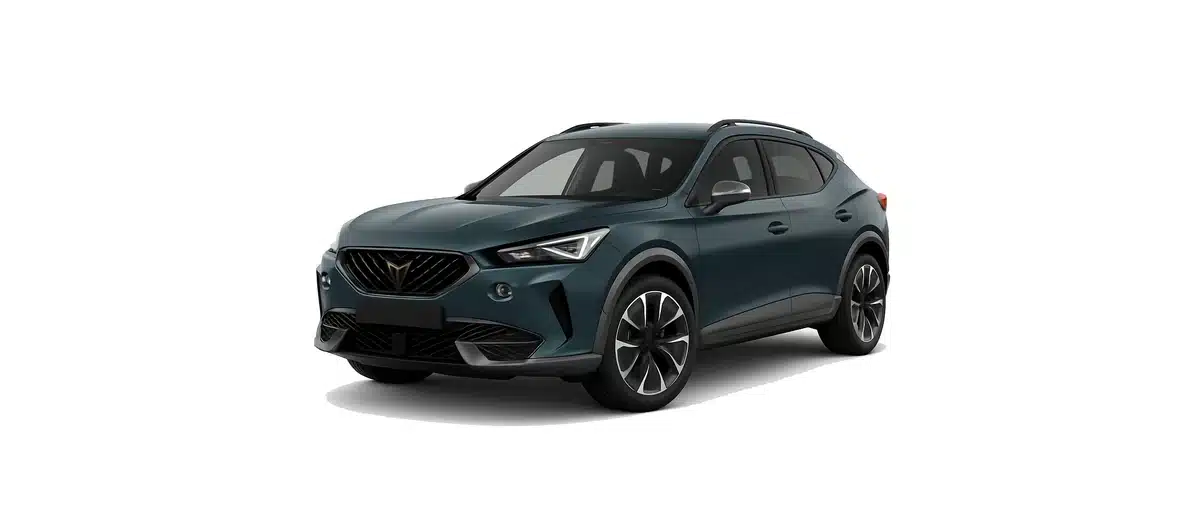
The CUPRA Formentor is a sporty crossover SUV available in the UK with several different powertrains. For charging purposes, the important point is that not every Formentor needs a cable. Petrol-only and mild-hybrid/eTSI versions do not plug in, while the chargeable models are plug-in hybrids sold as Formentor e-HYBRID.
There is also a major model-year split. Earlier pre-facelift Formentor e-HYBRID models used a 1.4-litre plug-in hybrid system with a battery of around 13 kWh and AC charging only. The current 2024-on facelift UK Formentor e-HYBRID uses a newer 1.5 e-HYBRID system with a much larger 25.8 kWh gross battery, 11 kW AC charging and up to 50 kW DC rapid charging according to CUPRA UK price-list data.
That means the right charging advice depends on which version you own. This guide focuses on identifying the difference, choosing the correct charging approach and understanding what to expect from home and public charging in the UK.
View Cupra Formentor Charging Cables
Cupra Formentor Battery and Charging Specifications
The CUPRA Formentor e-HYBRID is a plug-in hybrid rather than a full battery-electric vehicle. It can drive on electric power for local journeys when charged, while retaining a petrol engine for longer trips or when the battery is depleted. This makes its charging requirements different from those of a BEV: regular charging can significantly reduce fuel use, but rapid charging is not always essential because the car can continue on petrol.
For UK owners, the headline specifications depend strongly on model generation:
- Current 2024-on/facelift 1.5 e-HYBRID: 25.8 kWh gross battery, up to 77 miles WLTP electric range in some trims, 11 kW AC charging and 50 kW DC charging.
- Earlier/pre-facelift 1.4 e-HYBRID: around 12.8-13 kWh battery, roughly mid-30-mile official electric range depending on source and trim, Type 2 AC charging only, with no rapid-charging capability reported in the sources checked.
If you are buying a cable, planning a public charging stop or comparing charge times, first check whether your Formentor is the older 1.4 e-HYBRID or the newer 1.5 e-HYBRID.
Battery Options
The current UK Formentor e-HYBRID, introduced as part of the facelifted range, is available in 204PS and 272PS plug-in hybrid forms depending on trim. CUPRA UK price-list data lists a 25.8 kWh battery for these current e-HYBRID models. The usable capacity is not clearly published in the sources checked, so it is better to treat 25.8 kWh as the gross battery capacity rather than assuming the full amount is available for driving.
Earlier Formentor e-HYBRID models are a different case. Launch information and independent charging data point to a smaller battery of approximately 13 kWh, sometimes listed as 12.8 kWh. These cars were designed around shorter electric trips and slower AC charging, so current-model figures should not be applied to them.
A simple way to separate the two is by powertrain generation. If your car is a pre-facelift 1.4 e-HYBRID, it is the older charging setup. If it is the facelifted 1.5 e-HYBRID sold from 2024-on, it is the newer setup with the larger battery and faster charging capability.
AC Charging Speed
AC charging is the main charging method for most Formentor e-HYBRID owners. At home, this usually means a dedicated wallbox. In public, it may mean an untethered Type 2 AC post where you bring your own cable.
For the current 2024-on Formentor e-HYBRID, CUPRA UK price-list data states 11 kW AC charging with a 0-100% charge time of around 2 hours 30 minutes. However, many UK home wallboxes are 7 kW single-phase units. On that type of supply, an 11 kW-capable car will not normally charge at its full 11 kW rate. To achieve 11 kW AC, you usually need a compatible three-phase supply or a suitable public AC charger.
Older 1.4 e-HYBRID Formentor models are slower. Independent data for the earlier car reports a 0-100% charge taking around 3 hours 33 minutes from a 7.4 kW wallbox and almost 6 hours from a three-pin plug. That indicates the car’s onboard charger is the limiting factor, so using a higher-rated AC post will not necessarily make it charge faster.
For cable choice, a Type 2 charging cable is the important accessory for AC charging. The car’s onboard charger determines the maximum AC rate it can accept, while the cable and charge point must also be suitable for the available current.
DC Rapid Charging Speed
DC rapid charging is one of the biggest differences between older and newer Formentor e-HYBRID models.
The current 2024-on UK Formentor e-HYBRID supports DC fast charging at up to 50 kW, with CUPRA UK data giving a 10-80% charge time of 26 minutes. That is unusual for a plug-in hybrid and can be useful if you want to add electric range during a longer day without waiting several hours on AC.
Because accessible UK specification text confirms AC/DC charging but does not clearly name the connector in the sources checked, owners should confirm the physical charging inlet on their own vehicle or in the owner’s manual before relying on a specific connector description. UK and European DC-capable cars of this type would typically use a CCS Combo 2 style rapid-charging inlet, but it is sensible to visually check the socket flap and handbook before planning a journey around rapid charging.
Earlier pre-facelift Formentor e-HYBRID models should not be treated as rapid-charge capable. They are reported as AC-only, so DC rapid chargers are not suitable for those cars. If your older Formentor has only a Type 2 AC inlet, use AC charging equipment only.
Range and Efficiency
The official electric range of the current Formentor e-HYBRID is up to 77 miles WLTP in some UK trims. CUPRA UK also shows 72 miles for at least one 272PS VZ2 version, so the exact official range depends on specification. These figures are laboratory test results, not a guaranteed everyday distance.
Real-world electric range will vary with temperature, route, speed, driving style, wheel size, cabin heating or cooling, and how much of the battery is reserved by the car. In urban and suburban driving, regular charging may allow many short journeys to be completed mostly on electric power. On faster roads or in cold weather, the petrol engine may be used more often and the electric range may be lower than the official figure.
The earlier 1.4 e-HYBRID models have a much shorter electric range because of their smaller battery. Sources for the older model report official electric range in the mid-30-mile area, depending on version. Again, this should be viewed as a test figure rather than a fixed real-world promise.
Charging at Home
Home charging is likely to be the most convenient and cost-effective way to run a Formentor e-HYBRID. Plugging in overnight or between journeys helps ensure the car starts each day with useful electric range available.
A dedicated home wallbox is generally the best day-to-day option. For most UK homes this will be a 7 kW single-phase charger, which is enough to charge either generation of Formentor e-HYBRID comfortably overnight and, for the current car, often within a few hours. If your property has three-phase electrical supply and a suitable charger, the current 11 kW-capable e-HYBRID may be able to charge faster, but this is not typical for many domestic installations.
A 3-pin charger is generally best suited as a backup or occasional charging solution, but can be used regularly if a qualified electrician has confirmed the socket and electrical installation are suitable for sustained EV charging. Avoid using extension leads, damaged sockets or unknown outdoor outlets, as EV charging places a continuous load on the electrical circuit.
For untethered home chargers, you will need a compatible Type 2 cable. Cable length is a practical consideration: choose one that comfortably reaches from the wallbox to the car without being stretched across walkways or tightly bent.
Public Charging
Public charging depends heavily on which Formentor e-HYBRID you have.
For earlier 1.4 e-HYBRID models, public charging means AC charging only. You can use Type 2 AC posts where the socket and cable are compatible, but DC rapid chargers are not relevant. Because the older car has a smaller battery and slower onboard charging, short AC top-ups may be less useful on a long motorway journey, though they can still work well at workplaces, supermarkets, hotels or town-centre car parks.
For the current 2024-on 1.5 e-HYBRID, you have more flexibility. AC charging remains ideal when the car will be parked for a while, while DC rapid charging can add a significant amount of electric range in a shorter stop. CUPRA quotes 10-80% in 26 minutes at up to 50 kW, although actual charging speed can vary with charger output, battery temperature, state of charge and site conditions.
Remember that DC rapid chargers normally have tethered cables, so you do not bring your own cable for DC charging. For untethered AC public chargers, you normally do need your own Type 2 cable.
Vehicle-Specific Features
The Formentor e-HYBRID’s most important charging-related feature is the clear distinction between generations. The current 1.5 e-HYBRID model has a much larger battery than the earlier 1.4 e-HYBRID and adds DC fast charging, making it more practical to use electric driving on longer days.
CUPRA also advertises My CUPRA app functions for the Formentor, including the ability to manage vehicle charging and climate remotely. This can be useful for setting charging around your routine, checking charge status and preparing the cabin before you leave. Availability and exact app functions can depend on vehicle specification, software and connected services status, so owners should check their car’s own infotainment and app setup.
As with many modern vehicles, specifications can vary by model year, trim and market. If you are unsure, check the V5C, order paperwork, infotainment charging menu, charging flap and owner’s manual before buying charging accessories or planning to use a particular type of public charger.
Charging Tips
- Identify your version first: older 1.4 e-HYBRID models and current 1.5 e-HYBRID models have very different charging capabilities.
- Use Type 2 AC for routine charging: this is the key cable type for home wallboxes and many public AC posts.
- Do not assume rapid charging: only the current 2024-on e-HYBRID should be treated as DC-capable, and the inlet should be confirmed on the vehicle.
- Expect 7 kW at many UK homes: even if your current model can accept 11 kW AC, a typical single-phase home wallbox will usually be lower.
- Charge little and often: a PHEV is at its best when regularly plugged in, especially if your daily mileage fits within the electric range.
- Check cable rating and length: the cable should be suitable for the charger and convenient for your parking position.
Frequently Asked Questions
Is the CUPRA Formentor a full electric car?
No. The chargeable versions are plug-in hybrids called e-HYBRID. They have a petrol engine and a rechargeable battery. Petrol-only and eTSI versions of the Formentor do not use external charging cables.
What charging cable does a Formentor e-HYBRID need?
For AC charging, the Formentor e-HYBRID uses Type 2 charging equipment. Older pre-facelift models are AC-only. Current 2024-on models also support DC charging, but DC rapid chargers normally have their own tethered cable.
Can all CUPRA Formentor e-HYBRID models use rapid chargers?
No. This is the key model-year difference. Earlier 1.4 e-HYBRID models are reported as Type 2 AC-only with no rapid charging. Current 2024-on 1.5 e-HYBRID models support DC fast charging at up to 50 kW according to CUPRA UK data.
How long does the current Formentor e-HYBRID take to charge?
CUPRA UK price-list data gives around 2 hours 30 minutes for 0-100% on 11 kW AC, and 26 minutes for 10-80% on 50 kW DC. At a typical UK 7 kW home wallbox, the AC charging time may be longer than the 11 kW figure.
How far can the Formentor e-HYBRID drive on electric power?
The current model offers up to 77 miles WLTP electric range in some trims, with 72 miles shown for at least one 272PS VZ2 version. Older models have a shorter official electric range because they use a smaller battery. Real-world range will vary.
What This Means for Drivers
The CUPRA Formentor e-HYBRID is best understood as two different charging stories. The earlier 1.4 e-HYBRID is a conventional AC-charging PHEV with a relatively small battery, well suited to home charging and short electric trips. The current 1.5 e-HYBRID has a much larger battery, a longer official electric range and the added benefit of DC rapid charging, making it more flexible than many plug-in hybrids.
For most owners, the most important purchase is still a suitable Type 2 cable for home and public AC charging. If you own the current DC-capable model, rapid charging can be useful on longer days, but routine charging at home or at destination AC posts will usually remain the simplest way to keep the battery topped up.
Looking for a Charging Cable for Cupra Formentor?
If you need a compatible charging cable for your CUPRA Formentor e-HYBRID, We offer options for UK home and public AC charging; just make sure you select equipment that matches your vehicle generation, charger type and parking setup.
View Cupra Formentor Charging Cables
Please note that this information is intended as a guide. Charging specifications may change due to model and year of manufacture. For precise information, always refer to your vehicle user manual.

