
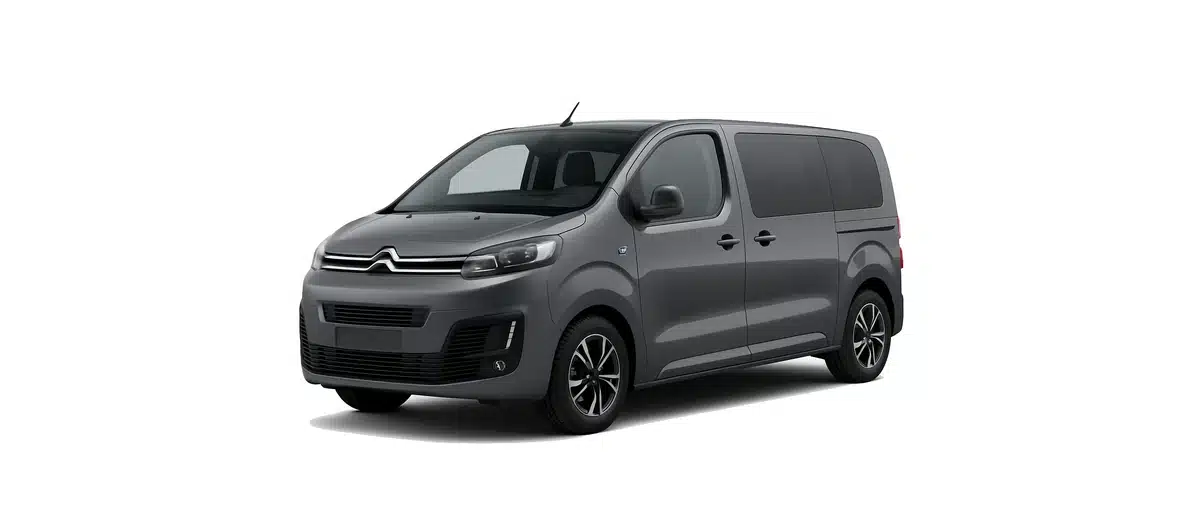
The Citroen e-SpaceTourer, also written as the Citroën ë-SpaceTourer, is a fully electric large MPV based on the SpaceTourer passenger van. It is aimed at families, business users, airport transfer operators and shuttle services that need the practicality of a high-roof, multi-seat vehicle without using petrol or diesel. Depending on configuration, it can offer up to 9 seats, with M and XL body lengths available in the current UK range.
Charging advice for the e-SpaceTourer needs a little care because specifications vary by model year and battery pack. Current UK information commonly highlights the 75 kWh version, with a WLTP range of up to around 216 miles, but public sources also reference 50 kWh versions, and earlier 2020 to early 2024 vehicles were sold with different battery and range figures. For owners, the most important first step is to confirm whether the vehicle is a 50 kWh or 75 kWh model and whether it has the standard 7.4 kW AC onboard charger or an 11 kW three-phase-capable setup.
In everyday UK use, the e-SpaceTourer uses a Type 2 connection for AC charging at home and at many public charge points. For longer journeys, it uses the CCS Combo 2 inlet for DC rapid charging. Because this is a large, upright MPV, range can be affected noticeably by speed, passenger load, weather, heating use and luggage, so realistic journey planning matters more than simply relying on the headline WLTP figure.
View Citroen e-SpaceTourer Charging Cables
Citroen e-SpaceTourer Battery and Charging Specifications
The Citroen e-SpaceTourer is a battery-electric vehicle, not a plug-in hybrid or range-extender. Diesel SpaceTourer models have also existed, but the e-SpaceTourer / ë-SpaceTourer name refers to the fully electric version.
| Vehicle type | Large electric MPV / passenger van |
|---|---|
| Charging port | Type 2 for AC charging; CCS Combo 2 for DC rapid charging |
| Battery options | 50 kWh and 75 kWh references exist depending on model year and version |
| Typical UK home AC charging | Up to 7.4 kW on a suitable single-phase wallbox |
| Three-phase AC charging | Up to 11 kW where the vehicle specification and site supply support it |
| DC rapid charging | Up to around 100 kW peak on suitable rapid chargers |
The key point is that not every e-SpaceTourer should be treated as having the same battery, same range or same AC charging capability. If you are buying a charging cable, planning a home installation or working out public charging stops, check the vehicle’s build year, battery size and onboard charger specification where possible.
Battery Options
Current and recent Citroen e-SpaceTourer information includes both 50 kWh and 75 kWh battery references. Citroën UK’s more recent price and specification information appears to focus on 75 kWh versions for the current UK range, while other current public sources still list 50 kWh and 75 kWh options. For used vehicles, 50 kWh and 75 kWh versions are both relevant.
The 50 kWh version is typically listed with around 46.3 kWh usable battery capacity. It can suit local passenger work, school runs, town use and short regional journeys, but owners should be realistic about motorway and cold-weather range. A high-roof MPV carrying passengers and luggage will use more energy than a smaller hatchback, especially at 70 mph.
The 75 kWh version is typically listed with around 69 kWh usable battery capacity. This is the more suitable option for longer family trips, airport transfers, shuttle work and mixed motorway use. Citroën UK quotes up to around 216 miles WLTP for the 75 kWh Size M version, while real-world estimates for 75 kWh models are commonly closer to around 160 miles depending on conditions.
AC Charging Speed
For most UK owners, AC charging means using a home wallbox, workplace charger, destination charger or public AC post. The e-SpaceTourer uses a Type 2 connector for AC charging.
On a typical UK single-phase home wallbox, the practical maximum is usually 7.4 kW. Citroën’s UK technical information lists a 7.4 kW single-phase charging time for the 75 kWh model of around 11 hours 20 minutes from 0-100%. In real use, most drivers do not regularly charge from completely empty to full, so overnight charging is normally the more useful way to think about it.
Some e-SpaceTourer specifications may support 11 kW AC charging on a suitable three-phase supply, and Citroën’s data lists an 11 kW 0-100% time of around 7 hours 30 minutes for the 75 kWh battery. However, 11 kW charging should not be assumed for every UK vehicle or every home. It requires both a compatible onboard charger and a three-phase electrical supply, which is more common at commercial premises than at ordinary homes.
For cable selection, a 32A Type 2 cable is the sensible starting point for most owners using untethered home charge points and public AC posts. If you regularly use three-phase AC posts and your vehicle supports 11 kW AC charging, a three-phase Type 2 cable is worth considering.
DC Rapid Charging Speed
For longer journeys, the e-SpaceTourer uses the CCS Combo 2 connector for DC rapid charging. The rapid charger has its own tethered CCS cable, so you do not use your own Type 2 cable for DC rapid charging.
The e-SpaceTourer is commonly listed with DC rapid charging at up to around 100 kW peak. This is a peak figure, not a speed that will be held throughout the whole session. Charging power depends on the charger, battery state of charge, battery temperature and vehicle charging curve. As with most EVs, charging usually slows as the battery gets fuller.
For the 75 kWh version, public data suggests a typical 10-80% rapid charge of around 40 minutes on a suitable charger, while Citroën’s UK price/specification guide lists a 5-80% DC time of around 45 minutes. Those charge windows are not identical, so it is worth reading them carefully. In practice, the best strategy on long journeys is usually to arrive at a rapid charger with a lower state of charge and leave at around 80%, rather than waiting for the final 20% to fill slowly.
Range and Efficiency
The e-SpaceTourer’s official range depends heavily on battery size, body length, model year and test conditions. The 75 kWh version is currently associated with a headline WLTP figure of up to around 216 miles, while 50 kWh versions have lower official and real-world range expectations.
For many drivers, especially those carrying several passengers, the real-world range figure is more useful than the best-case brochure number. A 75 kWh e-SpaceTourer may be around the 160-mile mark in mixed real-world use, but this can fall in winter, on fast motorway routes or when the vehicle is heavily loaded. The 50 kWh version needs even more careful planning for longer trips.
The e-SpaceTourer’s shape is excellent for passenger and luggage space, but it is not as aerodynamic as a low car. Cold weather, cabin heating, roof load, tyre pressures and sustained high speeds can all make a noticeable difference. If you are running the vehicle as a shuttle or family transporter, it is sensible to plan charging around your actual usage pattern rather than assuming the maximum WLTP range will be available every day.
Charging at Home
Home charging is the most convenient and usually the most cost-effective way to run an e-SpaceTourer. A dedicated Type 2 home wallbox on a suitable electrical installation can typically charge at up to 7.4 kW on single-phase supply. For a 75 kWh version, this is well suited to overnight charging. For a 50 kWh version, the overnight window is usually more than enough for routine daily use.
If your home charger is untethered, you will need your own Type 2 charging cable. A 32A cable gives the vehicle access to the maximum output of a standard 7.4 kW single-phase wallbox. Some owners prefer a 5 metre cable for neat driveway charging, while others choose a longer cable if the charge point location varies or if the e-SpaceTourer is parked in different positions.
A 3-pin charger is generally best suited as a backup or occasional charging solution, but can be used regularly if a qualified electrician has confirmed the socket and electrical installation are suitable for sustained EV charging. Because the e-SpaceTourer has a comparatively large battery, a 3-pin connection will be slow and is not the most practical solution for frequent high-mileage use.
Public Charging
Public charging for the e-SpaceTourer falls into two main categories: AC charging and DC rapid charging. Public AC charge points are often found at hotels, workplaces, leisure centres, car parks and town centres. Many are untethered, which means you need to bring your own Type 2 cable. These are useful when the vehicle will be parked for several hours.
DC rapid chargers are better for motorway services, major A-road routes and longer journeys. They use a tethered CCS cable attached to the charger. For a large MPV, route planning is especially important because energy use can rise quickly at motorway speeds. If you are travelling with passengers, it is often better to plan a reliable 20-40 minute rapid charging stop than to push the battery very low and rely on a single charger being available.
For shuttle and business users, it can be helpful to build charging into waiting time. Airport collection windows, hotel stops, depot dwell time and lunch breaks can all be opportunities to add range without disrupting the day.
Vehicle-Specific Features
The e-SpaceTourer’s main strength is passenger-carrying practicality. Depending on specification, it can offer up to 9 seats, with current UK information listing M and XL body lengths. The M version is around 4.98 metres long, while the XL / L version is around 5.33 metres, making parking space and cable length worth considering when setting up a home or depot charger.
The vehicle is based on a Stellantis/PSA EMP2-derived multi-energy platform rather than a dedicated EV-only platform. It uses a 100 kW / 136 hp front-drive electric motor. Citroën UK equipment information also references a Mode 3 Type 2 charging cable and regenerative braking paddles on current models, though the exact equipment fitted should always be checked against the individual vehicle.
Public EV data does not list heat pump, battery preconditioning, V2L, V2G or V2H support for the e-SpaceTourer, so owners should not rely on those features being present unless confirmed for their exact vehicle.
Charging Tips
- Confirm your battery size. A 50 kWh and 75 kWh e-SpaceTourer can feel very different on longer journeys.
- Use 7.4 kW as the normal UK home reference. 11 kW AC charging is only relevant where both the vehicle and electrical supply support it.
- Carry a Type 2 cable. Many public AC posts are untethered, and a 32A Type 2 cable is suitable for most UK AC charging scenarios.
- Use CCS for rapid charging. Rapid chargers have their own tethered cable, so your Type 2 cable is not used for DC charging.
- Plan around 10-80% on long trips. Rapid charging slows at higher states of charge, so stopping at around 80% is usually more time-efficient.
- Allow for load and weather. Passenger numbers, luggage, heating and motorway speeds can reduce range significantly.
Frequently Asked Questions
What charging cable does the Citroen e-SpaceTourer use?
The Citroen e-SpaceTourer uses a Type 2 cable for AC charging at home, work and many public AC charge points. For DC rapid charging, it uses the CCS Combo 2 inlet and the rapid charger’s tethered cable.
Is the Citroen e-SpaceTourer 7.4 kW or 11 kW on AC?
For most UK home charging, 7.4 kW single-phase charging is the practical reference. Some specifications may support 11 kW AC charging on a suitable three-phase supply, but this depends on the vehicle’s onboard charger and the site’s electrical supply.
How long does the Citroen e-SpaceTourer take to charge at home?
For the 75 kWh version, Citroën’s UK data lists around 11 hours 20 minutes from 0-100% on a 7.4 kW supply, and around 7 hours 30 minutes on 11 kW three-phase charging where supported. Everyday top-ups will usually take less time because drivers rarely charge from completely empty.
How fast can the Citroen e-SpaceTourer rapid charge?
The e-SpaceTourer is commonly listed with DC rapid charging up to around 100 kW peak. A 75 kWh version is typically estimated at around 40 minutes for a 10-80% rapid charge on a suitable charger, while Citroën lists around 45 minutes for 5-80% in its UK technical data.
Does every Citroen e-SpaceTourer have the 75 kWh battery?
No. Current UK information often highlights the 75 kWh model, but 50 kWh versions are also referenced in public sources, and older used vehicles may be 50 kWh or 75 kWh depending on version and market. Always confirm the exact vehicle specification.
What This Means for Drivers
The Citroen e-SpaceTourer is a practical electric MPV, but it rewards owners who understand its charging needs. For most UK drivers, the ideal setup is a dedicated 7.4 kW home wallbox and a good-quality 32A Type 2 cable for untethered home and public AC charging. If you operate the vehicle commercially or have access to three-phase charging, check whether your specific e-SpaceTourer supports 11 kW AC before choosing a cable or planning charging times around that figure.
For longer journeys, the CCS rapid charging capability is essential. The 75 kWh version is better suited to family holidays, shuttle routes and motorway work, while 50 kWh versions need more frequent charging stops. In both cases, planning around realistic range and 10-80% rapid charging sessions will make the vehicle easier to live with.
Looking for a Charging Cable for Citroen e-SpaceTourer?
We offer charging cables suitable for the Citroen e-SpaceTourer, including Type 2 options for home wallboxes and public AC charging. Choose the cable length and phase rating that best matches your vehicle, charger and parking setup.
View Citroen e-SpaceTourer Charging Cables
Please note that this information is intended as a guide. Charging specifications may change due to model and year of manufacture. For precise information, always refer to your vehicle user manual.

