
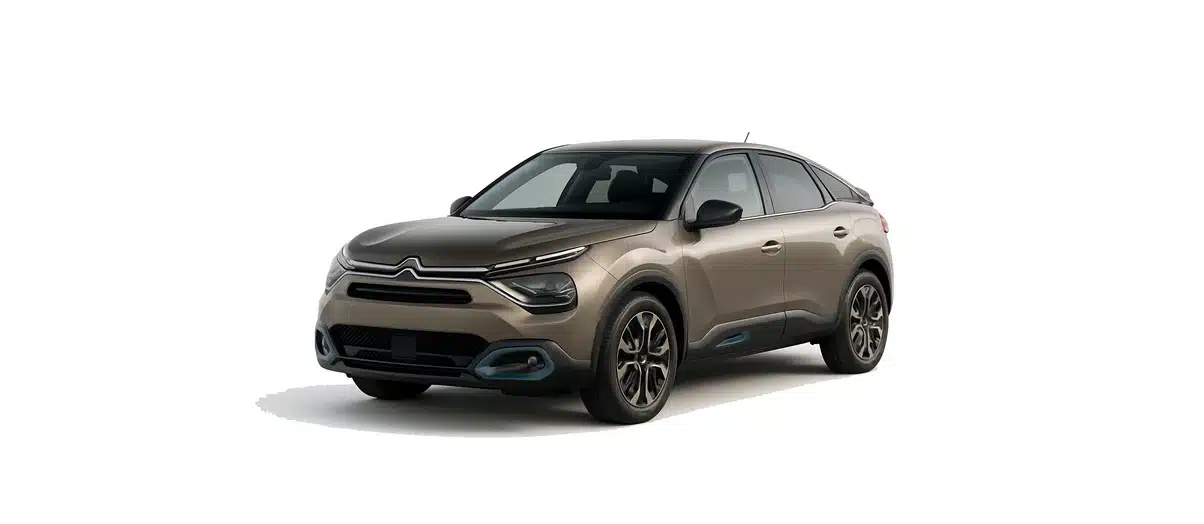
The Citroën ë-C4 is the fully electric version of the C4 hatchback, combining a five-door family car layout with a slightly raised, crossover-style body. For UK drivers, it is important to distinguish the ë-C4 Electric from the non-plug-in C4 Hybrid petrol models: the ë-C4 is a battery electric vehicle, so it is charged from a socket, wallbox or public charger and has no petrol engine.
Current UK information lists two electric battery choices: a 50 kWh Standard Range version and a 54 kWh Extended Range version. Both use a Type 2 connection for AC charging and CCS Combo 2 for rapid DC charging. The standard AC onboard charger is 7.4 kW single-phase, while an 11 kW three-phase onboard charger is listed as an option on some cars. That distinction matters when choosing a cable, wallbox and public charging routine.
View Citroen e-C4 Charging Cables
Citroen e-C4 Battery and Charging Specifications
The Citroën ë-C4 uses a combined charging inlet that supports both Type 2 AC charging and CCS rapid charging. In everyday UK use, this means home wallbox charging and most untethered public AC posts use a Type 2-to-Type 2 cable. Rapid DC chargers, such as motorway and hub chargers, normally have their own tethered CCS cable attached, so you do not use your own cable for those sessions.
Citroën lists the standard AC charging capability at 7.4 kW. A 100 kW DC rapid charging capability is also quoted, although the actual rate during a session will depend on battery temperature, state of charge, charger output and site conditions. Some ë-C4 models may have the optional 11 kW onboard AC charger, but it only provides a meaningful advantage where three-phase AC supply is available.
Battery Options
For the latest UK model-year context, there are two main electric versions to be aware of. The 100 kW, 136 hp Standard Range model uses a 50 kWh battery. EV Database lists this version with around 46.3 kWh usable capacity, while Citroën’s UK price and specification information gives WLTP combined range figures that vary by specification.
The 115 kW, 156 hp Extended Range model uses a 54 kWh battery. EV Database lists this version with around 50.8 kWh usable capacity. Citroën’s public material and price/specification documents give slightly different upper WLTP figures depending on source and specification, so it is best to treat the official range as trim, wheel and model-year dependent rather than one universal number.
If you are buying used, ordering new or comparing trims, check the vehicle documentation or configurator carefully. The battery size, motor output, trim level and optional equipment can all affect the figures you see in adverts and brochures.
AC Charging Speed
The standard Citroën ë-C4 AC setup is a 7.4 kW single-phase onboard charger. On a typical UK 7 kW or 7.4 kW home wallbox, this is the speed most owners should expect. Citroën’s UK information quotes a full 0-100% charge from a 32A wallbox in roughly seven and a half hours with the standard charger, while independent estimates for the larger-battery version are in a similar overnight-charging range.
An 11 kW three-phase onboard charger is available as an optional factory item on some versions. This can reduce AC charging time when connected to a suitable three-phase supply, such as certain workplace, destination or commercial AC charge points. Citroën quotes approximately 20-80% in just over three hours on an 11 kW wallbox, depending on version.
However, most UK homes have single-phase electricity. If your home supply and wallbox are single-phase, the optional 11 kW onboard charger will not turn a normal 7 kW home charger into an 11 kW charger. For many private owners, the everyday home charging experience will therefore be similar whether or not the car has the 11 kW option.
DC Rapid Charging Speed
The Citroën ë-C4 supports CCS DC rapid charging at up to 100 kW. Citroën quotes 20-80% charging in around 25 minutes for the 50 kWh version and around 27 minutes for the 54 kWh version, while EV Database estimates about 28 minutes for a 10-80% session on a suitable high-power CCS charger.
As with all electric cars, the headline rapid charging rate is a peak figure rather than a constant rate. Charging is usually fastest at a lower state of charge and slows as the battery fills, especially above 80%. On longer journeys, it is usually more efficient to plan shorter rapid charging stops in the 10-80% or 20-80% window instead of waiting for a near-full battery.
Range and Efficiency
Range for the Citroën ë-C4 depends on the battery version, trim, wheels, weather and driving style. Current UK documentation lists WLTP combined ranges that vary by specification, with the 50 kWh version generally lower than the 54 kWh Extended Range version. The highest WLTP figures in current information reach up to the high-200-mile area, but not every car will achieve the same official figure.
For real-world planning, independent estimates put the current 50 kWh version at around 175 miles and the 54 kWh version at around 200 miles, depending on conditions. Gentle urban and suburban driving in mild weather may do better, while sustained motorway speeds, winter temperatures, roof loads and heavy use of heating can reduce range.
The practical takeaway is simple: use the WLTP figure for comparison between models, but use your own driving pattern to judge charging frequency. A driver covering 30-40 miles a day may only need to charge every few days, while motorway users may prefer to top up more often.
Charging at Home
For most UK ë-C4 owners, a dedicated 7 kW or 7.4 kW Type 2 home wallbox is the most convenient way to charge. It allows the car to be plugged in overnight and ready the next morning, often while taking advantage of off-peak electricity tariffs if your energy supplier and charger support scheduled charging.
A tethered home charger has its own Type 2 lead attached, which is convenient if you always charge the same car in the same place. An untethered wallbox has a socket only, so you use your own Type 2 cable. This can look tidier and makes it easier to replace the cable later, but you need to keep the cable available at home.
A 3-pin portable charger can be useful in limited circumstances, but it is generally best suited as a backup or occasional charging solution, but can be used regularly if a qualified electrician has confirmed the socket and electrical installation are suitable for sustained EV charging. A dedicated wallbox is normally safer, faster and more convenient for regular home charging.
Public Charging
For public AC charging, the Citroën ë-C4 normally requires a Type 2-to-Type 2 cable unless the post is tethered. Many supermarket, town-centre, hotel, workplace and destination chargers are AC units, and some are untethered. Carrying the correct Type 2 cable makes these chargers much easier to use.
If your car has the standard 7.4 kW onboard charger, it will draw up to around 7.4 kW from a suitable AC point. If it has the optional 11 kW onboard charger and the charge point provides three-phase AC, it may charge faster. If you frequently use three-phase workplace or destination chargers, this option may be worth looking for. If you mainly charge at home on single-phase, it is less likely to change your routine.
For rapid charging, use CCS chargers. These units have their own heavy DC cable attached, so your Type 2 cable remains in the boot. The ë-C4’s 100 kW rapid charging capability is well suited to coffee-stop top-ups on longer trips, particularly if you arrive with a lower battery percentage and stop before charging slows heavily above 80%.
Vehicle-Specific Features
There are a few ë-C4-specific options worth checking before purchase. The optional 11 kW three-phase onboard charger is not the same as the standard 7.4 kW charger, and it is not fitted to every car. If AC charging speed away from home matters to you, confirm the exact specification of the vehicle.
A heat pump is listed as an option in Citroën’s UK price/specification information. A heat pump can help reduce heating energy use in cold weather, but availability is trim and option dependent, so do not assume every ë-C4 has one fitted.
Vehicle-to-Load capability is also listed in Citroën material via an adapter kit for Collection versions only, with pricing and supply to be confirmed by a retailer. This is intended for powering external devices, where supported. It should not be treated as a universal feature across all ë-C4 models.
Citroën also promotes e-Routes and MyCitroën planning tools for longer journeys. These can help with route planning and charging stops, although it is still sensible to check live charger availability through the relevant charging network app before setting off.
Charging Tips
- Use a 7 kW home wallbox for regular charging: it suits the standard 7.4 kW onboard charger and is ideal for overnight top-ups.
- Choose the right Type 2 cable: a Type 2-to-Type 2 cable is the key cable for untethered home and public AC charging.
- Check whether the car has 11 kW AC: it is optional and only gives its full benefit on three-phase AC supply.
- Use rapid chargers in the efficient window: 10-80% or 20-80% stops are usually quicker than charging close to 100%.
- Do not rely on one range number: battery size, trim, tyres, temperature and driving speed all affect range.
- For daily use, consider charging to around 80%: this is usually enough for normal journeys and avoids spending extra time in the slowest part of the charge curve.
Frequently Asked Questions
What charging cable does the Citroen e-C4 use?
The Citroën ë-C4 uses a Type 2 connector for AC charging. For untethered public AC chargers and untethered home wallboxes, you need a Type 2-to-Type 2 charging cable. For DC rapid charging, the CCS cable is attached to the charger.
Is the Citroen e-C4 a plug-in hybrid?
No. The ë-C4 Electric is a battery electric vehicle. Citroën also sells non-plug-in C4 Hybrid petrol models, but those are separate from the fully electric ë-C4.
Does the Citroen e-C4 charge at 11 kW at home?
Only if the car has the optional 11 kW onboard charger and the charging supply is three-phase. Most UK homes are single-phase, so the usual home charging rate is around 7 kW or 7.4 kW.
How long does rapid charging take?
Citroën quotes 20-80% rapid charging in around 25-27 minutes depending on battery version. Independent estimates suggest around 28 minutes for a 10-80% session on a suitable high-power CCS charger.
Should I choose a single-phase or three-phase cable?
If your car has the standard 7.4 kW onboard charger, a suitable single-phase Type 2 cable is normally sufficient for AC charging. If your car has the optional 11 kW onboard charger and you use three-phase AC chargers, a three-phase Type 2 cable may be the better choice.
What This Means for Drivers
The Citroën ë-C4 is straightforward to live with if you match your charging setup to the version you own. Most UK drivers will get the best day-to-day experience from a 7 kW home wallbox and a good Type 2 cable for public AC charging. The optional 11 kW charger can be useful, but mainly for drivers with access to three-phase AC charging rather than a typical single-phase home supply.
When comparing cars, pay attention to the exact battery size, whether the optional 11 kW charger is fitted, and whether features such as the heat pump or V2L adapter compatibility are included. Range and charging figures are specification dependent, so checking the vehicle’s own paperwork is always worthwhile.
Looking for a Charging Cable for Citroen e-C4?
If you need a suitable Type 2 cable for home or public AC charging, choose one that matches your Citroën ë-C4 specification and charging routine, especially if your car has the optional 11 kW three-phase onboard charger.
View Citroen e-C4 Charging Cables
Please note that this information is intended as a guide. Charging specifications may change due to model and year of manufacture. For precise information, always refer to your vehicle user manual.

