
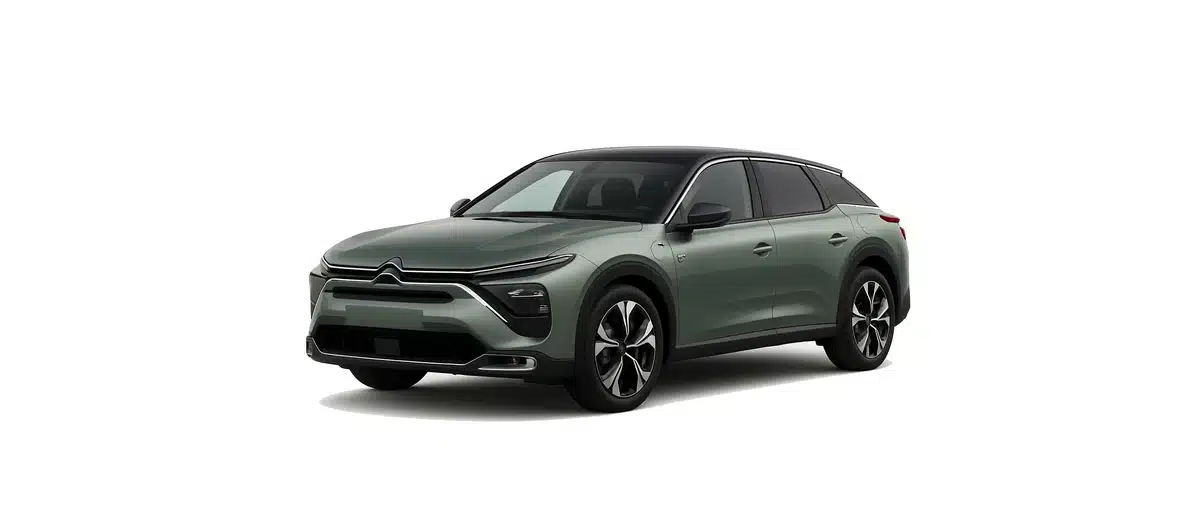
The Citroen C5 X is slightly unusual in the UK used-car market because not every electrified version needs a charging cable. The cable-relevant model is the Citroen C5 X Plug-in Hybrid, sold in versions such as the Plug-in Hybrid 225 ë-EAT8 and later Plug-in Hybrid 180 ë-EAT8. These are petrol plug-in hybrids with an external charging port, a Type 2 AC connection and a relatively compact traction battery designed for regular top-ups.
By contrast, later UK C5 X Hybrid 136 ë-DCS6 models are non-plug-in 48V hybrids. They do not have an external charging socket and do not use EV charging cables. As UK right-hand-drive C5 X sales and production have ended, many buyers will now be looking at used examples, so it is worth checking the exact model and charging specification before buying a cable.
This guide focuses on the Citroen C5 X Plug-in Hybrid only: how it charges at home, what cable it uses on public AC charge points, why DC rapid charging is not applicable, and what used owners should check before choosing a cable.
View Citroen C5 X Charging Cables
Citroen C5 X Battery and Charging Specifications
The Citroen C5 X Plug-in Hybrid is a petrol-electric plug-in hybrid rather than a full battery-electric vehicle. UK launch material described the Plug-in Hybrid 225 as combining a 1.6-litre PureTech petrol engine with an electric motor and an e-EAT8 automatic gearbox. The car is intended to offer useful electric-only driving for shorter journeys, while retaining the petrol engine for longer trips.
For charging, the key point is that the C5 X Plug-in Hybrid uses a Type 2 AC charging connection. It does not use a CCS rapid-charging connector and it is not designed for DC rapid charging. For most owners, the normal routine will be charging from a home wallbox, workplace charger or public AC post.
Citroen UK material confirms a 12.4 kWh traction battery for the plug-in hybrid versions. Supporting European technical data lists a usable capacity of around 11.3 kWh, although this should be treated as supporting information rather than a UK-specific brochure figure. In practical terms, it is a small PHEV battery compared with a full EV, so it can be recharged in a relatively short time from a suitable AC charger.
Battery Options
The charging-cable-relevant Citroen C5 X models use the 12.4 kWh plug-in hybrid battery. This applies to the C5 X Plug-in Hybrid 225 ë-EAT8 and later references to Plug-in Hybrid 180 ë-EAT8 models. There is no separate large-battery BEV version of the C5 X in the UK, and reliable reporting confirms that the C5 X was not engineered as a pure-electric model.
Used buyers should be careful not to confuse the plug-in hybrid with the later C5 X Hybrid 136. The Hybrid 136 is a mild hybrid, not a plug-in hybrid. It has no external charging requirement, so a Type 2 cable, 3-pin EV lead or wallbox charging setup is not relevant to that version.
If you are unsure which model you have, check for a charging flap and Type 2 inlet, review the V5C and service records, or confirm the specification using the VIN with a Citroen dealer. This is particularly important because online adverts may use “hybrid” wording loosely.
AC Charging Speed
The Citroen C5 X Plug-in Hybrid charges using AC power through a Type 2 connection. UK launch material refers to a 7.4 kW on-board charger and quotes a full charge time of about 1 hour 40 minutes. Later Citroen plug-in hybrid updates also refer to under-two-hour charging in this context.
However, there is an important used-car caveat. Some official and technical sources list a 3.7 kW standard charger with a 7.4 kW charger as an option on some versions or in some markets, with quoted 0-100% AC times of around 3 hours 25 minutes for the lower-powered charger and around 1 hour 40 minutes for the 7.4 kW charger. Because of this, owners should not assume that every used C5 X Plug-in Hybrid has the faster 7.4 kW on-board charger without checking the exact car.
A 7 kW or 7.4 kW single-phase home wallbox is sufficient to achieve the fastest quoted AC charging speed on cars fitted with the 7.4 kW on-board charger. Using a 22 kW three-phase public post or a higher-rated cable will not make the car charge faster than its own on-board charger allows.
DC Rapid Charging Speed
The Citroen C5 X Plug-in Hybrid does not support DC rapid charging. It has a Type 2 AC charging connection and no CCS rapid-charging capability. Citroen business charging material also states that 100 kW charging points are not compatible with the C5 X Plug-in Hybrid.
That means you should not plan motorway charging stops around DC rapid chargers in the way you would with a full battery-electric car. The C5 X Plug-in Hybrid is better understood as a car that is charged at home, at work or on public AC chargers, with the petrol engine available for longer journeys when the battery is depleted.
This also means there is no meaningful 10-80% DC charging time to quote. If you see a rapid-charging figure associated with another Citroen model or a different plug-in vehicle, do not apply it to the C5 X Plug-in Hybrid.
Range and Efficiency
Citroen UK launch information quoted up to 37 miles of electric range for the C5 X Plug-in Hybrid, while later UK material referred to up to 39 miles WLTP after updates. Some price and specification references show a broader range depending on version and equipment. As with all plug-in hybrids, real-world electric range will vary with temperature, speed, driving style, terrain, use of heating or air conditioning, and how often the car is charged.
The best efficiency from a plug-in hybrid normally comes from using the battery for shorter local journeys and keeping it topped up regularly. If the car is used as a conventional petrol automatic and rarely charged, it will not deliver the same economy benefits as an owner who charges little and often.
For many drivers, the C5 X Plug-in Hybrid’s battery capacity is well suited to overnight charging at home or daytime charging at work. Even if you do not fully deplete the battery, regular partial top-ups can help maximise electric running and reduce petrol use on routine journeys.
Charging at Home
For most C5 X Plug-in Hybrid owners, home charging is the simplest and most cost-effective option. A dedicated 7 kW or 7.4 kW home wallbox provides a convenient way to charge the car while parked overnight or between journeys. If your car has the 7.4 kW on-board charger, this is the setup needed for the fastest quoted home charging time of around 1 hour 40 minutes from empty to full.
If your specific car has the lower 3.7 kW on-board charger, it can still charge from a 7 kW wallbox, but it will only draw power at the rate the car can accept. This is why confirming the exact on-board charger specification matters when comparing charging times.
A tethered home wallbox has its own cable attached, in which case you simply plug the Type 2 connector into the car. An untethered wallbox requires a separate Type 2 to Type 2 cable. Many public AC posts in the UK are also untethered, so a Type 2 to Type 2 cable is useful even if your home charger is tethered.
A domestic 3-pin EV charging lead is generally best suited as a backup or occasional charging solution, but can be used regularly if a qualified electrician has confirmed the socket and electrical installation are suitable for sustained EV charging. Citroen material has quoted a 3-pin charging time of roughly 7 hours 5 minutes to 100%, but a dedicated wallbox is usually more convenient for regular PHEV use.
Public Charging
For UK public AC charge points, the Citroen C5 X Plug-in Hybrid uses a Type 2 to Type 2 cable. This is the standard cable for many untethered destination chargers found in car parks, hotels, supermarkets, workplaces and town centres.
Public AC charging is most useful when the car will be parked for a while. Because the C5 X Plug-in Hybrid has a small PHEV battery and no DC charging capability, it is not intended for rapid top-ups during long motorway journeys. Instead, use AC charging where it fits naturally into your day: at work, while shopping, during a meal or at a hotel overnight.
If you connect to a 22 kW public AC post, the car will still charge only at the maximum rate supported by its on-board charger. On a 7.4 kW-equipped car, that means up to around 7.4 kW under suitable conditions. On a 3.7 kW-equipped car, charging will be slower regardless of the public post’s higher rating.
Vehicle-Specific Features
The C5 X Plug-in Hybrid sits on a Stellantis EMP2-family plug-in hybrid architecture and was positioned by Citroen as a large crossover / fastback estate with comfort-focused long-distance ability. UK launch material highlighted Citroen Advanced Comfort Active Suspension on PHEV variants, alongside the petrol-electric drivetrain and e-EAT8 automatic gearbox.
From a charging perspective, the most important vehicle-specific points are straightforward: it is AC-only, it uses Type 2, and it is a plug-in hybrid rather than a full EV. That combination makes cable selection simpler, but it also means you should avoid buying accessories intended for CCS rapid charging or assuming full-EV charging behaviour.
No vehicle-specific official confirmation was found in the supplied research for features such as vehicle-to-load, vehicle-to-grid, traction-battery preconditioning or a heat pump, so they should not be treated as part of the C5 X Plug-in Hybrid charging setup.
Charging Tips
- Confirm the model first: only the C5 X Plug-in Hybrid needs a charging cable. The Hybrid 136 mild hybrid does not plug in.
- Check the on-board charger: some sources indicate 3.7 kW standard charging with 7.4 kW optional, while UK launch and later PHEV information highlights 7.4 kW charging.
- Choose Type 2 for AC charging: use a Type 2 to Type 2 cable for untethered home wallboxes and UK public AC posts.
- Do not plan around DC rapid charging: the C5 X Plug-in Hybrid has no CCS rapid-charging capability.
- Charge little and often: regular home or workplace top-ups help a PHEV deliver its best economy.
- Do not overbuy for speed: a 22 kW cable or charge point will not make the car exceed its own AC charging limit.
Frequently Asked Questions
What charging cable does the Citroen C5 X Plug-in Hybrid use?
It uses a Type 2 AC connection. For untethered public AC charge points and untethered home wallboxes, you need a Type 2 to Type 2 cable.
Is the Citroen C5 X a fully electric car?
No. The cable-relevant C5 X is a petrol plug-in hybrid. It can drive on electric power for shorter trips, but it also has a petrol engine. Later C5 X Hybrid 136 models are mild hybrids and do not plug in.
How fast can the Citroen C5 X Plug-in Hybrid charge?
UK material quotes around 1 hour 40 minutes for a full charge with a 7.4 kW on-board charger. Some sources list 3.7 kW standard charging on certain versions, with a longer full-charge time of around 3 hours 25 minutes, so used owners should check the exact specification.
Can the Citroen C5 X Plug-in Hybrid use rapid chargers?
No. It does not support CCS or DC rapid charging. Charging is via Type 2 AC only.
Will a 22 kW cable make it charge faster?
No. A higher-rated AC cable can be compatible if it has the correct Type 2 connectors, but the car will only charge at the rate allowed by its on-board charger.
What This Means for Drivers
The Citroen C5 X Plug-in Hybrid is at its best when treated as a regularly charged PHEV rather than a full EV. If you have access to home or workplace charging, its Type 2 AC setup is simple and the battery is small enough for convenient top-ups. For many daily journeys, that can mean using electric power for local driving and saving petrol for longer trips.
The main buying advice is to check before you order a cable. Make sure the car is definitely a plug-in hybrid, not the later non-plug-in Hybrid 136, and confirm whether your specific used example has the 3.7 kW or 7.4 kW on-board charger. Once that is clear, a suitable Type 2 cable will cover the charging situations the car was designed for.
Looking for a Charging Cable for Citroen C5 X?
If you have confirmed that your car is a Citroen C5 X Plug-in Hybrid, We offer compatible Type 2 charging cables for home wallboxes and public AC charging.
View Citroen C5 X Charging Cables
Please note that this information is intended as a guide. Charging specifications may change due to model and year of manufacture. For precise information, always refer to your vehicle user manual.

