
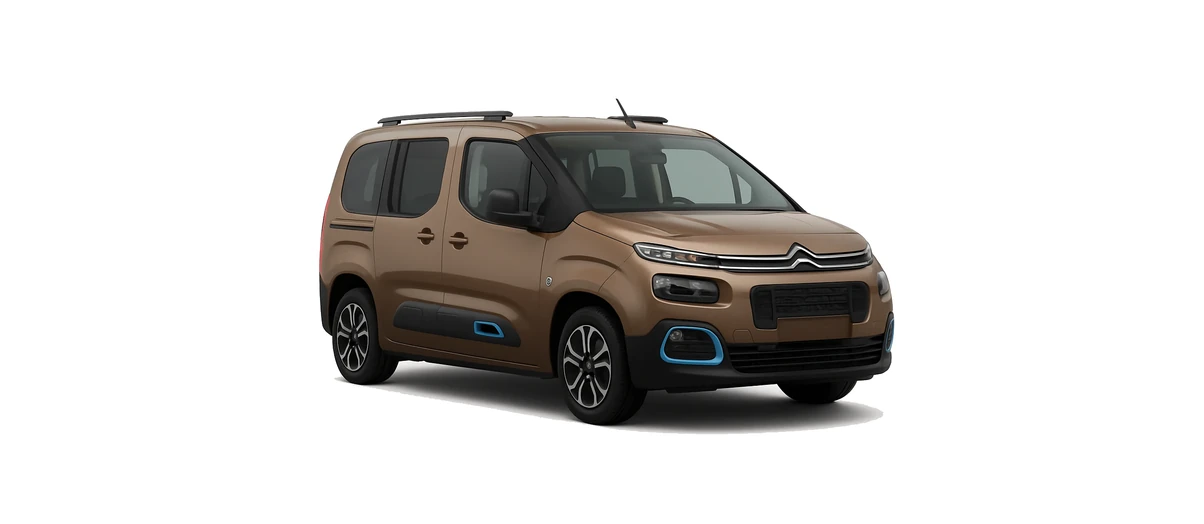
The Citroën ë-Berlingo, also written as the e-Berlingo, is a fully electric small MPV based around the practical Berlingo formula: sliding doors, a large boot, flexible seating and a cabin designed for family, leisure and business use. UK passenger versions have been available since 2021, with current models offered in M 5-seat and XL 7-seat lengths. There is also an ë-Berlingo Van, which uses broadly similar charging hardware, but range and payload figures can differ from the passenger MPV.
For charging cable selection, the key point is that UK ë-Berlingo models use a Type 2 connection for AC charging and CCS Combo 2 for DC rapid charging. However, not every 2021-on car has the same battery capacity, official range or AC charging capability. Earlier 2021 to early-2024 cars used the original 50 kWh battery pack, while the facelift/current model has a larger usable capacity and improved official range. The standard onboard AC charger is 7.4 kW single-phase, with an 11 kW three-phase onboard charger listed as an option on relevant versions.
View Citroën ë-Berlingo Charging Cables
Citroën ë-Berlingo Battery and Charging Specifications
The ë-Berlingo is a battery electric vehicle, not a plug-in hybrid. It charges from an external power source and drives on electric power only. In the UK and Europe it uses a Combined CCS / Type 2 charging port arrangement: the upper Type 2 section is used for AC charging at home, work and many destination chargers, while the larger CCS connector is used for DC rapid charging at motorway and high-power public charging sites.
Across the main passenger versions researched, DC rapid charging capability is up to 100 kW. AC charging depends on the onboard charger fitted to the vehicle rather than the maximum output of the public post. Most UK owners should plan around 7.4 kW single-phase AC charging unless they have confirmed that their specific car has the optional 11 kW three-phase onboard charger.
Battery Options
There are two main battery contexts for UK buyers to understand. The original 2021 to early-2024 ë-Berlingo passenger model used a 50 kWh gross lithium-ion battery. EV Database lists this version at around 46.3 kWh usable, and Citroën launch information quoted up to 174 miles WLTP for the passenger MPV. This is the version many used buyers will be considering.
The current/facelift ë-Berlingo, available from around 2024, is listed in Citroën’s UK price and specification guide with a 52 kWh battery, while EV Database lists 52.0 kWh nominal and about 50.0 kWh usable. Citroën’s live UK model page has also used 54 kWh wording, so it is worth checking the latest specification document or vehicle paperwork if exact battery capacity matters. Current official WLTP range is roughly 211-213 miles for the M version and around 206 miles for the XL version, depending on specification and test basis.
This means it is best not to quote one universal battery size or range for every ë-Berlingo from 2021 onwards. A used 2021-2024 car and a current facelift car may look similar in charging socket terms, but they can differ noticeably in usable battery capacity and expected range.
AC Charging Speed
The standard AC charging setup for UK ë-Berlingo models is 7.4 kW single-phase. This matches a typical UK home wallbox and is the speed most owners should expect from a correctly installed 7 kW domestic charge point. Citroën quotes a full charge from a 7.4 kW wallbox at around 7.5 hours, while EV Database estimates roughly 7 hours 30 minutes for earlier 46.3 kWh usable versions and around 8 hours for current models with about 50 kWh usable capacity.
An optional 11 kW onboard charger has been listed for some versions. This only helps when the car is connected to a compatible three-phase AC supply, such as certain workplace, commercial or European public charging locations. It will not make a standard single-phase 7.4 kW home wallbox charge at 11 kW.
It is also important not to confuse the rating of the public AC post with the car’s actual AC charging rate. If a standard ë-Berlingo with the 7.4 kW onboard charger is plugged into a 22 kW public Type 2 post, the car will still be limited to around 7.4 kW. If the optional 11 kW three-phase onboard charger is fitted and the post supplies three-phase AC, the car may charge at up to around 11 kW, not 22 kW.
DC Rapid Charging Speed
For longer journeys, the ë-Berlingo can use CCS rapid chargers at up to 100 kW. Citroën quotes charging from 0-80% in about 30 minutes on a suitable 100 kW DC charger. EV Database gives a typical 10-80% rapid charging estimate of about 28 minutes for the current model, which is a useful planning figure for motorway stops.
In practice, rapid charging speed varies with battery temperature, state of charge, charger output, charger sharing, weather and the vehicle’s charging curve. For the quickest stops, it is usually better to arrive with a lower state of charge and charge to around 80% rather than waiting for the final 20%, where DC charging generally slows down. The ë-Berlingo is a practical family MPV rather than a long-range motorway car, so planning sensible breaks around the 10-80% window can make longer trips more predictable.
Range and Efficiency
Range depends strongly on which ë-Berlingo you have. The original 2021-early 2024 passenger version was officially quoted at up to about 174 miles WLTP. The current/facelift model improves on this, with official WLTP figures of roughly 211-213 miles for M versions and around 206 miles for XL versions in current UK specification material.
Real-world range will usually be lower than WLTP, especially in winter, at motorway speeds or when the vehicle is heavily loaded. EV Database estimates around 145 miles of real-world range for the current M model. Owners of earlier used cars should expect a smaller usable battery and a lower real-world range than the current facelift model. The XL version, extra passengers, roof bars, cold weather and higher speeds can all reduce efficiency.
The ë-Berlingo’s appeal is practicality, not aerodynamic efficiency. Its upright body, large frontal area and flexible interior make it useful for families and active lifestyles, but they also mean energy use can rise quickly on faster roads. For everyday local driving, school runs, commuting and mixed urban use, the range is likely to feel more comfortable than it does on repeated high-speed motorway journeys.
Charging at Home
For most UK ë-Berlingo owners, the most convenient setup is a dedicated 7.4 kW single-phase home wallbox and a suitable Type 2 charging cable if the unit is untethered. This matches the standard onboard charger and allows the car to recharge overnight. A tethered wallbox has its own fixed cable, while an untethered wallbox requires you to plug in your own Type 2 cable.
A 32 amp Type 2 cable is the usual choice for making full use of 7.4 kW single-phase charging. If your car has the optional 11 kW onboard charger and you regularly use three-phase AC posts, a three-phase Type 2 cable may be worth considering. A three-phase cable can still be used on single-phase posts, but a single-phase cable will not enable 11 kW three-phase AC charging.
A 3-pin portable charger can be useful, but it is generally best suited as a backup or occasional charging solution. It can be used regularly if a qualified electrician has confirmed the socket and electrical installation are suitable for sustained EV charging. Domestic sockets were not originally designed for repeated high-load EV charging over many hours, so a properly installed wallbox is normally the safer, faster and more convenient long-term option.
Public Charging
On public AC chargers, the ë-Berlingo uses a Type 2 cable. Many destination chargers at supermarkets, hotels, car parks and workplaces are untethered, so you need to carry your own cable. A 22 kW AC post will not automatically mean 22 kW charging: the standard car is limited by its 7.4 kW onboard charger, while cars with the optional 11 kW charger are still limited to around 11 kW on suitable three-phase AC.
For rapid and ultra-rapid public charging, the cable is normally attached to the charger and you use the CCS connector. The ë-Berlingo can accept up to 100 kW DC, so using a higher-rated charger is fine, but the vehicle will only take what it can use. On busy routes, any reliable charger rated at 100 kW or above should be suitable for achieving the car’s best possible rapid charging performance when conditions allow.
Vehicle-Specific Features
The main vehicle-specific detail is the difference between M and XL body lengths, and between earlier and current battery specifications. The M version is the shorter 5-seat model, while the XL offers 7-seat practicality. The XL’s additional size and weight can slightly reduce official range compared with the M version.
Some versions list a heat pump as optional. Where fitted, this can help cabin heating efficiency in colder conditions, although the actual benefit depends on journey type and weather. Remote cabin temperature pre-conditioning may be available on some equipment levels, but this should not be described as battery preconditioning. EV Database lists battery preconditioning as not available for the current M and XL models.
Charging Tips
- Check the model year: 2021-early 2024 cars have a smaller usable battery than current facelift versions.
- Confirm the onboard charger: do not assume 11 kW AC charging is fitted; 7.4 kW single-phase is standard.
- Choose the right Type 2 cable: a 32 amp Type 2 cable suits normal 7.4 kW UK home charging, while a three-phase cable is useful if you have the optional 11 kW charger and access to three-phase posts.
- Use CCS for long journeys: plan rapid stops around the 10-80% range for shorter, more efficient charging breaks.
- Account for load and weather: passengers, luggage, cold temperatures and motorway speeds can reduce range.
- Do not compare van and MPV range directly: payload, body specification and usage can change real-world results.
Frequently Asked Questions
What charging cable does the Citroën ë-Berlingo use?
UK and European ë-Berlingo models use a Type 2 connection for AC charging. For DC rapid charging, they use the CCS Combo 2 connector, with the rapid charger’s cable usually tethered to the charging unit.
Can the Citroën ë-Berlingo charge at 22 kW AC?
No confirmed UK passenger version should be expected to charge at 22 kW AC. The standard onboard charger is 7.4 kW single-phase. Some versions have an optional 11 kW three-phase onboard charger, but even those are limited to around 11 kW on suitable AC posts.
How long does the Citroën ë-Berlingo take to charge at home?
Using a 7.4 kW home wallbox, a full charge is typically around 7.5 to 8 hours depending on battery version and conditions. This makes overnight charging practical for most owners.
How fast can the Citroën ë-Berlingo rapid charge?
The ë-Berlingo supports up to 100 kW DC rapid charging via CCS. Citroën quotes about 30 minutes for 0-80% on a suitable 100 kW charger, while EV Database estimates around 28 minutes for a 10-80% rapid charge on the current model.
Is the Citroën ë-Berlingo a plug-in hybrid?
No. The ë-Berlingo is a fully electric battery electric vehicle. It does not have a petrol or diesel engine for propulsion.
What This Means for Drivers
The Citroën ë-Berlingo is straightforward to charge, but owners should identify the exact version before setting expectations. The charging connector family is consistent: Type 2 for AC and CCS for DC rapid charging. The differences are in usable battery capacity, official range and whether the optional 11 kW AC onboard charger is fitted.
For most UK drivers, the best everyday arrangement is a 7.4 kW home wallbox and a suitable Type 2 cable for untethered home or public AC charging. Used buyers should be aware that 2021-early 2024 models have lower official range than the current facelift model, while XL versions may use slightly more energy than M versions. For longer trips, CCS rapid charging at up to 100 kW makes practical journey planning possible, especially when stops are planned around the faster 10-80% charging window.
Looking for a Charging Cable for Citroën ë-Berlingo?
We offer charging cables suitable for Citroën ë-Berlingo models from 2021 onwards, including Type 2 options for home, workplace and public AC charging.
View Citroën ë-Berlingo Charging Cables
Please note that this information is intended as a guide. Charging specifications may change due to model and year of manufacture. For precise information, always refer to your vehicle user manual.

